
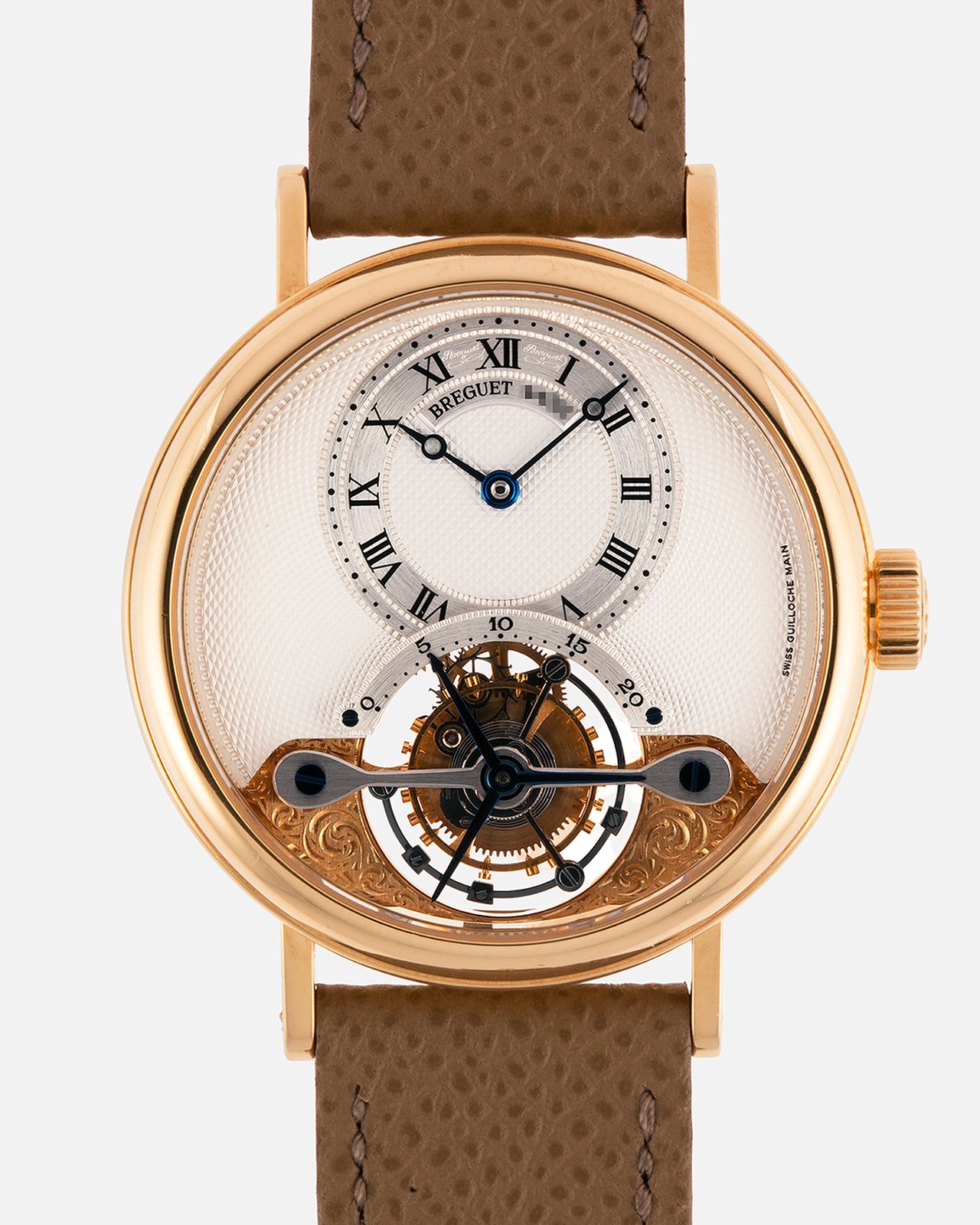
Wristwatches · Wristwatch
Breguet Classique Tourbillon 3357BA, 2000
- Maker / attribution
- Breguet (maker)
- Date
- 2000
- Historical period
- Mechanical Renaissance (1990 – 2010)
- Country of origin
- Switzerland
- Object type
- Wristwatch
- Dimensions
- Case 35 mm
- Stock no.
- Product 7834243924055
- Credit line
- Dealer listing, S.Song Watches (product 7834243924055)
- Catalogue title (original)
- Breguet Classique Tourbillon 3357BA (English)
View the source record (dealer listing) ↗ (opens another website in a new tab)Suggest a correction
Record summary
Catalogued by S.Song Watches (dealer), Seattle (stock number Product 7834243924055), this is a wristwatch by Breguet, made in Switzerland, dated 2000. The Atlas places it in the Mechanical Renaissance period (1990 – 2010) of its Wristwatches collection. Recorded dimensions: Case 35 mm. The record is illustrated with 6 photographs.
Assembled from the source record's structured fields. Dates and attributions are given as the source states them; where a field is missing the Atlas leaves it blank rather than estimating.
Catalogue description
Dealer description — S.Song Watches
Few names in watchmaking carry as much historical significance as Abraham-Louis Breguet, whose contributions to horology during the late eighteenth and early nineteenth centuries fundamentally shaped the development of the modern mechanical watch. Among his numerous inventions, perhaps none is more celebrated than the tourbillon, patented on 26 June 1801. Conceived as a means of compensating for the effects of gravity on the regulating organ of a pocket watch, the mechanism placed the escapement and balance within a rotating cage, averaging out positional errors over the course of its rotation. More than two centuries later, the tourbillon remains one of the most prestigious complications in traditional watchmaking. Despite having invented the mechanism, Breguet would not introduce a tourbillon wristwatch until 1988, when the reference 3350 made its debut. Its creation was largely attributable to Daniel Roth, who had joined Breguet during the Chaumet ownership era and was tasked with restoring the manufacture's reputation for high-end traditional watchmaking. Drawing extensively from the historical pocket watches of Abraham-Louis Breguet, Roth developed a watch that incorporated many of the Maison's most recognisable design elements, including the guilloché dial, blued steel hands, fluted caseband and prominently displayed tourbillon. At a time when tourbillon wristwatches were extraordinarily uncommon, the 3350 represented an important milestone not only for Breguet, but for complicated wristwatch production more broadly. The reference 3357 was subsequently introduced during the 1990s as a subtle evolution of the original 3350, retaining essentially the same design and movement architecture while incorporating several refinements, including a sapphire display caseback, revised dial details and a signed crown. Here, we have a K-series example in 18-carat yellow gold, dating to 2001. Measuring approximately 35mm in diameter and just over 9mm in thickness, the 3357 retains wonderfully classical proportions, particularly when compared with the considerably larger tourbillon watches that would become popular in subsequent decades. The yellow gold case features Breguet's characteristic fluted caseband, straight soldered lugs and a relatively slim, polished bezel, creating a design that is immediately recognisable as a Breguet. Despite its modest dimensions, the substantial dial opening and prominent tourbillon give the watch a surprisingly strong presence on the wrist. The dial is undoubtedly one of the most attractive aspects of the reference. Crafted from solid gold and finished with traditional hand-executed guilloché, it features a chapter ring with classical Roman numerals and blued steel Breguet hands. The fine engine-turned patterns introduce a wonderful sense of texture, while the restrained use of colour allows the intricacy of the dial to be appreciated without overwhelming the overall design. Occupying the lower portion of the dial is the exposed one-minute tourbillon, surrounded by an elaborately hand-engraved movement plate. Particularly unusual is the arrangement of three blued steel seconds indicators attached to the rotating carriage, each traversing a 20-second scale as the tourbillon completes its full rotation. This distinctive display was carried over from the original Daniel Roth-designed 3350 and remains one of the most recognisable features of Breguet's early wristwatch tourbillons. Powering the watch is the manually wound calibre 558, developed with Nouvelle Lémania under Daniel Roth's direction. Operating at 18,000 vibrations per hour with a power reserve of approximately 50 hours, the movement is notable not only for its historical significance but also for its exceptional decorative finishing. Visible through the sapphire caseback are beautifully hand-engraved bridges featuring elaborate floral motifs, polished bevels and traditional finishing techniques that are particularly evocative of the great pocket watches produced during Breguet's early history. What I find particularly appealing about the 3357 is how faithfully it translates the design and mechanical philosophy of Abraham-Louis Breguet into a modern wristwatch. Unlike many contemporary tourbillons that emphasise technical spectacle through oversized cases and increasingly elaborate constructions, the 3357 remains remarkably restrained, with its compact proportions, traditional guilloché dial and beautifully engraved movement allowing the tourbillon itself to take centre stage. It is arguably one of the most important designs of Breguet's modern era, and a particularly successful interpretation of the complication most closely associated with the manufacture's founder.
Historical context
Mechanical Renaissance (1990 – 2010)
Mechanical watches return as cultural objects; independent watchmaking flourishes.
Mechanical watches returned as cultural and luxury objects. Complications, tourbillons and new materials proliferated; independent watchmakers such as George Daniels, F.P. Journe and Philippe Dufour revived artisanal watchmaking; collecting vintage watches became a major field.
Read the period in the timelineMore wristwatches from this periodEarlier: Quartz Revolution
Atlas type guide
Wristwatches
Bracelet watches were worn by women from the early nineteenth century — Breguet made one for Caroline Murat, Queen of Naples, in 1810–12 — but the wristwatch only became a man's instrument with military use and aviation in the early twentieth century. Between the World Wars it overtook the pocket watch; the 1920s and 1930s brought rectangular Art Deco cases, water-resistant cases and the first automatic winding systems.
After 1945 the wristwatch became a carrier of identity — dress watches, sports and dive watches, chronographs, calendars — produced by Swiss, American, Japanese, German, Soviet and Chinese industries. The quartz revolution after 1969 and the mechanical renaissance since the 1990s, including the rise of independent watchmakers, complete the story.
What to look for
- The reference number (between the lugs or inside the case back) and serial number, the starting point for dating.
- The calibre: its maker and number are often stamped under the dial or on the bridge.
- Originality of dial, hands and crown — refinished ('redial') dials are common.
- Case material marks: 18K/750, 14K/585, stainless steel, gold-filled, plated.
Dating clues
- Wire-lug cases: before c. 1925.
- Water-resistant screw-down cases: from 1926.
- Quartz movements: from 1969; sapphire crystals widespread after c. 1980.
General guidance written by the Atlas editors about this kind of object. It is not a statement about this particular piece; for that, rely on the source record above and on physical examination.
Related records
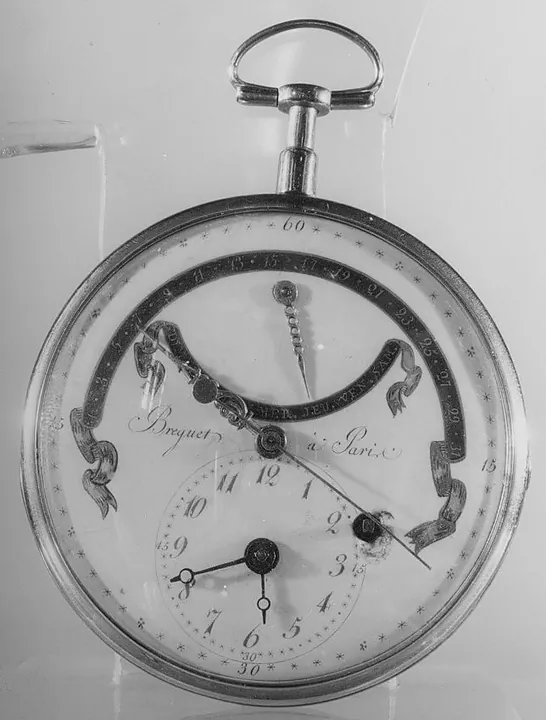
Pocket Watches · 1700–1799
Pocket watch by Breguet, Belgium, 1700–1799
Royal Institute for Cultural Heritage
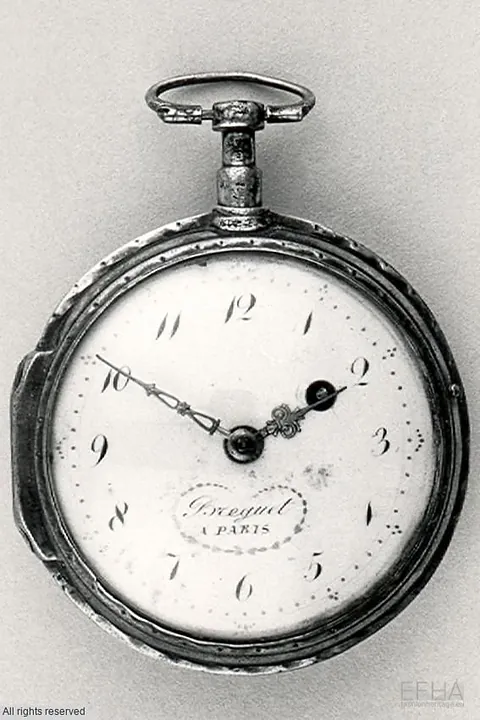
Pocket Watches · 1700–1799
Pocket watch by Breguet, France, 1700–1799
Fashion Museum of Antwerp
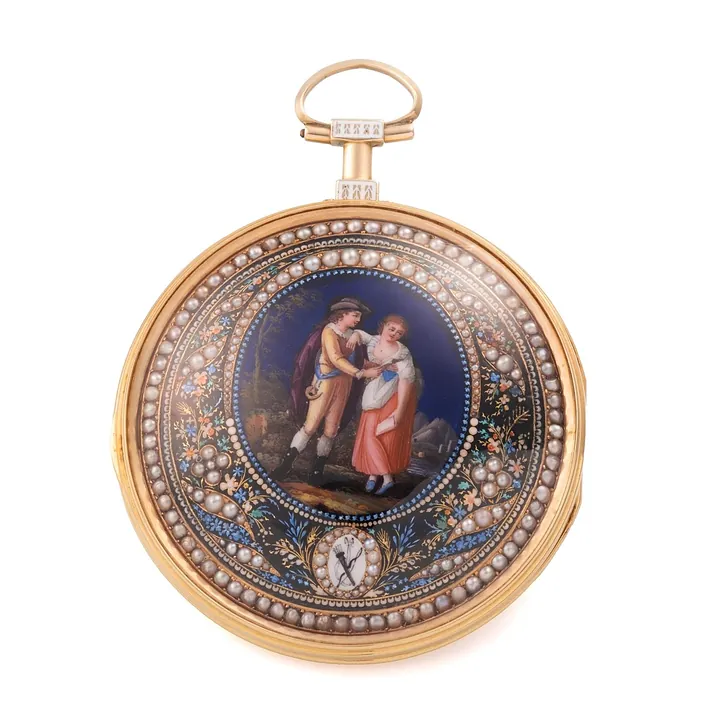
Pocket Watches · c. 1790
Breguet Love Letter, c. 1790
Antiquorum auction archive, Geneva
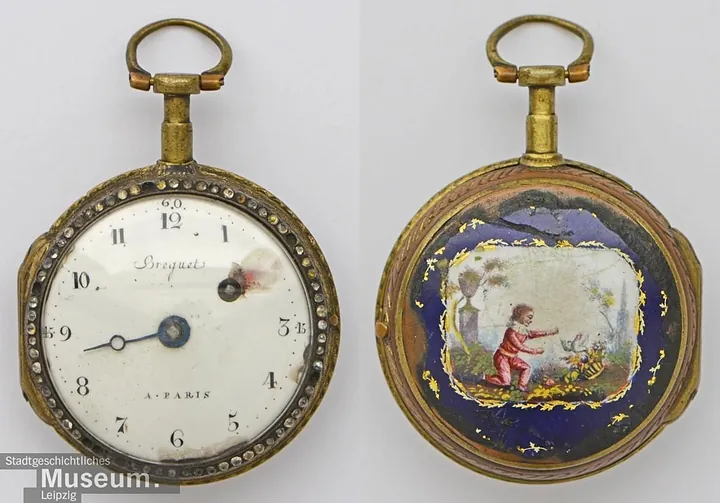
Pocket Watches · 1790
Pocket watch possibly by Breguet, France, 1790
Museum of City History Leipzig

Wristwatches · 2008
Wristwatch by Breitling?, 2008
Museum Rotterdam

Wristwatches · c. 1990s
Audemars Piguet Bamboo, c. 1990s
Antiquorum auction archive, Geneva

Wristwatches · c. 1990
Audemars Piguet Huitieme Perpetual Calendar, ref. 25696PT, c. 1990
Antiquorum auction archive, Geneva

Wristwatches · c. 1990
Breitling Chronomat, ref. b13050.1, c. 1990
Antiquorum auction archive, Geneva