
Wristwatches · Wristwatch
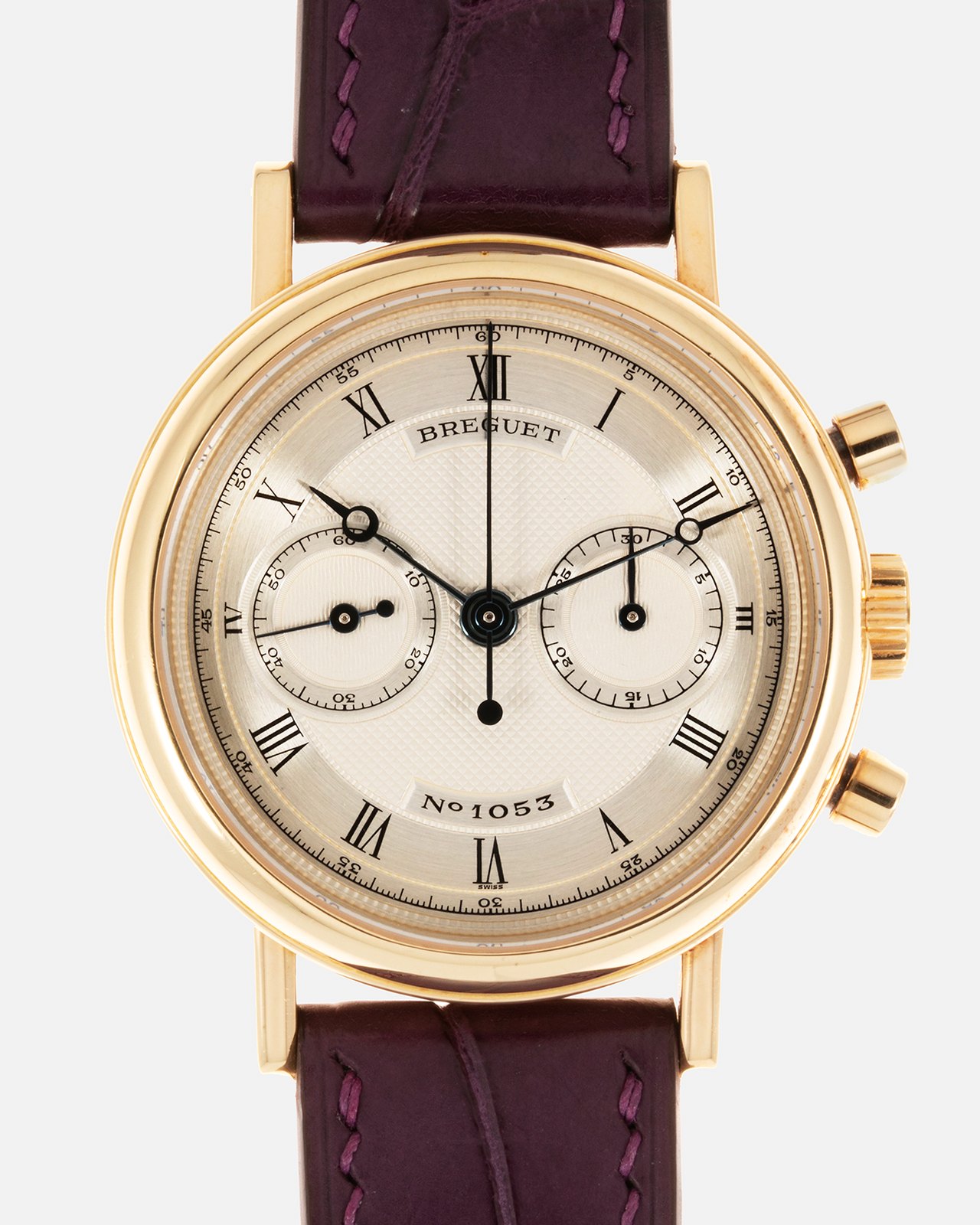
Breguet Classique Chronograph 3237, 1990s
- Maker / attribution
- Breguet (maker)
- Date
- 1990s
- Historical period
- Mechanical Renaissance (1990 – 2010)
- Country of origin
- Switzerland
- Object type
- Wristwatch
- Dimensions
- Case 36 mm
- Stock no.
- Product 6978716106839
- Credit line
- Dealer listing, S.Song Watches (product 6978716106839)
- Catalogue title (original)
- Breguet Classique Chronograph 3237 (English)
View the source record (dealer listing) ↗ (opens another website in a new tab)Suggest a correction
Record summary
Catalogued by S.Song Watches (dealer), Seattle (stock number Product 6978716106839), this is a wristwatch by Breguet, made in Switzerland, dated 1990s. The Atlas places it in the Mechanical Renaissance period (1990 – 2010) of its Wristwatches collection. Recorded dimensions: Case 36 mm. The record is illustrated with 6 photographs.
Assembled from the source record's structured fields. Dates and attributions are given as the source states them; where a field is missing the Atlas leaves it blank rather than estimating.
Catalogue description
Dealer description — S.Song Watches
Without a doubt, Abraham Louis Breguet is considered the most influential watchmaker of all time. With inventions such as the overcoil hairspring and the Tourbillon amongst a myriad of others, the brand has one of the richest histories out of any manufacture in the world today. It wasn’t always like this though. While the brand enjoyed great success in the 18th and 19th centuries, producing pocket watches for the most influential people in the world, by the 20th century, the brand was decrepit and nearly non-existent. Other than producing the occasional piece here and there, they predominantly supplied Type 20 watches to the military. The Type 20 models, in terms of design, were a departure from the elegant timepieces that had characterized the brand's earlier years. In the mid-1970s, the Chaumet brothers, renowned for their jewelry brand, acquired Breguet and sought to revitalize the manufacture. Under the leadership of François Bodet and the relocation from Paris to Switzerland, Daniel Roth was enlisted to head the watchmaking team. The outcome of this rejuvenation effort has become part of horological history. To this day, the style reintroduced in the ’70s and ’80s remains, most notably the engine-turned dials that feature contrasting guilloché patterns, the coin case with its fluted middle section and straight lugs, and the pomme-shaped ‘Breguet’ hands. The Classique Chronograph Ref. 3237, which is also the watch offered here today, serves as a shining emblem of Breguet's enduring commitment to excellence in modern watchmaking. It was one of the earliest models released by the brand and in my opinion one of the most historically important. It features all of the aforementioned design cues, with a cross-hatch guilloché pattern on the solid gold dial contrasting with a vertical wave pattern within the sub-dials. This is topped off with the outer chapter ring featuring a circular brushing and blued steel Breguet hands. It is elegantly sized at 36mm and quintessentially Breguet in its looks and proportions. Powered by the venerable Lemania Cal. 2310, it is the same used on similarly important references such as the Vacheron Constantin Les Historiques Chronographe and the Patek Philippe Ref. 5070. The column wheel movement features a swan neck regulator and is beautifully finished. This specific example has gracefully aged in the best way possible, displaying a light patina on the dial that has developed over time. Amidst the overlooked gems of the '80s and '90s, the Breguet Ref. 3237 emerges as historically significant, impeccably designed, and equipped with a top-tier movement—truly a pinnacle timepiece. It doesn’t get any better than this.
Historical context
Mechanical Renaissance (1990 – 2010)
Mechanical watches return as cultural objects; independent watchmaking flourishes.
Mechanical watches returned as cultural and luxury objects. Complications, tourbillons and new materials proliferated; independent watchmakers such as George Daniels, F.P. Journe and Philippe Dufour revived artisanal watchmaking; collecting vintage watches became a major field.
Read the period in the timelineMore wristwatches from this periodEarlier: Quartz Revolution
Atlas type guide
Chronographs and split-seconds watches
A chronograph is a watch with an additional seconds hand that can be started, stopped and returned to zero independently of the timekeeping. Louis Moinet built an early example in 1816 and Nicolas Rieussec a recording 'chronographe' in 1821; Adolphe Nicole's heart-shaped reset cam (patented 1862) made the modern return-to-zero possible. Split-seconds (rattrapante) chronographs add a second hand that can be stopped for intermediate times; flyback chronographs restart instantly.
Chronographs were essential tools for doctors (pulsometer scales), artillery (telemeter), engineers and sport. In wristwatches, Valjoux, Venus, Lemania and later the automatic chronographs of 1969 (Zenith El Primero, the Chronomatic Calibre 11 group and Seiko 6139) are milestones.
What to look for
- Push-pieces on the case band or a single button in the crown (monopusher).
- Subsidiary registers for minutes and hours; tachymeter, telemeter or pulsometer scales.
- Column wheel versus cam control visible in the movement.
- Calibre markings of specialist makers (Valjoux, Lemania, Venus, Landeron).
Dating clues
- Pocket chronographs with heart cam reset: after 1862.
- Wrist chronographs: from c. 1910; two-button designs from the 1930s.
- Automatic chronographs: from 1969.
General guidance written by the Atlas editors about this kind of object. It is not a statement about this particular piece; for that, rely on the source record above and on physical examination.
Read next:Flyback chronographChronograph
Related records
Pocket Watches · 1700–1799
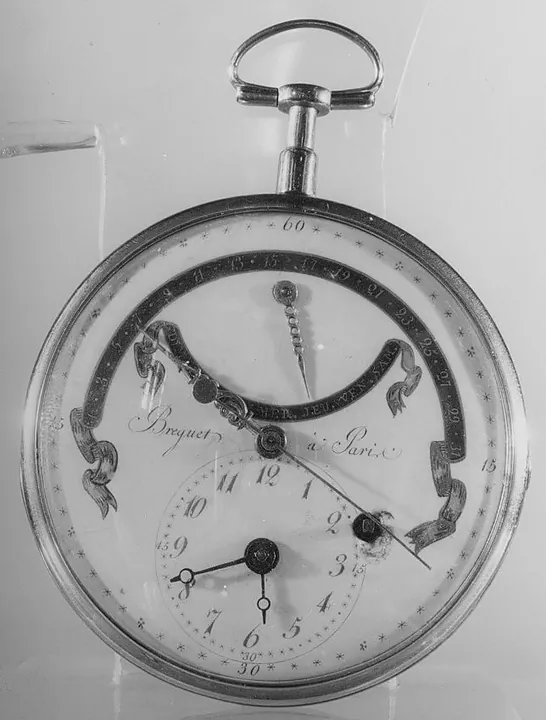
Pocket watch by Breguet, Belgium, 1700–1799
Royal Institute for Cultural Heritage
Pocket Watches · 1700–1799
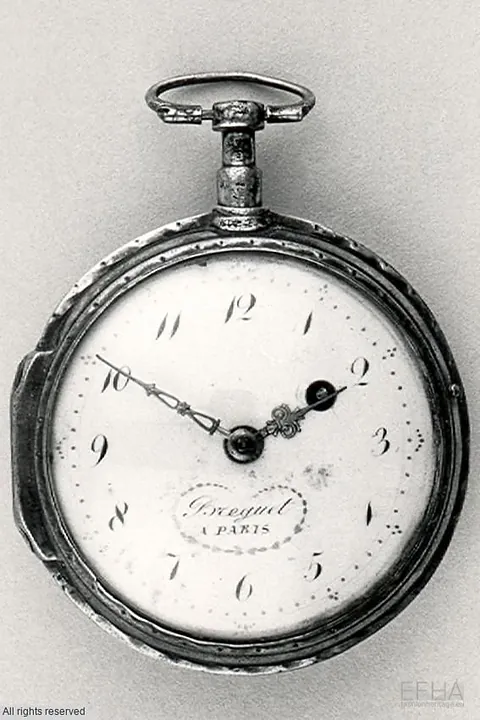
Pocket watch by Breguet, France, 1700–1799
Fashion Museum of Antwerp
Pocket Watches · c. 1790
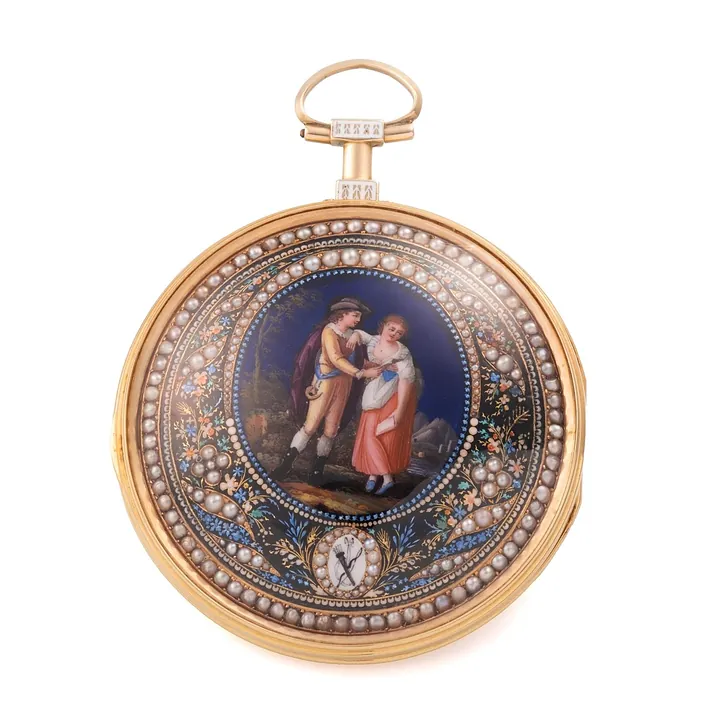
Breguet Love Letter, c. 1790
Antiquorum auction archive, Geneva
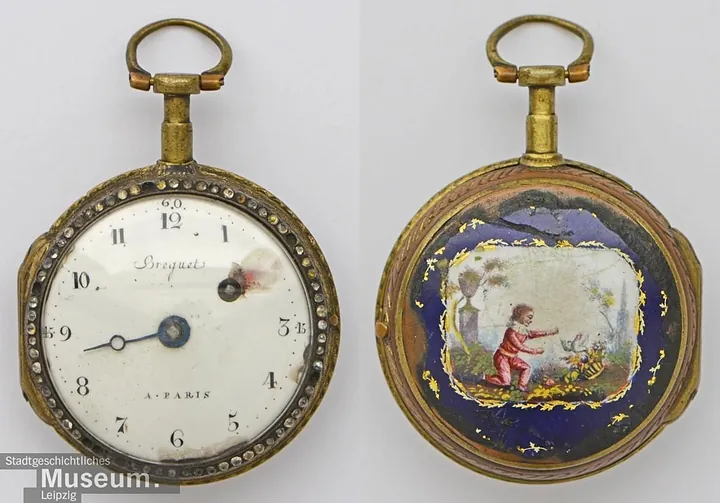
Pocket Watches · 1790
Pocket watch possibly by Breguet, France, 1790
Museum of City History Leipzig

Wristwatches · 2008
Wristwatch by Breitling?, 2008
Museum Rotterdam

Wristwatches · c. 1990s
Audemars Piguet Bamboo, c. 1990s
Antiquorum auction archive, Geneva

Wristwatches · c. 1990
Audemars Piguet Huitieme Perpetual Calendar, ref. 25696PT, c. 1990
Antiquorum auction archive, Geneva

Wristwatches · c. 1990
Breitling Chronomat, ref. b13050.1, c. 1990
Antiquorum auction archive, Geneva