
Clocks · Clock
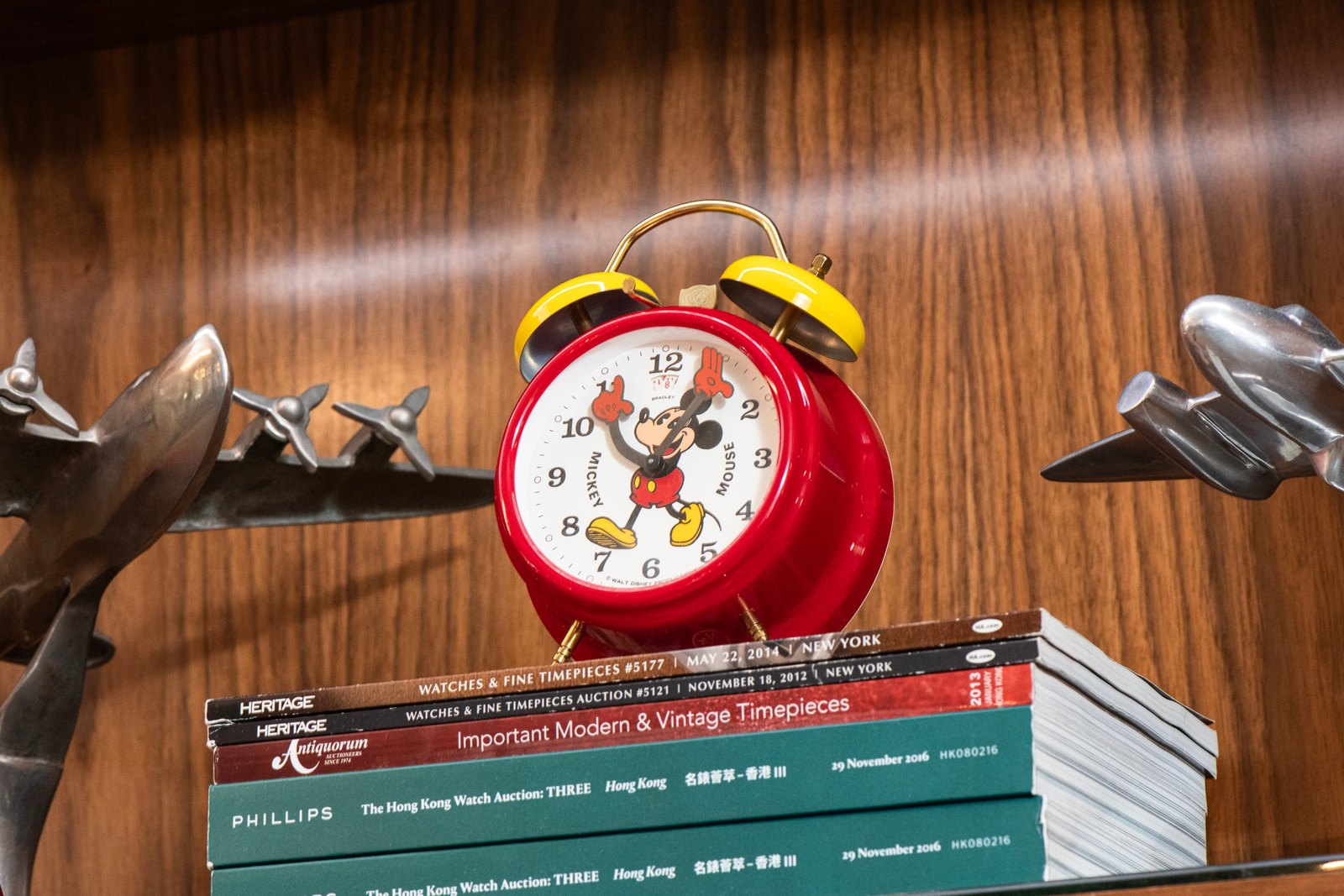
Bradley Mickey Mouse Alarm Clock, 1980s
- Maker / attribution
- Bradley (maker)
- Date
- 1980s
- Historical period
- Quartz Revolution (1969 – 1990)
- Country of origin
- Unrecorded in source
- Object type
- Clock
- Stock no.
- 39131076
- Credit line
- Dealer listing, Analog/Shift (39131076)
- Catalogue title (original)
- Bradley Mickey Mouse Alarm Clock (English)
View the source record (dealer listing) ↗ (opens another website in a new tab)Suggest a correction
Record summary
Catalogued by Analog/Shift (dealer), New York (stock number 39131076), this is a clock by Bradley, dated 1980s. The Atlas places it in the Quartz Revolution period (1969 – 1990) of its Clocks collection. The record is illustrated with 6 photographs.
Assembled from the source record's structured fields. Dates and attributions are given as the source states them; where a field is missing the Atlas leaves it blank rather than estimating.
Catalogue description
Dealer description — Analog/Shift
Sure, Analog:Shift is a business built around the love of wristwatches — primarily higher-end mechanical watches, to be honest. But it’s our love for timepieces, timekeeping, and artifacts from history in general that are the common themes present in the items we procure. And that includes a love of clocks in general: pocket watches, travel clocks, and more. After all, in the couple hundred years before the First World War, personal timekeeping was all about the pocket watch, and before that, it was larger clocks that were front and center, horologically. We still believe a good clock deserves a place in any watch lover’s collection. This charming vintage find features the ever-cheerful, round-eared rodent that calls back to the child in us all — Mickey Mouse! This playful alarm clock features Mickey at the center of the dial with his arms functioning as hour and minute hands to keep you on time with a healthy dollop of whimsy. This large clock, built for Bradley in Germany, is an officially licensed Walt Disney Productions product dating to the 1980s. The clock has a traditional two-bell and hammer mechanism and an alarm window used to set the alarm time directly below the 12 o’clock position. Standing on a pair of stylized brass legs, this round-bodied clock is finished in a cheerful red housing with yellow alarm bells and a warm creamy white dial. This vintage Mickey alarm clock is the perfect way to lighten up the mood in any living space and comes with its original box and guarantee/instruction manual. Set the time, wait for the bell, and remember not to take all of this so seriously!
Historical context
Quartz Revolution (1969 – 1990)
Seiko's Astron begins mass quartz timekeeping; traditional industries contract sharply.
Quartz movements and digital displays made accurate clocks cheap and ubiquitous after the early 1970s. LED and LCD clocks, clock radios and radio-controlled clocks appeared, while traditional mechanical clockmaking contracted sharply in Germany, France and Britain.
Read the period in the timelineMore clocks from this periodEarlier: Modern Mechanical Horology
Atlas type guide
Alarm clocks
Alarm work is among the oldest clock functions: monastic clocks woke monks for night prayers, and Renaissance table clocks often carried an alarm disc set by a pin. A separate spring or weight is released at the set time and drives a hammer against a bell. Some early alarms also lit a candle by striking a flint — the 'tinder pistol' alarm.
The cheap, mass-produced alarm clock arrived in the second half of the nineteenth century. American firms such as Seth Thomas and Westclox (the 'Big Ben' of 1910) and German makers such as Junghans and Kienzle made millions of drum-shaped alarms with pin-pallet escapements. Electric, quartz and digital alarm clocks followed in the twentieth century.
What to look for
- A separate alarm-setting dial or disc and an extra winding key.
- Twin bells on top (common after c. 1920) or a bell enclosed in the base.
- Pin-pallet escapements in inexpensive factory alarms.
- Trademarks and patent dates on dial or back.
Dating clues
- Renaissance alarm table clocks: sixteenth to seventeenth centuries.
- Drum alarm clocks: from the 1870s.
- Luminous dials with radium paint: c. 1910–1960.
General guidance written by the Atlas editors about this kind of object. It is not a statement about this particular piece; for that, rely on the source record above and on physical examination.
Related records
Wristwatches · c. 1960s
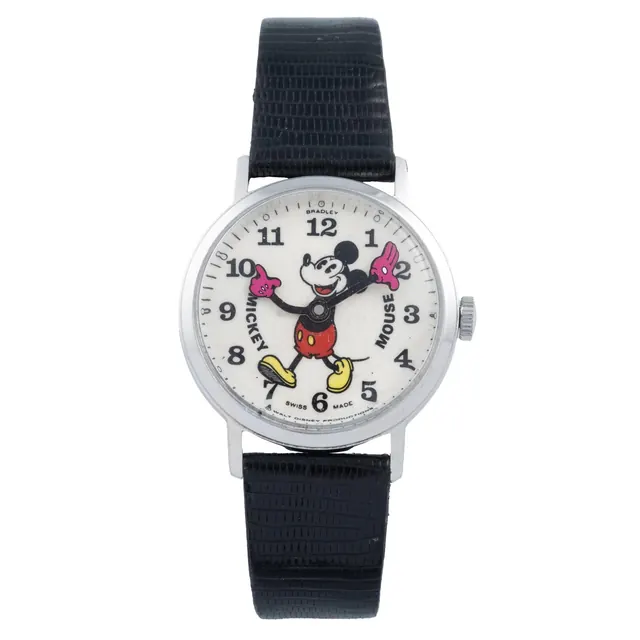
Bradley wristwatch, Mickey Mouse Base Metal, circa 1960's
Antiquorum auction archive, Geneva
Clocks · 1980s
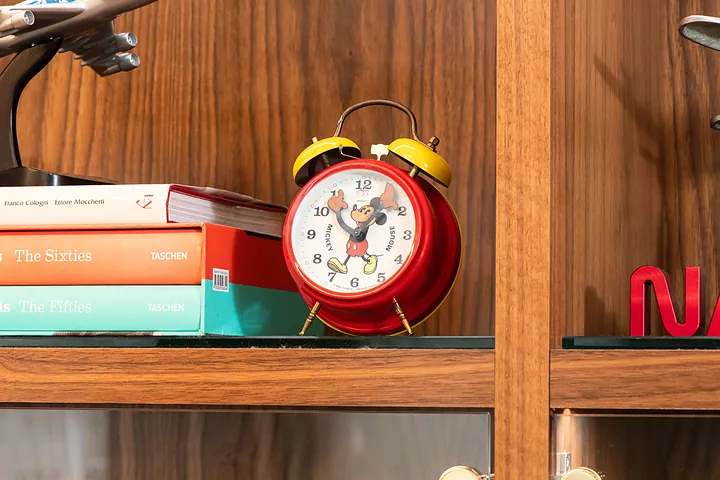
Bradley Mickey Mouse Alarm Clock, 1980s
Analog/Shift (dealer), New York
Clocks · late 20th century
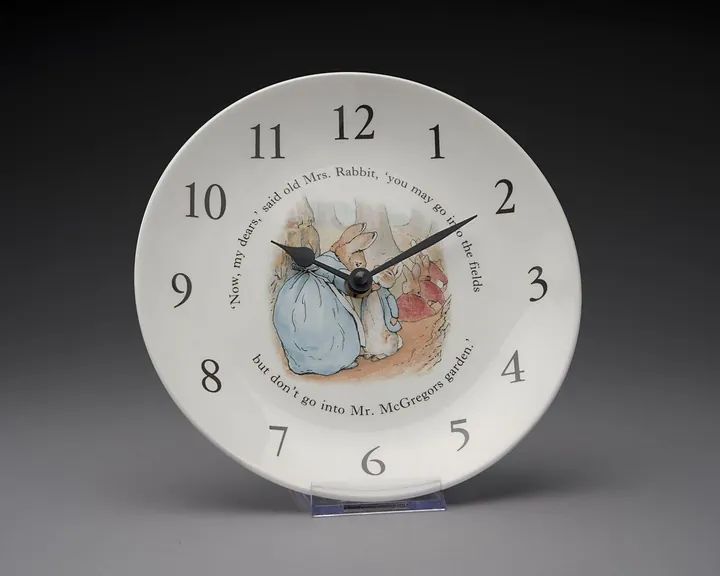
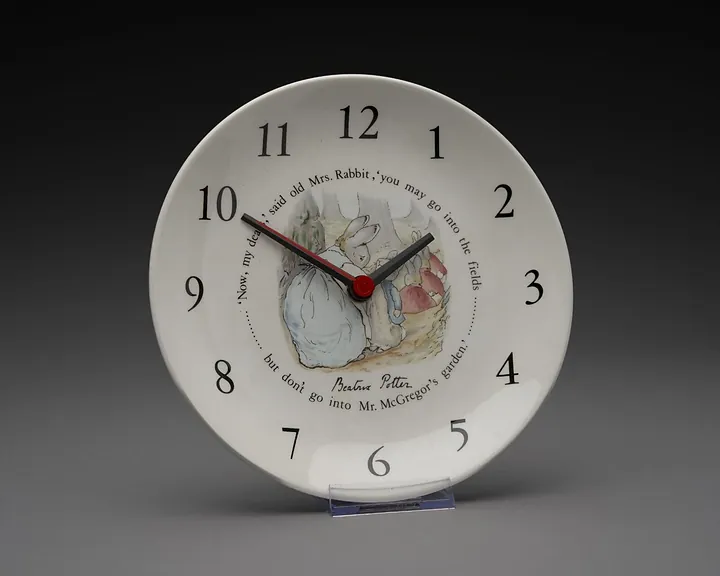
Clock, 'Peter Rabbit', Queen's ware, transfer printing, Josiah Wedgwood and Sons, Barlaston, late 20th century (V&A WE.17466-2014)
Victoria and Albert Museum, London
Clocks · late 20th century
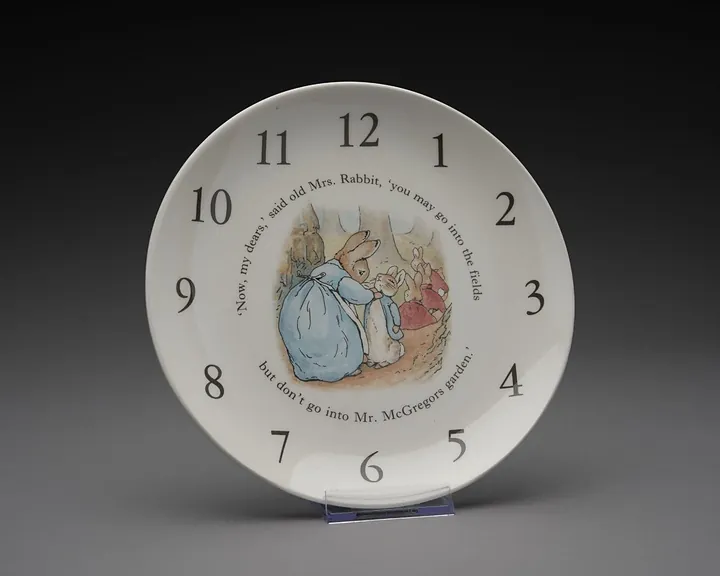
Clock, 'Peter Rabbit', Queen's ware, transfer printing, Josiah Wedgwood and Sons, Barlaston, late 20th century (V&A WE.18029-2014)
Victoria and Albert Museum, London
Clocks · late 20th century
Clock, 'Peter Rabbit', glazed earthenware, transfer printing, Josiah Wedgwood and Sons, Barlaston, late 20th century
Victoria and Albert Museum, London
Clocks · c. 1960-1970s
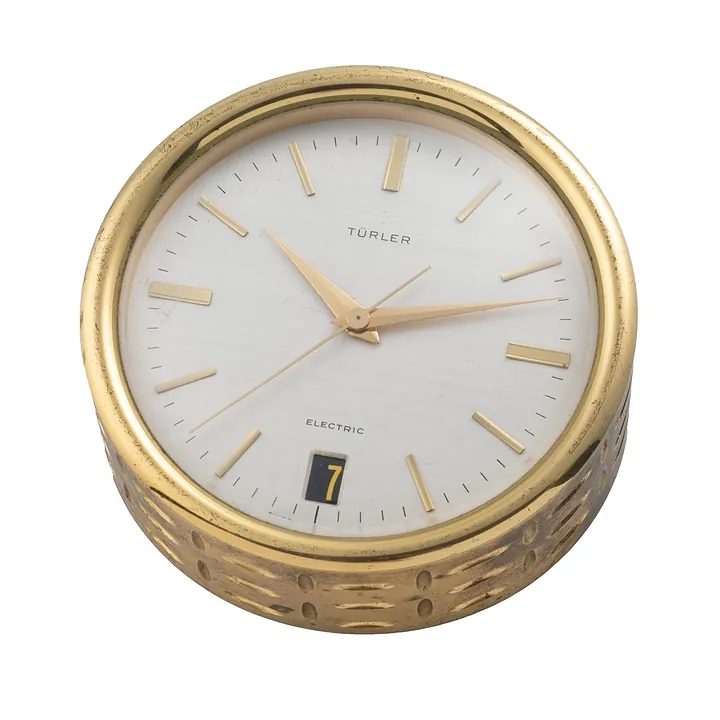
Anonymous clock, c. 1960-1970s
Antiquorum auction archive, Geneva
Clocks · 1960–1996
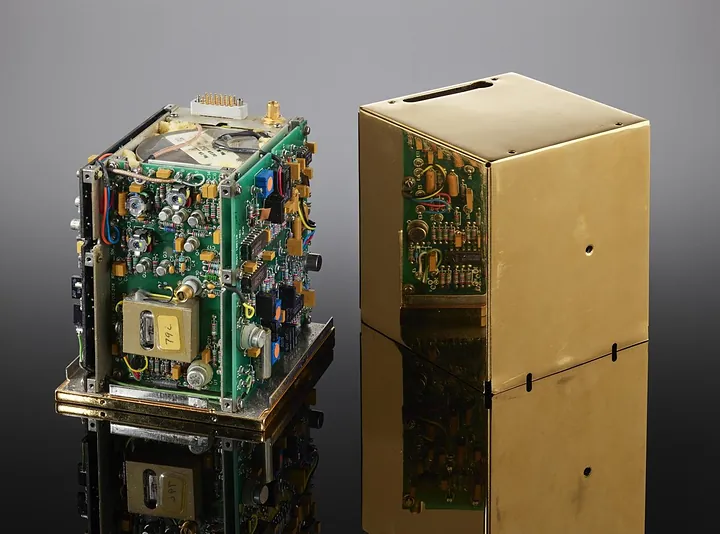
Electric clock by Efratom GmbH, Germany, 1960–1996
Science Museum Group, London
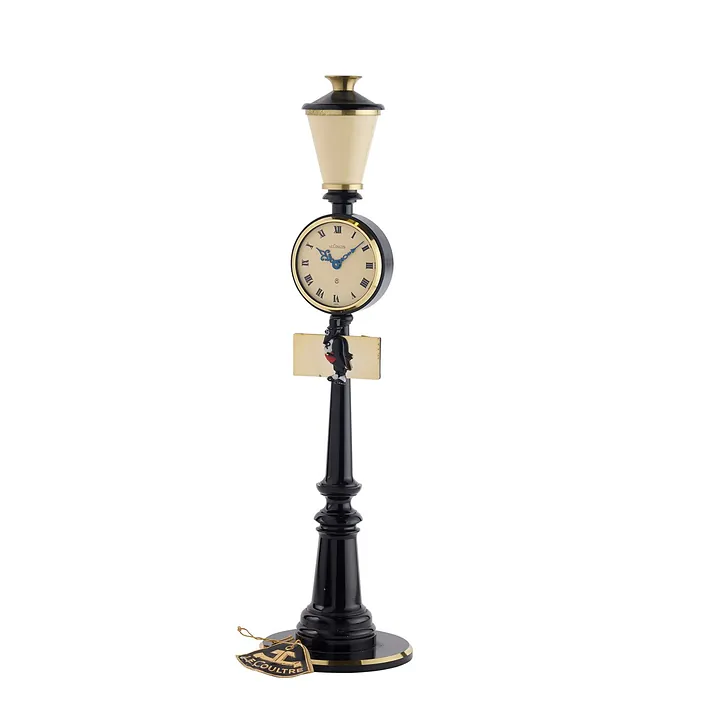
Clocks · c. 1960-1970s
Lecoultre Street Light Lamp, ref. 397, c. 1960-1970s
Antiquorum auction archive, Geneva