
Wristwatches · Wristwatch
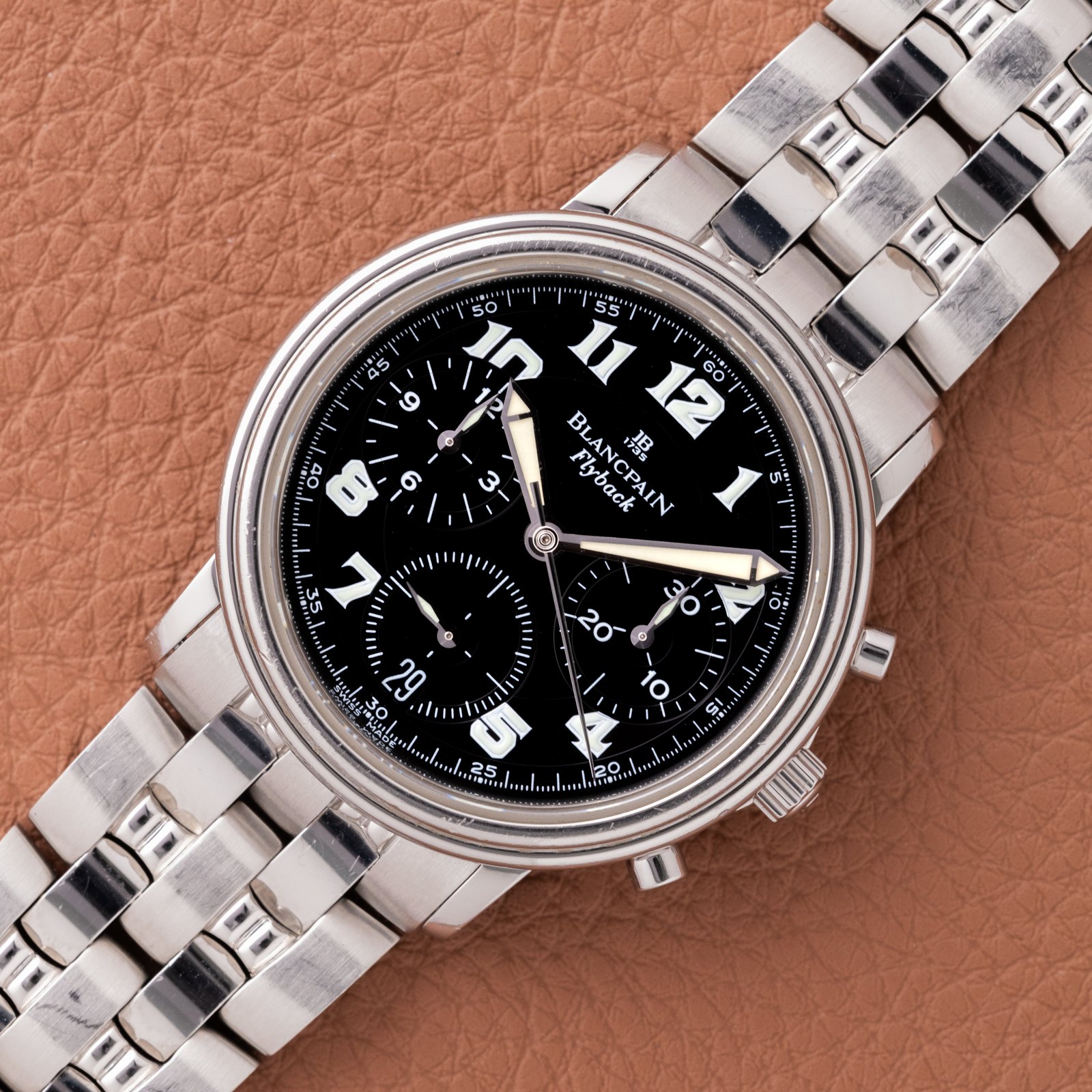
Blancpain Léman Flyback 34mm Military Dial (Ref. 1185F-1130M-63), 1990s
- Maker / attribution
- Blancpain (maker)
- Date
- 1990s
- Historical period
- Mechanical Renaissance (1990 – 2010)
- Country of origin
- Switzerland
- Object type
- Wristwatch
- Dimensions
- Case 34 mm
- Stock no.
- Product 8806085263543
- Credit line
- Dealer listing, Huntington Company (product 8806085263543)
- Catalogue title (original)
- 1990s Blancpain Léman Flyback 34mm Military Dial (Ref. 1185F-1130M-63) (English)
View the source record (dealer listing) ↗ (opens another website in a new tab)Suggest a correction
Record summary
Catalogued by Huntington Company (dealer) (stock number Product 8806085263543), this is a wristwatch by Blancpain, made in Switzerland, dated 1990s. The Atlas places it in the Mechanical Renaissance period (1990 – 2010) of its Wristwatches collection. Recorded dimensions: Case 34 mm. The record is illustrated with 6 photographs.
Assembled from the source record's structured fields. Dates and attributions are given as the source states them; where a field is missing the Atlas leaves it blank rather than estimating.
Catalogue description
Dealer description — Huntington Company
History and Significance The Blancpain Léman Flyback is familiar territory for collectors of 1990s Blancpain, but the reference 1185F-1130M-63 is a version that seems to have largely disappeared from the conversation. Most encounters with the 34mm Flyback lead to the better-known 2100 series, with its thicker case and screw-down chronograph pushers. The reference 1185F takes a noticeably different approach, placing the flyback chronograph into a slimmer, more traditional case reminiscent of Blancpain's Villeret designs. It gives the watch an elegance that feels almost unexpected for a military-inspired automatic chronograph. That distinction becomes especially important on the wrist. The smaller conventional pushers allow the case to remain visually clean, while the thin bezel and rounded profile keep the watch from feeling overly technical. It is an interesting reminder that a complicated sports watch did not always need to announce itself through size or bulk. Blancpain managed to fit a serious automatic flyback chronograph into proportions that still feel like a traditional mechanical wristwatch. At the center of the reference 1185F is Blancpain's automatic flyback chronograph architecture, allowing the chronograph to be reset and restarted with a single press while it is running. During this period, the flyback became one of the signatures of Blancpain's sportier watches, particularly within the Léman family. Yet the military-style dial gives this execution a personality distinct from the more restrained dress watches associated with the manufacture. Large Arabic numerals, luminous hands, and a three-register layout make the watch immediately legible without losing the refinement expected from Blancpain. What makes the reference 1185F particularly compelling today is how little attention it receives compared with neighboring references. Production appears to have been limited, and examples surface far less frequently than the 2100 Flyback that followed. That relative obscurity has left one of the most appealing configurations of the Léman chronograph hiding in plain sight. It belongs to the category of watches that becomes considerably more interesting once the small differences between references start to matter. The original bracelet changes the character again. Rather than turning the watch into a conventional modern sports chronograph, its articulated design feels distinctly tied to Blancpain's design language of the period. Combined with the military dial and compact case architecture, the result sits somewhere between dress watch, complicated chronograph, and understated sports watch. The reference 1185F-1130M-63 is an unusually complete expression of what Blancpain was doing during an era that remains underexplored by collectors. Writer's Thoughts There is something especially appealing about a complicated watch that does not need to be large to prove its point. The reference 1185F-1130M-63 has all of the mechanical interest expected from a Blancpain Flyback, but the execution feels restrained and almost old-fashioned in the best possible way. The smaller pushers and elegant case completely change the personality compared with the chunkier 2100 series. Add the military dial and original bracelet, and this becomes one of those obscure Blancpain references that makes digging through the brand's back catalog worthwhile. Our Promise Every watch is thoroughly vetted, carefully described with complete transparency, and guaranteed authentic. Each piece is offered in honest condition, ensuring collectors receive a timepiece that reflects both originality and integrity. Specifications Brand: Blancpain Model: Léman Flyback Reference: 1185F-1130M-63 Year: 1990s Case Material: Stainless steel Case Size: 34mm Dial: Black military-style dial Movement: Automatic flyback chronograph Strap/Buckle: Original stainless steel bracelet Buckle/Clasp: Original integrated clasp Contents: Watch only Condition Case: Stainless steel case shows light signs of wear consistent with careful use. Dial: Black military-style dial presents cleanly with strong printing and attractive luminous accents. Hands: Hands present well with luminous material remaining intact. Crystal: Crystal presents well with no significant imperfections visible. Strap/Buckle: Original stainless steel bracelet shows normal signs of wear throughout. Buckle/Clasp: Original clasp remains present and shows normal signs of use.
Historical context
Mechanical Renaissance (1990 – 2010)
Mechanical watches return as cultural objects; independent watchmaking flourishes.
Mechanical watches returned as cultural and luxury objects. Complications, tourbillons and new materials proliferated; independent watchmakers such as George Daniels, F.P. Journe and Philippe Dufour revived artisanal watchmaking; collecting vintage watches became a major field.
Read the period in the timelineMore wristwatches from this periodEarlier: Quartz Revolution
Atlas type guide
Chronographs and split-seconds watches
A chronograph is a watch with an additional seconds hand that can be started, stopped and returned to zero independently of the timekeeping. Louis Moinet built an early example in 1816 and Nicolas Rieussec a recording 'chronographe' in 1821; Adolphe Nicole's heart-shaped reset cam (patented 1862) made the modern return-to-zero possible. Split-seconds (rattrapante) chronographs add a second hand that can be stopped for intermediate times; flyback chronographs restart instantly.
Chronographs were essential tools for doctors (pulsometer scales), artillery (telemeter), engineers and sport. In wristwatches, Valjoux, Venus, Lemania and later the automatic chronographs of 1969 (Zenith El Primero, the Chronomatic Calibre 11 group and Seiko 6139) are milestones.
What to look for
- Push-pieces on the case band or a single button in the crown (monopusher).
- Subsidiary registers for minutes and hours; tachymeter, telemeter or pulsometer scales.
- Column wheel versus cam control visible in the movement.
- Calibre markings of specialist makers (Valjoux, Lemania, Venus, Landeron).
Dating clues
- Pocket chronographs with heart cam reset: after 1862.
- Wrist chronographs: from c. 1910; two-button designs from the 1930s.
- Automatic chronographs: from 1969.
General guidance written by the Atlas editors about this kind of object. It is not a statement about this particular piece; for that, rely on the source record above and on physical examination.
Read next:Chronograph
Related records
Clocks · c. 2010
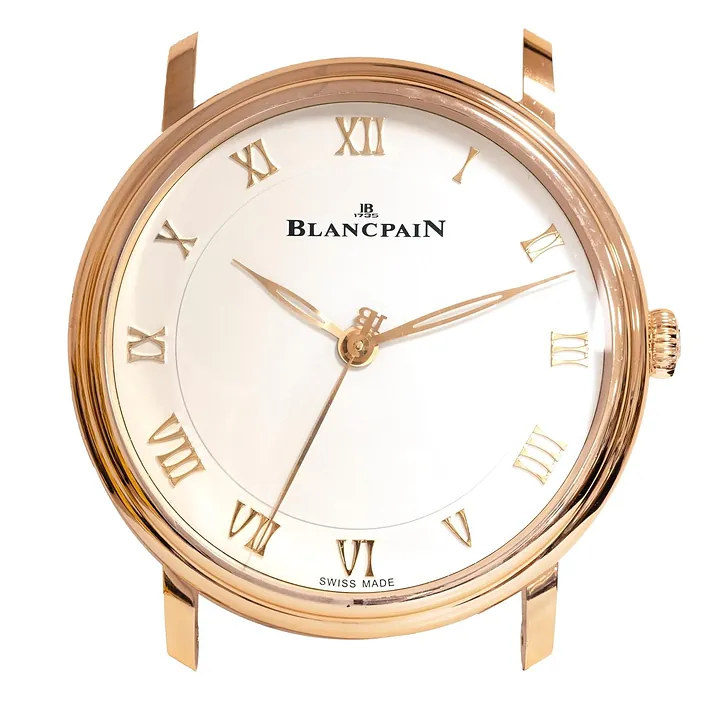
Blancpain clock, c. 2010
Antiquorum auction archive, Geneva
Wristwatches · c. 1930
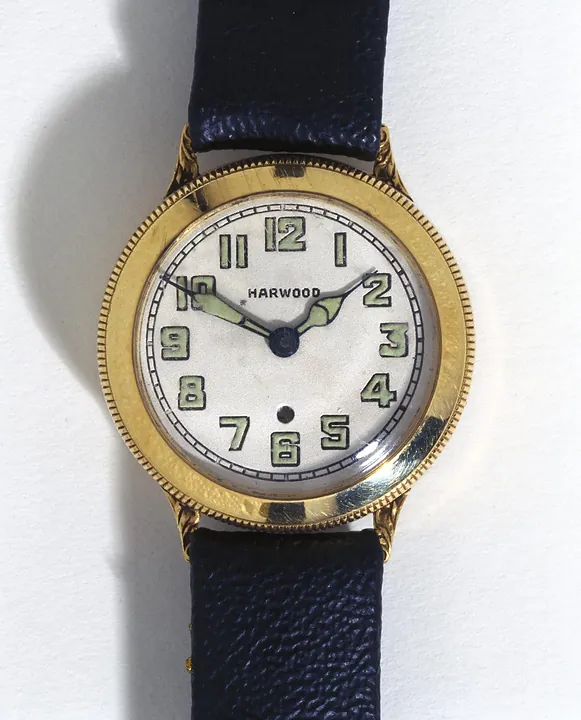
Wristwatch by J. Harwood and Son and Blancpain, Switzerland, c. 1930
Science Museum Group, London
Wristwatches · c. 1930
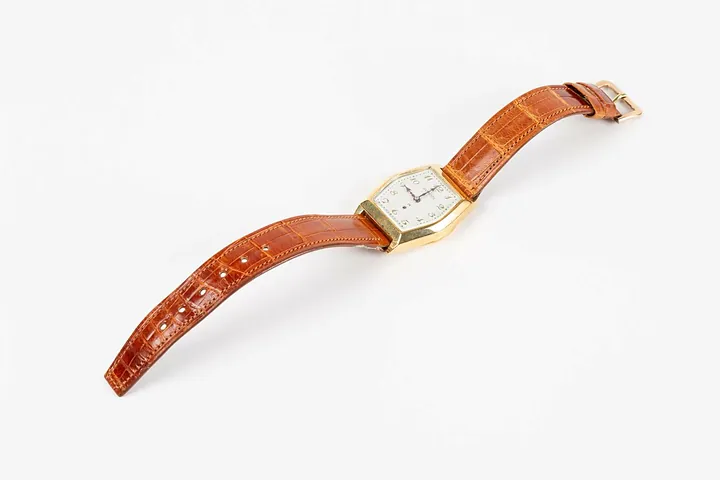
Wristwatch by Harwood (Société Centrale de la Montre Sans Remontoir), Switzerland, c. 1930 (no. 58042)
German Clock Museum
Wristwatches · c. 1932
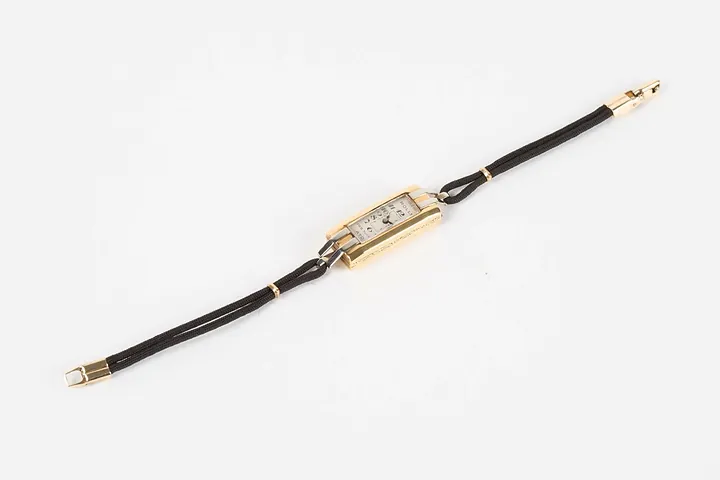
Wristwatch by Blancpain, Switzerland, c. 1932
German Clock Museum

Wristwatches · 2008
Wristwatch by Breitling?, 2008
Museum Rotterdam

Wristwatches · c. 1990s
Audemars Piguet Bamboo, c. 1990s
Antiquorum auction archive, Geneva

Wristwatches · c. 1990
Audemars Piguet Huitieme Perpetual Calendar, ref. 25696PT, c. 1990
Antiquorum auction archive, Geneva

Wristwatches · c. 1990
Breitling Chronomat, ref. b13050.1, c. 1990
Antiquorum auction archive, Geneva