
Wristwatches · Wristwatch
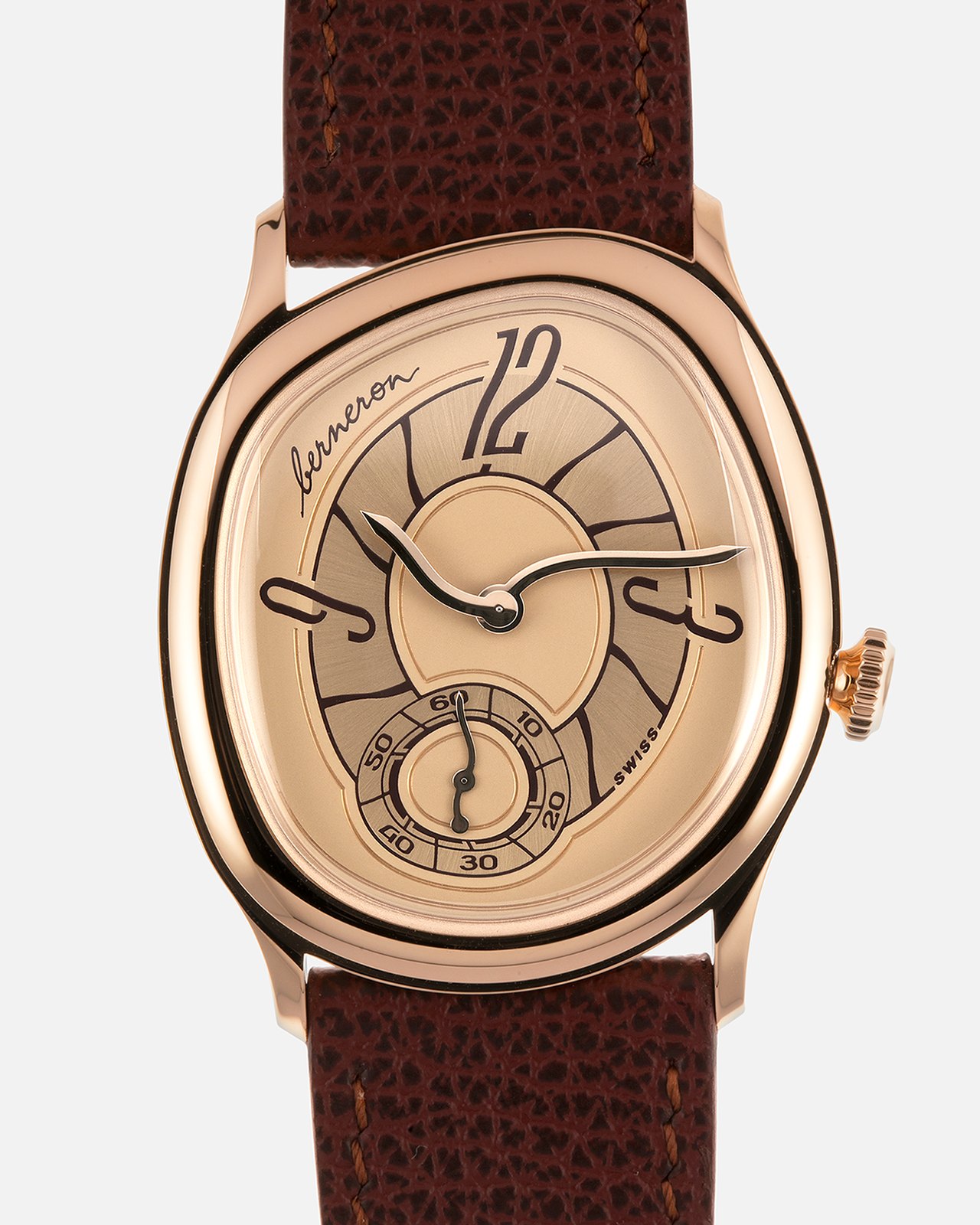
Berneron Mirage 38 Sienna, 2026
- Maker / attribution
- Berneron (maker)
- Date
- 2026
- Historical period
- Contemporary Horology (2010 – Present)
- Country of origin
- Unrecorded in source
- Object type
- Wristwatch
- Dimensions
- Case 38 mm
- Stock no.
- Product 7739295006807
- Credit line
- Dealer listing, S.Song Watches (product 7739295006807)
- Catalogue title (original)
- Berneron Mirage 38 Sienna (English)
View the source record (dealer listing) ↗ (opens another website in a new tab)Suggest a correction
Record summary
Catalogued by S.Song Watches (dealer), Seattle (stock number Product 7739295006807), this is a wristwatch by Berneron, dated 2026. The Atlas places it in the Contemporary Horology period (2010 – Present) of its Wristwatches collection. Recorded dimensions: Case 38 mm. The record is illustrated with 6 photographs.
Assembled from the source record's structured fields. Dates and attributions are given as the source states them; where a field is missing the Atlas leaves it blank rather than estimating.
Catalogue description
Dealer description — S.Song Watches
Independent watchmaking is perhaps more exciting today than it has ever been. While established names such as F.P. Journe, Philippe Dufour, and Kari Voutilainen have rightfully become some of the most coveted watchmakers in the world, a new generation is beginning to emerge with ideas that feel genuinely fresh. Among them, Sylvain Berneron and his eponymous brand have quickly become one of the most talked-about. Berneron's background is somewhat unconventional. A designer by training rather than a watchmaker, he spent years working in the automotive industry with names such as BMW, Porsche, and Ducati before eventually moving into watches, first at IWC and later Breitling. It was while working at Breitling that he began developing his own watch, with the intention of creating something without the commercial and technical constraints normally associated with a larger brand. The result was the Mirage, and to me, what makes it particularly interesting is that its unusual shape isn't simply there for the sake of design. Berneron began with the movement and effectively designed the watch from the inside out. Rather than forcing a conventional round calibre into an asymmetrical case, the proprietary Cal. 233 itself is asymmetrical, allowing its components to occupy the space they actually require. The case and dial then follow the architecture of the movement, resulting in the wonderfully distorted form you see here. Here, we have the Mirage 38 Sienna, perhaps the warmer and more classical of the original two configurations. Measuring 38mm x 34mm and an incredible 7mm thick, the case is made entirely from 18-carat yellow gold and has an almost fluid quality to its design. There are obvious hints of watches such as the Cartier Crash and Gilbert Albert's creations for Patek Philippe, but the Mirage doesn't feel like a recreation of either. The proportions, irregular curves, and incredibly thin profile give it a character entirely of its own. The dial follows the same distorted architecture and is probably where the Mirage earns its name most convincingly. Made from solid 18-carat gold, everything appears to twist and flow around the dial, from the sector-style minute track and applied numerals to the wonderfully unusual hands and off-centred small seconds. Despite all this asymmetry, the watch somehow feels remarkably balanced. It is unconventional without being gimmicky, which is an incredibly difficult line to walk. I particularly love the Sienna colour scheme. The name comes from the natural earth pigment famously used throughout art history, which develops its characteristic reddish-brown tone when heated. Against the yellow gold case, the warm dial takes on an almost vintage quality, shifting between gold, copper, brown, and subtle reddish tones depending on the light. It is an unusual colour, but one that works beautifully with the organic shape of the watch. Powering the Mirage is the manually wound Cal. 233, a proprietary movement developed specifically around the shape of the watch. Measuring just 2.3mm thick, it features a large free-sprung balance, direct small seconds, and an oversized barrel providing an impressive 72-hour power reserve. Berneron even reversed the conventional hand stack, placing the hour hand above the minute hand, allowing the crystal and case to be made thinner still. It is a wonderfully obsessive piece of engineering for what is, ultimately, a simple time-only watch. The movement is equally impressive aesthetically. Its solid-gold bridges follow the irregular contours of the case and are decorated with guilloché, anglage, and a host of traditional finishing techniques. There is no attempt to disguise the unusual architecture behind a conventional bridge layout. Instead, the movement celebrates its asymmetry and looks every bit as considered as the dial on the other side. For me, this is what makes the Mirage such an impressive debut. There are plenty of independent watches today with unusual cases, beautiful finishing, and increasingly elaborate dials. The Mirage is different because its design isn't merely applied on top of conventional watchmaking. The movement, case, dial, and even the placement of the hands were conceived together, with seemingly no consideration given to whether doing so was sensible or economical. Production is equally uncompromising, with the Mirage 38 made in exceptionally small numbers and all pieces already allocated by the brand. More importantly, it feels like the beginning of a genuinely distinctive design language rather than a one-off exercise. For a first watch from a young independent brand, that is no small achievement. Beautifully proportioned, mechanically interesting, and completely unconventional, the Mirage 38 Sienna is one of those rare watches that becomes more impressive the more you understand why it looks the way it does. There is an incredible amount of watchmaking hidden beneath what initially appears to be a wonderfully strange dress watch, and in my opinion, that is exactly what makes it so special.
Historical context
Contemporary Horology (2010 – Present)
Silicon components, connected watches, optical-lattice research clocks and a thriving independent scene.
Smartwatches became the world's best-selling watches, while mechanical watchmaking focuses on craft, innovation (silicon components, new escapements) and independent makers.
Read the period in the timelineMore wristwatches from this periodEarlier: Mechanical Renaissance
Atlas type guide
Wristwatches
Bracelet watches were worn by women from the early nineteenth century — Breguet made one for Caroline Murat, Queen of Naples, in 1810–12 — but the wristwatch only became a man's instrument with military use and aviation in the early twentieth century. Between the World Wars it overtook the pocket watch; the 1920s and 1930s brought rectangular Art Deco cases, water-resistant cases and the first automatic winding systems.
After 1945 the wristwatch became a carrier of identity — dress watches, sports and dive watches, chronographs, calendars — produced by Swiss, American, Japanese, German, Soviet and Chinese industries. The quartz revolution after 1969 and the mechanical renaissance since the 1990s, including the rise of independent watchmakers, complete the story.
What to look for
- The reference number (between the lugs or inside the case back) and serial number, the starting point for dating.
- The calibre: its maker and number are often stamped under the dial or on the bridge.
- Originality of dial, hands and crown — refinished ('redial') dials are common.
- Case material marks: 18K/750, 14K/585, stainless steel, gold-filled, plated.
Dating clues
- Wire-lug cases: before c. 1925.
- Water-resistant screw-down cases: from 1926.
- Quartz movements: from 1969; sapphire crystals widespread after c. 1980.
General guidance written by the Atlas editors about this kind of object. It is not a statement about this particular piece; for that, rely on the source record above and on physical examination.
Related records
Wristwatches · 2025
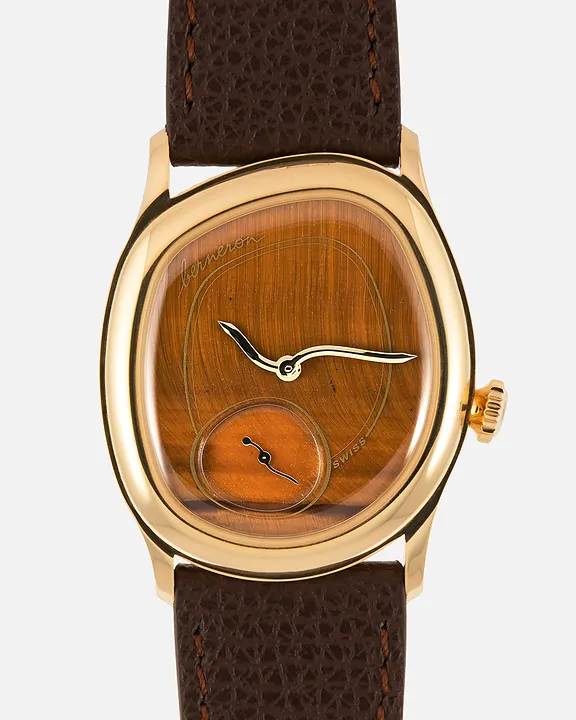
Berneron Mirage 34 Tiger Eye, 2025
S.Song Watches (dealer), Seattle
Wristwatches · 2010
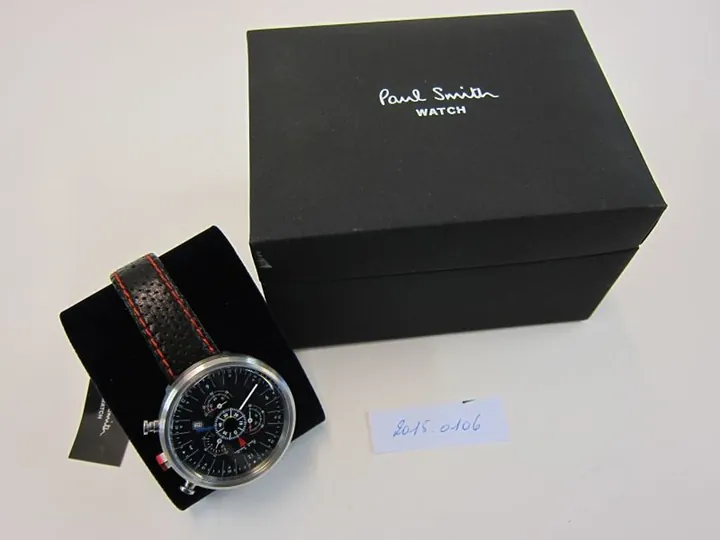
Wristwatch, 2010
Modemuseum Hasselt
Wristwatches · 2018 (Series 4 released in September 2018; '1977' in the source is the model number A1977)
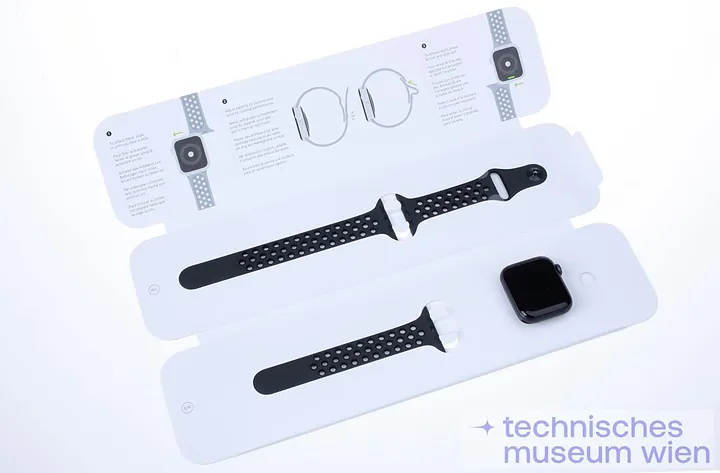
Apple Watch Series 4 (GPS, 40 mm, model A1977), 2018
Vienna Museum of Science and Technology
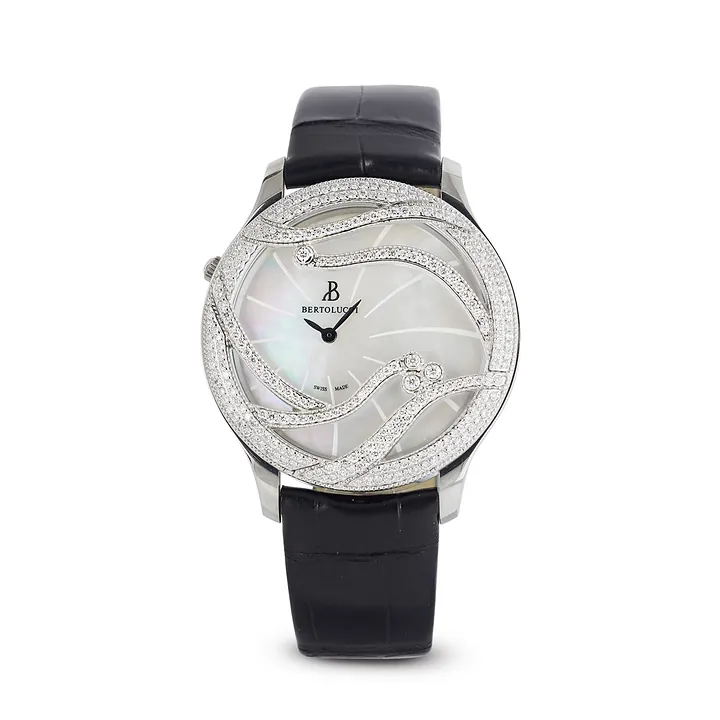
Wristwatches · c. 2010s
Bertolucci Stria III, ref. 11513.50.45.B88.6C1.501, c. 2010s
Antiquorum auction archive, Geneva
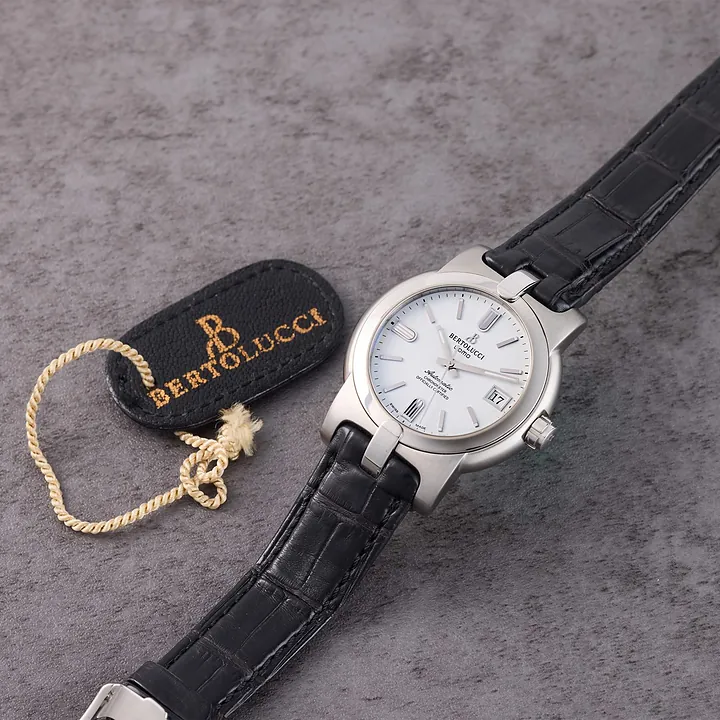
Wristwatches · c. 2010s
Bertolucci Uoma, ref. 824.51.41.10B, c. 2010s
Antiquorum auction archive, Geneva

Wristwatches · c. 2010s
Breguet Type XXI, ref. 3810, c. 2010s (Antiquorum Lot 381-24)
Antiquorum auction archive, Geneva

Wristwatches · c. 2010s
Breguet Type XXI, ref. 3810, c. 2010s (Antiquorum Lot 386-229)
Antiquorum auction archive, Geneva

Wristwatches · Sold in September 2010
Breitling Cosmonaute, ref. A 22322, Sold in September 2010
Antiquorum auction archive, Geneva