
Pocket Watches · Military dive watch
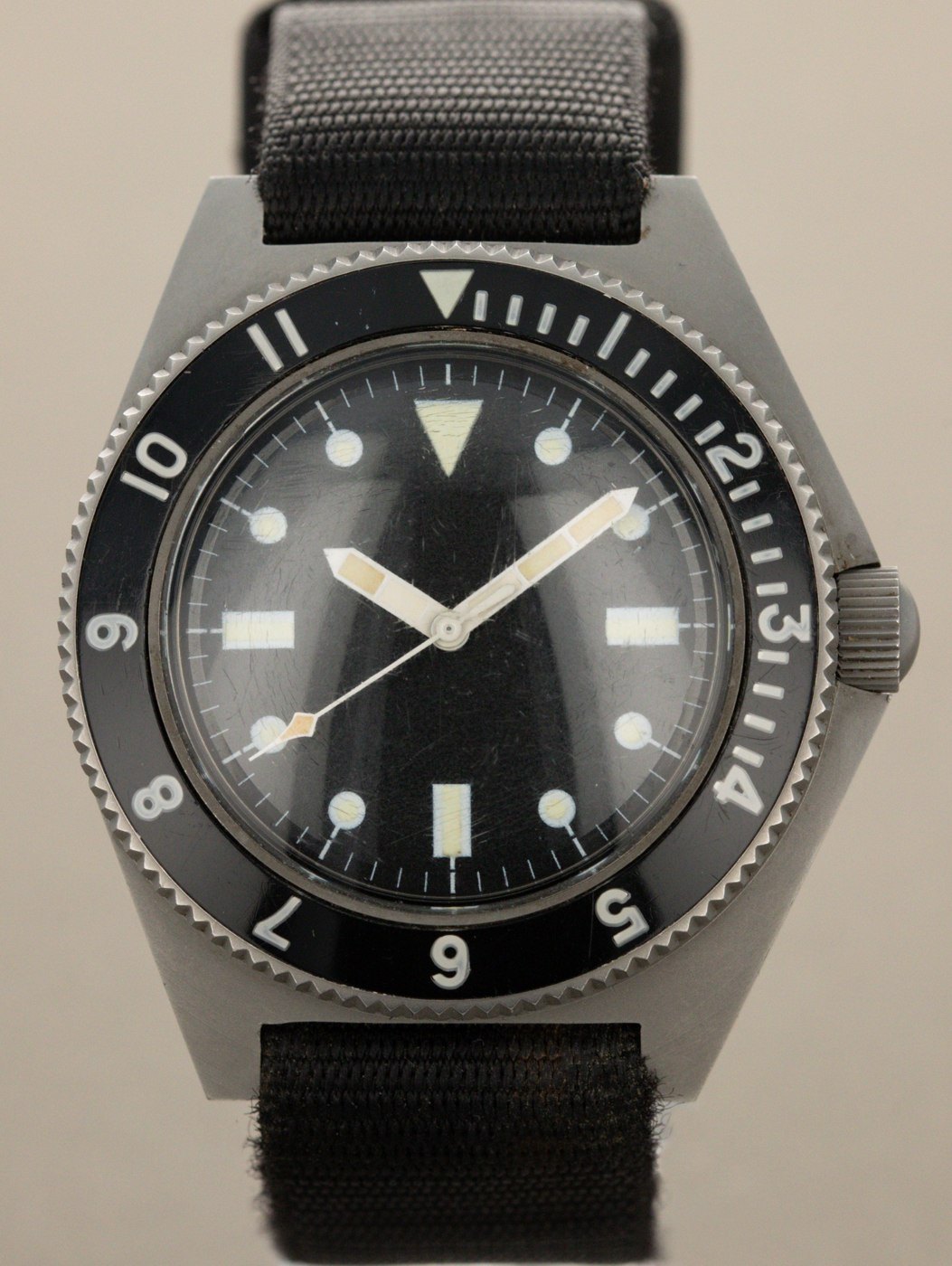
Benrus Type I Class A Military Dive Watch
- Maker / attribution
- Benrus (source attribution)
- Date
- c. 1979
- Historical period
- Quartz Revolution (1969 – 1990)
- Country of origin
- United States
- Object type
- Military dive watch
- Dimensions
- 42.5mm
- Holding institution
- Oliver & Clarke
- Accession / object no.
- benrus-type-i-class-a-military-dive-watch-d88086927f
- Credit line
- Oliver & Clarke
- Catalogue title (original)
- Benrus Type I Class A - Matte Black 'Sterile' Dial Military-Issued (English)
View the source record ↗ (opens another website in a new tab)Suggest a correction
Record summary
Held and catalogued by Oliver & Clarke (object number benrus-type-i-class-a-military-dive-watch-d88086927f), this is a military dive watch attributed to Benrus, made in United States, dated c. 1979. The Atlas places it in the Quartz Revolution period (1969 – 1990) of its Pocket Watches collection. Recorded dimensions: 42.5mm. The record is illustrated with 1 photograph.
Assembled from the source record's structured fields. Dates and attributions are given as the source states them; where a field is missing the Atlas leaves it blank rather than estimating.
Catalogue description
Original object description
Produced by Benrus around April 1979, this military diving watch conforms to the U.S. Department of Defense MIL-W-50717 standard, an equipment specification deployed between 1972 and 1980 by specialist forces including Navy SEALs. An asymmetrical 42.5 mm case displays an unpolished parkerized coating, a screw-down crown bearing hash marks, and a bidirectional bezel housing a black 12-hour acrylic insert. Minor surface wear appears on the sterile matte black dial, which is configured with white hands and evenly aged Tritium hour plots. The engraved caseback carries military specification and production date details. Securing the watch is a black single-pass nylon strap fastened with a PVD-finished buckle.
Historical context
Quartz Revolution (1969 – 1990)
Seiko's Astron begins mass quartz timekeeping; traditional industries contract sharply.
Quartz pocket watches and inexpensive novelty watches appeared, while traditional mechanical pocket watches survived mainly as collectibles and gifts.
Read the period in the timelineMore pocket watches from this periodEarlier: Modern Mechanical Horology
Atlas type guide
Pocket watches
The pocket watch was the dominant personal timekeeper from the late seventeenth century until the First World War. Its development tracks the history of the escapement: verge watches with fusees until the late eighteenth century; Thomas Mudge's lever escapement (c. 1755) and the cylinder escapement popularised by George Graham and later by Swiss makers; and the Swiss and English lever watches of the nineteenth century. Lépine's bar-bridge calibre and keyless winding made watches thinner and easier to use.
Industrialisation transformed the trade: American factories such as Waltham (from 1850) and Elgin produced interchangeable parts by machine, and Swiss makers responded with their own mechanisation after the 1876 Philadelphia Exhibition. By 1900 a reliable watch was affordable to millions; the finest makers continued to produce complications and precision watches.
What to look for
- The escapement: verge (crown wheel), cylinder, duplex, English or Swiss lever.
- Key winding (a square arbor in dial or back) or keyless crown winding.
- Signatures and serial numbers on the movement, dial and inside case back.
- Hallmarks, case maker's marks and gold or silver standards stamped in the case.
- Dial material: enamel, silver, gold, later printed metal.
Dating clues
- Verge watches dominate before c. 1800; cylinder watches c. 1770–1900; lever watches after c. 1820.
- Keyless winding: increasingly common after c. 1860.
- Manufacturer serial number lists exist for Waltham, Elgin, Longines, Omega, Patek Philippe and others.
General guidance written by the Atlas editors about this kind of object. It is not a statement about this particular piece; for that, rely on the source record above and on physical examination.
Read next:Verge escapementDetached lever escapementFuseeIdentification Centre
Related records
Wristwatches · c. 1960
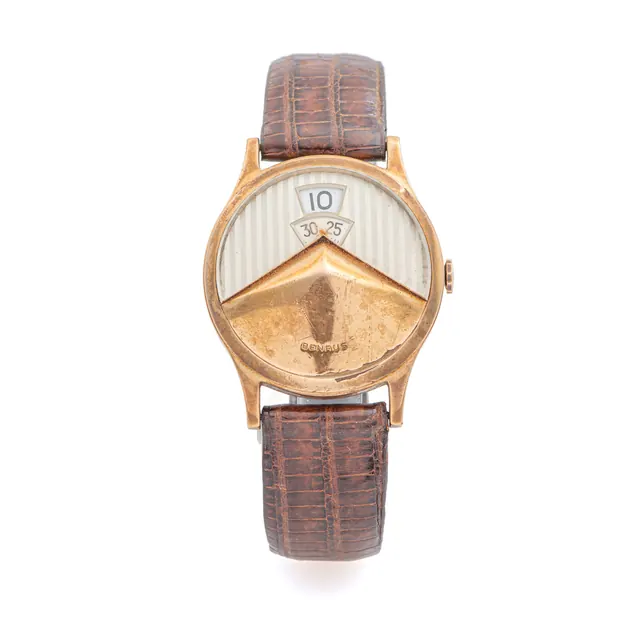
Benrus wristwatch, Dial-O-Rama Digital Jump Hour, circa 1960
Antiquorum auction archive, Geneva
Wristwatches · 1970s
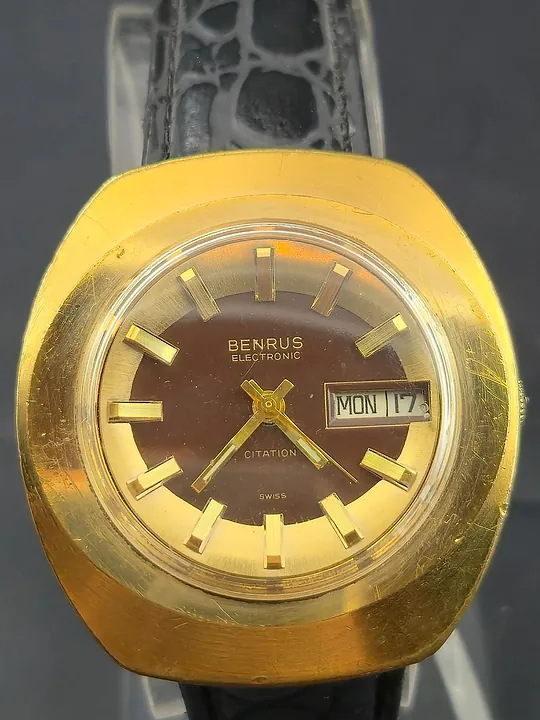
1970s Benrus Citation Electronic HS19 7J Day-Date Wristwatch, Gold-Tone Case, New Battery, Running
LiveAuctioneers auction archive
Wristwatches · 1950s
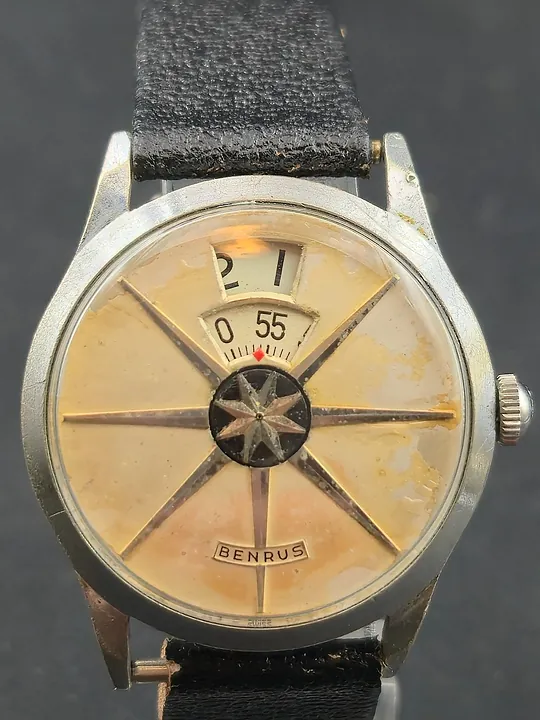
1950s Benrus “Dial-O-Rama” Jump Hour 17J Manual Wind Watch, 33 mm – Runs
LiveAuctioneers auction archive
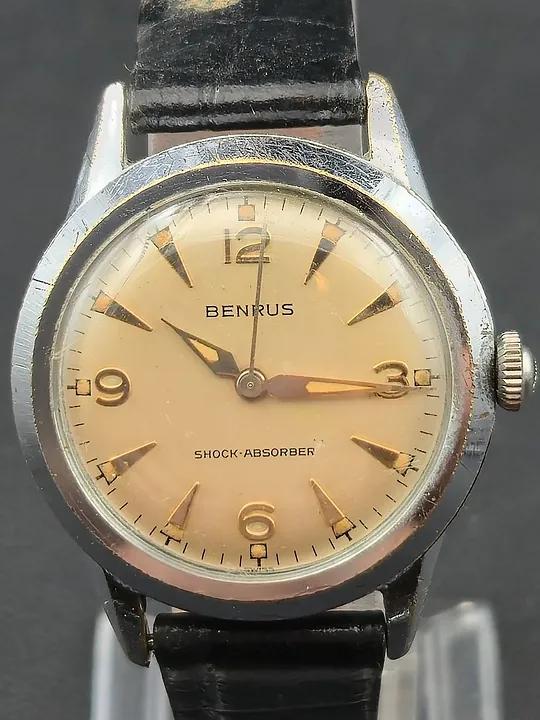
Wristwatches · 1940s
1940s Benrus Shock Absorber 17J U.S. Zone Germany 32mm Runs
LiveAuctioneers auction archive
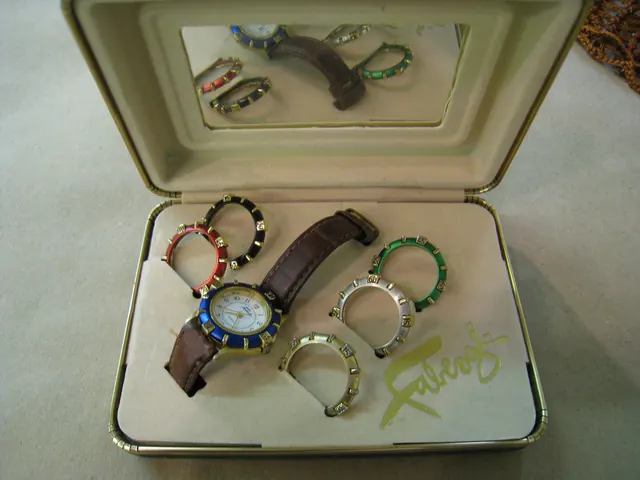
Pocket Watches · c. 1970
Watch by M.Z. Berger and Co., Inc
Yale University Art Gallery, New Haven
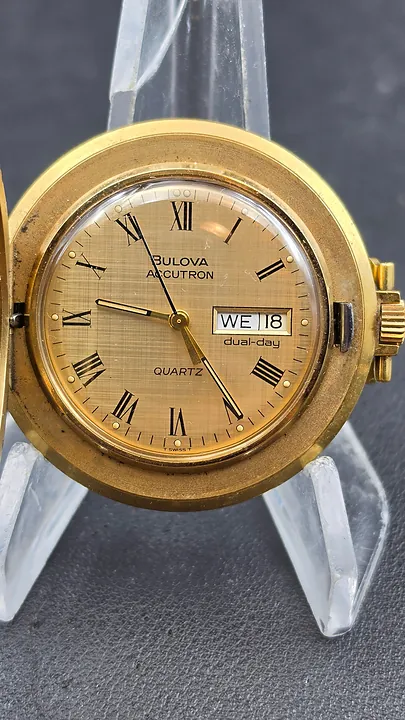
Pocket Watches · c. 1978
Bulova Accutron Dual-Day Quartz Pendant Pocket Watch, Gold-Tone, circa 1978
LiveAuctioneers auction archive
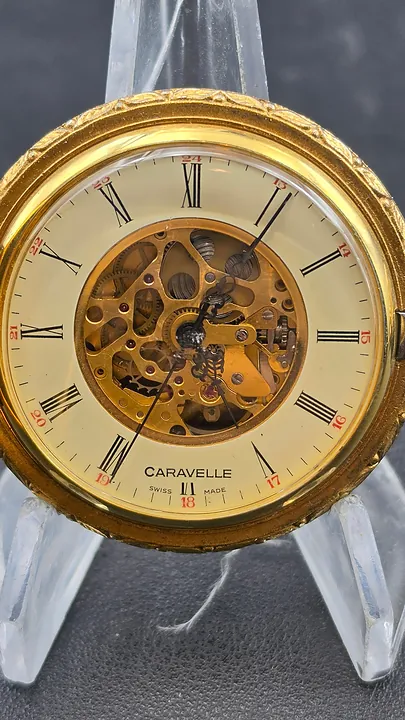
Pocket Watches · c. 1980
Caravelle (Bulova) Full Hunter Skeleton Pocket Watch, 17 Jewels, circa 1980
LiveAuctioneers auction archive
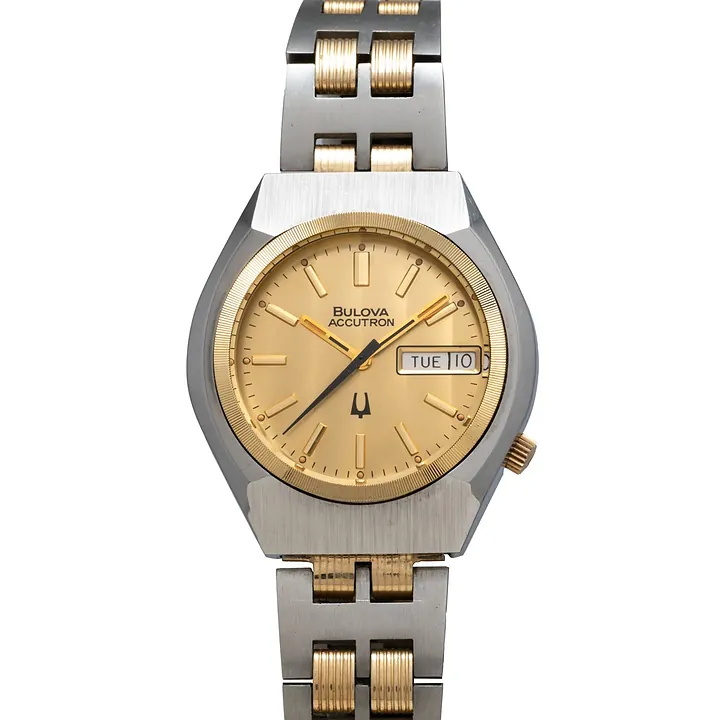
Pocket Watches · 1976
Bulova Accutron Day-Date 'Holographic'
Analog Shift