
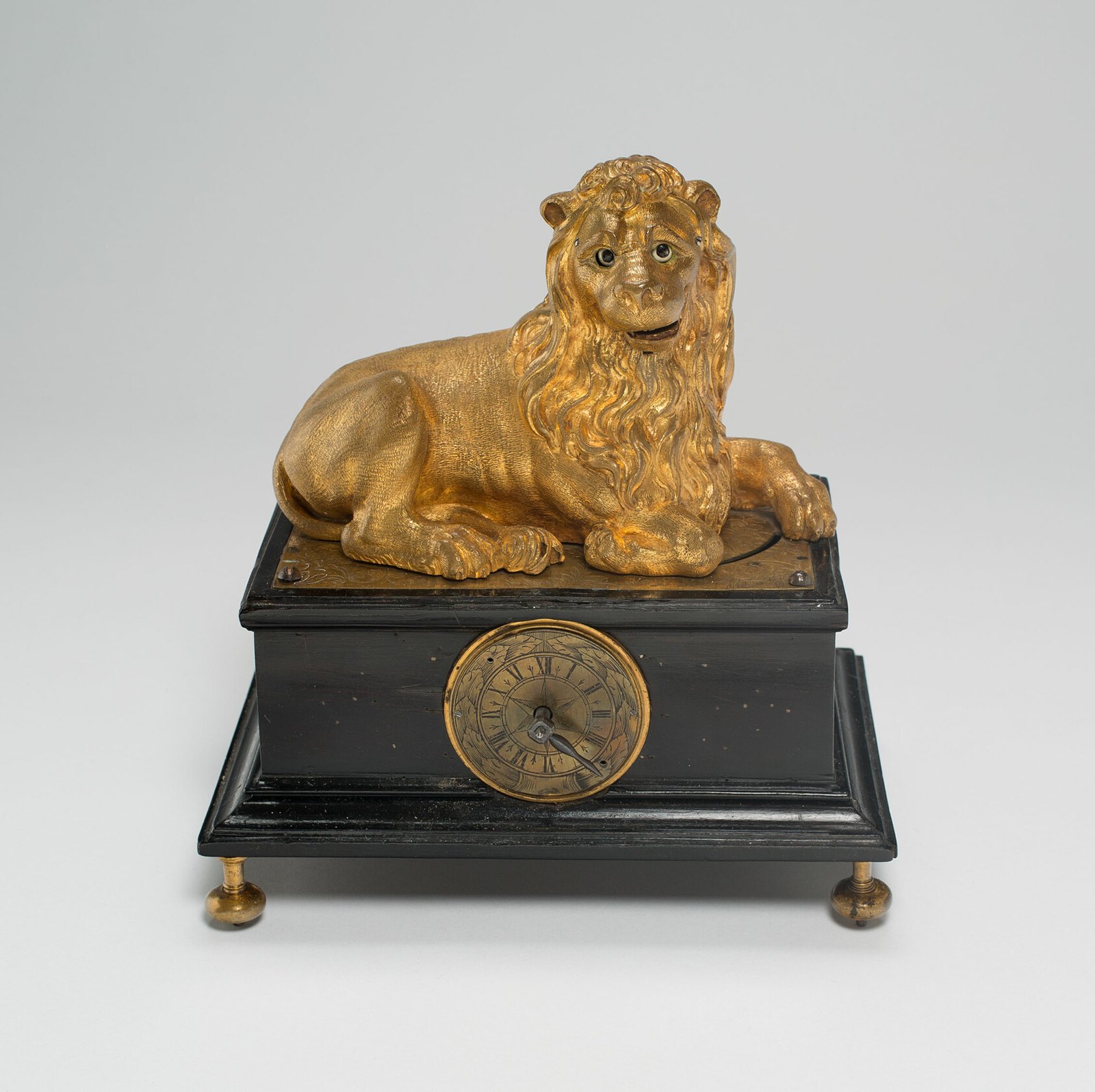
Clocks · Automaton Clock in the Shape of a Lion
Automaton Clock in the Shape of a Lion
- Maker / attribution
- Germany Augsburg (maker)
- Date
- c. 1630
- Historical period
- Early Modern Horology (1600 – 1750)
- Country of origin
- Germany
- Place
- Germany
- Object type
- Automaton Clock in the Shape of a Lion
- Materials / technique
- Gilt bronze, ebony, and metal
- Dimensions
- 20.3 × 12.7 × 22.9 cm (8 × 5 × 9 in.)
- Holding institution
- Art Institute of Chicago
- Accession / object no.
- 1990.194.2
- Credit line
- George F. Harding Collection
- Catalogue title (original)
- Automaton Clock in the Shape of a Lion (English)
View the source record ↗ (opens another website in a new tab)Suggest a correction
Record summary
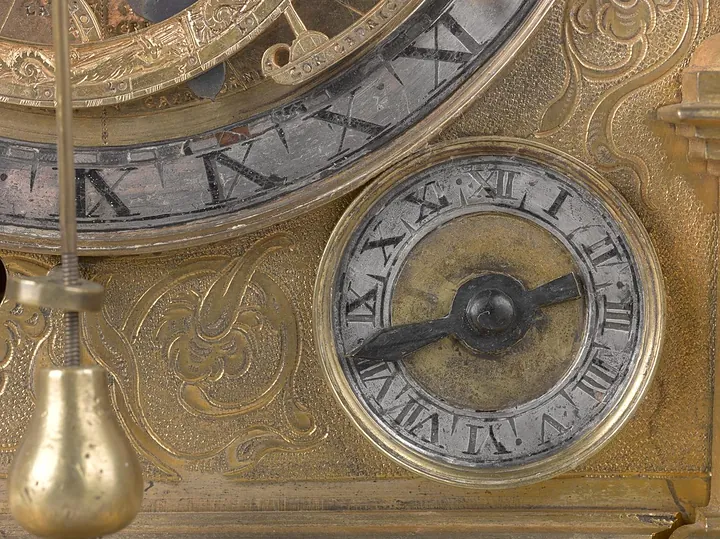
Held and catalogued by Art Institute of Chicago (object number 1990.194.2), this is an automaton clock in the shape of a lion by Germany Augsburg, made in Germany, dated c. 1630. The Atlas places it in the Early Modern Horology period (1600 – 1750) of its Clocks collection. Materials and techniques recorded by the source: Gilt bronze, ebony, and metal. Recorded dimensions: 20.3 × 12.7 × 22.9 cm (8 × 5 × 9 in.). The record is illustrated with 1 photograph.
Assembled from the source record's structured fields. Dates and attributions are given as the source states them; where a field is missing the Atlas leaves it blank rather than estimating.
Catalogue description
The source record does not include a narrative description. The structured fields above are reproduced from it.
Historical context
Early Modern Horology (1600 – 1750)
Huygens' pendulum and balance spring transform accuracy; English makers develop the anchor and deadbeat escapements.
Huygens's pendulum (1656–57) improved clock accuracy from about a quarter of an hour to under a minute a day. The anchor escapement (c. 1670) and the long seconds pendulum created the longcase clock; London makers such as Fromanteel, Knibb, Tompion and Quare led European clockmaking, and French makers created the Boulle pendule.
Read the period in the timelineMore clocks from this periodEarlier: Renaissance Horology
Atlas type guide
Astronomical, musical and automaton clocks
Astronomical clocks display more than the hour: the positions of the sun and moon in the zodiac, the phase of the moon, the calendar, sometimes the planets and eclipses. From Richard of Wallingford's and Giovanni de' Dondi's fourteenth-century clocks to the Prague Orloj and the Strasbourg cathedral clocks, they demonstrated the order of the cosmos. Renaissance makers in Augsburg and Nuremberg built celestial globe clocks and monstrance clocks as princely treasures.
Automaton and musical clocks entertained as well as informed: figures move, birds sing, organs and carillons play tunes from pinned cylinders. The eighteenth-century trade with China ('sing-songs') and Ottoman Turkey created a market for elaborate English, Swiss and French automata.
What to look for
- Subsidiary dials for moon phase, calendar, zodiac and planetary positions.
- Celestial globes or armillary spheres turned by the movement.
- Pinned cylinders, bellows and pipes or bells for music.
- Figures on cams and levers; separate trains for automaton work.
Dating clues
- Renaissance astronomical table and globe clocks: c. 1550–1650.
- English and Swiss automaton clocks for the Chinese market: c. 1760–1820.
- Picture clocks (clockwork pictures) are mostly nineteenth century.
General guidance written by the Atlas editors about this kind of object. It is not a statement about this particular piece; for that, rely on the source record above and on physical examination.
Read next:Verge escapementFusee
Related records
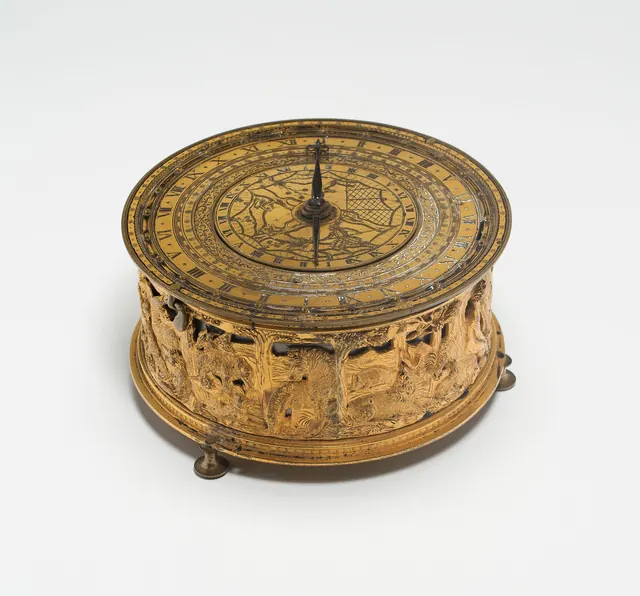
Clocks · c. 1575/1625
Table clock by Germany Augsburg, Germany, c. 1575/1625
Art Institute of Chicago
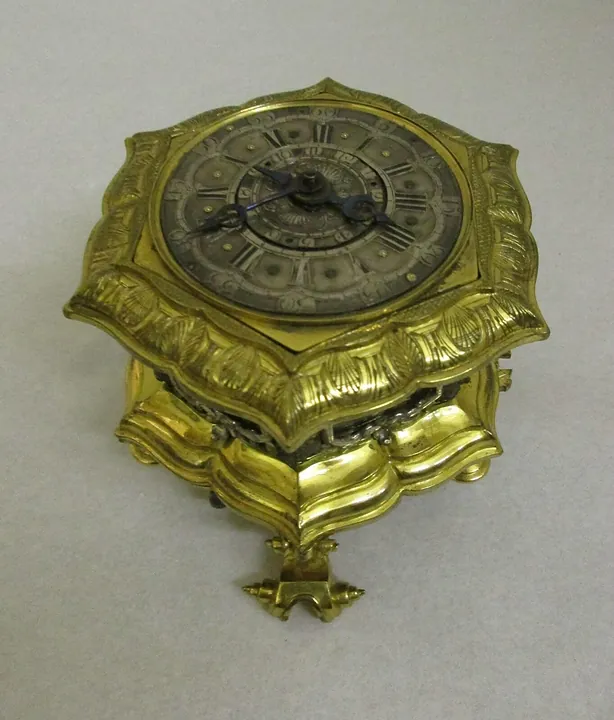
Clocks · 1600–1700
Clock, Germany, 1600–1700
Victoria and Albert Museum, London
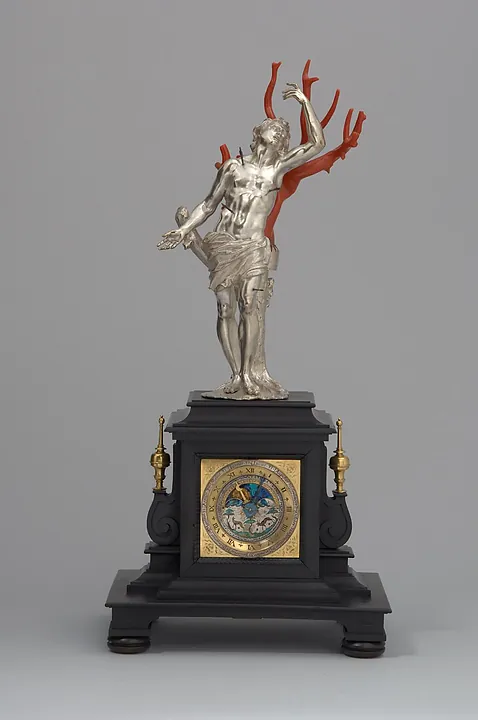
Clocks · 1600–1699
Table clock by Hans Christoph II. Fesenmair, Germany, 1600–1699
Fine Arts Museum Vienna
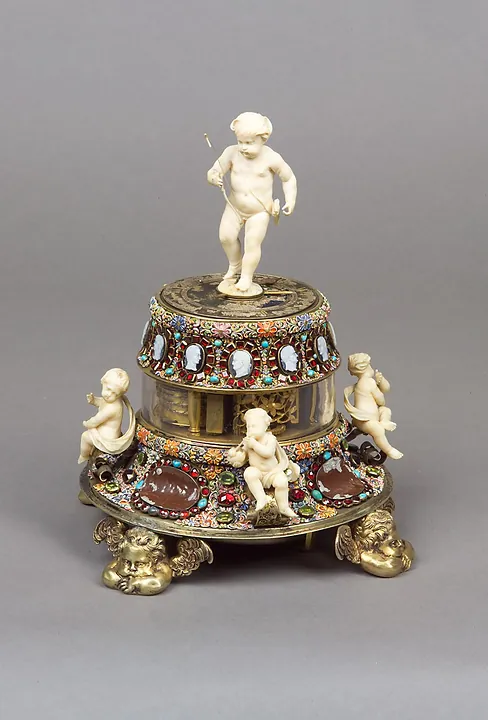
Clocks · 1600–1699
Table clock by Hans Jakob Mair, Germany, 1600–1699
Fine Arts Museum Vienna
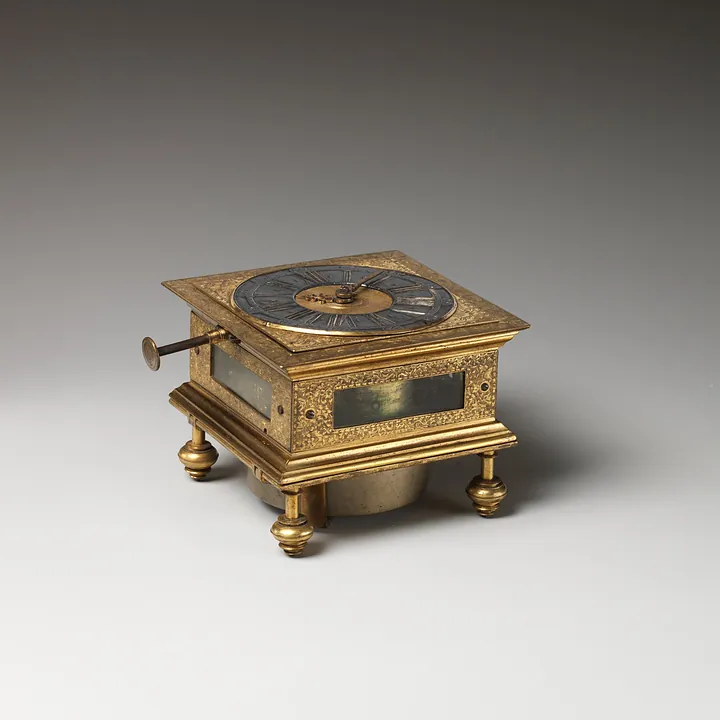
Clocks · 17th century
Table clock by Johann Heinrich Kleinschmidt, Germany, 17th century
The Metropolitan Museum of Art, New York
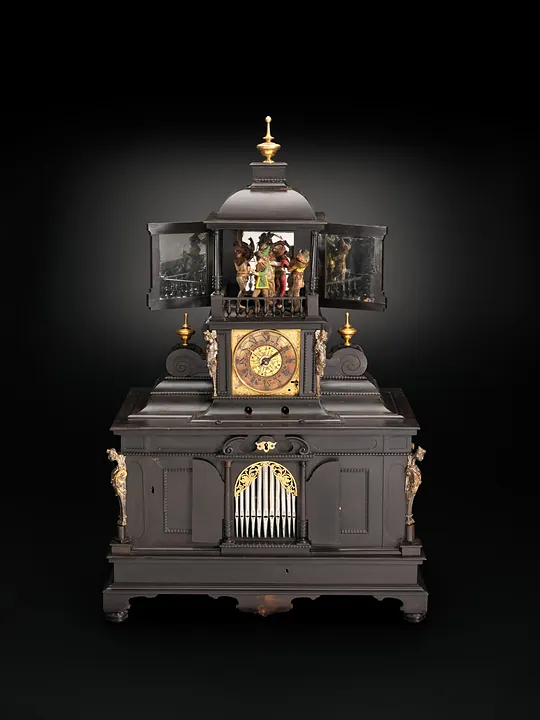
Clocks · c. 1625
Musical clock with spinet and organ by Veit Langenbucher, Germany, c. 1625
The Metropolitan Museum of Art, New York
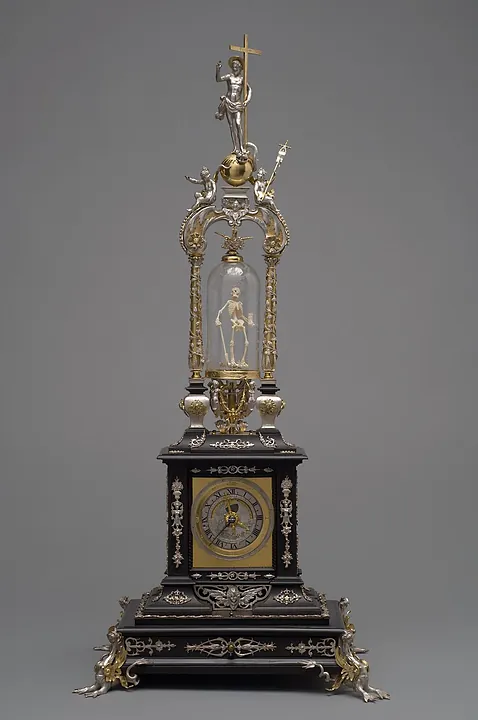
Clocks · 1624–1630
Table clock by Christoph Angermair, Germany, 1624–1630
Fine Arts Museum Vienna
Clocks · 1625–1635
Upright table clock with winding key, by unknown maker, made in Augsburg, Germany, 1625–1635
Science Museum Group, London