
Clocks · Clock
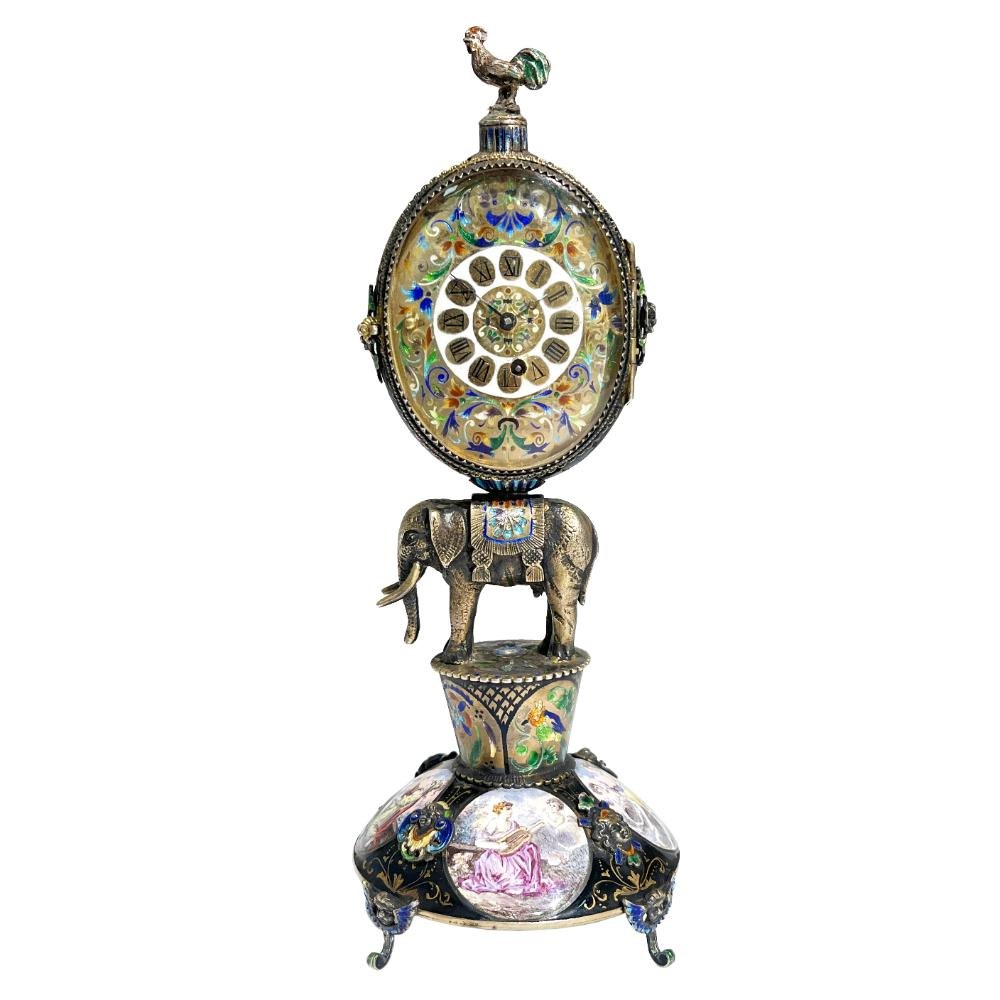
Austrian silver, gilt-bronze and enamel table clock, ca. 1880
- Maker / attribution
- Unrecorded in source
- Date
- c. 1880
- Historical period
- Industrial Revolution (1850 – 1900)
- Country of origin
- Austria
- Object type
- Clock
- Materials / technique
- bronze, enamel, silver, gold, glass
- Auction house
- Invaluable auction listings
- Lot
- Lot E3FFBE3E04
- Credit line
- Auction lot record: lot 628, INTERNATIONAL PAINTING, FURNITURE AND DECORATIVE ARTS, Zorrilla Subastas (2026), via Invaluable
- Catalogue title (original)
- Austrian clock ca. 1880. in silver Reloj austríaco en plata (English)
View the source record (auction lot) ↗ (opens another website in a new tab)Suggest a correction
Record summary
Catalogued by Invaluable auction listings (lot Lot E3FFBE3E04), this is a clock, made in Austria, dated c. 1880. The Atlas places it in the Industrial Revolution period (1850 – 1900) of its Clocks collection. Materials and techniques recorded by the source: bronze, enamel, silver, gold, glass. The record is illustrated with 2 photographs.
Assembled from the source record's structured fields. Dates and attributions are given as the source states them; where a field is missing the Atlas leaves it blank rather than estimating.
Catalogue description
Lot description — Zorrilla Subastas
Austrian table clock ca. 1880. in silver, gold bronze and hand painted polychrome enamel. A fine example of the Viennese goldsmiths of eclectic and historical character. The central medallion, whose back and interior are illustrated by hand-painted oval scenes with & nbsp; allegorical and landscape motifs, is protected by a hinged cap with chiseled glass, with an enamelled dial in the champlevé technique, decorated with polychrome volits and floral motifs, while the hours are indicated in black Roman numbers, housed in small golden medallions. This main body is supported by the sculptural figure of an elephant, which carries on its back a mantilla decorated in enamel and rests on a pedestal again decorated in enamel. The whole set, crowned by the figure of a small rooster, rests on a dome-shaped base arranged on four angel-shaped legs and decorated with four hand-painted circular medallions with allegorical and mythological scenes. The clock machinery was performed by Gregson, Paris, with machine number 11430. Total stop 20 cm. It presents small cascade in dial enamel. & nbsp; Reloj de sobremesa austríaco ca. 1880. en plata, bronce dorado y esmalte policromado pintado a mano. Fino ejemplo de la orfebrería vienesa de carácter ecléctico e historicista. El medallón central, cuyo reverso e interior se ilustran con escenas ovales pintada a mano con motivos alegóricos y paisajísticos, está protegido por una tapa de bisagra con cristal bombé con marco cincelado, presenta un dial esmaltado en la técnica champlevé, decorado con volutas y motivos florales polícromos, mientras las horas están indicadas en números romanos negros, alojados en pequeños medallones dorados. Este cuerpo principal está sostenido por la figura escultórica de un elefante, que lleva sobre su lomo una mantilla decorada en esmalte y se apoya sobre un pedestal nuevamente decorado en esmalte. Todo el conjunto, coronada por la figura de un pequeño gallo, descansa sobre una base en forma de domo dispuesta sobre cuatro patas en forma de ángeles y decorada con cuatro medallones circulares pintados a mano con escenas alegóricas y mitológicas. La maquinaria del reloj fue realizada por Gregson, París, con número de máquina 11430. Altura total 20 cm. Presenta pequeña cascadura en esmalte de esfera.
Historical context
Industrial Revolution (1850 – 1900)
American interchangeable-parts manufacture; railroad time standards; Swiss and German factory systems.
Factory production transformed the clock into an everyday object. American makers (Seth Thomas, Ansonia, Waterbury) and German factories (Junghans, Gustav Becker, Lenzkirch) sold millions of shelf, wall and alarm clocks worldwide; France produced standardised Paris movements and carriage clocks; electric time distribution began.
Read the period in the timelineMore clocks from this periodEarlier: Precision & Scientific Horology
Atlas type guide
Bracket, table and spring-driven clocks
Spring-driven clocks freed timekeeping from the hanging weight. The coiled mainspring, documented from the fifteenth century, made portable table clocks possible; to even out its declining force, makers used the fusee, a conical pulley connected to the barrel by a gut line or chain. Renaissance table clocks from Augsburg and Nuremberg — drum-shaped, square or tower-shaped in gilt brass — were luxury scientific objects, often with astronomical dials and alarms.
After the pendulum, English makers developed the bracket clock: a wooden case with a carrying handle, a short pendulum with a verge escapement, and often repeating work to sound the hours on demand at night. Later examples use the anchor escapement. In the nineteenth century, 'table clock' became a broad term for spring clocks of every nationality.
What to look for
- A fusee in the movement (cone-shaped pulley) and the type of line — gut or chain.
- Verge escapement with a short bob pendulum, often with a decoratively engraved backplate.
- Repeat cords or buttons that make the clock strike again on demand.
- Gilt-brass engraved cases and horizontal dials on Renaissance pieces.
- Case shapes: inverted bell, bell top, break-arch, lancet or balloon.
Dating clues
- Drum and tower table clocks: c. 1520–1650.
- Ebony veneered English bracket clocks with verge escapements: c. 1670–1800.
- Engraved backplates were usual on English clocks until c. 1800, then generally plain.
General guidance written by the Atlas editors about this kind of object. It is not a statement about this particular piece; for that, rely on the source record above and on physical examination.
Related records
Clocks · c. 1867
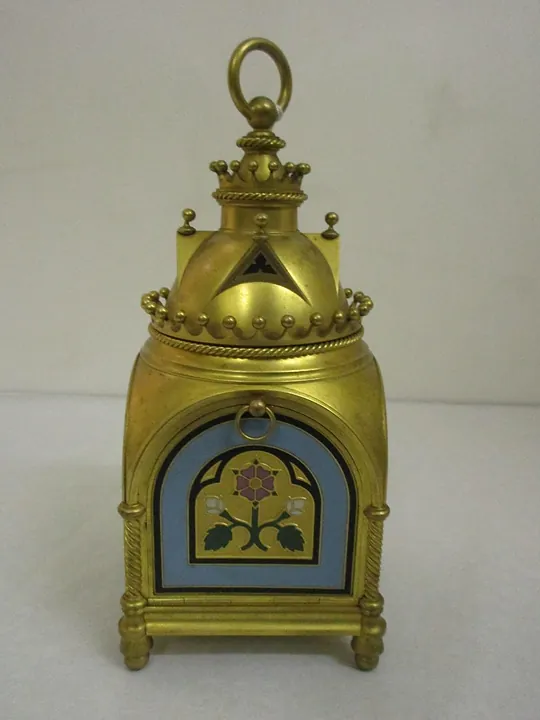
Clock and key, gilt metal with champleve enamel, Dziedzinsky and Hanusch, Austria, c. 1867
Victoria and Albert Museum, London
Clocks · 1864–1874
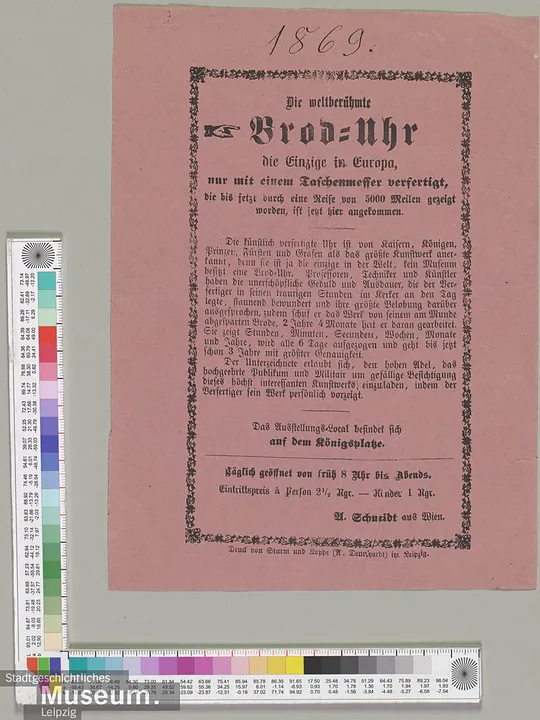
Clock by Sturm und Koppe (A. Dennhardt), Austria, 1864–1874
Museum of City History Leipzig
Clocks · 1899
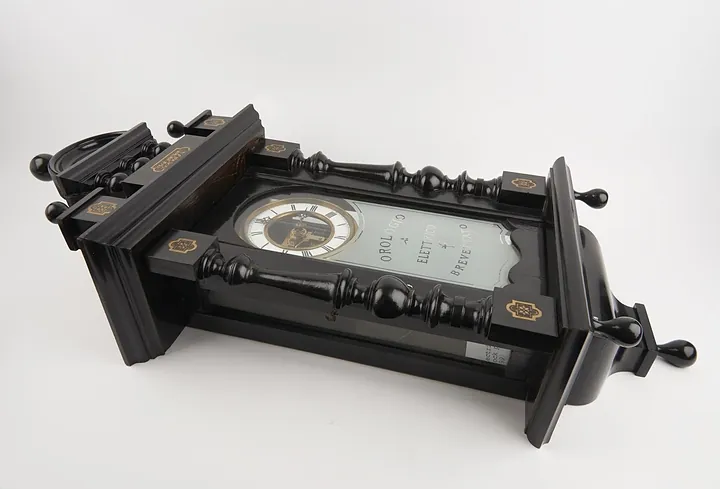
Clock, Austria, 1899
Science Museum Group, London
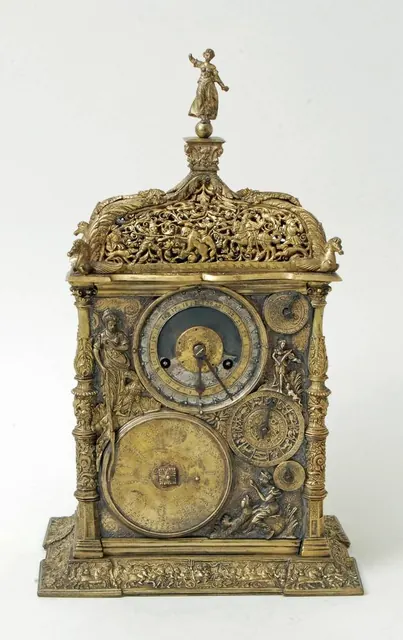
Clocks · 1873, after the original (Augsburg, 1564) in the Kunsthistorisches Museum, Vienna
Copy of Jeremias Metzger's 1564 table clock, Vienna, 1873
Dresden State Art Collections. Museum of Decorative Arts
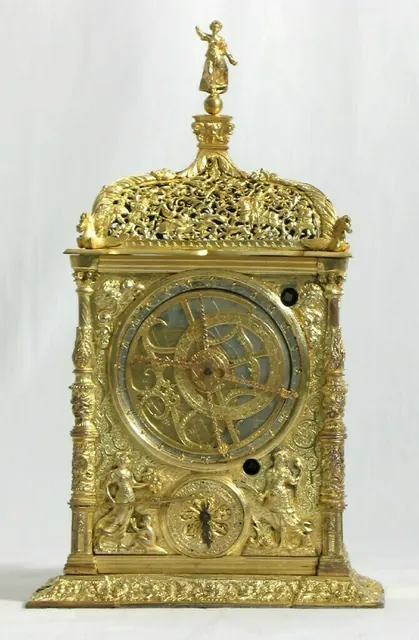
Clocks · 1865–1870
Table clock by Fa. Carl Haas (Wien), Austria, 1865–1870
GRASSI Museum für Angewandte Kunst Leipzig
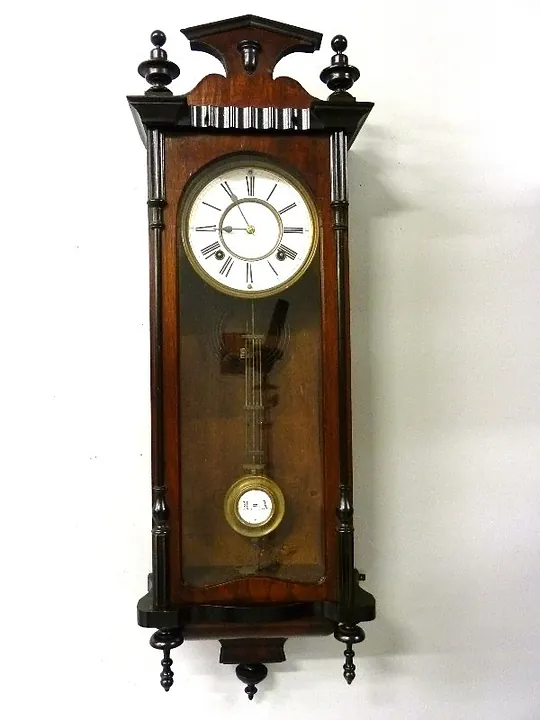
Clocks · c. 1880
Circa 1880's VIENNA (RA) Wall Regulator Signed
LiveAuctioneers auction archive
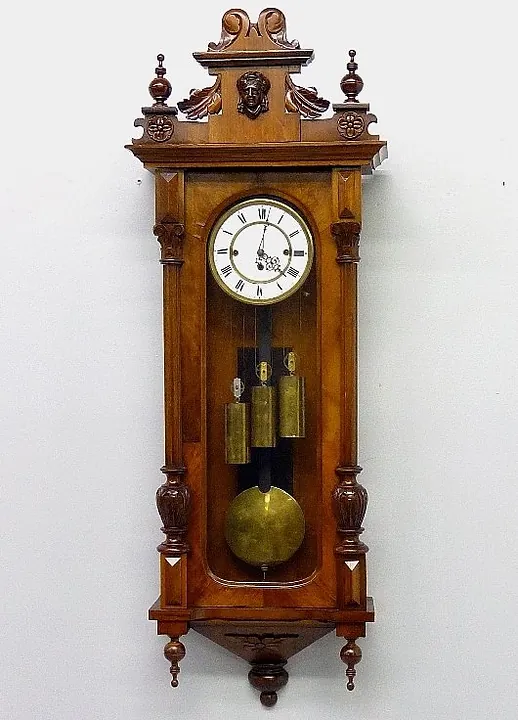
Clocks · c. 1890
Circa 1890 Three Weight Vienna Regulator Signed (VRMC-
LiveAuctioneers auction archive
Clocks · c. 1880
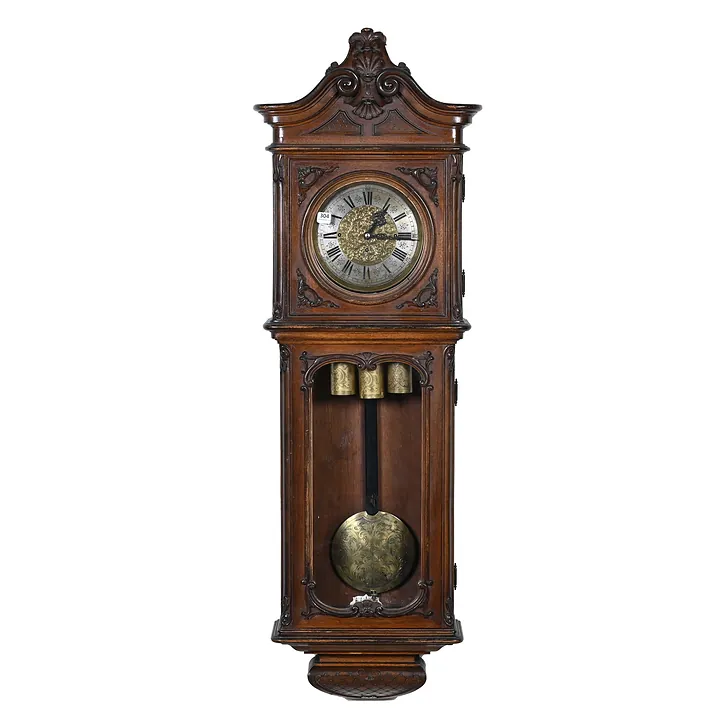
Vienna Regulator Clock, Baroque Style, Three Weight, Original Case Finish, Austrian, circa 1880
LiveAuctioneers auction archive