
Wristwatches · Wristwatch
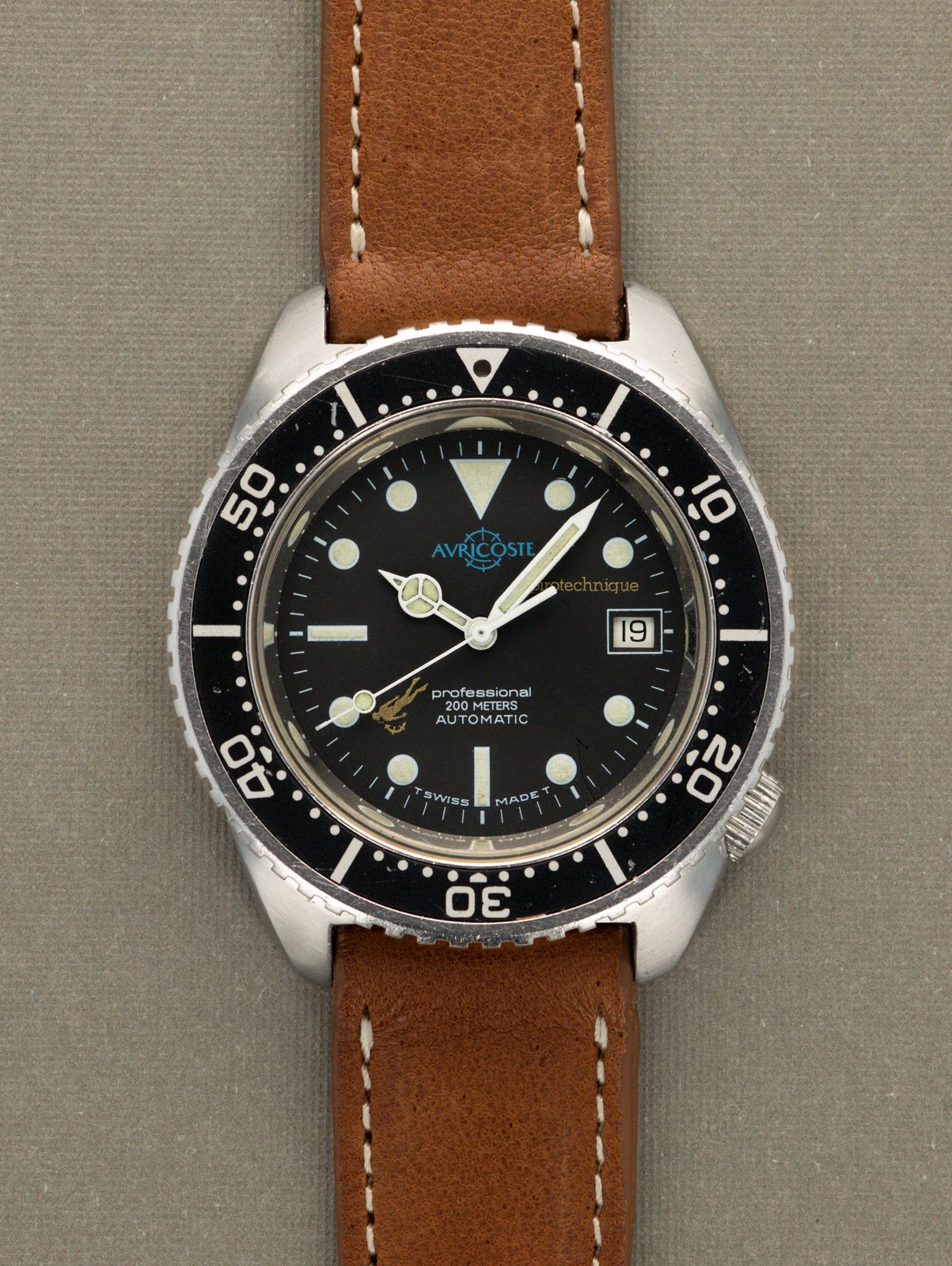
Auricoste Spirotechnique ref. 906.21.05 'M.N.'
- Maker / attribution
- Auricoste (maker)
- Date
- early 1990s
- Historical period
- Mechanical Renaissance (1990 – 2010)
- Country of origin
- Unrecorded in source
- Object type
- Wristwatch
- Dimensions
- Case 41.5 mm
- Stock no.
- OC3309
- Credit line
- Dealer listing, Oliver & Clarke (OC3309)
- Catalogue title (original)
- Auricoste Spirotechnique Ref. 906.21.05 'M.N.' - Matte Black Tritium Dial W/ Decommission Papers (English)
View the source record (dealer listing) ↗ (opens another website in a new tab)Suggest a correction
Record summary
Catalogued by Oliver & Clarke (dealer), United Kingdom (stock number OC3309), this is a wristwatch by Auricoste, dated early 1990s. The Atlas places it in the Mechanical Renaissance period (1990 – 2010) of its Wristwatches collection. Recorded dimensions: Case 41.5 mm. The record is illustrated with 6 photographs.
Assembled from the source record's structured fields. Dates and attributions are given as the source states them; where a field is missing the Atlas leaves it blank rather than estimating.
Catalogue description
Dealer description — Oliver & Clarke
Auricoste was established in France as a manufacturer supplying timepieces to the French Military and Navy, with civilian models produced as a secondary line. As a result, the overwhelming majority of surviving Auricoste watches trace their origins to military contracts. La Spirotechnique, founded in 1947 by Jacques Cousteau and Emile Gagnan, began as the distributor for Cousteau's newly developed Aqua-Lung regulator, and the company built its reputation supplying professional-grade diving equipment to divers worldwide. Beyond civilian markets, Spirotechnique became a key supplier of diving gear, watches included, to the French Navy and Army. Its American operations were established under the name U.S. Divers Company, an entity later rebranded as Aqua Lung. The brand crossover doesn't stop there, however. The piece that we have here utilizes a case design originally utilized by Heuer in their Deep Dive model, but production for Auricoste was contracted out to Zodiac. So, what we've got here is one heck of a compilation of brand stories all rolled into one piece that just happens to have been issued to the French Navy; better known as the Marine Nationale. Dating to the early 1990s, the case is 41.5mm in diameter and is made from stainless steel, with both a screw-down caseback and crown. Thanks to the 4 o'clock position of the crown and being largely recessed within the case, combined with the downward sloping lug design, this piece wears much more like a typical 39-40mm timepiece. The bezel has a uni-directional rotating design and houses a black aluminum insert with individual minute markers. Inside, the dial features vibrant colored text and logos, along with Tritium plots and a high-contrast white-painted handset. Powering this piece is the robust workhorse Calibre 2824-2 by ETA. Last but not least, flip it over and you'll find the appropriate Military engravings denoting that it was property of the French Military. It is also accompanied by its decommission paper dating to 2003. This is a real piece of history — a phrase often repeated in the world of watches, though rarely as deservedly as in this case. And when compared to other military-issued pieces from other brands, particularly other dive watches issued to the Marine Nationale, this actually is fantastic value, and they do not grow on trees!
Historical context
Mechanical Renaissance (1990 – 2010)
Mechanical watches return as cultural objects; independent watchmaking flourishes.
Mechanical watches returned as cultural and luxury objects. Complications, tourbillons and new materials proliferated; independent watchmakers such as George Daniels, F.P. Journe and Philippe Dufour revived artisanal watchmaking; collecting vintage watches became a major field.
Read the period in the timelineMore wristwatches from this periodEarlier: Quartz Revolution
Atlas type guide
Wristwatches
Bracelet watches were worn by women from the early nineteenth century — Breguet made one for Caroline Murat, Queen of Naples, in 1810–12 — but the wristwatch only became a man's instrument with military use and aviation in the early twentieth century. Between the World Wars it overtook the pocket watch; the 1920s and 1930s brought rectangular Art Deco cases, water-resistant cases and the first automatic winding systems.
After 1945 the wristwatch became a carrier of identity — dress watches, sports and dive watches, chronographs, calendars — produced by Swiss, American, Japanese, German, Soviet and Chinese industries. The quartz revolution after 1969 and the mechanical renaissance since the 1990s, including the rise of independent watchmakers, complete the story.
What to look for
- The reference number (between the lugs or inside the case back) and serial number, the starting point for dating.
- The calibre: its maker and number are often stamped under the dial or on the bridge.
- Originality of dial, hands and crown — refinished ('redial') dials are common.
- Case material marks: 18K/750, 14K/585, stainless steel, gold-filled, plated.
Dating clues
- Wire-lug cases: before c. 1925.
- Water-resistant screw-down cases: from 1926.
- Quartz movements: from 1969; sapphire crystals widespread after c. 1980.
General guidance written by the Atlas editors about this kind of object. It is not a statement about this particular piece; for that, rely on the source record above and on physical examination.
Related records
Wristwatches · 1999
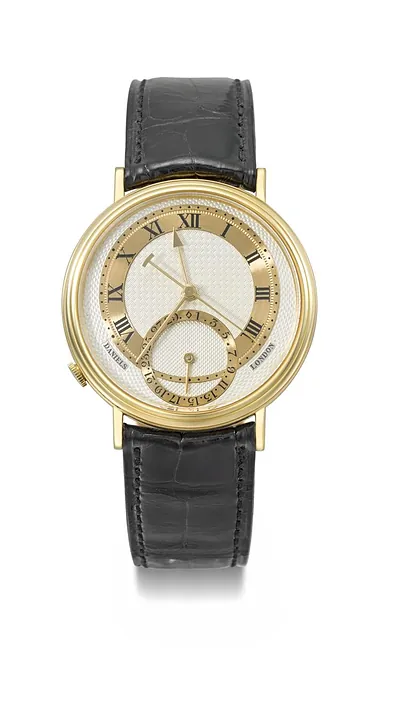
'Millennium' co-axial wristwatch by George Daniels and Omega, England, 1999
Science Museum Group, London

Wristwatches · 2008
Wristwatch by Breitling?, 2008
Museum Rotterdam
Wristwatches · 2008
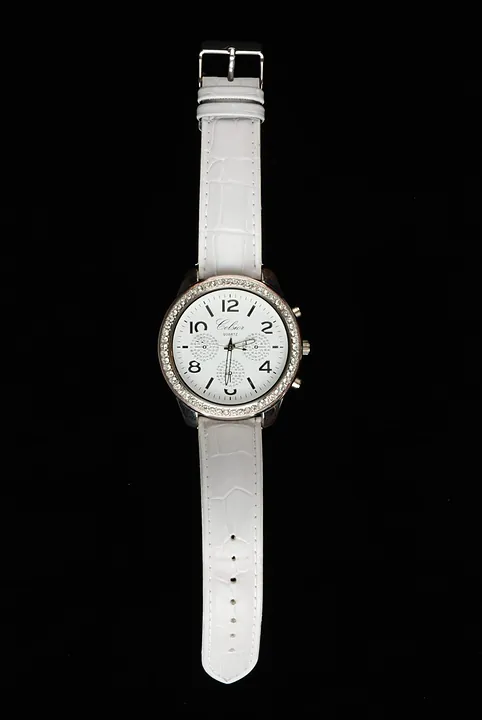
Wristwatch by Celsior Quartz, 2008
Museum Rotterdam
Wristwatches · 2008
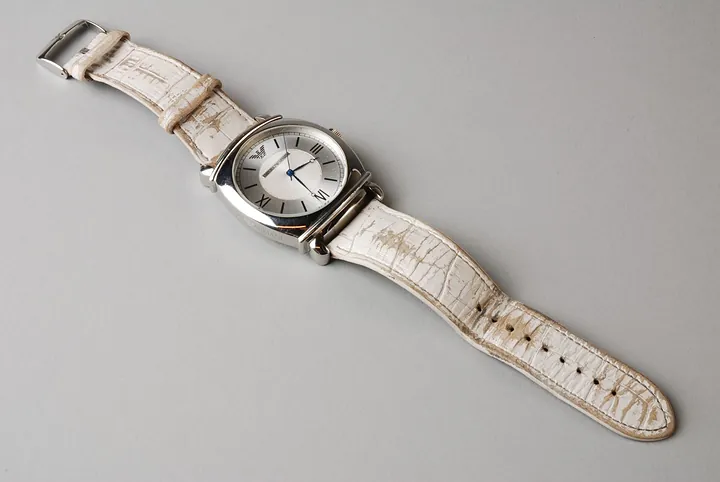
Wristwatch possibly by Emporio Armani, 2008
Museum Rotterdam

Wristwatches · c. 1990s
Audemars Piguet Bamboo, c. 1990s
Antiquorum auction archive, Geneva

Wristwatches · c. 1990
Audemars Piguet Huitieme Perpetual Calendar, ref. 25696PT, c. 1990
Antiquorum auction archive, Geneva

Wristwatches · c. 1990
Breitling Chronomat, ref. b13050.1, c. 1990
Antiquorum auction archive, Geneva
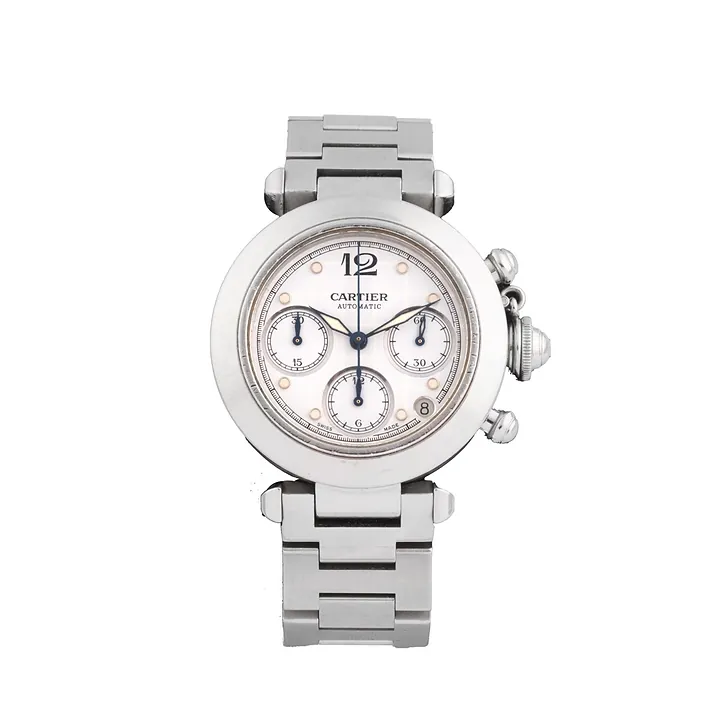
Wristwatches · c. 1990
Cartier Pasha, ref. 2412, c. 1990
Antiquorum auction archive, Geneva