
Wristwatches · Automatic wristwatch
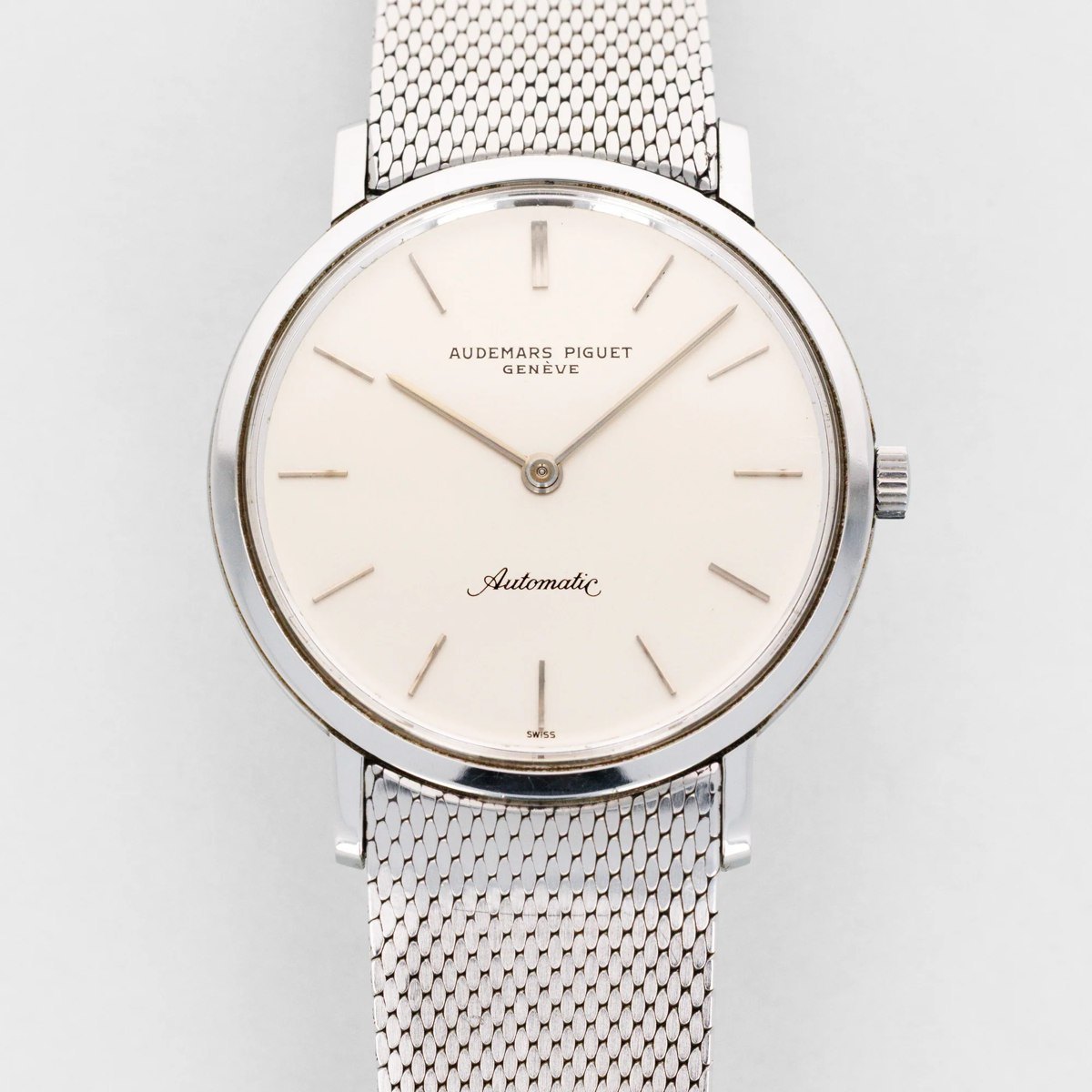
Audemars Piguet Steel Automatic Watch with Caliber 2120 Movement
- Maker / attribution
- Audemars Piguet (source attribution)
- Date
- 1960s
- Historical period
- Modern Mechanical Horology (1945 – 1969)
- Country of origin
- Switzerland
- Object type
- Automatic wristwatch
- Dimensions
- 34 mm
- Holding institution
- The Keystone Watches
- Accession / object no.
- 206976
- Credit line
- The Keystone Watches
- Catalogue title (original)
- Audemars Piguet Vintage Cal. 2120 Steel\n– The Keystone Watches (English)
View the source record ↗ (opens another website in a new tab)Suggest a correction
Record summary
Held and catalogued by The Keystone Watches (object number 206976), this is an automatic wristwatch attributed to Audemars Piguet, made in Switzerland, dated 1960s. The Atlas places it in the Modern Mechanical Horology period (1945 – 1969) of its Wristwatches collection. Recorded dimensions: 34 mm. The record is illustrated with 1 photograph.
Assembled from the source record's structured fields. Dates and attributions are given as the source states them; where a field is missing the Atlas leaves it blank rather than estimating.
Catalogue description
Original object description
Reported to date from the 1960s, this vintage stainless steel Audemars Piguet wristwatch features a 34 mm circular case with straight lugs and a fluted crown at 3 o'clock. It is fitted with an adjustable woven steel mesh bracelet measuring 227 mm with a signed clasp, though internal construction stamps and clasp details are not visually documented. The light silver dial carries slender applied baton indices and central baton hands, alongside the inscriptions "AUDEMARS PIGUET GENÈVE" under 12 o'clock, "Automatic" in cursive above 6 o'clock, and "SWISS" at the dial's bottom edge. The seller states the timepiece is powered by an automatic Caliber 2120 mechanism from the 1960s; however, internal movement images and case serial numbers are absent, and verifying the specific calibre markings and case reference number would necessitate physical examination.
Historical context
Modern Mechanical Horology (1945 – 1969)
Tool watches for divers, pilots and astronauts; electric watches anticipate the electronic age.
The classic era of the mechanical wristwatch: dive watches, chronographs for motor racing and space flight, GMT watches for jet travel, slim dress watches, automatic calendars, and the rise of Japanese manufacturers alongside Swiss, American, German and Soviet industries.
Read the period in the timelineMore wristwatches from this periodEarlier: Golden Age of Mechanical Watchmaking
Atlas type guide
Automatic (self-winding) watches
Self-winding watches use the wearer's motion to wind the mainspring. Abraham-Louis Perrelet and Breguet made 'perpétuelle' pocket watches with oscillating weights in the late eighteenth century, but the principle only became practical in the wristwatch. John Harwood patented a bumper automatic in 1923; Rolex's Perpetual rotor (1931) winding in one direction, and later bidirectional rotors (Eterna, Felsa Bidynator), established the modern form. Micro-rotors (Universal Genève, Buren) and peripheral rotors made automatic watches thinner.
What to look for
- A semicircular rotor turning 360° over the movement, or a 'bumper' weight that rebounds between springs.
- 'Automatic', 'Perpetual' or 'Self-winding' on the dial.
- A sealed screw-back case, since automatic watches are wound less often by the crown.
Dating clues
- Bumper automatics: 1923–c. 1955.
- Full rotors: from 1931 (Rolex); widespread after c. 1950.
- Micro-rotors: from 1954–1958.
General guidance written by the Atlas editors about this kind of object. It is not a statement about this particular piece; for that, rely on the source record above and on physical examination.
Related records

Clocks · c. 1990s
Audemars Piguet Royal Oak, c. 1990s
Antiquorum auction archive, Geneva

Pocket Watches · c. 1960
Audemars Piguet ''couteau'', c. 1960
Antiquorum auction archive, Geneva
Pocket Watches · originally sold in November 1961 (per the lot record)
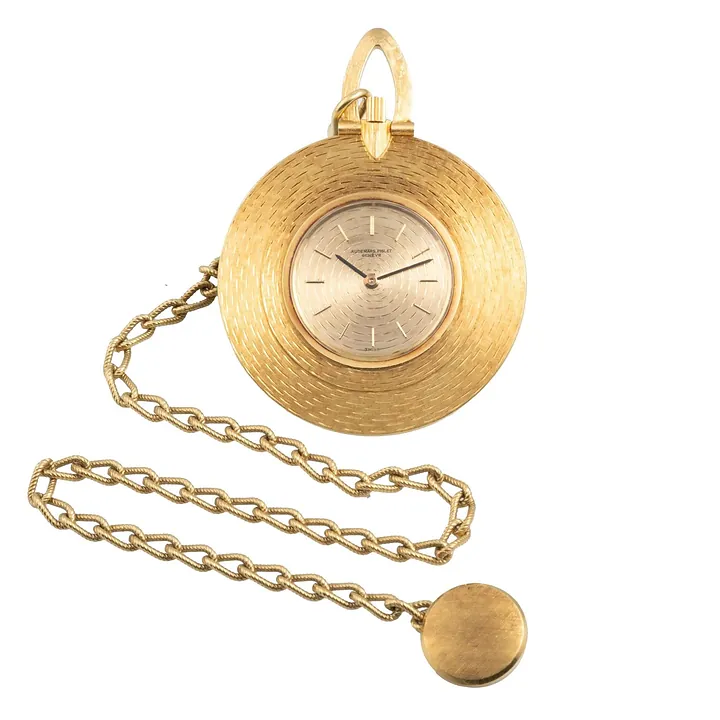
Audemars Piguet "extra Plate", ref. 5633 BA, originally sold in November 1961
Antiquorum auction archive, Geneva

Pocket Watches · c. 1980
Audemars Piguet pocket watch, c. 1980
Antiquorum auction archive, Geneva

Wristwatches · 1945
Wristwatch by Eterna, 1945
Museum Rotterdam

Wristwatches · c. 1945
Breitling Premier, ref. 790, c. 1945
Antiquorum auction archive, Geneva

Wristwatches · c. 1945
Universal Genève Uni-Compax, ref. 22492, c. 1945
Antiquorum auction archive, Geneva

Wristwatches · c. 1950s
Baume & Mercier wristwatch, c. 1950s
Antiquorum auction archive, Geneva