
Wristwatches · Wristwatch
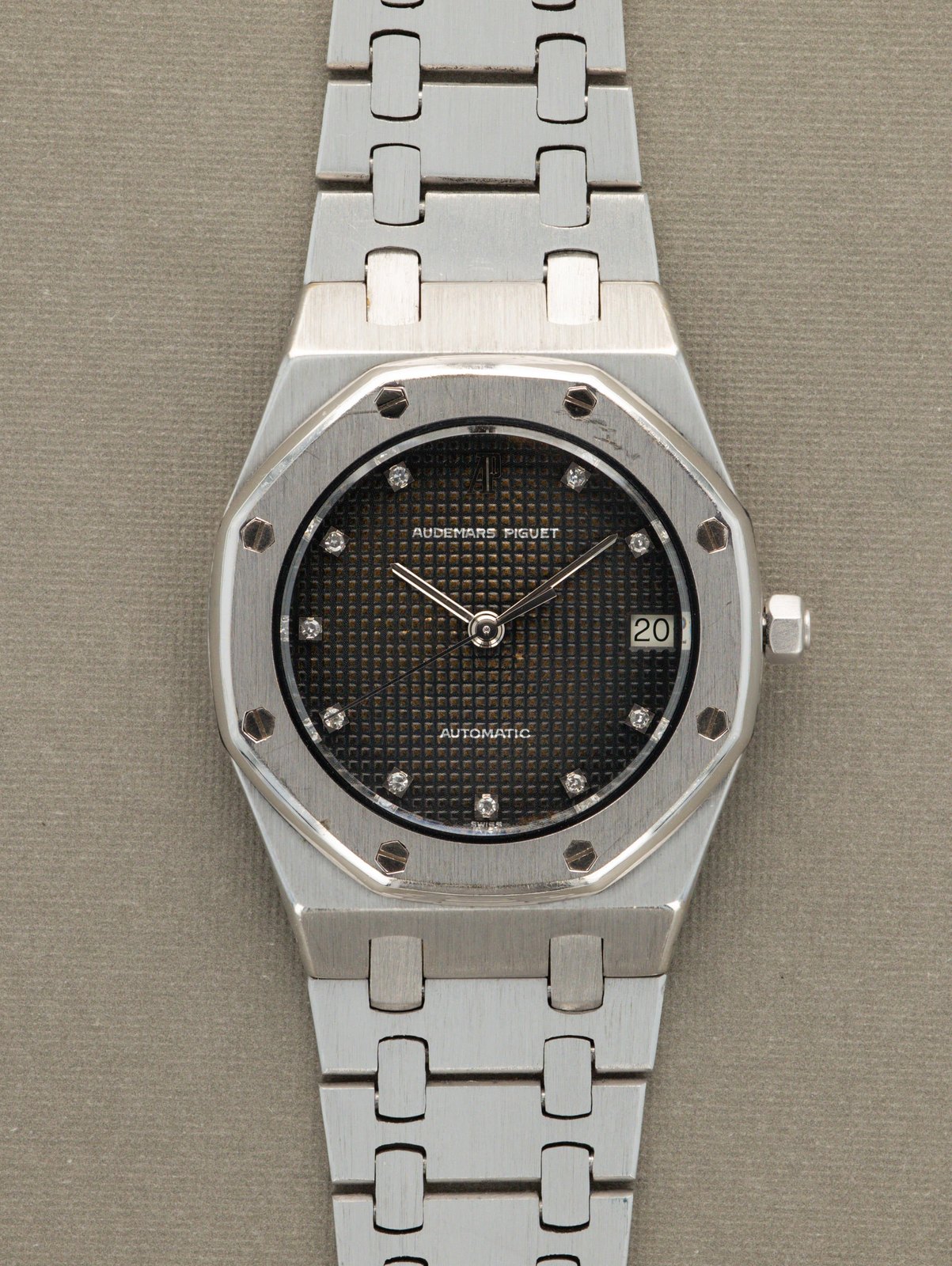
Audemars Piguet Royal Oak ref. 4100BC, 'Midsize' with Tropical Diamond Dial
- Maker / attribution
- Audemars Piguet (maker)
- Date
- c. 1981
- Historical period
- Quartz Revolution (1969 – 1990)
- Country of origin
- Switzerland
- Object type
- Wristwatch
- Dimensions
- Case 35 mm
- Stock no.
- OC2702
- Credit line
- Dealer listing, Oliver & Clarke (OC2702)
- Catalogue title (original)
- Audemars Piguet Royal Oak Ref. 4100BC - 'Midsize' W/ Tropical Diamond Dial (English)
View the source record (dealer listing) ↗ (opens another website in a new tab)Suggest a correction
Record summary
Catalogued by Oliver & Clarke (dealer), United Kingdom (stock number OC2702), this is a wristwatch by Audemars Piguet, made in Switzerland, dated c. 1981. The Atlas places it in the Quartz Revolution period (1969 – 1990) of its Wristwatches collection. Recorded dimensions: Case 35 mm. The record is illustrated with 6 photographs.
Assembled from the source record's structured fields. Dates and attributions are given as the source states them; where a field is missing the Atlas leaves it blank rather than estimating.
Catalogue description
Dealer description — Oliver & Clarke
It’s not unfair to say that Audemars Piguet Royal Oak is one of the most iconic watches ever made. Designed in 1972 by Gerald Genta, the Royal Oak completely changed the way that we look at a steel sports watch. For the first time, stainless steel was treated as a precious metal - receiving complex finishing techniques of brushing, polishing, and beveling - all by hand. The idea that its eight hexagonal bezel screws would be finely finished and left exposed for the wearer to see was a revolutionary thought. It’s no surprise that the model became the calling card for the family owned Audemars Piguet - not to mention one of the most sought after watches in the world. While the initial 5402 was time-only, AP quickly began to capitalize on the success of the Royal Oak and begin to integrate other complications and variations into this case. Which leads us to the Royal Oak that we have here, a 'midsize' Reference 4100BC. These pieces embody the ethos of the original Ref. 5402 'Jumbo' models, just in a slightly smaller and equally svelte 35mm case. In fact, at a glance, the only thing that differentiates it from its larger sibling, is the presence of a running central seconds hand. This particular example, a Reference 4100BC from circa 1981, is something incredibly special and rare. Firstly, rather than the usual stainless steel or yellow gold, this piece is crafter out of white gold — incredibly rare for any Royal Oak to begin with. Second, the dial within features not only factory applied diamond indices, but has also developed a mild 'tropical' patina from age. This is where the brass baseplate of the dial starts to show throughout the grey finishing on the 'micro-tapisserie' textured surface. The resulting patina is largely consistent and even and incredibly attractive. Being a non-luminous dial variant, the hands are a correct white gold 'pencil' set, also without luminous material. The case and matching integrated bracelet are in strong condition, having seen a light but tasteful previous polishing, and show just light signs of wear throughout. The clasp is the original white gold unit with an "AP" signed locking mechanism. The 35mm size lends itself to, we think, a more comfortable wearing experience for more people, in fact, we'd say virtually any wrist, versus the way a full size 39mm Royal Oak which can fit a little odd on some wrists due to how flat it is. These watches strike the perfect balance between the size and value proposition that a Royal Oak can offer. It is believed that the 4100BC shared its numbering with another rare gem-set reference, the 4153BC, totaling 40 units in total with just 20 units of each ever produced. This is a rare bird, full stop.
Historical context
Quartz Revolution (1969 – 1990)
Seiko's Astron begins mass quartz timekeeping; traditional industries contract sharply.
Quartz and digital watches transformed the market after 1969. Swiss employment collapsed, Japanese and Hong Kong production soared, and the Swatch (1983) helped the Swiss industry recover; mechanical watches survived as luxury goods.
Read the period in the timelineMore wristwatches from this periodEarlier: Modern Mechanical Horology
Atlas type guide
Wristwatches
Bracelet watches were worn by women from the early nineteenth century — Breguet made one for Caroline Murat, Queen of Naples, in 1810–12 — but the wristwatch only became a man's instrument with military use and aviation in the early twentieth century. Between the World Wars it overtook the pocket watch; the 1920s and 1930s brought rectangular Art Deco cases, water-resistant cases and the first automatic winding systems.
After 1945 the wristwatch became a carrier of identity — dress watches, sports and dive watches, chronographs, calendars — produced by Swiss, American, Japanese, German, Soviet and Chinese industries. The quartz revolution after 1969 and the mechanical renaissance since the 1990s, including the rise of independent watchmakers, complete the story.
What to look for
- The reference number (between the lugs or inside the case back) and serial number, the starting point for dating.
- The calibre: its maker and number are often stamped under the dial or on the bridge.
- Originality of dial, hands and crown — refinished ('redial') dials are common.
- Case material marks: 18K/750, 14K/585, stainless steel, gold-filled, plated.
Dating clues
- Wire-lug cases: before c. 1925.
- Water-resistant screw-down cases: from 1926.
- Quartz movements: from 1969; sapphire crystals widespread after c. 1980.
General guidance written by the Atlas editors about this kind of object. It is not a statement about this particular piece; for that, rely on the source record above and on physical examination.
Related records
Clocks · c. 1990s
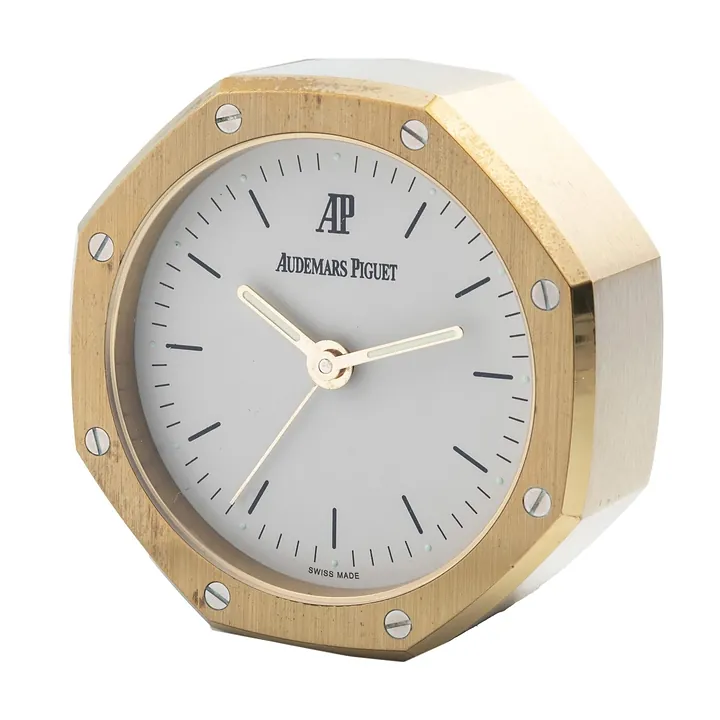
Audemars Piguet Royal Oak, c. 1990s
Antiquorum auction archive, Geneva
Pocket Watches · c. 1960
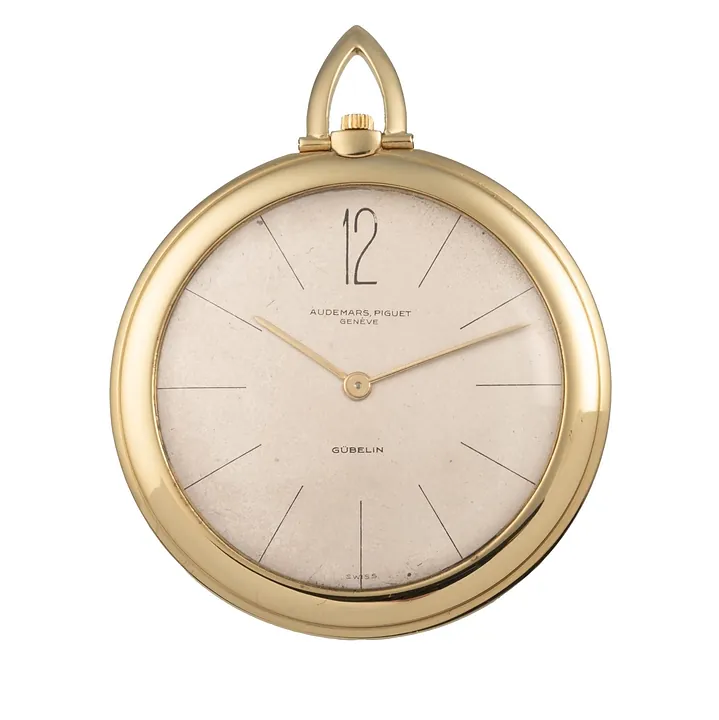
Audemars Piguet ''couteau'', c. 1960
Antiquorum auction archive, Geneva
Pocket Watches · originally sold in November 1961 (per the lot record)
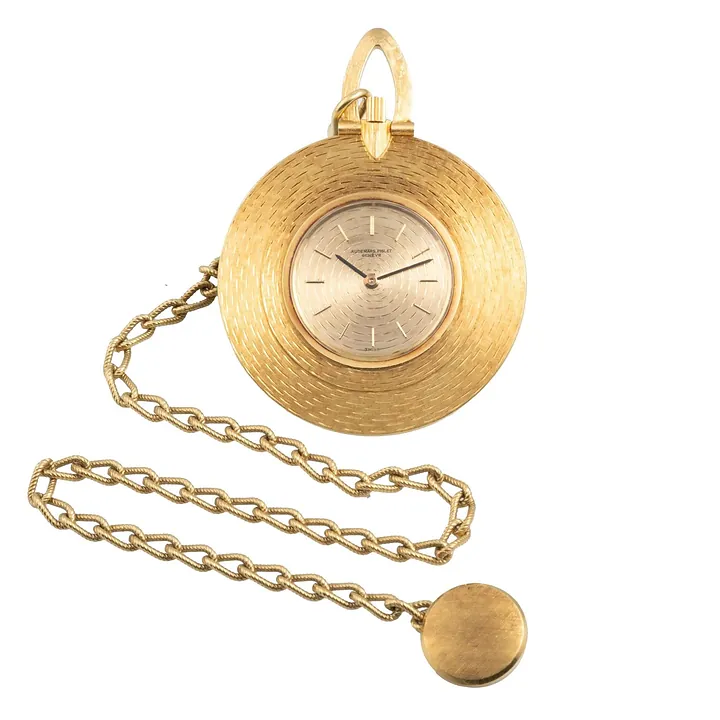
Audemars Piguet "extra Plate", ref. 5633 BA, originally sold in November 1961
Antiquorum auction archive, Geneva
Pocket Watches · c. 1980
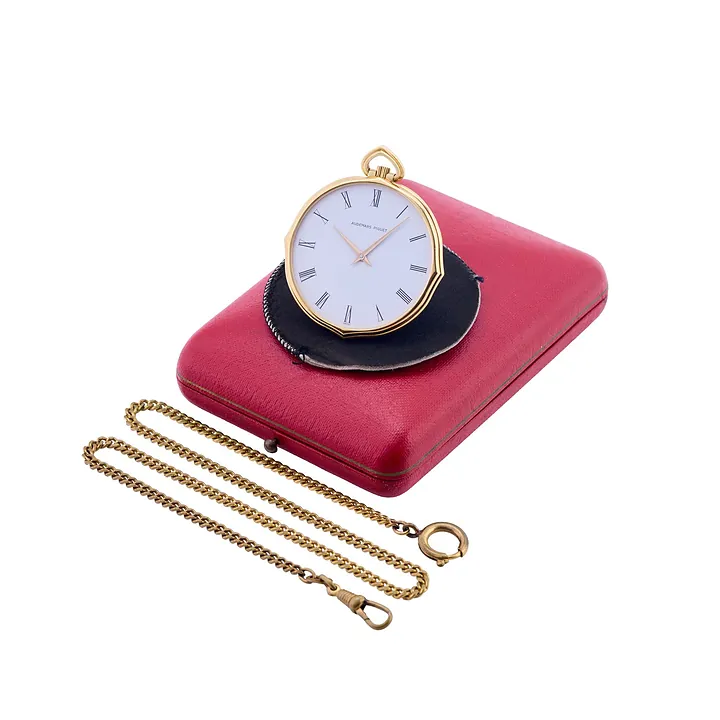
Audemars Piguet pocket watch, c. 1980
Antiquorum auction archive, Geneva

Wristwatches · 1970
Wristwatch by Heno, Switzerland, 1970
Museum Rotterdam

Wristwatches · 1960–1986
'Tri-Compax' calendar chronograph wristwatch in gold case, by Universal, Geneva, Switzerland, 1960–1986.
Science Museum Group, London

Wristwatches · 1969–1970
Beta 21 Quartz wristwatch movement, made in Switzerland, 1970.
Science Museum Group, London

Wristwatches · c. 1969
Omega Speedmaster Moonwatch, ref. 145022-69st, c. 1969
Antiquorum auction archive, Geneva