

Wristwatches · Wristwatch
Audemars Piguet Royal Oak Offshore, c. 2017
- Maker / attribution
- Audemars Piguet (maker)
- Date
- c. 2017
- Historical period
- Contemporary Horology (2010 – Present)
- Country of origin
- Switzerland
- Object type
- Wristwatch
- Dimensions
- Case 44 mm
- Stock no.
- 40990884
- Credit line
- Dealer listing, Analog/Shift (40990884)
- Catalogue title (original)
- Audemars Piguet Royal Oak Offshore (English)
View the source record (dealer listing) ↗ (opens another website in a new tab)Suggest a correction
Record summary
Catalogued by Analog/Shift (dealer), New York (stock number 40990884), this is a wristwatch by Audemars Piguet, made in Switzerland, dated c. 2017. The Atlas places it in the Contemporary Horology period (2010 – Present) of its Wristwatches collection. Recorded dimensions: Case 44 mm. The record is illustrated with 6 photographs.
Assembled from the source record's structured fields. Dates and attributions are given as the source states them; where a field is missing the Atlas leaves it blank rather than estimating.
Catalogue description
Dealer description — Analog/Shift
Audemars Piguet, the vaunted manufacture from Les Brassus, wasn't doing so well at the end of the 1960s. Their horological prowess aside, times were changing, customer tastes were evolving, and AP was stuck firmly in a very traditional past. Fortunately for us, their executives recognized this, and bet it all on the launch of an avant garde timepiece the likes of which the world had never seen. Utilizing the talents of a designer named Gerald Genta, AP planned from the beginning to make this new watch, dubbed the Royal Oak, a contradiction to tradition, and it became the world's first “luxury sports watch” — made in stainless steel, no less. The gamble paid off: Genta became a household name, and the watch world clamored to get its hands on the Royal Oak’s cutting-edge design, which featured a sharply angled watch with integrated bracelet, micro- tapisserie dial, and ultra-thin movement. In 1993, the Royal Oak line expanded to include the Offshore Chronograph, which drove the bulk of sales for AP in the past few decades. Debatably, the Offshore is responsible for carrying AP into the 21st century and ushering it into the powerhouse position in which it exists today. This particular Offshore, a Reference 26400SO, dates to circa 2017 and features a 44mm stainless steel case with a sapphire crystal, a signed crown, a luminous satin silver mega-tapisserie dial with black sub registers and a matching handset, a black ceramic bezel, and Audemars Piguet Calibre 3126/3840 automatic-winding chronograph movement - visible through the sapphire display caseback. It comes fitted to a black rubber strap with a signed stainless steel pin buckle and is accompanied by its full kit. This is a watch that successfully marries haute horlogerie with a tactical aesthetic. Not an easy feat, by any means!
Historical context
Contemporary Horology (2010 – Present)
Silicon components, connected watches, optical-lattice research clocks and a thriving independent scene.
Smartwatches became the world's best-selling watches, while mechanical watchmaking focuses on craft, innovation (silicon components, new escapements) and independent makers.
Read the period in the timelineMore wristwatches from this periodEarlier: Mechanical Renaissance
Atlas type guide
Wristwatches
Bracelet watches were worn by women from the early nineteenth century — Breguet made one for Caroline Murat, Queen of Naples, in 1810–12 — but the wristwatch only became a man's instrument with military use and aviation in the early twentieth century. Between the World Wars it overtook the pocket watch; the 1920s and 1930s brought rectangular Art Deco cases, water-resistant cases and the first automatic winding systems.
After 1945 the wristwatch became a carrier of identity — dress watches, sports and dive watches, chronographs, calendars — produced by Swiss, American, Japanese, German, Soviet and Chinese industries. The quartz revolution after 1969 and the mechanical renaissance since the 1990s, including the rise of independent watchmakers, complete the story.
What to look for
- The reference number (between the lugs or inside the case back) and serial number, the starting point for dating.
- The calibre: its maker and number are often stamped under the dial or on the bridge.
- Originality of dial, hands and crown — refinished ('redial') dials are common.
- Case material marks: 18K/750, 14K/585, stainless steel, gold-filled, plated.
Dating clues
- Wire-lug cases: before c. 1925.
- Water-resistant screw-down cases: from 1926.
- Quartz movements: from 1969; sapphire crystals widespread after c. 1980.
General guidance written by the Atlas editors about this kind of object. It is not a statement about this particular piece; for that, rely on the source record above and on physical examination.
Related records
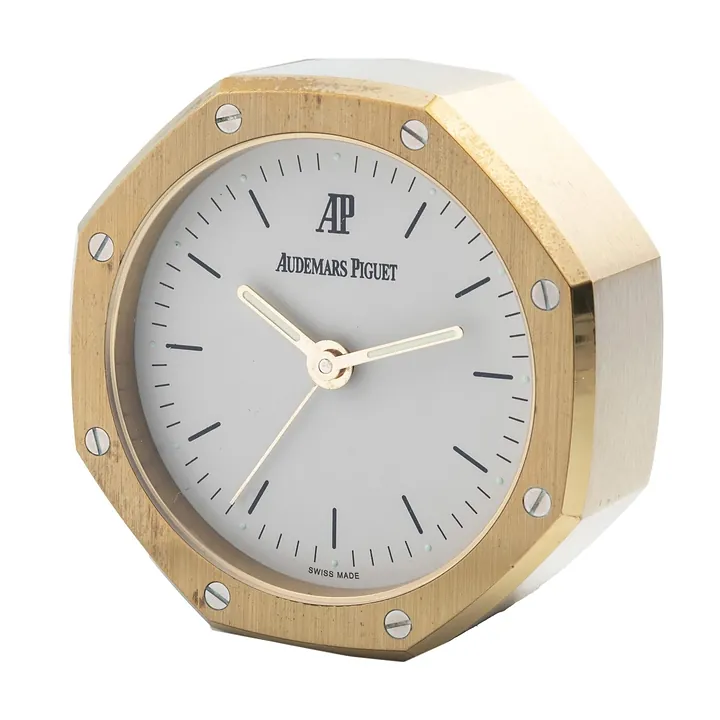
Clocks · c. 1990s
Audemars Piguet Royal Oak, c. 1990s
Antiquorum auction archive, Geneva
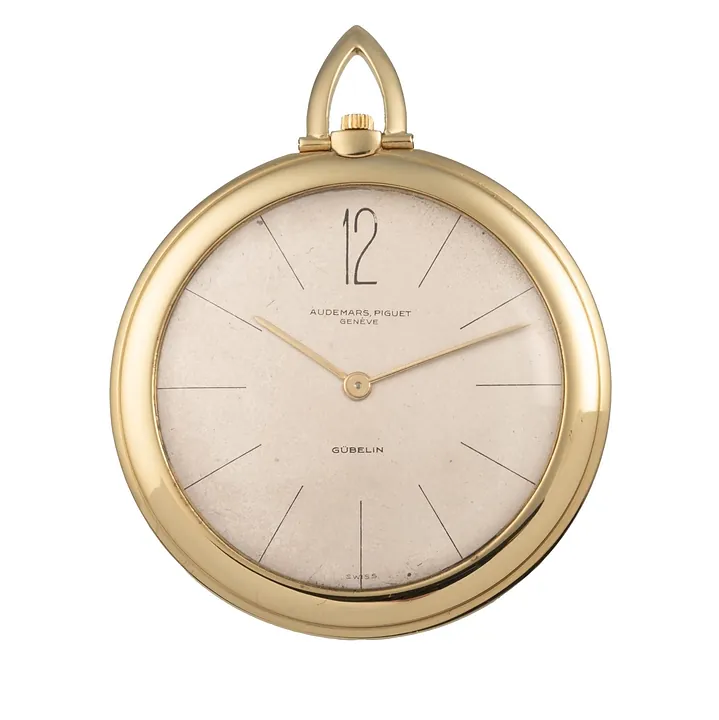
Pocket Watches · c. 1960
Audemars Piguet ''couteau'', c. 1960
Antiquorum auction archive, Geneva
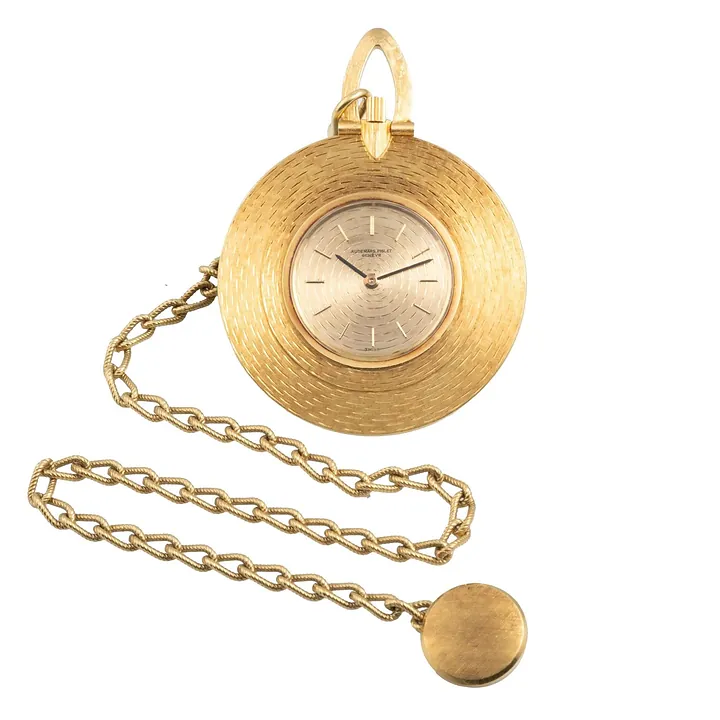
Pocket Watches · originally sold in November 1961 (per the lot record)
Audemars Piguet "extra Plate", ref. 5633 BA, originally sold in November 1961
Antiquorum auction archive, Geneva
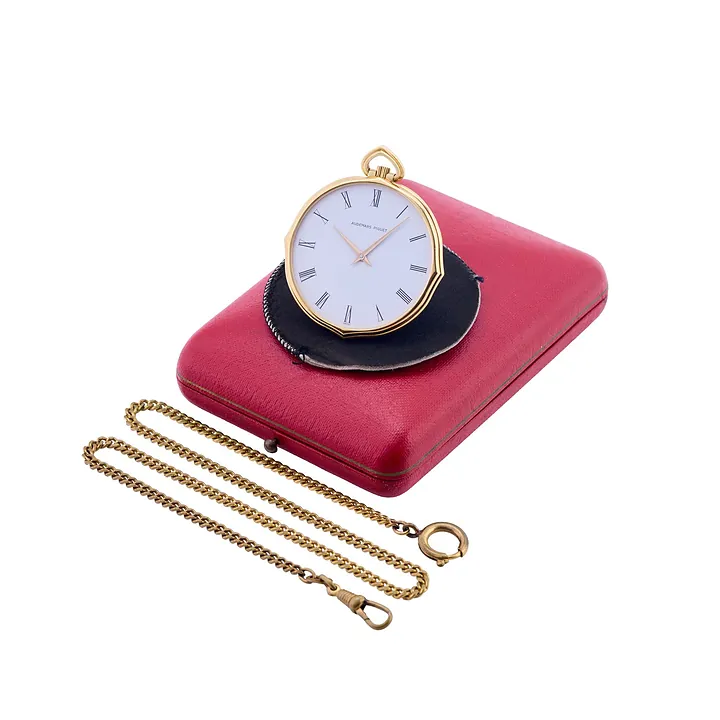
Pocket Watches · c. 1980
Audemars Piguet pocket watch, c. 1980
Antiquorum auction archive, Geneva

Wristwatches · c. 2010s
Breguet Type XXI, ref. 3810, c. 2010s (Antiquorum Lot 381-24)
Antiquorum auction archive, Geneva

Wristwatches · c. 2010s
Breguet Type XXI, ref. 3810, c. 2010s (Antiquorum Lot 386-229)
Antiquorum auction archive, Geneva

Wristwatches · Sold in September 2010
Breitling Cosmonaute, ref. A 22322, Sold in September 2010
Antiquorum auction archive, Geneva

Wristwatches · c. 2010
Corum Bubble Chrono, ref. 396.150.20, c. 2010
Antiquorum auction archive, Geneva