
Wristwatches · Wristwatch
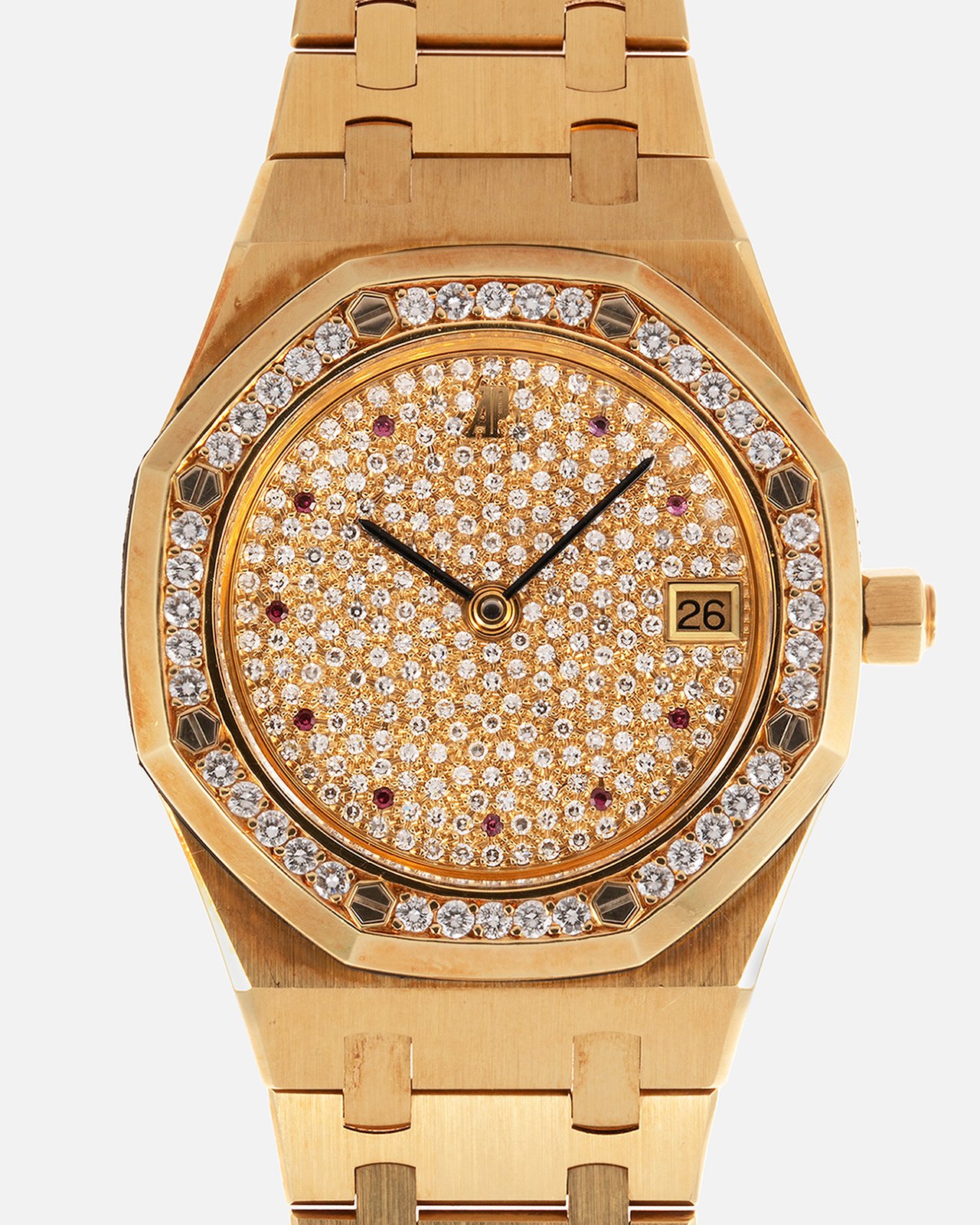
Audemars Piguet Royal Oak 14813BA Rubies, 1990s
- Maker / attribution
- Audemars Piguet (maker)
- Date
- 1990s
- Historical period
- Mechanical Renaissance (1990 – 2010)
- Country of origin
- Switzerland
- Object type
- Wristwatch
- Dimensions
- Case 36 mm
- Stock no.
- Product 6875175747671
- Credit line
- Dealer listing, S.Song Watches (product 6875175747671)
- Catalogue title (original)
- Audemars Piguet Royal Oak 14813BA Rubies (English)
View the source record (dealer listing) ↗ (opens another website in a new tab)Suggest a correction
Record summary
Catalogued by S.Song Watches (dealer), Seattle (stock number Product 6875175747671), this is a wristwatch by Audemars Piguet, made in Switzerland, dated 1990s. The Atlas places it in the Mechanical Renaissance period (1990 – 2010) of its Wristwatches collection. Recorded dimensions: Case 36 mm. The record is illustrated with 6 photographs.
Assembled from the source record's structured fields. Dates and attributions are given as the source states them; where a field is missing the Atlas leaves it blank rather than estimating.
Catalogue description
Dealer description — S.Song Watches
The Royal Oak, with its masculine octagonal case, exposed screws, and integrated bracelet is one of the most distinctive watches in the market today. It is imposing and recognizable, and in my opinion, one of the best statement watches money can buy. On top of this, with the current craze for integrated bracelet sports watches and many brands producing their own version, it was the Royal Oak that started it all. While it has always been about the ‘Jumbo’ or larger-sized Royal Oaks, in recent times, there has been a growing appreciation for mid-sized examples, which is the Ref. 14790. This is certainly in line with the large watch trend ending as collectors are beginning to appreciate proportionate and more elegantly sized watches. Since the reference’s introduction in the late 1980s, Audemars Piguet had designated the Ref. 14790 as a canvas to experiment with different metal combinations and dial designs, in order to appeal to a wider audience at the time. What we have on offer here today isn’t exactly the Ref. 14790, but rather, a derivative from the reference, and an exotic one at that. This is the Audemars Piguet Royal Oak Ref. 14813BA “Rubies” with a gorgeous factory-set pave diamond dial and bezel. According to Audemars Piguet, the Ref. 14813 was actually made with 12 different dial variants, the most common being the version made with lapis lazuli. Ultimately, this is a reference that you don’t usually see out in the wild, I can guarantee you that much. With this Ref. 14813BA, you will find a diamond-studded dial that is tastefully decorated (factory-set) with pave diamonds with 11 contrasting rubies as hour markers to mark the passage of time. It also features a contrasting set of hands for legibility, a date window aperture at the 3 o ‘clock position, and a very discreet “AP” logo applied at 12 o ‘clock. Additionally, its iconic porthole-inspired bezel with 8 screws is bedazzled with 40 more diamonds. As far as proportions go, it shares all the hallmarks of the Ref. 14790 in terms of its modest 36mm case diameter, as well as a 36-jeweled Cal. 2225 movement, which was derived from Jaeger LeCoultre’s Cal. 889. While I am not exactly a fan of diamond timepieces (read: “iced-out” pieces) in general, there is something about this particular Ref. 14813BA which still manages to make my heart flutter. If I had to put a finger on it, it is most probably due to the masterful overall balance of the design elements here that makes the Ref. 14813BA a glamorous yet tasteful diamond timepiece. It is opulent in appearance but not overdone, and coupled with an understated case size, you have a winning formula that is the Ref. 14813BA. If brands that offer diamond-set pieces follow the formula set down here by Audemars Piguet, I might actually develop a taste for such timepieces. The Ref. 14813BA is probably a reference not many collectors are used to seeing in the secondary market due to its rarity and its uncommon dial configuration, but that is exactly what makes this Ref. 14813BA so special. If you are a collector who has a palate for timepieces with factory-set diamonds and a classic aesthetic (and also, great taste), I suggest you take a closer look at this attractive-looking Ref. 14813BA.
Historical context
Mechanical Renaissance (1990 – 2010)
Mechanical watches return as cultural objects; independent watchmaking flourishes.
Mechanical watches returned as cultural and luxury objects. Complications, tourbillons and new materials proliferated; independent watchmakers such as George Daniels, F.P. Journe and Philippe Dufour revived artisanal watchmaking; collecting vintage watches became a major field.
Read the period in the timelineMore wristwatches from this periodEarlier: Quartz Revolution
Atlas type guide
Wristwatches
Bracelet watches were worn by women from the early nineteenth century — Breguet made one for Caroline Murat, Queen of Naples, in 1810–12 — but the wristwatch only became a man's instrument with military use and aviation in the early twentieth century. Between the World Wars it overtook the pocket watch; the 1920s and 1930s brought rectangular Art Deco cases, water-resistant cases and the first automatic winding systems.
After 1945 the wristwatch became a carrier of identity — dress watches, sports and dive watches, chronographs, calendars — produced by Swiss, American, Japanese, German, Soviet and Chinese industries. The quartz revolution after 1969 and the mechanical renaissance since the 1990s, including the rise of independent watchmakers, complete the story.
What to look for
- The reference number (between the lugs or inside the case back) and serial number, the starting point for dating.
- The calibre: its maker and number are often stamped under the dial or on the bridge.
- Originality of dial, hands and crown — refinished ('redial') dials are common.
- Case material marks: 18K/750, 14K/585, stainless steel, gold-filled, plated.
Dating clues
- Wire-lug cases: before c. 1925.
- Water-resistant screw-down cases: from 1926.
- Quartz movements: from 1969; sapphire crystals widespread after c. 1980.
General guidance written by the Atlas editors about this kind of object. It is not a statement about this particular piece; for that, rely on the source record above and on physical examination.
Related records

Clocks · c. 1990s
Audemars Piguet Royal Oak, c. 1990s
Antiquorum auction archive, Geneva

Pocket Watches · c. 1960
Audemars Piguet ''couteau'', c. 1960
Antiquorum auction archive, Geneva
Pocket Watches · originally sold in November 1961 (per the lot record)
Audemars Piguet "extra Plate", ref. 5633 BA, originally sold in November 1961
Antiquorum auction archive, Geneva

Pocket Watches · c. 1980
Audemars Piguet pocket watch, c. 1980
Antiquorum auction archive, Geneva

Wristwatches · 2008
Wristwatch by Breitling?, 2008
Museum Rotterdam

Wristwatches · c. 1990s
Audemars Piguet Bamboo, c. 1990s
Antiquorum auction archive, Geneva

Wristwatches · c. 1990
Audemars Piguet Huitieme Perpetual Calendar, ref. 25696PT, c. 1990
Antiquorum auction archive, Geneva

Wristwatches · c. 1990
Breitling Chronomat, ref. b13050.1, c. 1990
Antiquorum auction archive, Geneva