
Wristwatches · Wristwatch
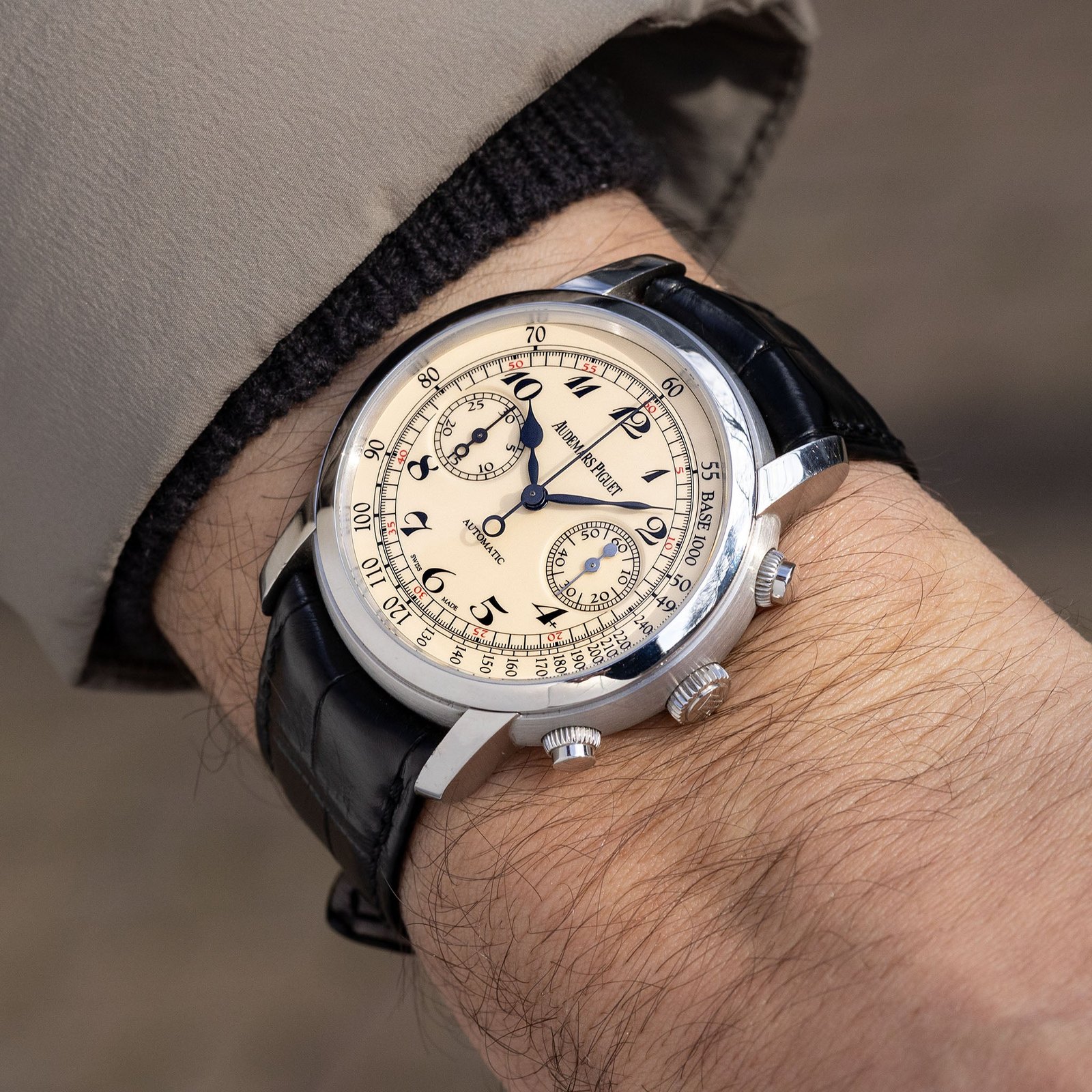
Audemars Piguet Jules Audemars Chronograph in 18k White Gold Cream Dial with Original Warranty and Register Booklet ref. 26100BC, c. 2012
- Maker / attribution
- Audemars Piguet (maker)
- Date
- c. 2012
- Historical period
- Contemporary Horology (2010 – Present)
- Country of origin
- Switzerland
- Object type
- Wristwatch
- Materials / technique
- 18k white gold
- Dimensions
- Case 41 mm
- Stock no.
- W-3551
- Credit line
- Dealer listing, Bulang & Sons (W-3551)
- Catalogue title (original)
- Audemars Piguet Jules Audemars Chronograph in 18k White Gold Cream Dial with Original Warranty and Register Booklet ref. 26100BC (English)
View the source record (dealer listing) ↗ (opens another website in a new tab)Suggest a correction
Record summary
Catalogued by Bulang & Sons (dealer), Copenhagen (stock number W-3551), this is a wristwatch by Audemars Piguet, made in Switzerland, dated c. 2012. The Atlas places it in the Contemporary Horology period (2010 – Present) of its Wristwatches collection. Materials and techniques recorded by the source: 18k white gold. Recorded dimensions: Case 41 mm. The record is illustrated with 6 photographs.
Assembled from the source record's structured fields. Dates and attributions are given as the source states them; where a field is missing the Atlas leaves it blank rather than estimating.
Catalogue description
Dealer description — Bulang & Sons
This handsome chronograph series was introduced in the Jules Audemars collection in 2008, featuring the first automatic-wound calibre in the line and paying homage to one of the company’s founders, Jules Louis Audemars. This specimen features a satin-brushed 18k white-gold case measuring 41 mm, with elegant pushers and a display case back. We particularly adore this eggshell—or better yet, cream-coloured—dial, which carries distinct Art Deco details, such as the font used on the base-1000 outer scale and the romantic glossy black Arabic numerals. Other notable details include the two recessed sub-dials, with a glossy black chronograph hand on the left counter and a polished metal hand on the right. Speaking of hands: they are blackened, with a spade-shaped hour hand and a minute hand that is reminiscent of a spear. A small splash of red on the minute track gives the dial a subtle touch of visual “pop”! Another show-stopper is visible on the back of the watch, where you have a clear view of the calibre 3124, complete with a beautifully crafted gold rotor engraved and decorated with various elements—more lively detailing from AP. This watch should be a real contender if you are looking for an understated, beautiful, and currently somewhat undervalued luxury chronograph—get in touch! Specifications: Audemars Piguet Jules Audemars chronograph reference 26100BC 41 mm 18k white gold case with display case back Case number H93xxx, dating to circa 2012 Cream dial with dual chrono registers, black painted Breguet numerals and black hands Automatic wound caliber 3124 with decorated gold rotor Comes on the pictured Audemars ' leather strap with 18 k white gold folding clasp Fully serviced by our watchmaker
Historical context
Contemporary Horology (2010 – Present)
Silicon components, connected watches, optical-lattice research clocks and a thriving independent scene.
Smartwatches became the world's best-selling watches, while mechanical watchmaking focuses on craft, innovation (silicon components, new escapements) and independent makers.
Read the period in the timelineMore wristwatches from this periodEarlier: Mechanical Renaissance
Atlas type guide
Chronographs and split-seconds watches
A chronograph is a watch with an additional seconds hand that can be started, stopped and returned to zero independently of the timekeeping. Louis Moinet built an early example in 1816 and Nicolas Rieussec a recording 'chronographe' in 1821; Adolphe Nicole's heart-shaped reset cam (patented 1862) made the modern return-to-zero possible. Split-seconds (rattrapante) chronographs add a second hand that can be stopped for intermediate times; flyback chronographs restart instantly.
Chronographs were essential tools for doctors (pulsometer scales), artillery (telemeter), engineers and sport. In wristwatches, Valjoux, Venus, Lemania and later the automatic chronographs of 1969 (Zenith El Primero, the Chronomatic Calibre 11 group and Seiko 6139) are milestones.
What to look for
- Push-pieces on the case band or a single button in the crown (monopusher).
- Subsidiary registers for minutes and hours; tachymeter, telemeter or pulsometer scales.
- Column wheel versus cam control visible in the movement.
- Calibre markings of specialist makers (Valjoux, Lemania, Venus, Landeron).
Dating clues
- Pocket chronographs with heart cam reset: after 1862.
- Wrist chronographs: from c. 1910; two-button designs from the 1930s.
- Automatic chronographs: from 1969.
General guidance written by the Atlas editors about this kind of object. It is not a statement about this particular piece; for that, rely on the source record above and on physical examination.
Read next:Flyback chronographChronograph
Related records

Clocks · c. 1990s
Audemars Piguet Royal Oak, c. 1990s
Antiquorum auction archive, Geneva

Pocket Watches · c. 1960
Audemars Piguet ''couteau'', c. 1960
Antiquorum auction archive, Geneva
Pocket Watches · originally sold in November 1961 (per the lot record)
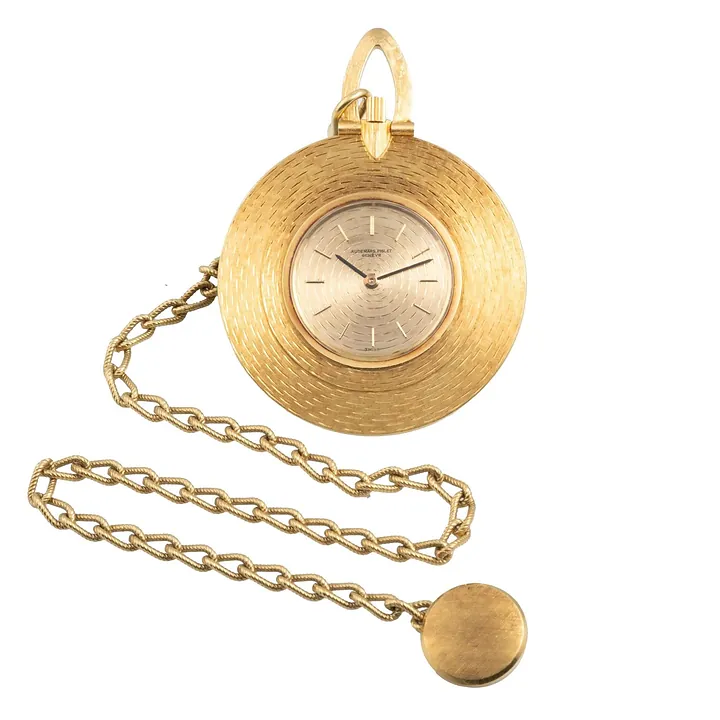
Audemars Piguet "extra Plate", ref. 5633 BA, originally sold in November 1961
Antiquorum auction archive, Geneva

Pocket Watches · c. 1980
Audemars Piguet pocket watch, c. 1980
Antiquorum auction archive, Geneva

Wristwatches · c. 2010s
Breguet Type XXI, ref. 3810, c. 2010s (Antiquorum Lot 381-24)
Antiquorum auction archive, Geneva

Wristwatches · c. 2010s
Breguet Type XXI, ref. 3810, c. 2010s (Antiquorum Lot 386-229)
Antiquorum auction archive, Geneva

Wristwatches · Sold in September 2010
Breitling Cosmonaute, ref. A 22322, Sold in September 2010
Antiquorum auction archive, Geneva

Wristwatches · c. 2010
Corum Bubble Chrono, ref. 396.150.20, c. 2010
Antiquorum auction archive, Geneva