
Wristwatches · Wristwatch
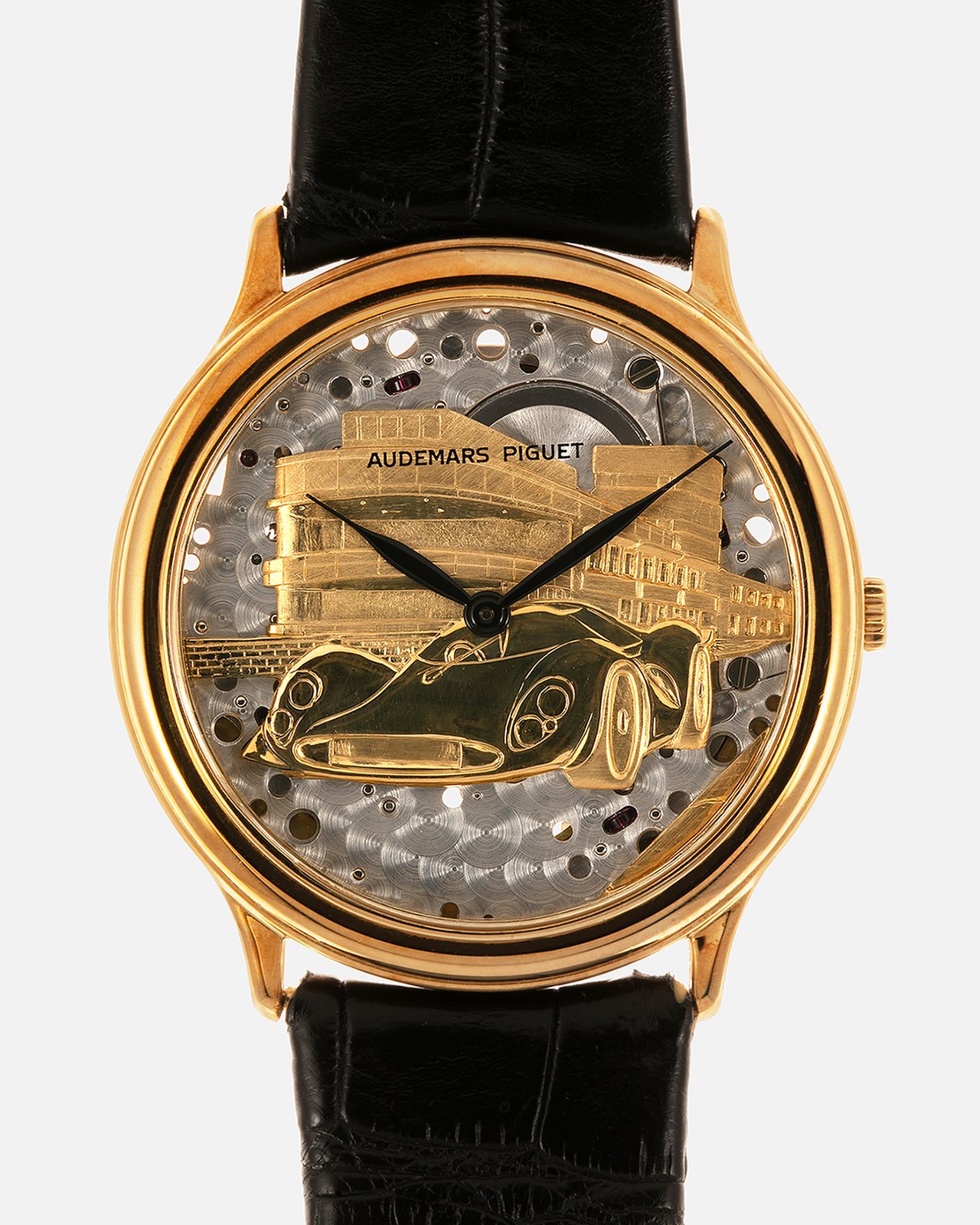
Audemars Piguet 14677BA Le Mans Ferrari 330 P4 Skeletonised, 1980s
- Maker / attribution
- Audemars Piguet (maker)
- Date
- 1980s
- Historical period
- Quartz Revolution (1969 – 1990)
- Country of origin
- Switzerland
- Object type
- Wristwatch
- Dimensions
- Case 34 mm
- Stock no.
- Product 7363235676247
- Credit line
- Dealer listing, S.Song Watches (product 7363235676247)
- Catalogue title (original)
- Audemars Piguet 14677BA Le Mans Ferrari 330 P4 Skeletonised (English)
View the source record (dealer listing) ↗ (opens another website in a new tab)Suggest a correction
Record summary
Catalogued by S.Song Watches (dealer), Seattle (stock number Product 7363235676247), this is a wristwatch by Audemars Piguet, made in Switzerland, dated 1980s. The Atlas places it in the Quartz Revolution period (1969 – 1990) of its Wristwatches collection. Recorded dimensions: Case 34 mm. The record is illustrated with 6 photographs.
Assembled from the source record's structured fields. Dates and attributions are given as the source states them; where a field is missing the Atlas leaves it blank rather than estimating.
Catalogue description
Dealer description — S.Song Watches
Before the Audemars Piguet x Marvel collaboration, the Maison actually released something similar in the early 1990s. However, instead of fictional superheroes, Audemars Piguet unveiled a series of extraordinary timepieces, all featuring a common design theme inspired by some of automotive history’s most iconic cars. While the exact reasoning behind these releases remains unclear, it may simply be a nod to the natural synergy between automotive engineering and haute horology. Regardless, these watches are undeniably gorgeous and captivating in design. The piece we are showcasing today is one prime example, and its rarity is further heightened by the possibility that it could be a piece unique, as no other similar models have surfaced on the market thus far. To date, we've only encountered a handful of examples of this reference featuring the Ferrari 315 S and the Rolls-Royce Phantom, but none quite like this one. Offered here today on the site is the Audemars Piguet Ref. 14677BA, a masterful design featuring a skeletonized dial with a beautifully engraved backdrop of the legendary Ferrari 330 P4 at Le Mans, complemented by a set of elegant feuille hands. As mentioned earlier, this reference is part of a series of timepieces showcasing some of the world’s most iconic cars of the era. Naturally, as expected from a ‘Holy Trinity’ brand, every detail on this dial is executed to perfection, and that level of craftsmanship extends seamlessly to the open-ended caseback. Here, you're treated to a breathtaking view of the meticulously decorated Audemars Piguet Cal. 2120 movement, complete with its intricately skeletonized 21-carat white gold rotor, which proudly displays an “AP” cutout. Visually, this timepiece is nothing short of spectacular in every respect. In terms of size, the Ref. 14677BA is housed in a stunning 18-carat yellow gold case that measures 34mm x 7mm, featuring a refined stepped bezel design and two pairs of elegantly executed lugs. While these dimensions might seem small on paper, I assure you that a design like this wouldn’t carry the same sophisticated allure in a larger size. Renowned actor Henry Golding once remarked, “There’s a certain charm to a dainty little gold men’s watch,” and I believe the Ref. 14677BA perfectly embodies this sentiment, especially in today’s context. There is simply something timeless about a well-proportioned gold dress watch that honors its illustrious heritage and resonates with the tastes of today’s collectors. While the Maison is renowned for the Royal Oak, pieces like the Ref. 14677BA serve as constant reminders of the brand’s technical mastery and artistry, showcasing the depth and diversity within the Audemars Piguet collection. It highlights just how expansive the world of AP collecting truly is, with designs that extend far beyond the iconic Royal Oak, each reflecting the same level of precision, innovation, and craftsmanship.
Historical context
Quartz Revolution (1969 – 1990)
Seiko's Astron begins mass quartz timekeeping; traditional industries contract sharply.
Quartz and digital watches transformed the market after 1969. Swiss employment collapsed, Japanese and Hong Kong production soared, and the Swatch (1983) helped the Swiss industry recover; mechanical watches survived as luxury goods.
Read the period in the timelineMore wristwatches from this periodEarlier: Modern Mechanical Horology
Atlas type guide
Wristwatches
Bracelet watches were worn by women from the early nineteenth century — Breguet made one for Caroline Murat, Queen of Naples, in 1810–12 — but the wristwatch only became a man's instrument with military use and aviation in the early twentieth century. Between the World Wars it overtook the pocket watch; the 1920s and 1930s brought rectangular Art Deco cases, water-resistant cases and the first automatic winding systems.
After 1945 the wristwatch became a carrier of identity — dress watches, sports and dive watches, chronographs, calendars — produced by Swiss, American, Japanese, German, Soviet and Chinese industries. The quartz revolution after 1969 and the mechanical renaissance since the 1990s, including the rise of independent watchmakers, complete the story.
What to look for
- The reference number (between the lugs or inside the case back) and serial number, the starting point for dating.
- The calibre: its maker and number are often stamped under the dial or on the bridge.
- Originality of dial, hands and crown — refinished ('redial') dials are common.
- Case material marks: 18K/750, 14K/585, stainless steel, gold-filled, plated.
Dating clues
- Wire-lug cases: before c. 1925.
- Water-resistant screw-down cases: from 1926.
- Quartz movements: from 1969; sapphire crystals widespread after c. 1980.
General guidance written by the Atlas editors about this kind of object. It is not a statement about this particular piece; for that, rely on the source record above and on physical examination.
Related records
Clocks · c. 1990s
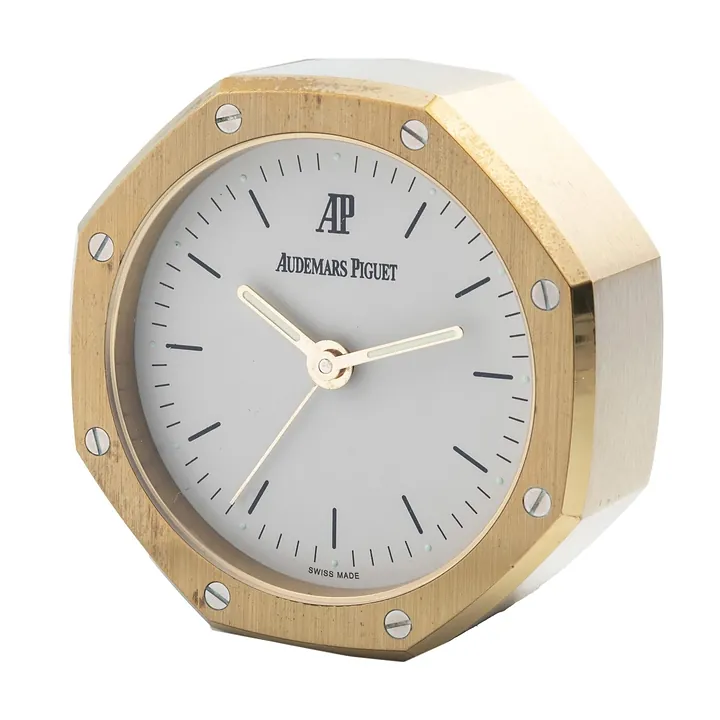
Audemars Piguet Royal Oak, c. 1990s
Antiquorum auction archive, Geneva
Pocket Watches · c. 1960
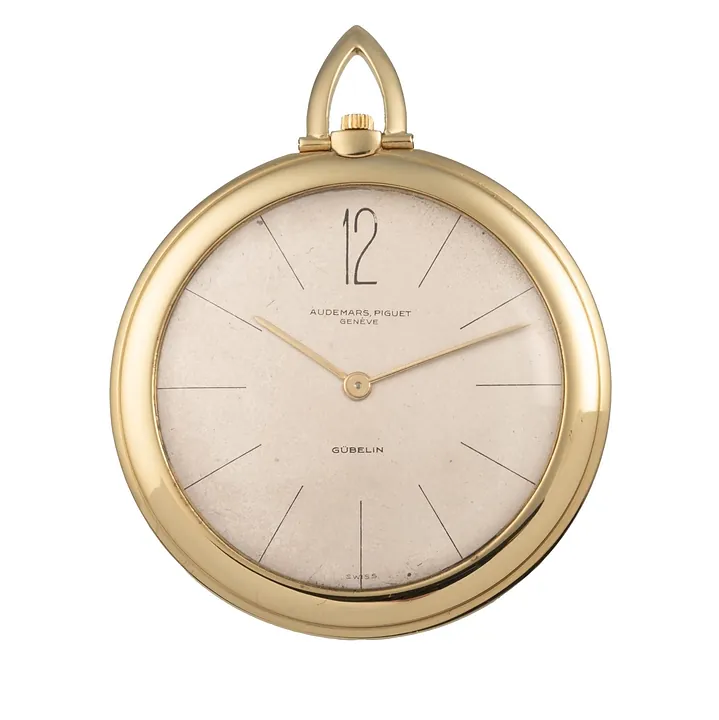
Audemars Piguet ''couteau'', c. 1960
Antiquorum auction archive, Geneva
Pocket Watches · originally sold in November 1961 (per the lot record)
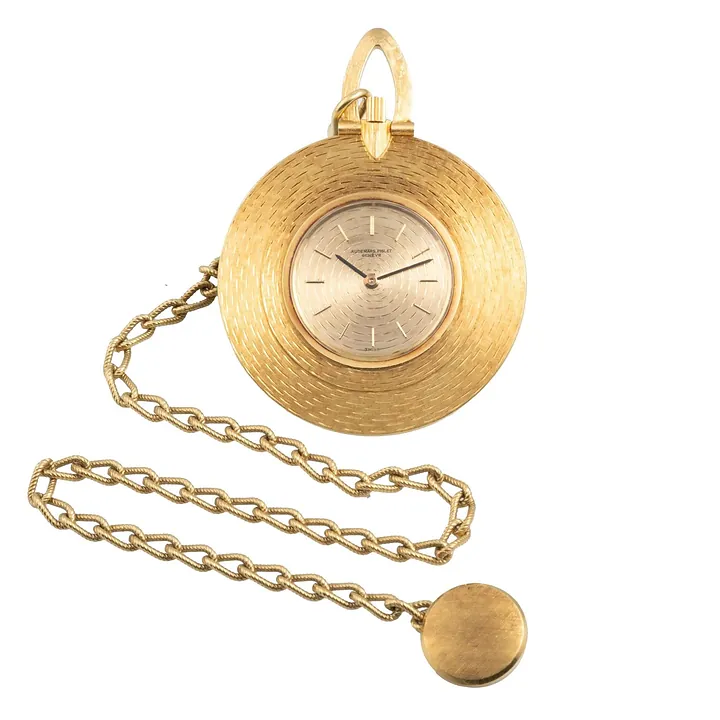
Audemars Piguet "extra Plate", ref. 5633 BA, originally sold in November 1961
Antiquorum auction archive, Geneva
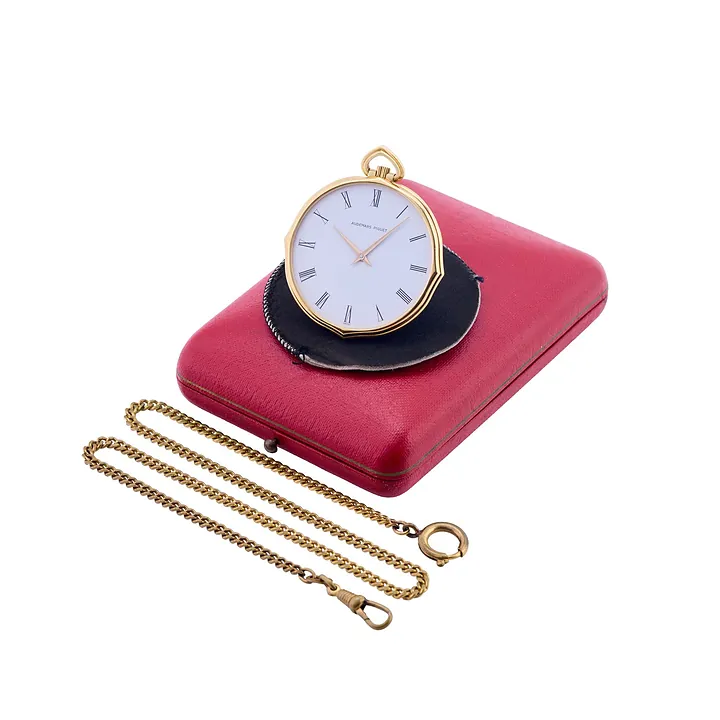
Pocket Watches · c. 1980
Audemars Piguet pocket watch, c. 1980
Antiquorum auction archive, Geneva

Wristwatches · 1970
Wristwatch by Heno, Switzerland, 1970
Museum Rotterdam

Wristwatches · 1960–1986
'Tri-Compax' calendar chronograph wristwatch in gold case, by Universal, Geneva, Switzerland, 1960–1986.
Science Museum Group, London

Wristwatches · 1969–1970
Beta 21 Quartz wristwatch movement, made in Switzerland, 1970.
Science Museum Group, London

Wristwatches · c. 1969
Omega Speedmaster Moonwatch, ref. 145022-69st, c. 1969
Antiquorum auction archive, Geneva