
Clocks · Atomic clock
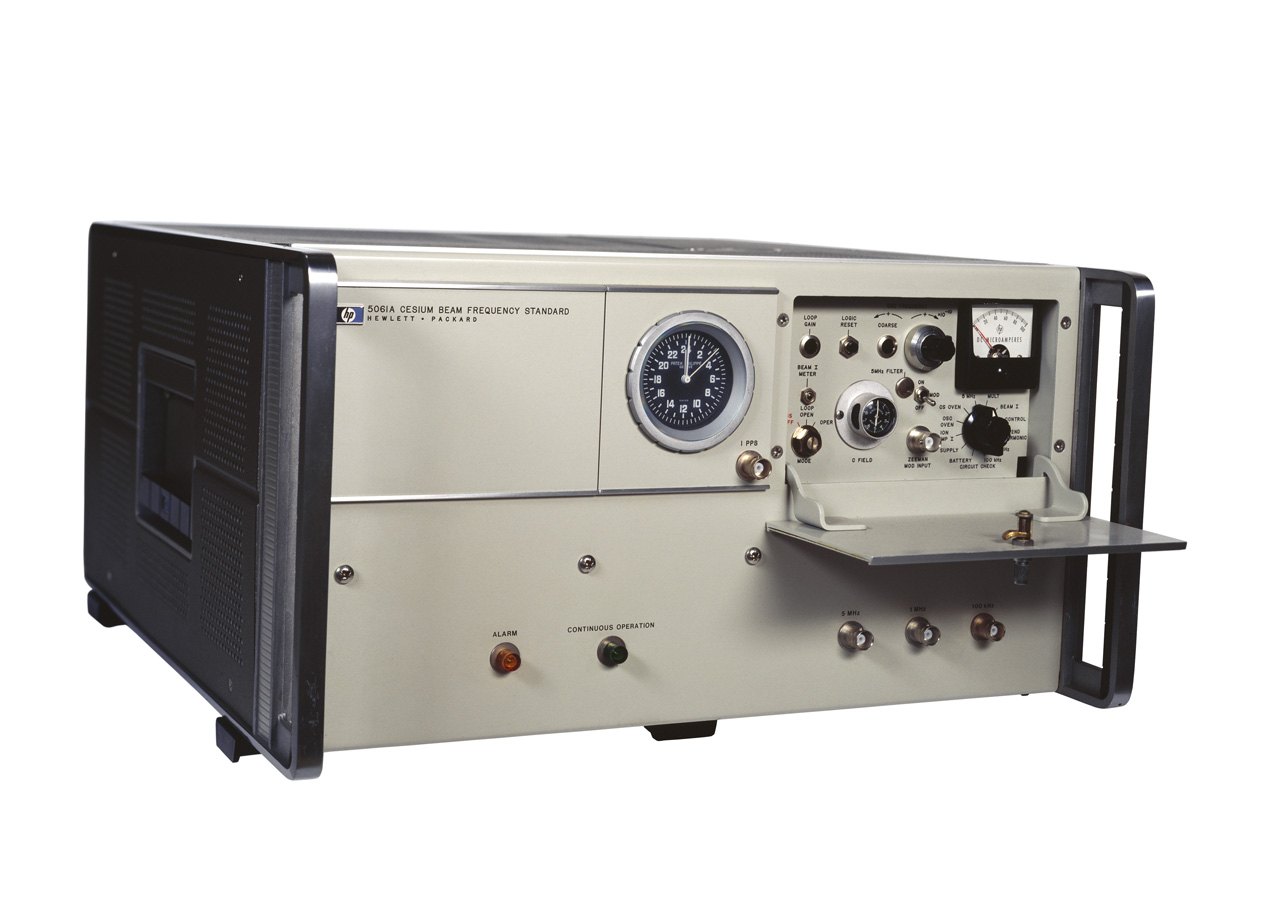
Atomic clock by Hewlett Packard & Co
- Maker / attribution
- Hewlett Packard & Co. (maker)
- Date
- 1973
- Historical period
- Quartz Revolution (1969 – 1990)
- Country of origin
- Unrecorded in source
- Place
- Santa Clara
- Object type
- Atomic clock
- Materials / technique
- metal; plastic
- Dimensions
- Overall: 230 x 425 x 460 mm
- Holding institution
- Royal Museums Greenwich
- Accession / object no.
- ZAA0549
- Credit line
- National Maritime Museum, Greenwich, London
- Catalogue title (original)
- Atomic clock (English)
View the source record ↗ (opens another website in a new tab)Suggest a correction
Record summary
Held and catalogued by Royal Museums Greenwich (object number ZAA0549), this is an atomic clock by Hewlett Packard & Co., made in Santa Clara, dated 1973. The Atlas places it in the Quartz Revolution period (1969 – 1990) of its Clocks collection. Materials and techniques recorded by the source: metal; plastic. Recorded dimensions: Overall: 230 x 425 x 460 mm. The record is illustrated with 2 photographs.
Assembled from the source record's structured fields. Dates and attributions are given as the source states them; where a field is missing the Atlas leaves it blank rather than estimating.
Catalogue description
Catalogue description — Royal Museums Greenwich
This is a replica of a Hewlett-Packard caesium-beam frequency standard, or atomic clock. The original was manufactured by the Santa Clara Division of the Hewlett Packard Company, USA (since 1999 a separate company called Agilent Technologies). The model HP 5061A atomic clock was used at observatories and timing laboratories around the world, including the Royal Greenwich Observatory, and is still in operation at some of them as part of the equipment contributing to that nation's timescale. An HP 5061A clock was also the device used to time the British national radio time signals broadcast from Rugby, in turn checked by the clocks at the National Physical Laboratory, Teddington, the home of Britain's time service today. One of the predictions of Einstein's theory of relativity was that gravity affects the passage of time: in other words, higher clocks run faster than lower clocks. In 1975 and 1977, two very important scientific experiments were carried out using HP 5061A atomic clocks in different positions on and above the Earth's surface, to test the predictions. Einstein was found to be correct, and it was only with the accuracy and portability of these atomic clocks that the experiments could be carried out. The first practical atomic clock was developed in 1955 by Louis Essen and Jack Parry at the UK's National Physical Observatory. Atomic clocks are essentially quartz clocks which are automatically corrected for frequency changes by being locked into a fixed relationship with the frequency of caesium atomic transitions. Since 1967 the standard interval of time is the atomic second, with astronomical definitions of time being relegated to specialist uses only.
Historical context
Quartz Revolution (1969 – 1990)
Seiko's Astron begins mass quartz timekeeping; traditional industries contract sharply.
Quartz movements and digital displays made accurate clocks cheap and ubiquitous after the early 1970s. LED and LCD clocks, clock radios and radio-controlled clocks appeared, while traditional mechanical clockmaking contracted sharply in Germany, France and Britain.
Read the period in the timelineMore clocks from this periodEarlier: Modern Mechanical Horology
Atlas type guide
Quartz, atomic and electronic time standards
In 1927 Warren Marrison and J. W. Horton at Bell Telephone Laboratories built the first quartz clock, which used the piezoelectric vibration of a quartz crystal as its oscillator. Quartz clocks replaced pendulum regulators in observatories in the 1930s and 1940s and revealed irregularities in the Earth's rotation. In 1955 Louis Essen and Jack Parry at the National Physical Laboratory in Britain operated the first practical caesium atomic clock; in 1967 the SI second was redefined in terms of the caesium-133 transition.
Atomic and quartz standards are distributed by radio time signals, telephone 'speaking clocks', and today by satellite navigation and network time protocols. Objects in this group — oscillators, frequency dividers, receivers, master clocks — document the transition from mechanical to electronic timekeeping.
What to look for
- Laboratory racks, oscillator ovens and frequency counters rather than dials.
- Makers' labels from national laboratories, observatories or telecom companies.
- Indications of frequency (e.g. 100 kHz, 9,192,631,770 Hz for caesium).
Dating clues
- Quartz observatory clocks: from about 1930.
- Caesium standards: from 1955.
- Radio-controlled consumer clocks: from the 1980s.
General guidance written by the Atlas editors about this kind of object. It is not a statement about this particular piece; for that, rely on the source record above and on physical examination.
Read next:The Quartz Revolution era
Related records
Clocks · late 20th century
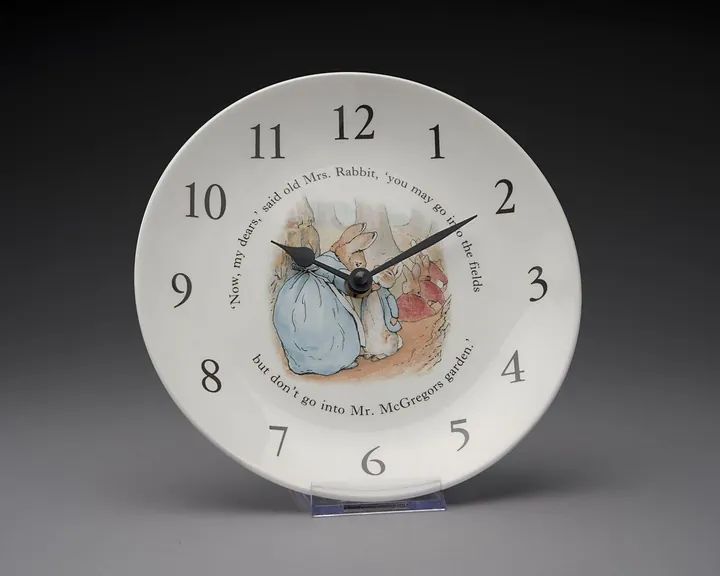
Clock, 'Peter Rabbit', Queen's ware, transfer printing, Josiah Wedgwood and Sons, Barlaston, late 20th century (V&A WE.17466-2014)
Victoria and Albert Museum, London
Clocks · late 20th century
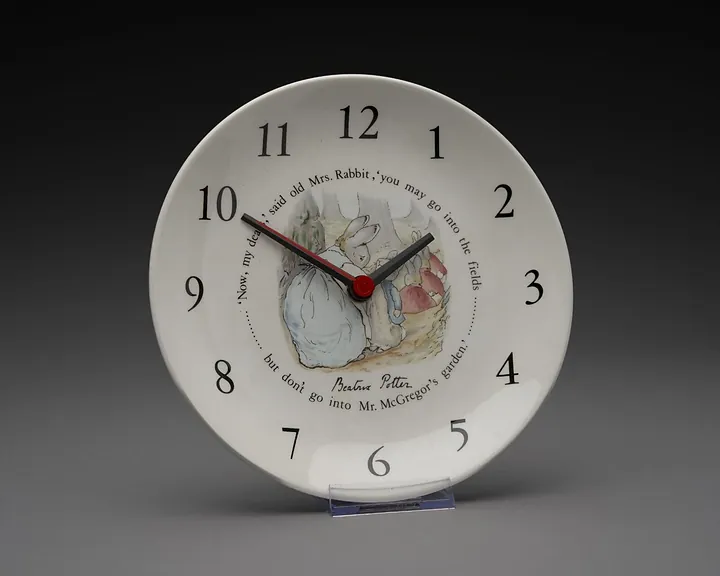
Clock, 'Peter Rabbit', Queen's ware, transfer printing, Josiah Wedgwood and Sons, Barlaston, late 20th century (V&A WE.18029-2014)
Victoria and Albert Museum, London
Clocks · late 20th century
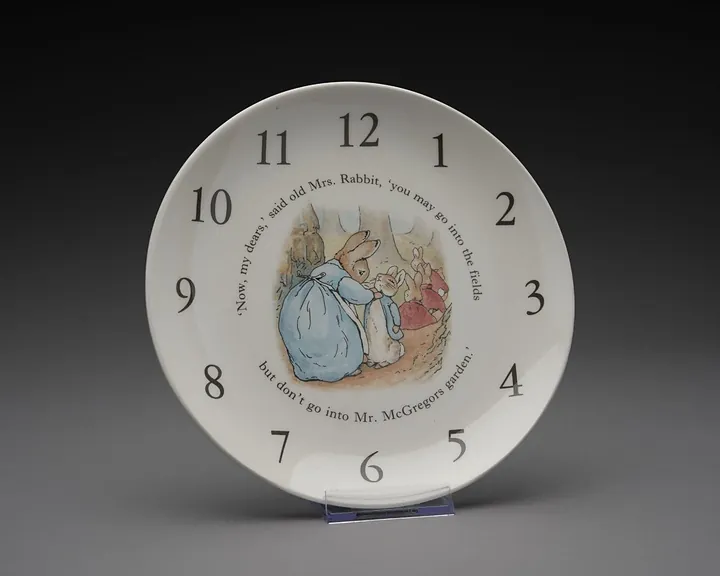
Clock, 'Peter Rabbit', glazed earthenware, transfer printing, Josiah Wedgwood and Sons, Barlaston, late 20th century
Victoria and Albert Museum, London
Clocks · c. 1960-1970s
Anonymous clock, c. 1960-1970s
Antiquorum auction archive, Geneva
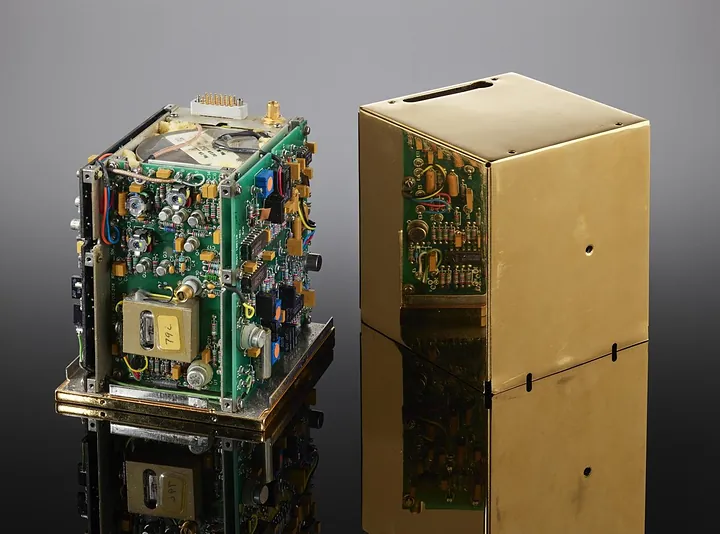
Clocks · 1960–1996
Electric clock by Efratom GmbH, Germany, 1960–1996
Science Museum Group, London
Clocks · c. 1960-1970s
Lecoultre Street Light Lamp, ref. 397, c. 1960-1970s
Antiquorum auction archive, Geneva
Clocks · c. 1960-1970s
Universal Genève clock, ref. 999.116.01, c. 1960-1970s
Antiquorum auction archive, Geneva
Clocks · 1964–1988
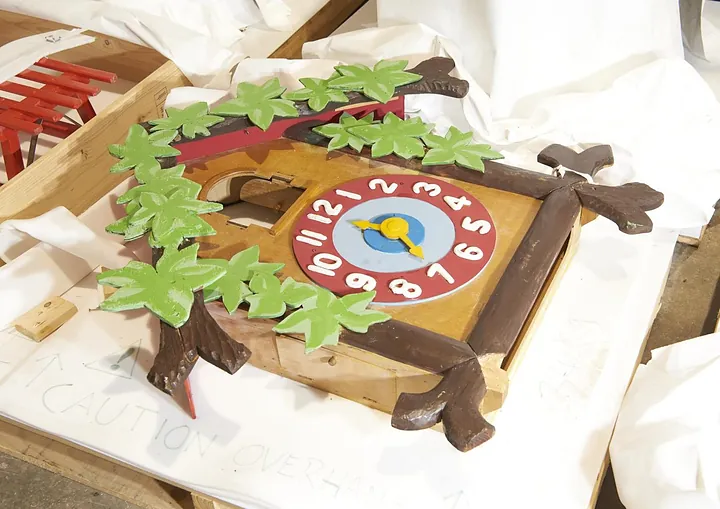
The clock from BBC children's television series 'Playschool', c 1977
Science Museum Group, London