
Wristwatches · Wristwatch
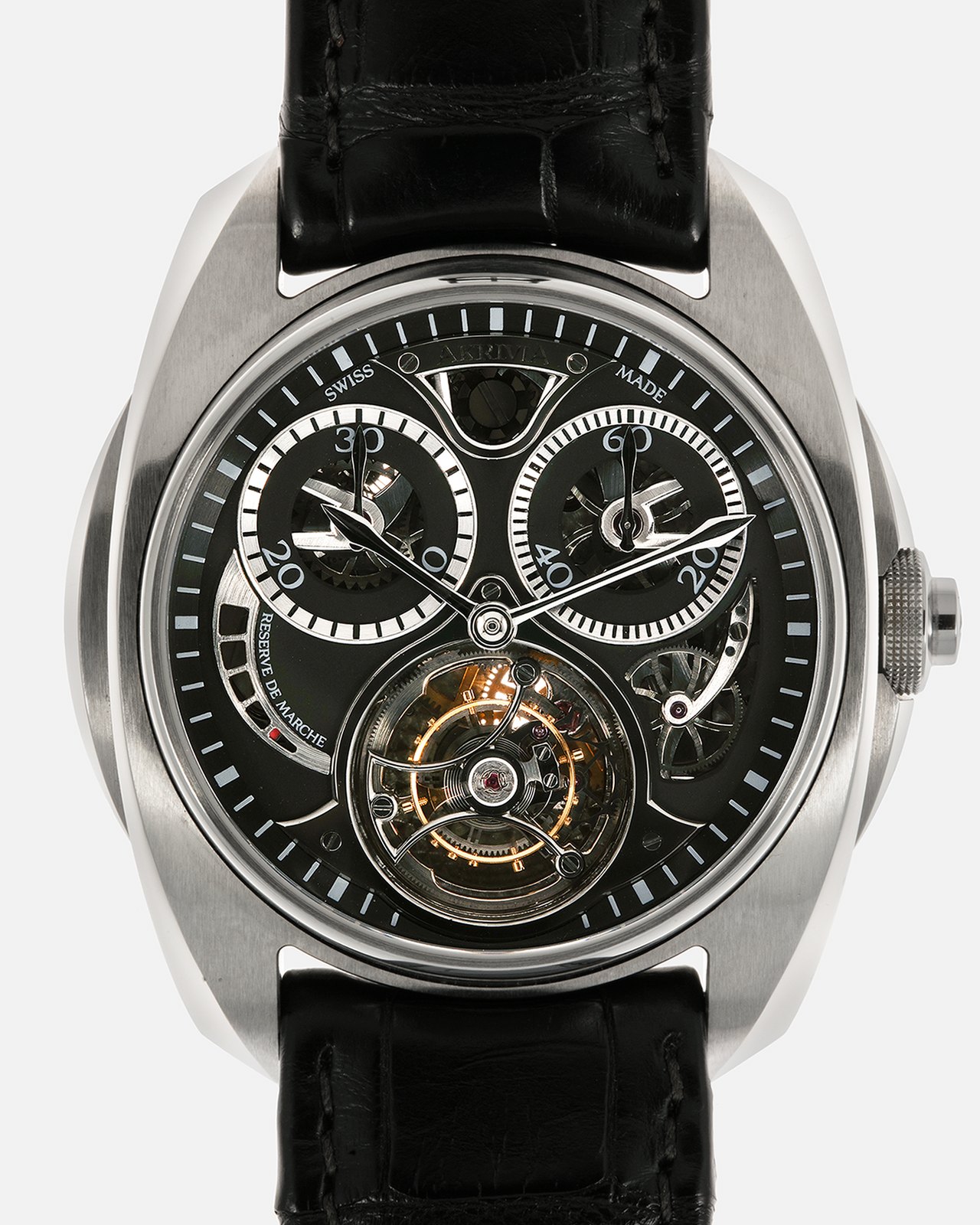
Akrivia AK-01 Tourbillon Chronograph Monopoussoir Steel, 2016
- Maker / attribution
- Akrivia (maker)
- Date
- 2016
- Historical period
- Contemporary Horology (2010 – Present)
- Country of origin
- Unrecorded in source
- Object type
- Wristwatch
- Materials / technique
- steel
- Stock no.
- Product 7568829481047
- Credit line
- Dealer listing, S.Song Watches (product 7568829481047)
- Catalogue title (original)
- Akrivia AK-01 Tourbillon Chronograph Monopoussoir Steel (English)
View the source record (dealer listing) ↗ (opens another website in a new tab)Suggest a correction
Record summary
Catalogued by S.Song Watches (dealer), Seattle (stock number Product 7568829481047), this is a wristwatch by Akrivia, dated 2016. The Atlas places it in the Contemporary Horology period (2010 – Present) of its Wristwatches collection. Materials and techniques recorded by the source: steel. The record is illustrated with 6 photographs.
Assembled from the source record's structured fields. Dates and attributions are given as the source states them; where a field is missing the Atlas leaves it blank rather than estimating.
Catalogue description
Dealer description — S.Song Watches
When discussing independent Haute Horlogerie, it is impossible to overlook the work of Rexhep Rexhepi. Despite his youth, he is one of the most respected names in this realm, best known for the Chronomètre Contemporain under his eponymous brand. That being said, before ‘Rexhep Rexhepi’ the brand, there was ‘Akrivia’. While it is easy to see the success of the brand and the watchmaker today, Akrivia’s beginnings in 2012 was not so obvious. With avant-garde designs presented to a world not ready for hyper high-end independent watchmaking, it wasn’t until the late 2010’s when momentum started shifting. For those only discovering his work today, that reputation began with the Akrivia AK-01 Tourbillon Monopusher, his first wristwatch unveiled at Baselworld 2013. Conceived as a highly technical and meticulously finished timepiece, the AK-01 showcased Rexhepi’s mastery and personal interpretation of traditional watchmaking through a form that is contemporary, distinctive, and boldly architectural. At the time, independent watchmaking occupied a quiet corner of the industry. The audience was niche, expectations were unforgivingly high, and credibility had to be earned slowly. Most young independents tend to start out conservatively by experimenting within familiar forms and conventional complications before going on to attempt more ambitious designs. To launch instead with a highly complicated tourbillon monopusher chronograph as an inaugural piece was both bold and risky. For a young, unproven brand like Akrivia (which translates to “precision” in Greek) at the time, the AK-01 conveyed remarkable confidence and a clear declaration of intent and conviction, laying down the foundation for one of the most closely followed careers in modern independent watchmaking. As you can see from the photos, the AK-01 immediately stands apart with its distinctive case design. Rather than a conventional round form, the U-shaped construction supports an unusual ovoid bezel and is flanked by a pair of sculptural “ears” on each side, with the right side serving as a crown guard for the recessed crown finished in clous de Paris knurling. Brushed titanium surfaces and wide, bevelled lugs reinforce the case’s entire architectural presence, establishing a blueprint that would later go on to define Akrivia’s signature design blueprint. The watch’s aesthetics continue through its movement, the Cal. AK-01, a manual-winding calibre originally based on a chronograph tourbillon concept by the now-defunct Swiss movement manufacturer BNB Concepts. Rexhepi redesigned the calibre entirely, adding a new 63-part tourbillon cage with revised escape and clutch wheels and a 100-hour power reserve. Here, the one-minute flying tourbillon serves as both a visual and structural anchor. Viewed through the sapphire caseback, the movement appears restrained at first glance, but a closer look reveals Rexhepi’s classical training at Patek Philippe and F.P. Journe through meticulous finishing. The two main bridges, decorated with sublime Côtes de Genève , align perfectly as if artfully carved from a single piece of metal, while the bridge supporting the central wheel is black-polished. Every edge is finished with mirrored anglage , and even the inscriptions—including place of manufacture origin and serial number—are hand-engraved. Only after completing the movement did Rexhepi turn to the dial, which was a masterful demonstration in clarity and balance. The chronograph registers and bell-shaped tourbillon aperture are arranged symmetrically at 10:00, 2:00, and 6:00, respectively, creating a calm, ordered surface despite the technical complexity nestled beneath. A grey, marked minute track encircles the dial’s periphery, with a discreet power reserve indicator at 8:30. Partially open-worked, the dial offers several little glimpses of the movement through carefully positioned apertures. As expected, the quality of finishing demonstrated here on the dial is also impeccable throughout, with brushed and polished surfaces catching light subtly, while all of its engraved details add further depth without veering into excess. As briefly mentioned earlier, when the AK-01 was first released, independent watchmaking was still a very different world. In hindsight, the watch represented more than just Rexhepi’s debut; it was the first pure expression of his vision, executed without compromise and driven by ambition. Having followed Rexhepi’s journey and aware of the adversity he faced in Akrivia’s early years, it is impossible not to reflect on how far he has come as a watchmaker. Every line, proportion, and detail seen here carries his DNA with unmistakable clarity. Even when it was laid out quietly on a table during our photography session, the watch commanded the attention of the room. Beyond a debut, it set a benchmark for what modern independent brands could achieve, proving that Akrivia could also stand alongside far older and more established brands in today’s watchmaking landscape. In terms of production, the AK-01 represents Rexhepi’s earliest work in high horology. While he initially planned 12 pieces each in rose gold, stainless steel, and titanium, only approximately 13 pieces were ultimately produced across all metals. Today, with demand for Akrivia watches growing and with Rexhepi having previously indicated plans to retire the Akrivia name, this limited output underscores the AK-01’s rarity, cementing its status as one of the most elusive modern independent watches money can buy to date.
Historical context
Contemporary Horology (2010 – Present)
Silicon components, connected watches, optical-lattice research clocks and a thriving independent scene.
Smartwatches became the world's best-selling watches, while mechanical watchmaking focuses on craft, innovation (silicon components, new escapements) and independent makers.
Read the period in the timelineMore wristwatches from this periodEarlier: Mechanical Renaissance
Atlas type guide
Chronographs and split-seconds watches
A chronograph is a watch with an additional seconds hand that can be started, stopped and returned to zero independently of the timekeeping. Louis Moinet built an early example in 1816 and Nicolas Rieussec a recording 'chronographe' in 1821; Adolphe Nicole's heart-shaped reset cam (patented 1862) made the modern return-to-zero possible. Split-seconds (rattrapante) chronographs add a second hand that can be stopped for intermediate times; flyback chronographs restart instantly.
Chronographs were essential tools for doctors (pulsometer scales), artillery (telemeter), engineers and sport. In wristwatches, Valjoux, Venus, Lemania and later the automatic chronographs of 1969 (Zenith El Primero, the Chronomatic Calibre 11 group and Seiko 6139) are milestones.
What to look for
- Push-pieces on the case band or a single button in the crown (monopusher).
- Subsidiary registers for minutes and hours; tachymeter, telemeter or pulsometer scales.
- Column wheel versus cam control visible in the movement.
- Calibre markings of specialist makers (Valjoux, Lemania, Venus, Landeron).
Dating clues
- Pocket chronographs with heart cam reset: after 1862.
- Wrist chronographs: from c. 1910; two-button designs from the 1930s.
- Automatic chronographs: from 1969.
General guidance written by the Atlas editors about this kind of object. It is not a statement about this particular piece; for that, rely on the source record above and on physical examination.
Read next:Flyback chronographChronograph
Related records
Wristwatches · 2021
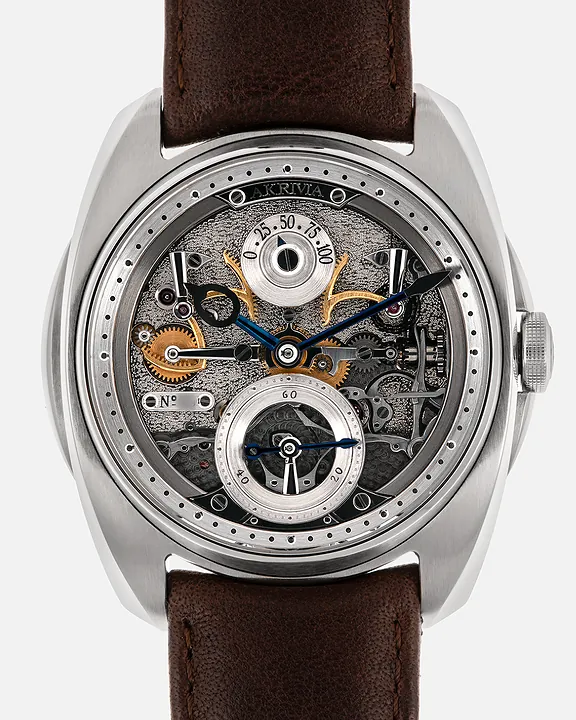
Akrivia AK-06 Steel, 2021
S.Song Watches (dealer), Seattle

Wristwatches · 2010
Wristwatch, 2010
Modemuseum Hasselt
Wristwatches · 2018 (Series 4 released in September 2018; '1977' in the source is the model number A1977)
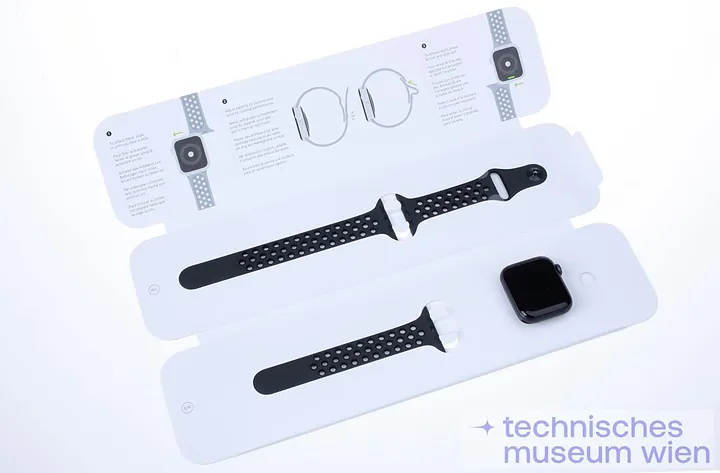
Apple Watch Series 4 (GPS, 40 mm, model A1977), 2018
Vienna Museum of Science and Technology
Wristwatches · c. 2010s
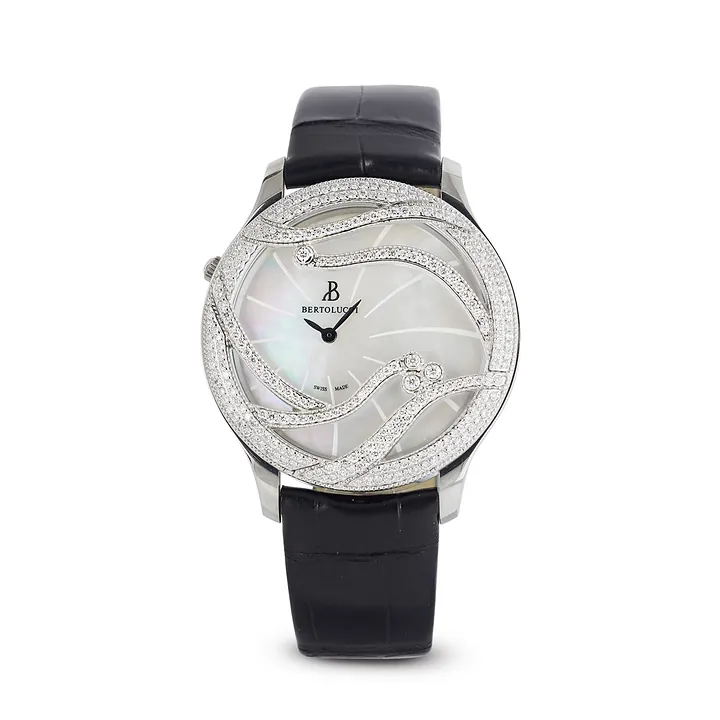
Bertolucci Stria III, ref. 11513.50.45.B88.6C1.501, c. 2010s
Antiquorum auction archive, Geneva
Wristwatches · c. 2010s
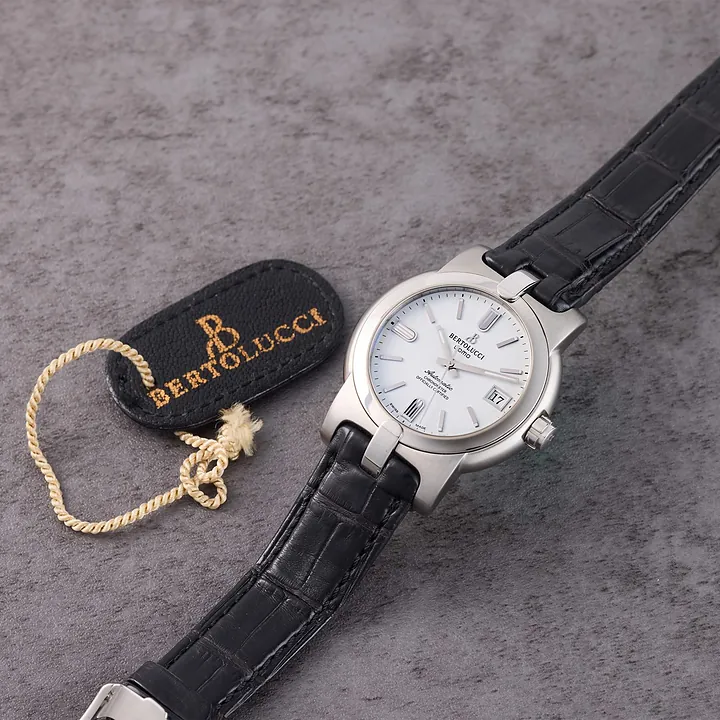
Bertolucci Uoma, ref. 824.51.41.10B, c. 2010s
Antiquorum auction archive, Geneva

Wristwatches · c. 2010s
Breguet Type XXI, ref. 3810, c. 2010s (Antiquorum Lot 381-24)
Antiquorum auction archive, Geneva

Wristwatches · c. 2010s
Breguet Type XXI, ref. 3810, c. 2010s (Antiquorum Lot 386-229)
Antiquorum auction archive, Geneva

Wristwatches · Sold in September 2010
Breitling Cosmonaute, ref. A 22322, Sold in September 2010
Antiquorum auction archive, Geneva