
Wristwatches · Wristwatch
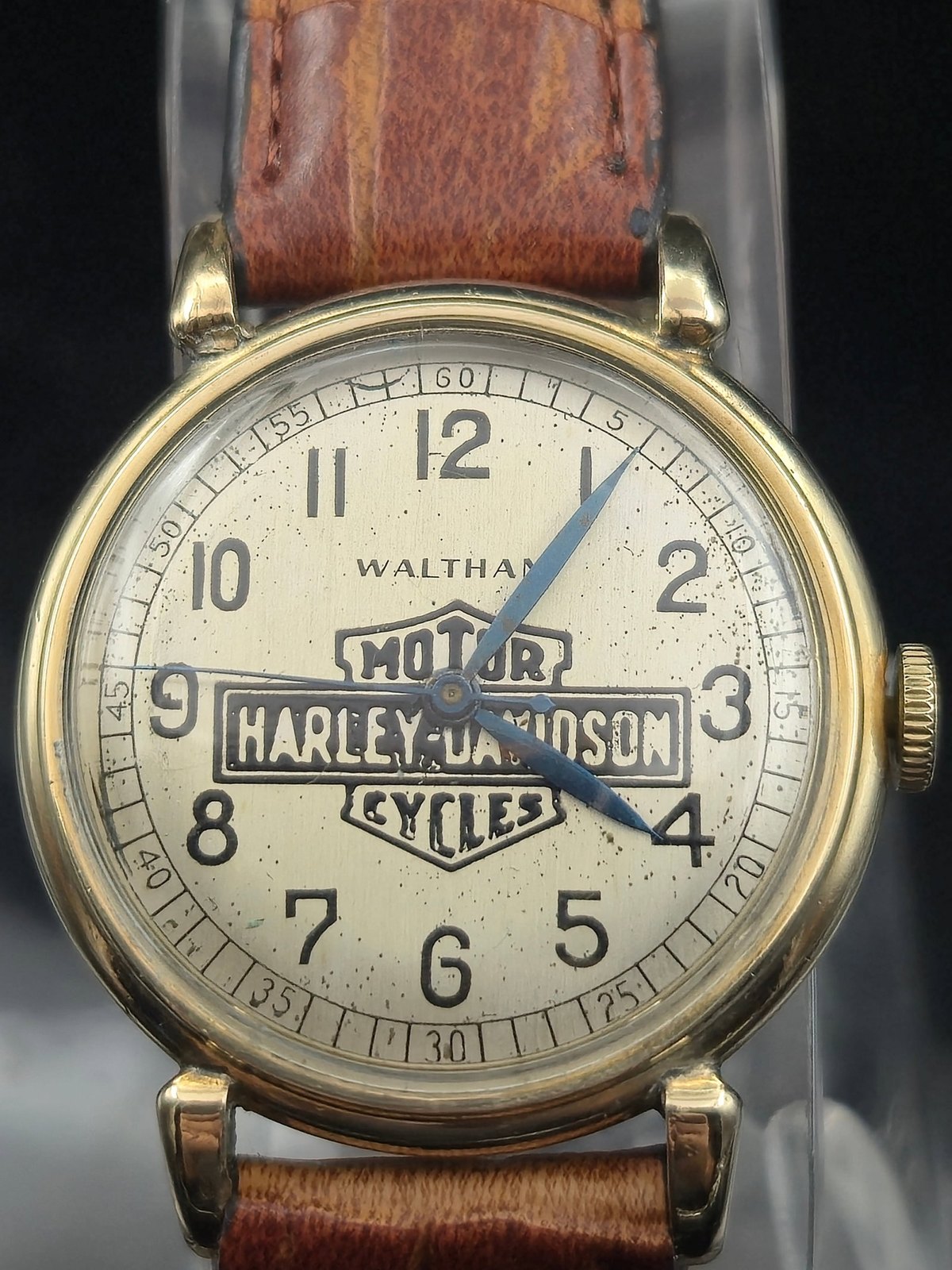
1940s Waltham 6/0-C 17J Harley-Davidson Dial 10K GF 34mm Watch
- Maker / attribution
- Waltham (maker)
- Date
- 1940s
- Historical period
- Golden Age of Mechanical Watchmaking (1900 – 1945)
- Country of origin
- United States
- Object type
- Wristwatch
- Auction house
- LiveAuctioneers auction archive
- Lot
- Item 213026896
- Credit line
- Auction lot record: lot 43, Exclusive Watches and Pocket watches, Sphere Auctions LLC (2025), via LiveAuctioneers
- Catalogue title (original)
- 1940s Waltham 6/0-C 17J Harley-Davidson Dial 10K GF 34mm Watch (English)
View the source record (auction lot) ↗ (opens another website in a new tab)Suggest a correction
Record summary
Catalogued by LiveAuctioneers auction archive (lot Item 213026896), this is a wristwatch by Waltham, made in United States, dated 1940s. The Atlas places it in the Golden Age of Mechanical Watchmaking period (1900 – 1945) of its Wristwatches collection. The record is illustrated with 4 photographs.
Assembled from the source record's structured fields. Dates and attributions are given as the source states them; where a field is missing the Atlas leaves it blank rather than estimating.
Catalogue description
Lot description — Sphere Auctions LLC
Circa 1940s Waltham wristwatch featuring a rare Harley-Davidson Motor Cycles logo dial with black Arabic numerals, outer minute track, and blued steel hands. 10K gold-filled Keystone J. Boss case, measuring approximately 34.57mm (excluding crown). Powered by a Waltham USA 6/0-C manual wind movement with 17 jewels, serial number 32383. Case interior stamped “Keystone J. Boss 10K Gold Filled” with reference numbers. Fitted with a brown leather strap.Period:1940sCondition:Good; dial shows light patina and spotting, case with surface wear consistent with age, crystal with minor scratches. Running at time of cataloging but not tested for accuracy.Dimensions:Case: 34.57mm diameter (approx.)
Historical context
Golden Age of Mechanical Watchmaking (1900 – 1945)
The wristwatch displaces the pocket watch; waterproof cases, self-winding and grand complications.
The wristwatch overtook the pocket watch. Military use in the First World War, aviation, water-resistant cases (1926), automatic winding (1923–31), rectangular Art Deco designs and early chronographs and calendars defined the period.
Read the period in the timelineMore wristwatches from this periodEarlier: Industrial Revolution
Atlas type guide
Wristwatches
Bracelet watches were worn by women from the early nineteenth century — Breguet made one for Caroline Murat, Queen of Naples, in 1810–12 — but the wristwatch only became a man's instrument with military use and aviation in the early twentieth century. Between the World Wars it overtook the pocket watch; the 1920s and 1930s brought rectangular Art Deco cases, water-resistant cases and the first automatic winding systems.
After 1945 the wristwatch became a carrier of identity — dress watches, sports and dive watches, chronographs, calendars — produced by Swiss, American, Japanese, German, Soviet and Chinese industries. The quartz revolution after 1969 and the mechanical renaissance since the 1990s, including the rise of independent watchmakers, complete the story.
What to look for
- The reference number (between the lugs or inside the case back) and serial number, the starting point for dating.
- The calibre: its maker and number are often stamped under the dial or on the bridge.
- Originality of dial, hands and crown — refinished ('redial') dials are common.
- Case material marks: 18K/750, 14K/585, stainless steel, gold-filled, plated.
Dating clues
- Wire-lug cases: before c. 1925.
- Water-resistant screw-down cases: from 1926.
- Quartz movements: from 1969; sapphire crystals widespread after c. 1980.
General guidance written by the Atlas editors about this kind of object. It is not a statement about this particular piece; for that, rely on the source record above and on physical examination.
Related records
Pocket Watches · 1910s
Pocket watch by Waltham, United States, 1910s
Suomen Urheilumuseo
Pocket Watches · 1902
Pocket watch by Waltham, United States, 1902
Turun kaupunginmuseo
Instruments · c.1938
Marine chronometer watch no. 30683313 by Waltham
Royal Museums Greenwich
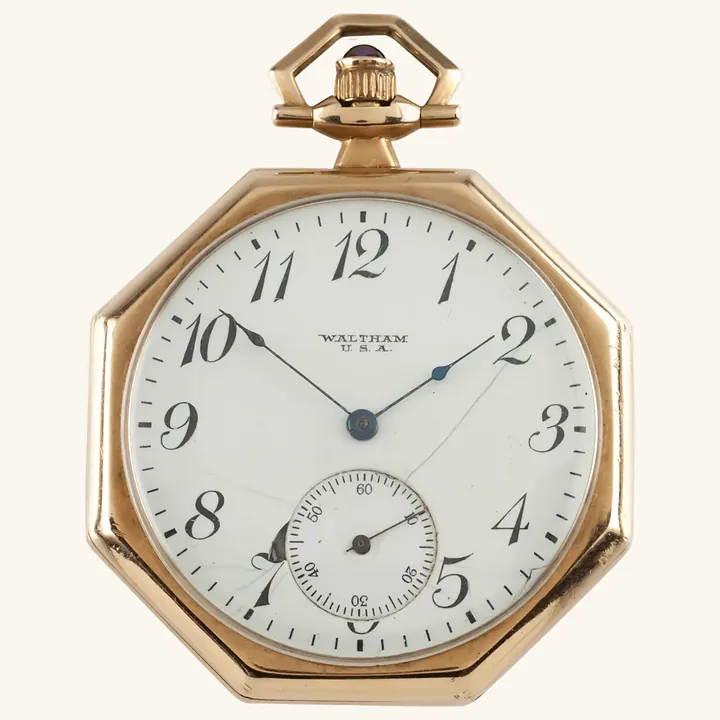
Pocket Watches · 1917
Waltham Octagon14 Karat Pocket Watch Jewel, 1917
WatchMuseum.org shop
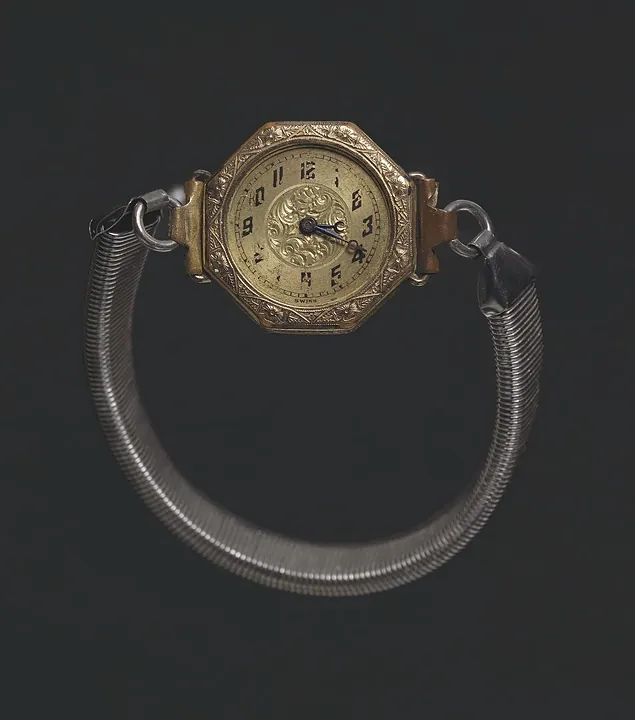
Wristwatches · early to mid 20th century
Woman's wristwatch worn by Harriette Vyda Simms Moore, early to mid 20th century
National Museum of African American History and Culture, Smithsonian Institution, Washington DC
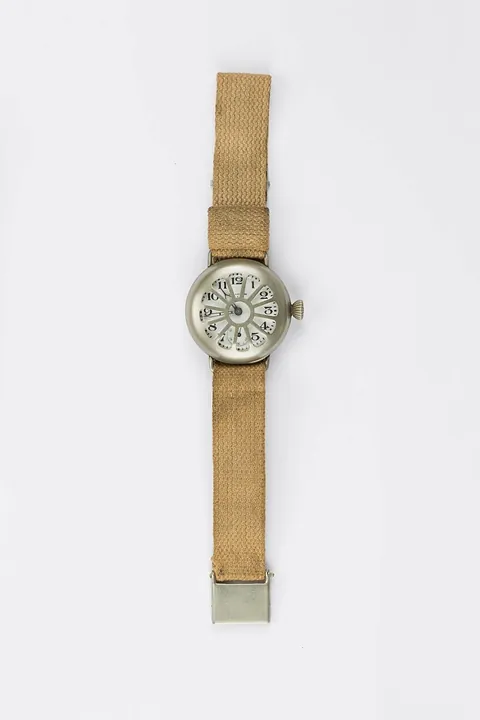
Wristwatches · 1921
Wristwatch by Waltham A. W. W. Co., United States, 1921
German Clock Museum
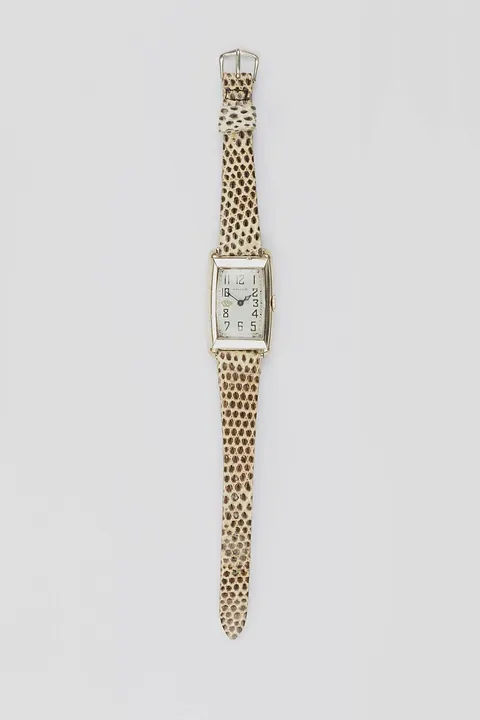
Wristwatches · 1929
Wristwatch by Waltham A. W. W. Co., United States, 1929
German Clock Museum
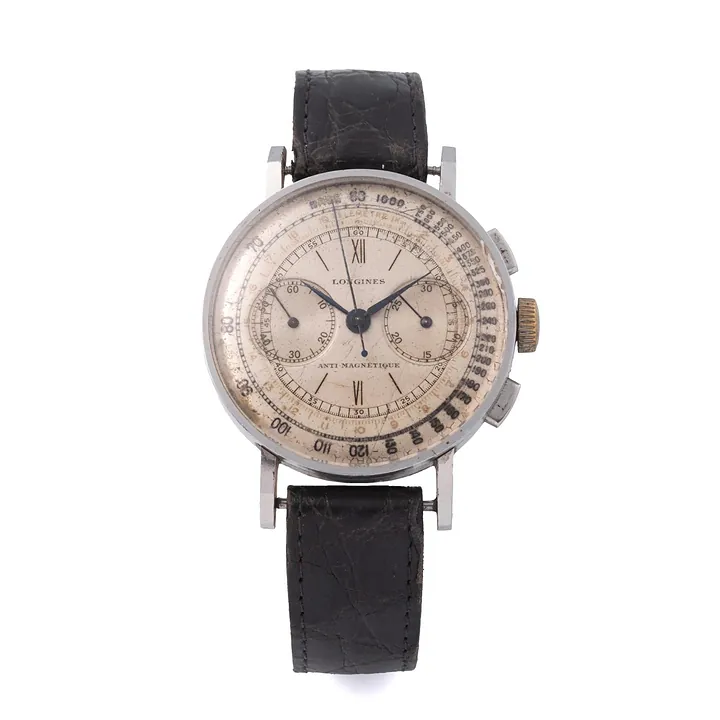
Wristwatches · 1930–1940
Longines Chronograph, ref. 22185, circa 1930/1940
Antiquorum auction archive, Geneva