
International Horology · Historical feature
The Astrolabe: Telling Time by the Sun and Stars, from Alexandria to Lahore
For a thousand years the astrolabe was the most sophisticated timekeeping instrument in the world. How a flat brass disc models the sky, how it was used to find the hour and the direction of prayer, and how to read the hundreds of surviving examples in museum collections.
Atlas Editorial · · 9 min read
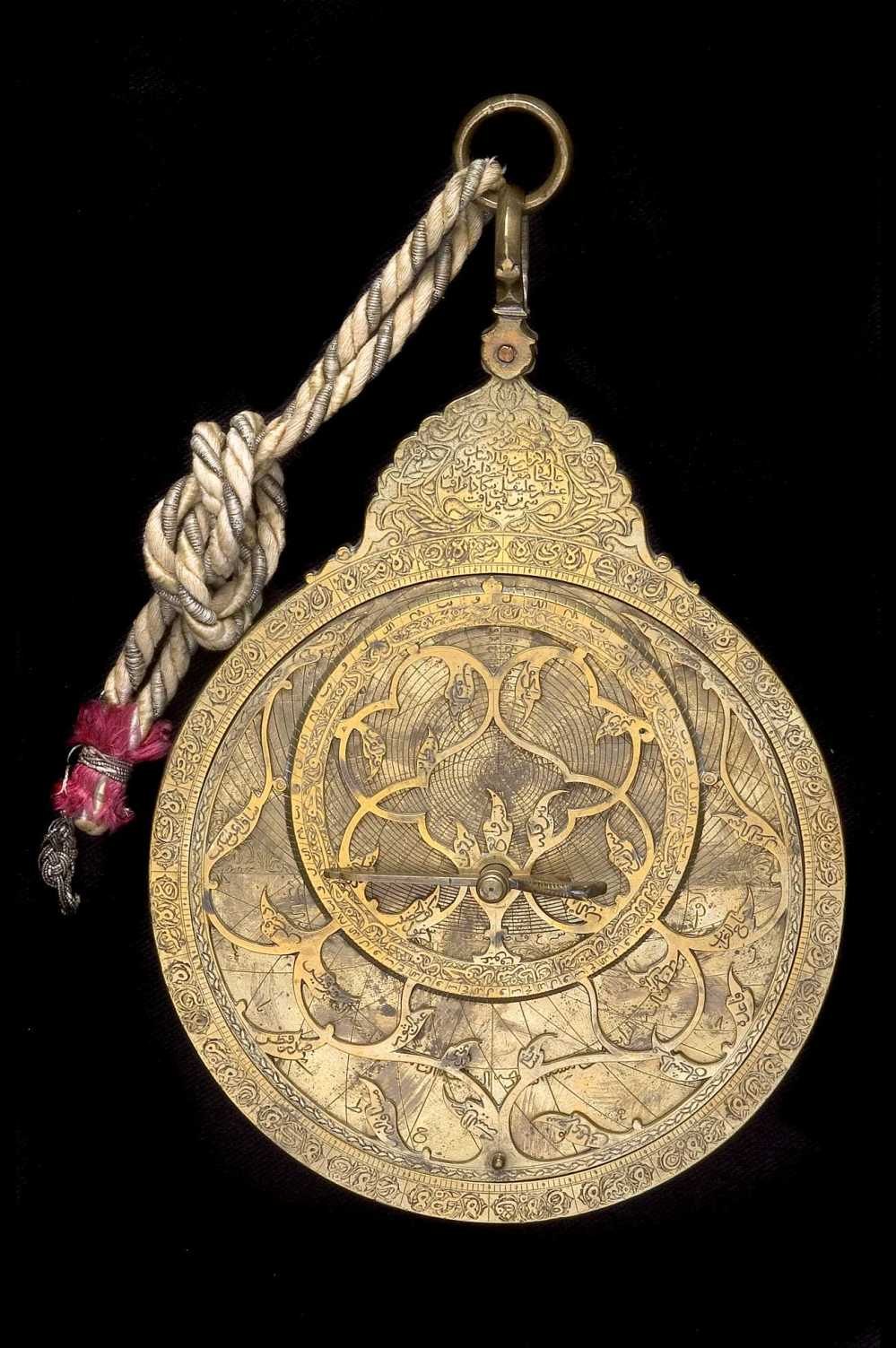
Unknown · CC BY-SA 4.0 · source (opens another website in a new tab)
Most of the instruments in the Atlas catalogue keep time: they run, tick and display an hour that someone set. The astrolabe does something different. It finds the time. Hold it up, sight the Sun or a bright star, turn a pierced brass star map until it matches what you have measured, and the instrument tells you the hour — along with the time of sunrise, the length of the day, the rising sign of the zodiac and, in the Islamic world, the times of prayer. No mechanical clock before the seventeenth century could check itself against the sky; the astrolabe was, in effect, the reference standard that clocks were set by.
The catalogue holds close to three hundred astrolabe records from collections in London, New York, Brussels, Oxford, Chicago and elsewhere, ranging from a twelfth-century instrument from al-Andalus to European teaching models of the eighteenth century. This feature explains how the instrument works, where it came from and how the surviving examples can be read — and treated with caution.
A map of the sky in brass
The planispheric astrolabe — the common type — rests on a mathematical idea known to Greek astronomers: stereographic projection, a way of drawing the sphere of the heavens on a flat plane so that circles on the sphere remain circles on the drawing. Ptolemy described the projection in a short work known as the Planisphaerium in the second century CE, and the method is often traced back further to Hipparchus, although the evidence for him is indirect. The earliest treatises that describe the instrument itself in detail are later: one in Greek by John Philoponus of Alexandria in the sixth century, and one in Syriac by Severus Sebokht in the seventh.
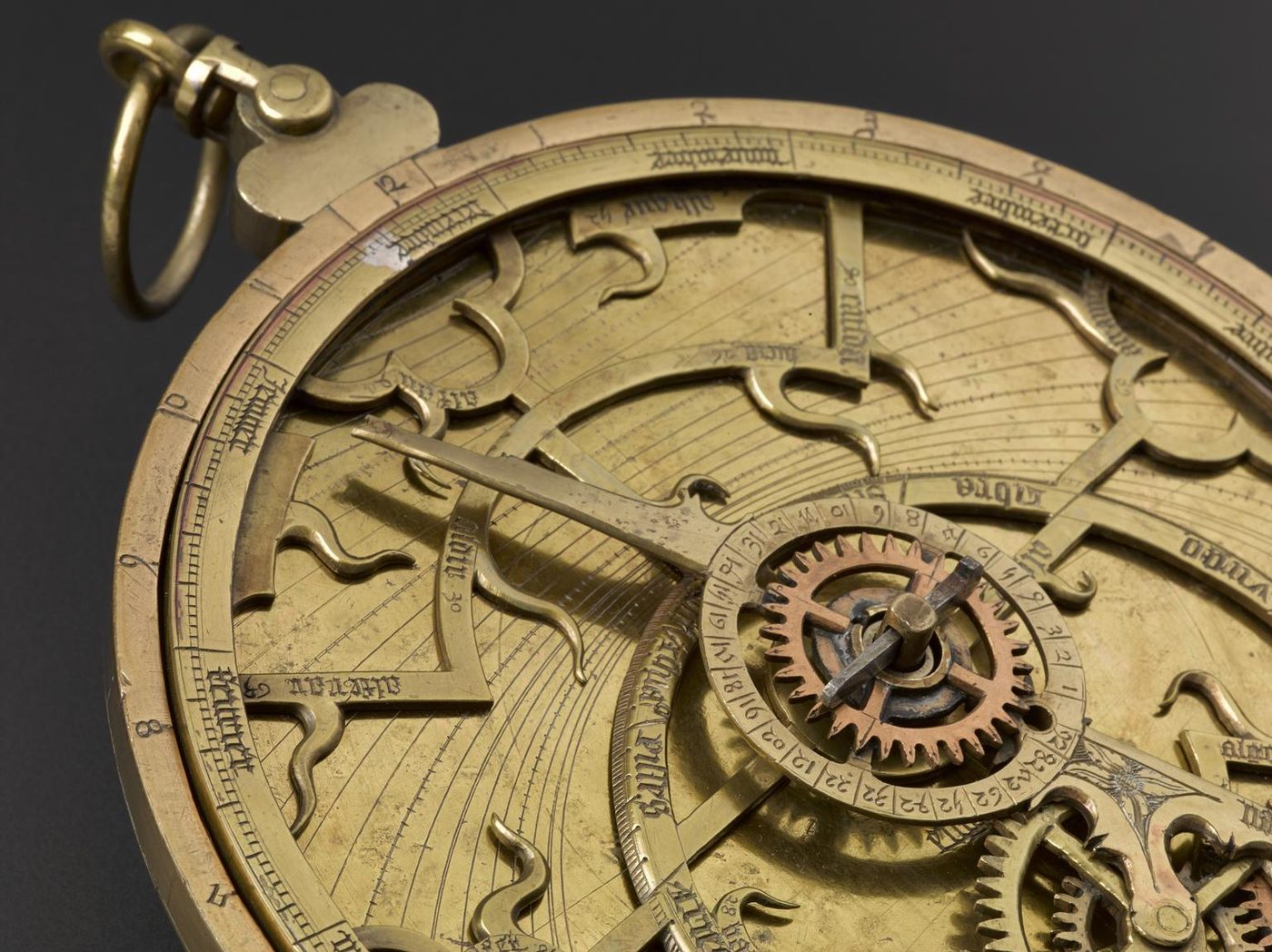
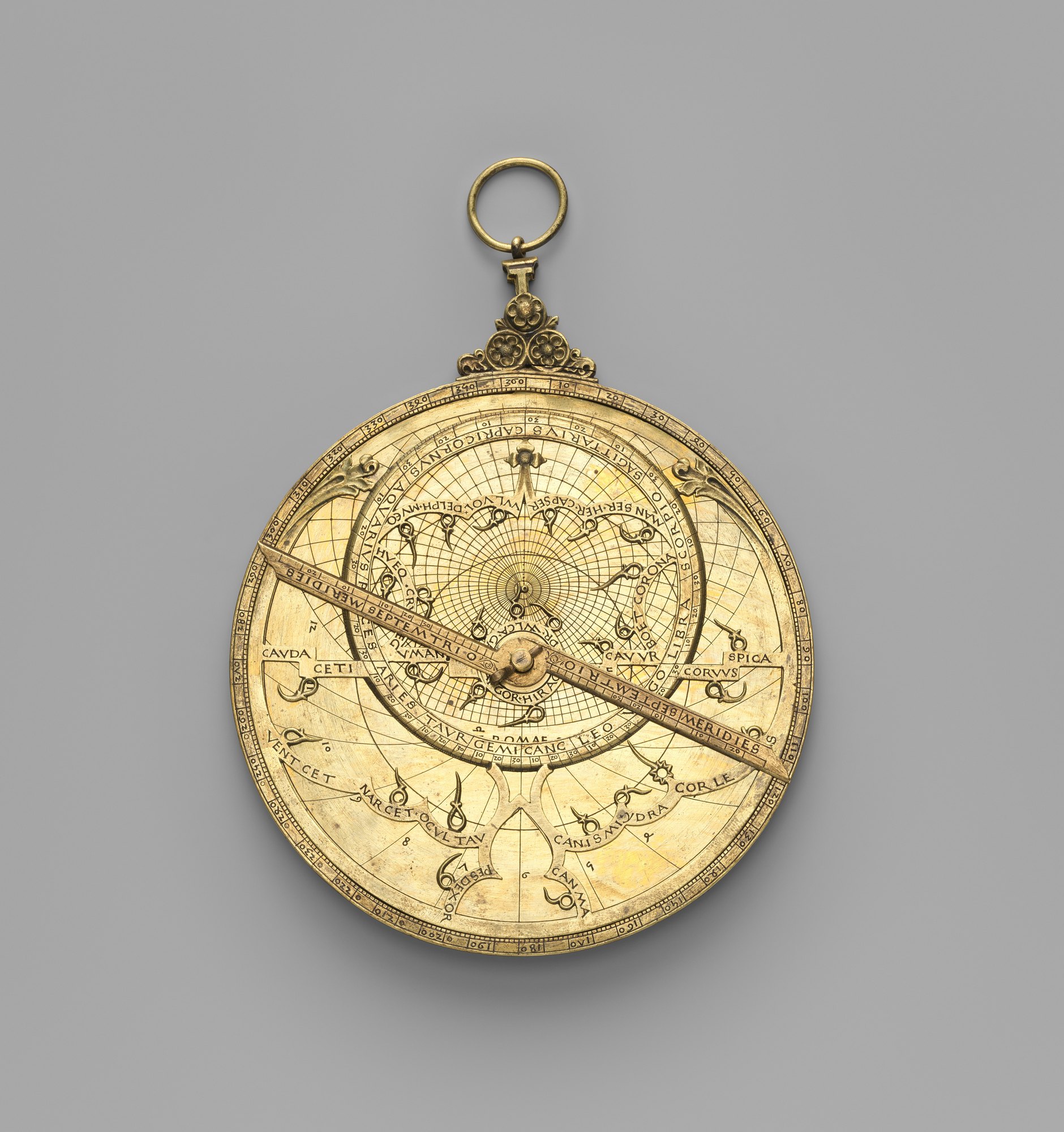
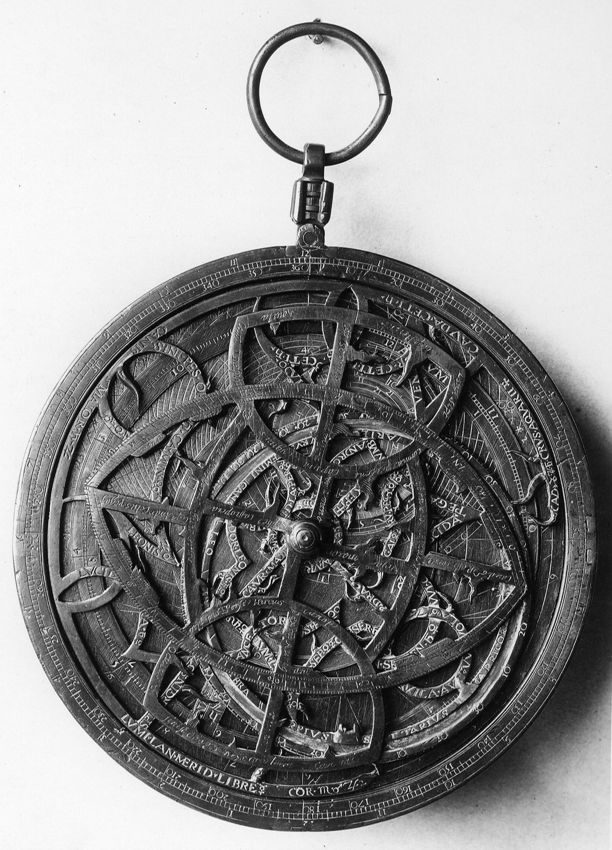
In the projection, the observer's sky — horizon, altitude circles, the meridian — is engraved on a plate, which depends on the latitude of the place. Over it turns the rete, an open-work star map showing the ecliptic (the Sun's yearly path) and pointers for a selection of bright stars. Because the stars and the Sun move round the sky once a day, rotating the rete over the plate reproduces the turning of the heavens above a particular place. Put the rete where the sky actually is, and the instrument has captured the moment; read the angle through which it has turned, and you have the time.
| Part | What it is | What it is used for |
|---|---|---|
| Mater | The main body, a thick disc with a raised rim | Holds the plates and rete; its back carries scales |
| Limb | The graduated rim of the mater | Degrees and hours, read against the rule |
| Plates (tympans) | Discs engraved for a given latitude | Horizon, altitude circles (almucantars), azimuths and hour lines |
| Rete | Pierced star map with ecliptic ring and star pointers | Rotated to match the sky at the moment of observation |
| Rule | Straight pointer on the front | Carries the Sun's position to the limb to read the time |
| Alidade | Sighting rule on the back | Measures the altitude of the Sun or a star |
| Shadow square | Scale on the back | Heights and distances by surveying |
| Throne and ring | Suspension at the top | Lets the instrument hang plumb for sighting |
The astrolabe in the Islamic world
The instrument flourished above all in the Islamic world, where Greek and Syriac learning was translated into Arabic from the eighth century and developed with remarkable inventiveness. Astrolabe makers worked in Baghdad, Isfahan, Cairo, Damascus, Toledo, Seville and many other cities. The oldest astrolabes that carry a date are from the tenth century; one signed by Nastulus (Muhammad ibn 'Abd Allah) and dated to 927–28 CE is often cited as the earliest dated example.
Timekeeping was a practical religious concern. The five daily prayers are defined by the Sun's position — dawn, noon, mid-afternoon, sunset and nightfall — and Muslims pray facing the qibla, the direction of Mecca. Astronomers developed tables, sundials, quadrants and astrolabes to serve both needs, and from the thirteenth century many large mosques employed a muwaqqit, a timekeeper responsible for regulating the hours of prayer. David King's studies of this tradition, listed in the sources below, document the scale of this science of timekeeping ('ilm al-miqat) and the thousands of instruments and tables it produced.
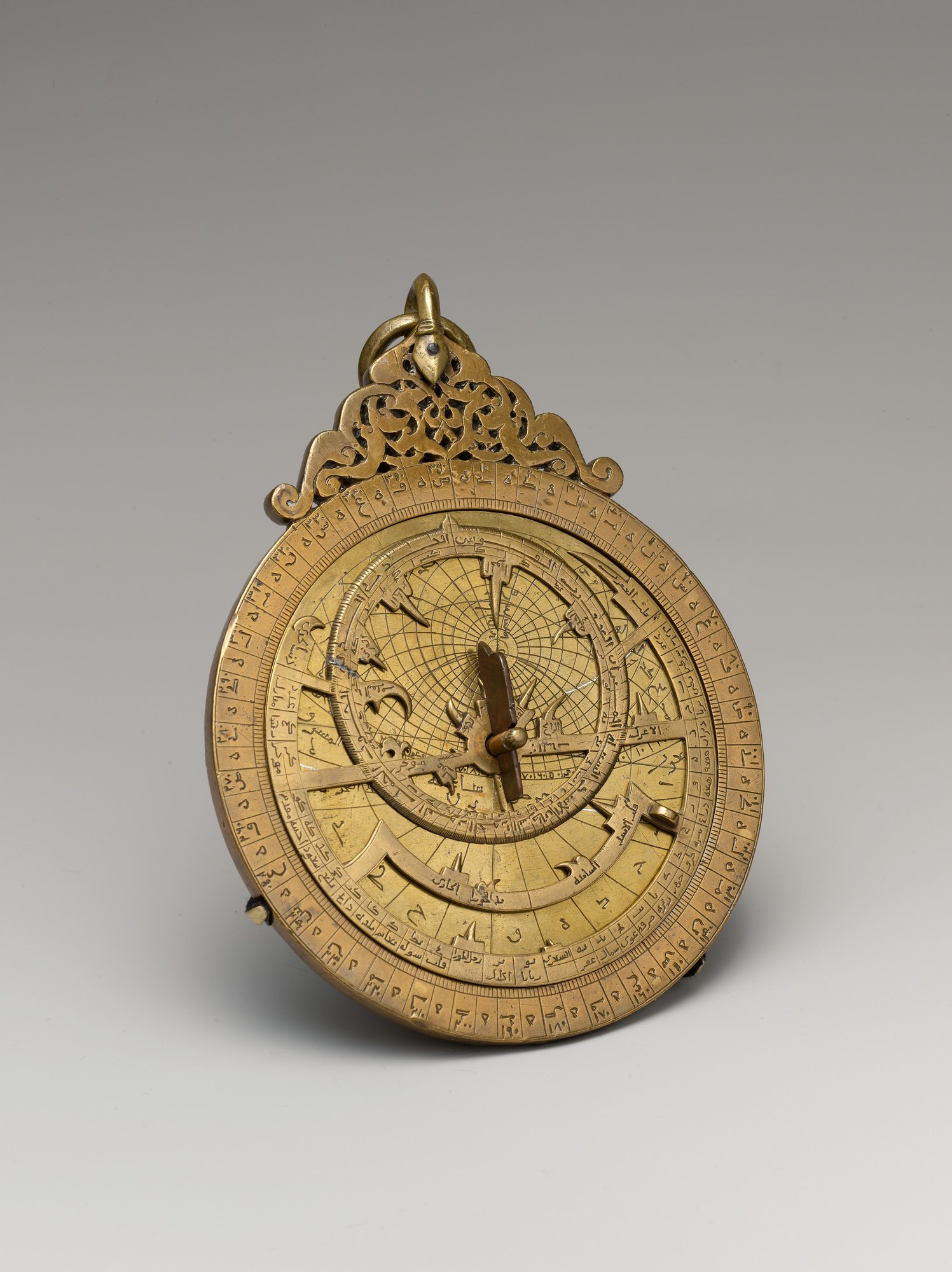
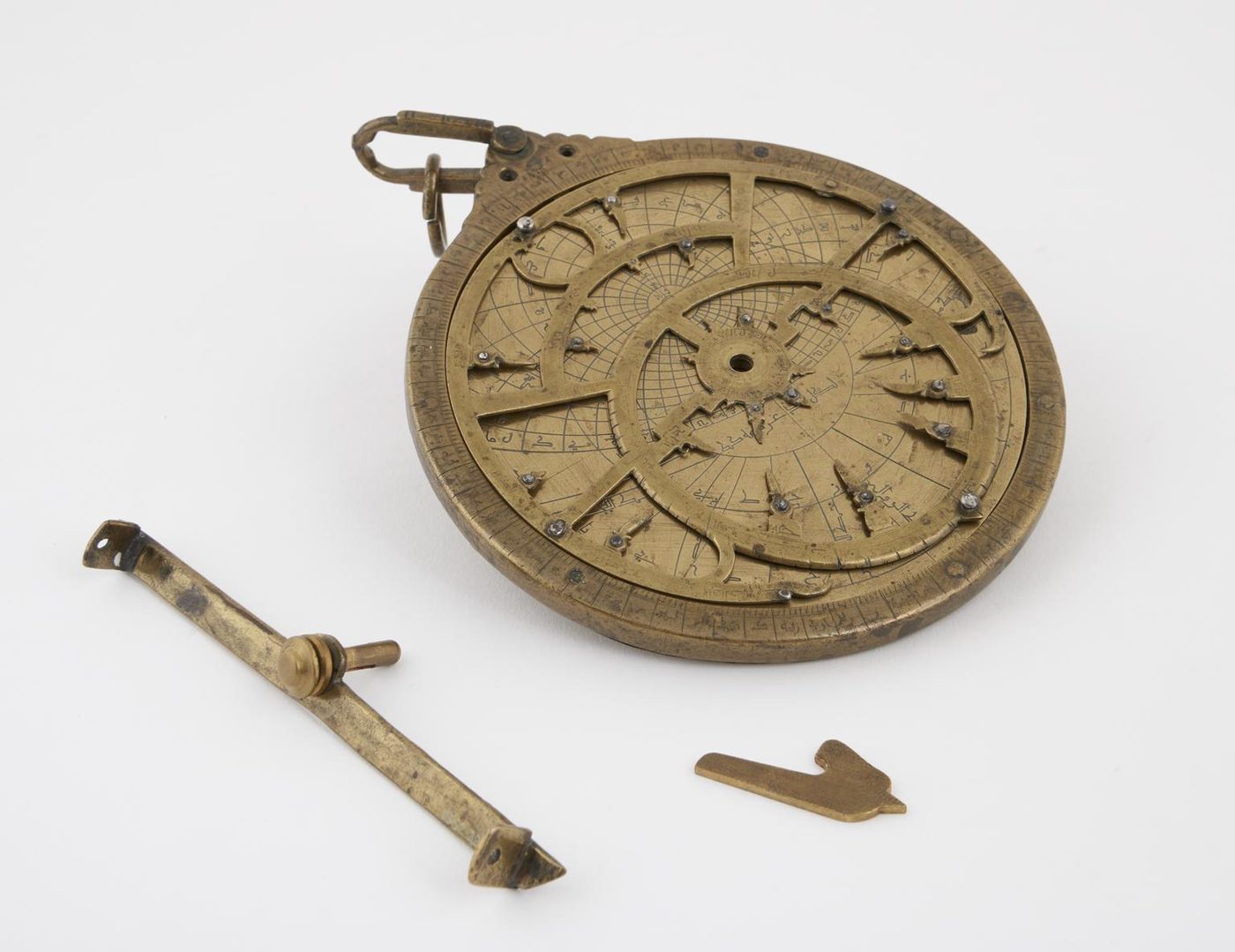
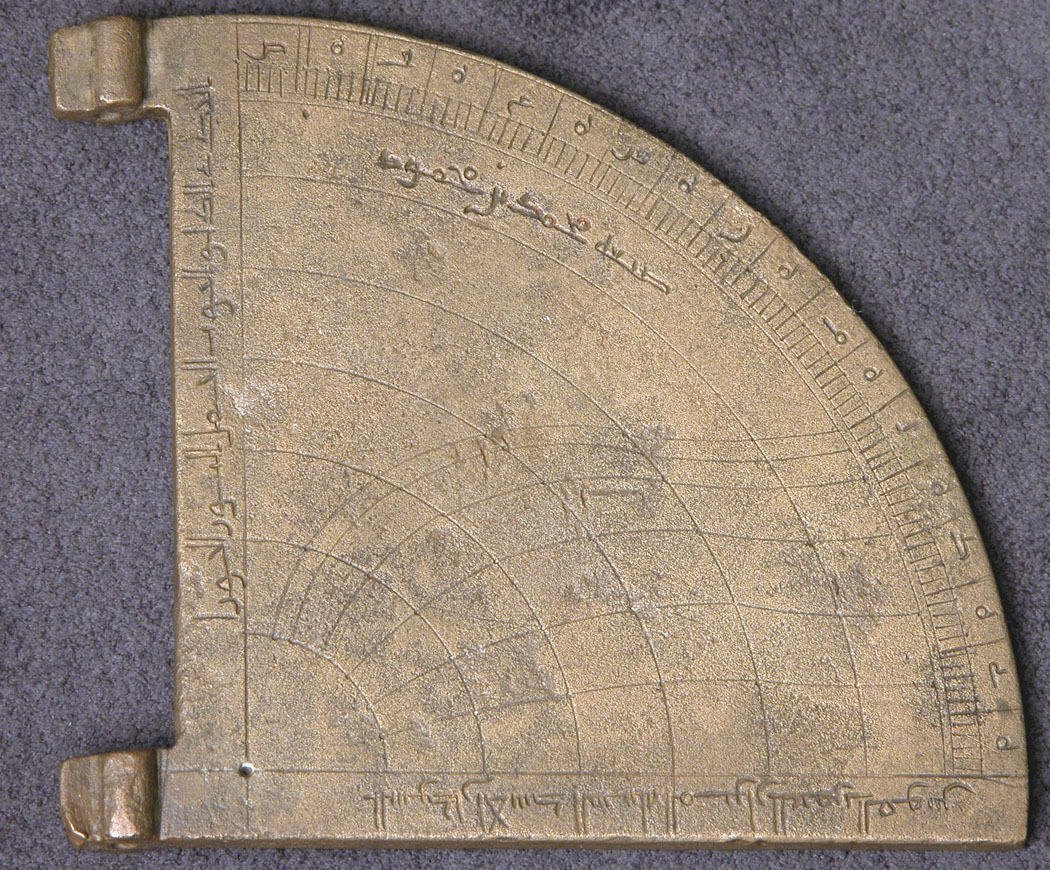
Islamic makers also extended the instrument's range. Universal astrolabes, which work at any latitude without changing plates, were developed in al-Andalus: the instrument known in Latin as the saphea is associated with the eleventh-century Toledo astronomer al-Zarqali. Quadrants, which pack much of the astrolabe's function into a quarter circle, became popular for timekeeping in the later Middle Ages. Further east, astrolabe making reached a peak of refinement in Safavid Iran and in Mughal India, where a family of makers in Lahore, founded by Allahdad in the sixteenth century, produced fine instruments for several generations.
Latin Europe: from Toledo to Nuremberg
Knowledge of the astrolabe reached Latin Europe through translations made in Spain and Italy from the late tenth century onwards. By the eleventh century Latin treatises on its construction and use were circulating, and the astrolabe became a standard teaching instrument of the medieval university curriculum in astronomy. In English, Geoffrey Chaucer wrote a Treatise on the Astrolabe around 1391, addressed to his young son Lewis — one of the earliest technical works in the English language.
European astrolabes differ in detail from Islamic ones — Latin inscriptions, star names often derived from Arabic, plates for northern European latitudes, and in many cases scales for the Christian calendar and saints' days. In the fifteenth and sixteenth centuries production concentrated in centres of mathematics and metalwork: Nuremberg, where Georg Hartmann made astrolabes in a series with standardised parts; Leuven, where Gemma Frisius and his nephew Gualterus Arsenius ran an influential workshop; Prague, where Erasmus Habermel worked for the court of Rudolf II; and London, Paris and Florence.
What the astrolabe could and could not do
- Find the time of day from the Sun's altitude, or at night from a star's, in equal or seasonal hours.
- Give the times of sunrise and sunset, the length of day and night, and the beginning and end of twilight for a given date.
- Show the rising and setting of stars and the ascendant — the point of the zodiac rising in the east, central to astrology.
- Help determine the direction of prayer and the times of the daily prayers, with suitable plates or markings.
- Measure heights and distances with the shadow square, and take altitudes for simple surveying.
- Not keep time on its own: it calculates the hour from an observation, so it needs a clear sky and a skilled user.
Its precision was limited by its size and the fineness of its engraving. A typical brass instrument of fifteen to twenty centimetres could give the time to within a few minutes in practised hands, which was better than any mechanical clock of the Middle Ages could keep over a day. That is why early mechanical clocks and astrolabes appear together: astronomers set clocks by the astrolabe, and astronomical clocks such as those described by Giovanni de' Dondi in the fourteenth century can be seen as attempts to make the astrolabe's model of the heavens run by itself. The astrolabe dial, with its turning rete, survives on many astronomical clocks, including the Prague Orloj.
Decline — and a long afterlife
In Europe the astrolabe lost its central role in the seventeenth and eighteenth centuries. Printed tables, telescopic instruments, logarithms and above all the pendulum clock gave astronomers better tools, and the astrolabe became a teaching device and a collector's piece. In the Islamic world and in India it remained in use for longer, and fine instruments were still being made in the nineteenth century. Jai Singh II's great observatories in early eighteenth-century India, while built mainly around monumental masonry instruments, included large metal astrolabes, showing how the tradition was carried into a new scale.
| Instrument | Where and when | Distinctive feature |
|---|---|---|
| Planispheric astrolabe | Late antiquity to 19th century, across Eurasia | Interchangeable latitude plates and rotating rete |
| Universal astrolabe (saphea and others) | Al-Andalus from the 11th century; Europe in the 16th | One projection usable at all latitudes |
| Spherical astrolabe | Islamic world, rare | A globe with a movable cage of star pointers |
| Horary quadrant | Islamic world and Europe, medieval and later | Quarter circle with hour lines and a plumb bob |
| Mariner's astrolabe | Iberian navigation, 15th–17th centuries | Heavy open ring for measuring altitude only |
To explore the instruments themselves, search the catalogue for 'astrolabe', 'quadrant' or 'nocturnal', or filter the Instruments collection by period. Each record shows the holding institution's photographs and description, and many include images of the back and of individual plates, where the latitude engravings that made the instrument usable in a particular city can be seen.
Sources & further reading
- In Synchrony with the Heavens: Studies in Astronomical Timekeeping and Instrumentation in Medieval Islamic Civilization — David A. King, Brill (Leiden), 2004–2005.
- Gears from the Greeks: The Antikythera Mechanism — Derek J. de Solla Price, Transactions of the American Philosophical Society 64 (7), 1974.
- A History of Mechanical Inventions — Abbott Payson Usher, McGraw-Hill (New York), 1929.
- History of the Hour: Clocks and Modern Temporal Orders — Gerhard Dohrn-van Rossum, University of Chicago Press, 1996 (German original 1992).
- Revolution in Time: Clocks and the Making of the Modern World — David S. Landes, Harvard University Press, 1983.