
Wristwatches · Wristwatch
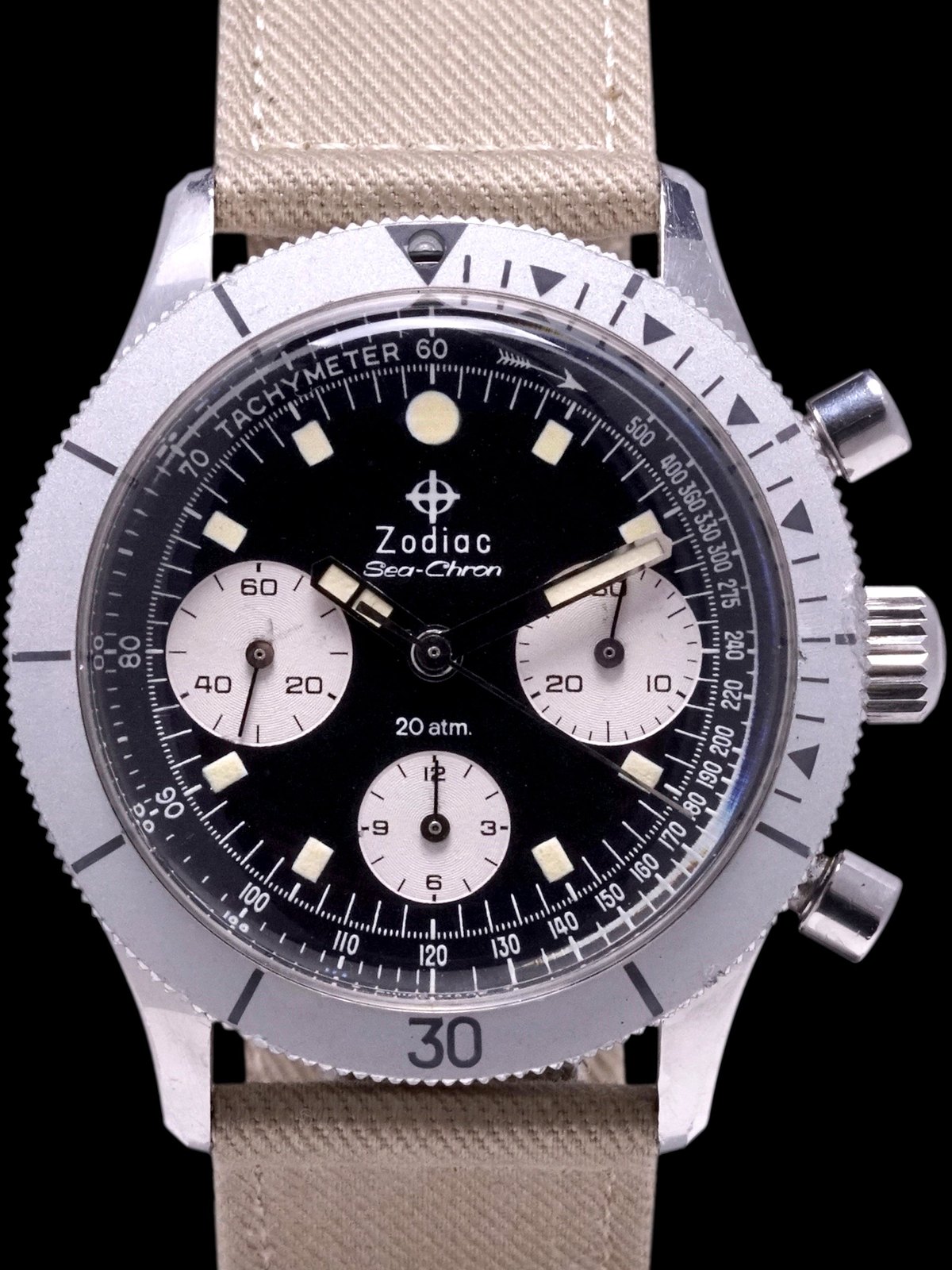
Zodiac Sea-Chron (Ref. 872-840), 1970s
- Maker / attribution
- Zodiac (maker)
- Date
- 1970s
- Historical period
- Quartz Revolution (1969 – 1990)
- Country of origin
- Switzerland
- Object type
- Wristwatch
- Stock no.
- ZSCH872840
- Credit line
- Dealer listing, Craft & Tailored (ZSCH872840)
- Catalogue title (original)
- 1970s Zodiac Sea-Chron (Ref. 872-840) (English)
View the source record (dealer listing) ↗ (opens another website in a new tab)Suggest a correction
Record summary
Catalogued by Craft & Tailored (dealer), Los Angeles (stock number ZSCH872840), this is a wristwatch by Zodiac, made in Switzerland, dated 1970s. The Atlas places it in the Quartz Revolution period (1969 – 1990) of its Wristwatches collection. The record is illustrated with 6 photographs.
Assembled from the source record's structured fields. Dates and attributions are given as the source states them; where a field is missing the Atlas leaves it blank rather than estimating.
Catalogue description
Dealer description — Craft & Tailored
The Zodiac Sea-Chron was a charming step to modernizing the brand to offer more sophisticated designs that their competitors were producing. The diving chronograph is powered by the Valjoux cal. 726 and shares some aesthetic design cues to its counterparts during the era, namely Heuer, Zenith, and Movado. However, the Sea-Chron remains unique through the classic Zodiac flare that collectors are starting to notice. SPECS Stock # ZSCH872840 Brand Zodiac Style Sea-Chron Model 872-840 Serial 22XXXXX Size Men's Material Stainless Steel Dial Matte Black Millimeters 39 Bracelet 2pc Canvas Strap CASE & BRACELET The case is in excellent condition and shows signs of being potentially lightly polished in the past while retaining thick chamfers on full and symmetrical lugs with light signs of use. The anodized pale silver bezel with dark grey accents has a unique and attractive aesthetic, the bezel is in great overall condition showing only a light amount of use at the 3 o'clock position. The case retains its original pump pushers and Zodiac signed crown. The case back retains all of its original factory markings. The watch comes supplied on a 2pc canvas strap. DIAL & HANDS The matte black chronograph dial is beautifully preserved, displaying no blemishes or damage on the dial itself. The white sub-dials show some minimal signs of age and accent the watch nicely. The tritium lume plots have aged to a charming yellow patina and exhibit no degradation when inspected under U.V. light. The original tritium hands match the dial perfectly, under U.V. light inspection the minute hand exhibits some very minor cracking and remains stable, the bottom window of the hour hand displays similar cracking and remains stable, the upper window is fully intact. ACCESSORIES None. The watch is in perfect working condition, previous service history is unknown.
Historical context
Quartz Revolution (1969 – 1990)
Seiko's Astron begins mass quartz timekeeping; traditional industries contract sharply.
Quartz and digital watches transformed the market after 1969. Swiss employment collapsed, Japanese and Hong Kong production soared, and the Swatch (1983) helped the Swiss industry recover; mechanical watches survived as luxury goods.
Read the period in the timelineMore wristwatches from this periodEarlier: Modern Mechanical Horology
Atlas type guide
Wristwatches
Bracelet watches were worn by women from the early nineteenth century — Breguet made one for Caroline Murat, Queen of Naples, in 1810–12 — but the wristwatch only became a man's instrument with military use and aviation in the early twentieth century. Between the World Wars it overtook the pocket watch; the 1920s and 1930s brought rectangular Art Deco cases, water-resistant cases and the first automatic winding systems.
After 1945 the wristwatch became a carrier of identity — dress watches, sports and dive watches, chronographs, calendars — produced by Swiss, American, Japanese, German, Soviet and Chinese industries. The quartz revolution after 1969 and the mechanical renaissance since the 1990s, including the rise of independent watchmakers, complete the story.
What to look for
- The reference number (between the lugs or inside the case back) and serial number, the starting point for dating.
- The calibre: its maker and number are often stamped under the dial or on the bridge.
- Originality of dial, hands and crown — refinished ('redial') dials are common.
- Case material marks: 18K/750, 14K/585, stainless steel, gold-filled, plated.
Dating clues
- Wire-lug cases: before c. 1925.
- Water-resistant screw-down cases: from 1926.
- Quartz movements: from 1969; sapphire crystals widespread after c. 1980.
General guidance written by the Atlas editors about this kind of object. It is not a statement about this particular piece; for that, rely on the source record above and on physical examination.
Related records
Wristwatches · c. 1960
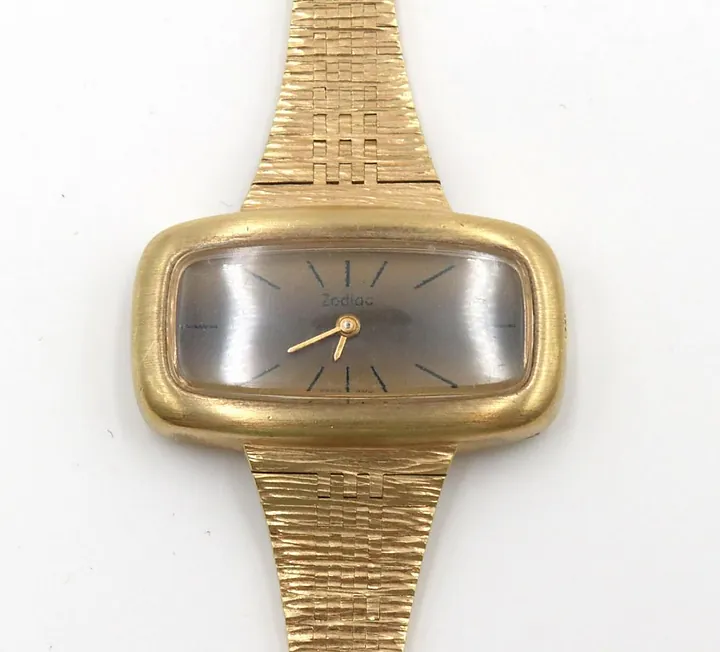
Unusual Shaped Ladies Zodiac Wristwatch, c. 1960
LiveAuctioneers auction archive
Wristwatches · c. 1960
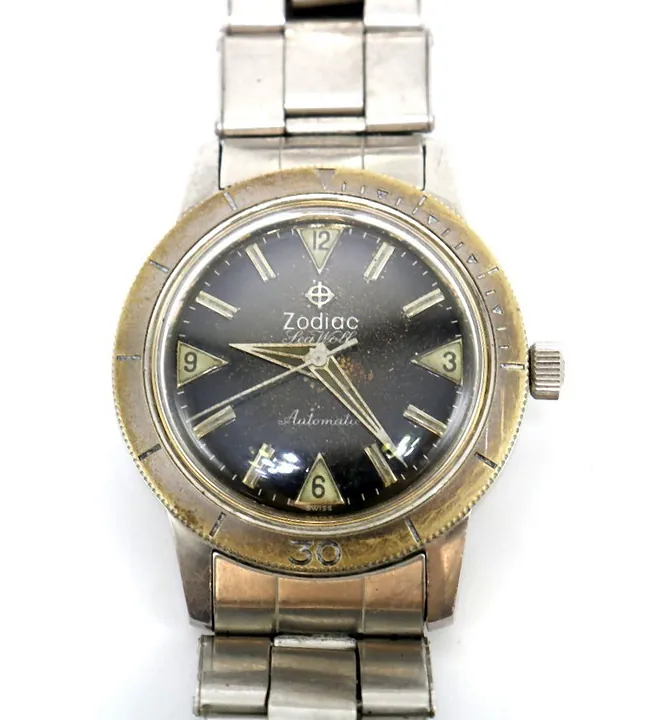
Zodiac Automatic Dive Stainless Steel Wristwatch, c. 1960
LiveAuctioneers auction archive
Wristwatches · 1970s
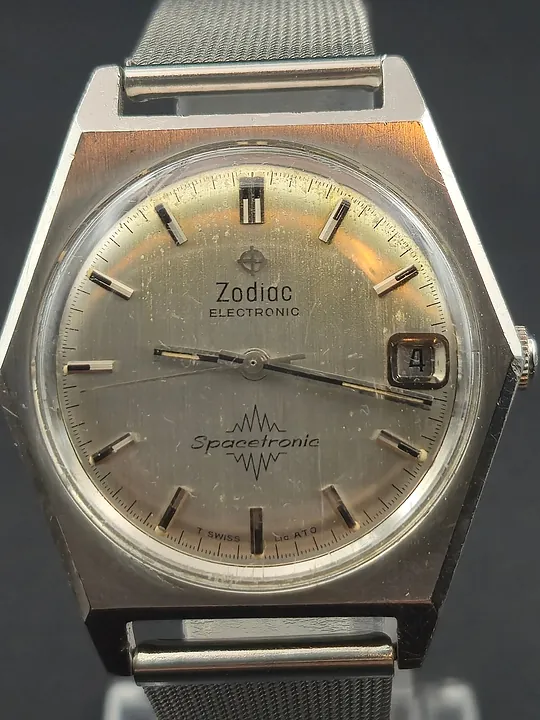
1970s Zodiac Spacetronic Electronic 36mm Men’s Watch Cal. 91 Runs
LiveAuctioneers auction archive
Wristwatches · 1960s
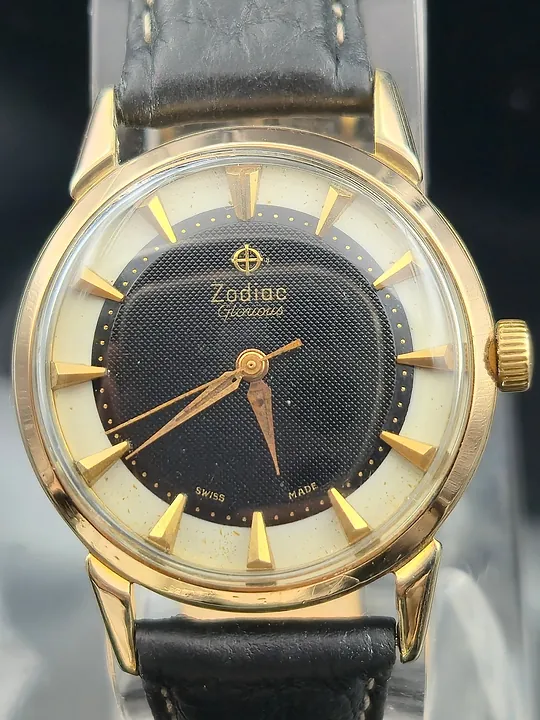
1960s Zodiac Glorious Cal. 1094 17J Gold-Tone Textured Dial Dress Watch
LiveAuctioneers auction archive

Wristwatches · 1970
Wristwatch by Heno, Switzerland, 1970
Museum Rotterdam

Wristwatches · 1960–1986
'Tri-Compax' calendar chronograph wristwatch in gold case, by Universal, Geneva, Switzerland, 1960–1986.
Science Museum Group, London

Wristwatches · 1969–1970
Beta 21 Quartz wristwatch movement, made in Switzerland, 1970.
Science Museum Group, London

Wristwatches · c. 1969
Omega Speedmaster Moonwatch, ref. 145022-69st, c. 1969
Antiquorum auction archive, Geneva