
Wristwatches · Wristwatch
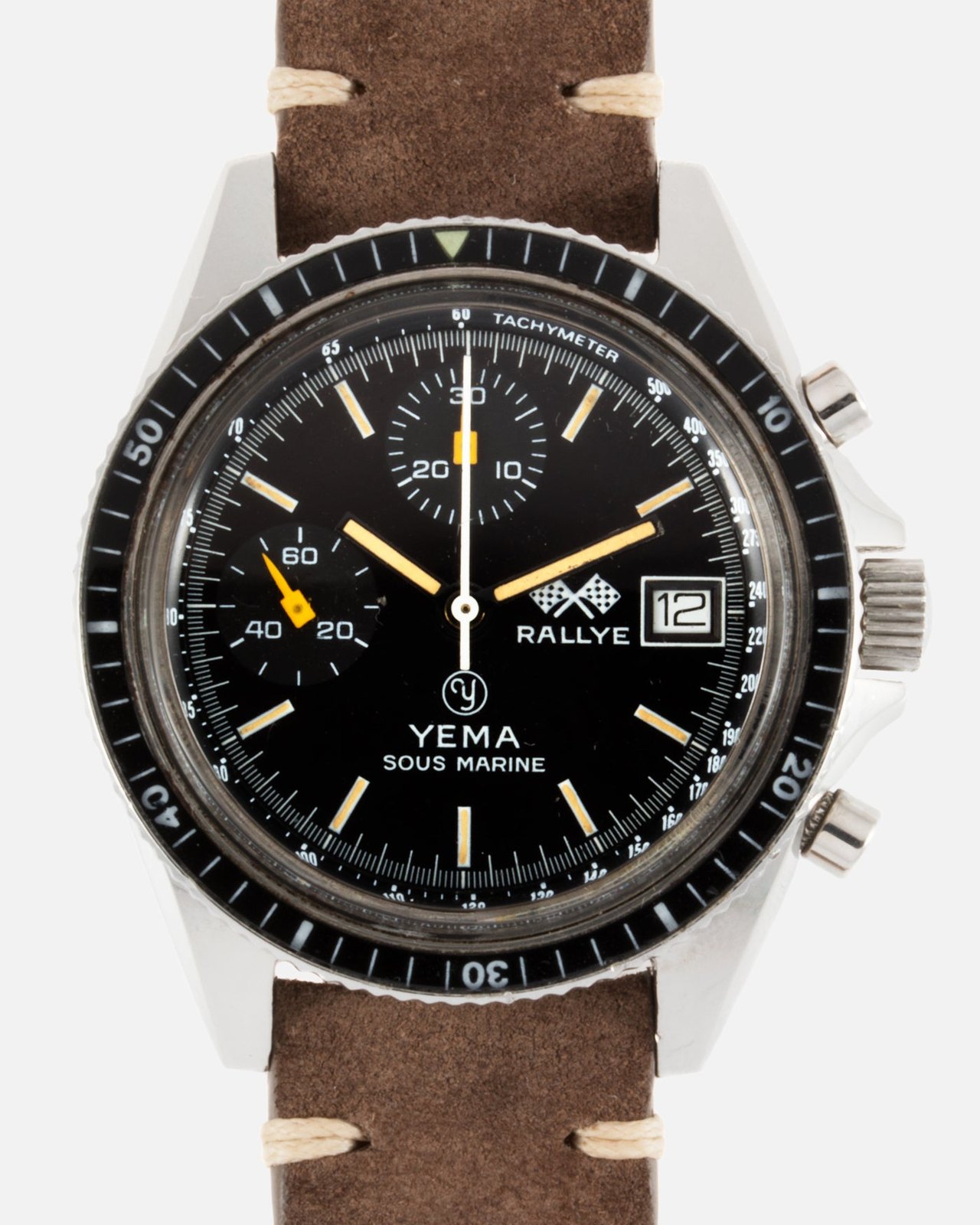
Yema Rallye Sous Marine, 1970s
- Maker / attribution
- Yema (maker)
- Date
- 1970s
- Historical period
- Quartz Revolution (1969 – 1990)
- Country of origin
- Unrecorded in source
- Object type
- Wristwatch
- Dimensions
- Case 39 mm
- Stock no.
- Product 764316811351
- Credit line
- Dealer listing, S.Song Watches (product 764316811351)
- Catalogue title (original)
- Yema Rallye Sous Marine (English)
View the source record (dealer listing) ↗ (opens another website in a new tab)Suggest a correction
Record summary
Catalogued by S.Song Watches (dealer), Seattle (stock number Product 764316811351), this is a wristwatch by Yema, dated 1970s. The Atlas places it in the Quartz Revolution period (1969 – 1990) of its Wristwatches collection. Recorded dimensions: Case 39 mm. The record is illustrated with 6 photographs.
Assembled from the source record's structured fields. Dates and attributions are given as the source states them; where a field is missing the Atlas leaves it blank rather than estimating.
Catalogue description
Dealer description — S.Song Watches
In recent years, Yema has gained a huge following largely due to their uniquely quirky dial design and characteristically French roots. With that being said, the Yema Rallye Sous Marine, or in English, the Yema Rally Submarine is in itself a quirky contradiction. The name suggests this immediately, with both the watch being targeted to race drivers (rally) and divers (submarine). With a tachymeter scale and chronograph function, I would say this is more of a racing watch than a diving one, but the inclusion of sous marine is very interesting. The Rallye Sous Marine is a very muscular watch, with typical 70’s design styling. It has a bulky stainless steel case with thick bevels and a glossy lacquered dial with luminous index markers and stick hands. This is coupled with a tachymeter scale on the tension ring, a very attractive acrylic bezel and finished off with rally flags on the dial. The Rallye Sous Marine is a fairly rare watch, especially in this all black configuration, but what sets this example apart is the stunning condition. It looks to have been sparingly worn and the glossy dial and stainless steel case is immaculate. On the wrist, it has a very sporty presence and with its large 39mm size, it remains very relevant even amongst modern watches.
Historical context
Quartz Revolution (1969 – 1990)
Seiko's Astron begins mass quartz timekeeping; traditional industries contract sharply.
Quartz and digital watches transformed the market after 1969. Swiss employment collapsed, Japanese and Hong Kong production soared, and the Swatch (1983) helped the Swiss industry recover; mechanical watches survived as luxury goods.
Read the period in the timelineMore wristwatches from this periodEarlier: Modern Mechanical Horology
Atlas type guide
Dive and water-resistant watches
Keeping water and dust out of a wristwatch was a long-standing challenge. Rolex's screw-down Oyster case (1926) and Omega's Marine (1932) were landmarks; in the early 1950s Blancpain's Fifty Fathoms and Rolex's Submariner defined the professional dive watch with rotating bezels for timing dives, luminous dials and high water resistance. The ISO 6425 standard (1982) later codified what a 'diver's watch' must do.
Dive watches became icons of post-war design and exploration, and their evolution — helium escape valves, ceramic bezels, saturation-diving depth ratings — records the history of underwater work.
What to look for
- Unidirectional or bidirectional rotating bezel with minute markings.
- Screw-down crown and case back; depth rating printed on the dial.
- Luminous hands and markers (radium before c. 1960, tritium c. 1960–1998, then Super-LumiNova).
- Reference numbers on the case between the lugs or inside the back.
Dating clues
- Screw-down Oyster cases: from 1926.
- Professional dive watches: from 1953.
- Tritium 'T' marks on dials: c. 1960–1998.
General guidance written by the Atlas editors about this kind of object. It is not a statement about this particular piece; for that, rely on the source record above and on physical examination.
Related records
Wristwatches · 1970s
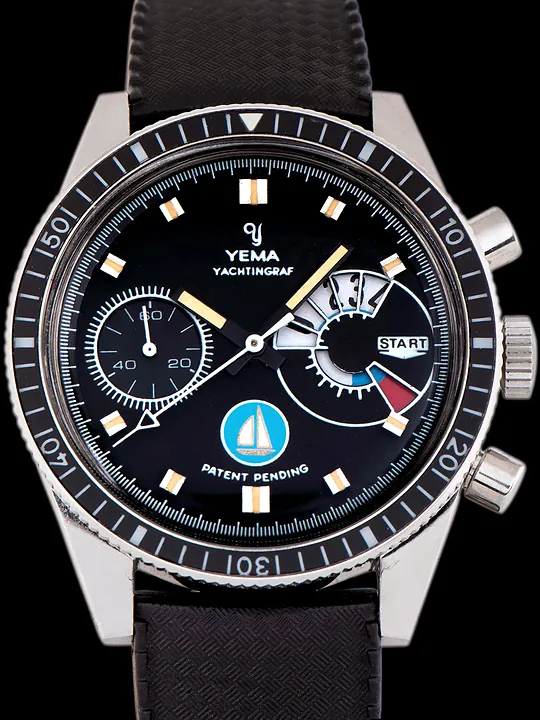
Yema Yachtingraf Régate (Ref. 5667370) "Blue Ship", 1970s
Craft & Tailored (dealer), Los Angeles
Wristwatches · 1960s
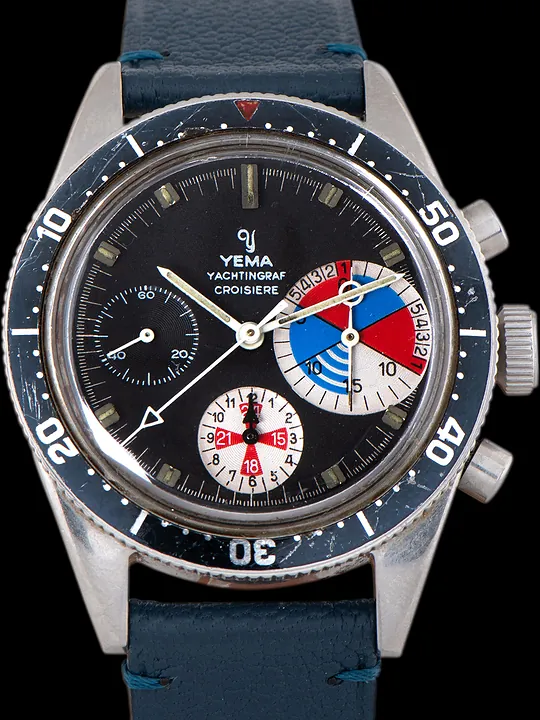
Yema Yachtingraf Croisière (Ref. 93012) "Big Eye", 1960s
Craft & Tailored (dealer), Los Angeles
Wristwatches · 1998
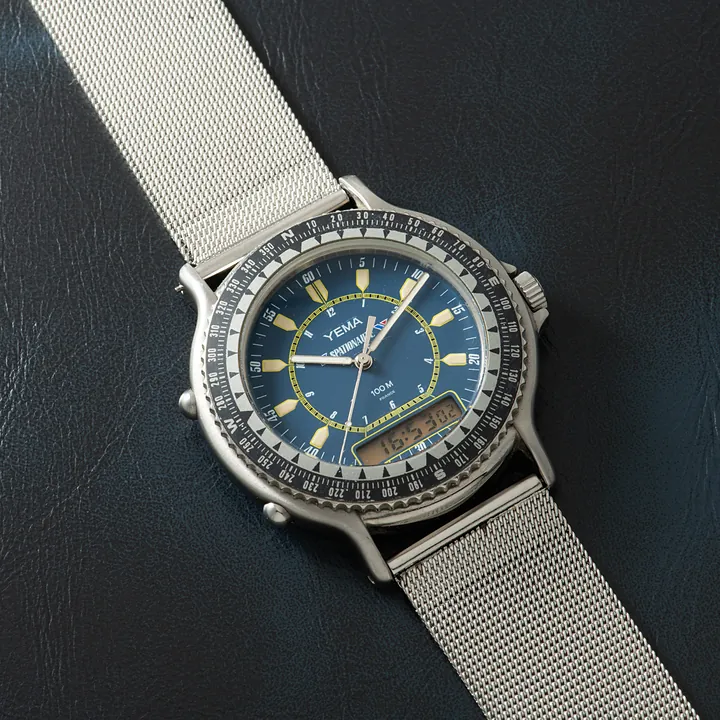
Yema Spationaute ISS, 1998
Analog/Shift (dealer), New York
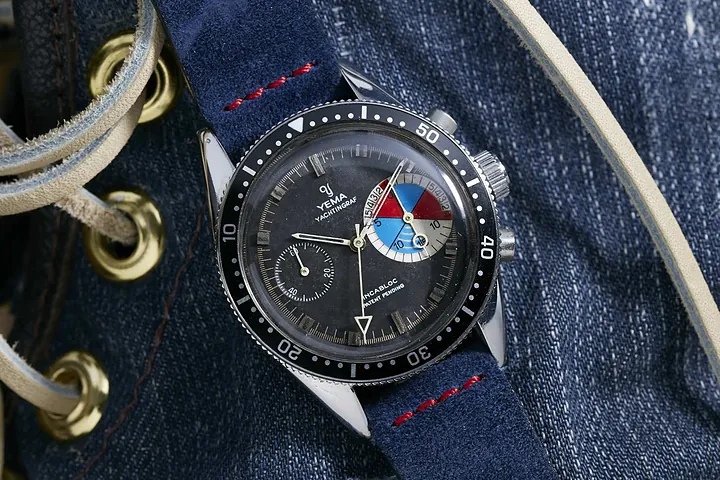
Wristwatches · late 1960s
Yema Yachtingraf, late 1960s
Analog/Shift (dealer), New York

Wristwatches · 1970
Wristwatch by Heno, Switzerland, 1970
Museum Rotterdam
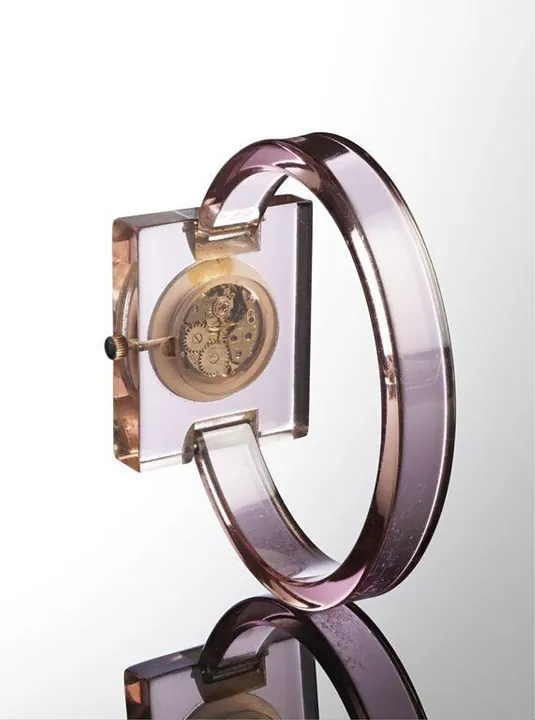
Wristwatches · 1970s
Wristwatch, plastic, by Gucci; Italy, 1970s.
Victoria and Albert Museum, London
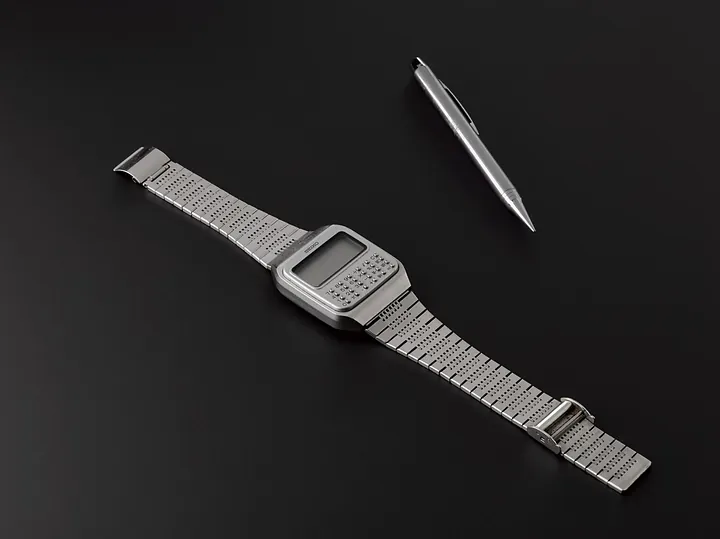
Wristwatches · 1978
Calculator wristwatch by Suwa Seikosha Co. Limited, Japan, 1978
Science Museum Group, London
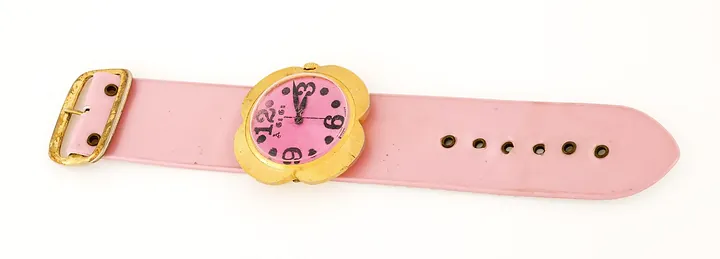
Wristwatches · 1980
Wristwatch, 1980 (no. 71413)
Museum Rotterdam