
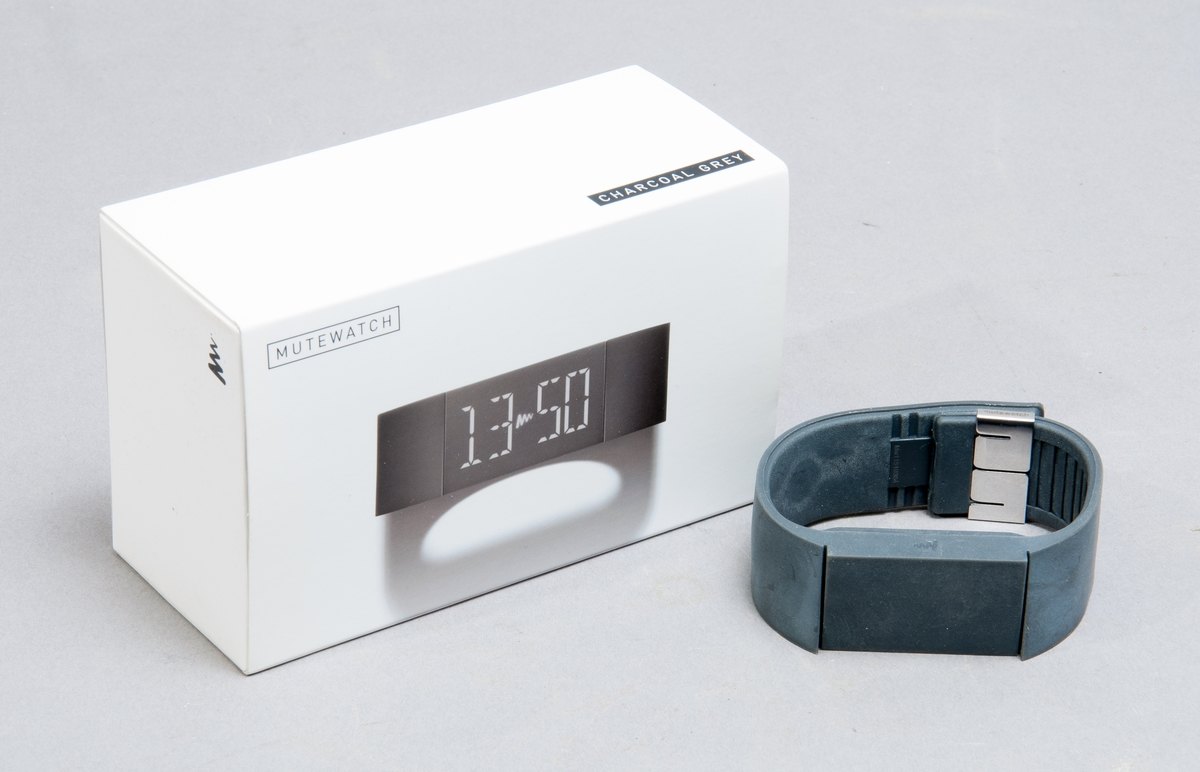
Wristwatches · Wristwatch
Wristwatch by Mindful Wearables AB, Sweden, 2011
- Maker / attribution
- Mindful Wearables AB (Maker)
- Date
- 2011
- Historical period
- Contemporary Horology (2010 – Present)
- Country of origin
- Sweden
- Place
- Taiwan, TW
- Object type
- Wristwatch
- Materials / technique
- Plast, gummi bakelit och liknande Papper
- Dimensions
- Vikt 0.15 kg Bredd 25.0 mm Tjocklek 12.5 mm
- Holding institution
- Swedish National Museum of Science and Technology
- Accession / object no.
- TEKS0057612
- Credit line
- Swedish National Museum of Science and Technology
- Catalogue title (original)
- Armbandsur (Swedish)
View the source record ↗ (opens another website in a new tab)Suggest a correction
Record summary
Held and catalogued by Swedish National Museum of Science and Technology (object number TEKS0057612), this is a wristwatch by Mindful Wearables AB, made in Taiwan, TW, Sweden, dated 2011. The Atlas places it in the Contemporary Horology period (2010 – Present) of its Wristwatches collection. Materials and techniques recorded by the source: Plast, gummi bakelit och liknande Papper. Recorded dimensions: Vikt 0.15 kg Bredd 25.0 mm Tjocklek 12.5 mm. The record is illustrated with 3 photographs.
Assembled from the source record's structured fields. Dates and attributions are given as the source states them; where a field is missing the Atlas leaves it blank rather than estimating.
Catalogue description
Catalogue description from Swedish National Museum of Science and Technology
Klockan består av ett grått gummiliknade material med originalkartong och beskrivning. I förpackning av papp. Vikt 41 gram Drivs av 2 st knappceller LED-display 100 Hz rate Idén bakom MuteWatch prisbelönats första gången 2007 i idétävlingen Guldräven vid Handelshögskolan i Stockholm. Produkten utvecklades av ett helsvenskt team som världens första klocka med touchscreen Produkten fick Red DOT Design Award inom kategorin industrial design 2012. Efter 20000 skeppade exemplar via butiker som MoMA, Selfridges, Fred Segal och Lane Crawford las produktionen av version 1 ned 2013. Produkten sålde slut inom några timmar när bolaget utannonserade i början av 2014 och produkten sägs ha inspirerat en rad produkter inom produktkategorin Wearables. Utvecklad och lanserad av bland annat Mai-Li Hammargren, Oscar Ritzén Praglowski, Gustav Hammargren, Johan Thelander, Livia Moore, Fredrik Lundin, Marcus Rudbäck von Euler, Andreas Enqvist, Erik Petersén, Tua Asplund, Malin Spjut och Gabriel Olsson.
Shown in the original language of the source catalogue. An editor-reviewed English translation has not yet been published; we do not publish machine translations as authoritative text.
Historical context
Contemporary Horology (2010 – Present)
Silicon components, connected watches, optical-lattice research clocks and a thriving independent scene.
Smartwatches became the world's best-selling watches, while mechanical watchmaking focuses on craft, innovation (silicon components, new escapements) and independent makers.
Read the period in the timelineMore wristwatches from this periodEarlier: Mechanical Renaissance
Atlas type guide
Wristwatches
Bracelet watches were worn by women from the early nineteenth century — Breguet made one for Caroline Murat, Queen of Naples, in 1810–12 — but the wristwatch only became a man's instrument with military use and aviation in the early twentieth century. Between the World Wars it overtook the pocket watch; the 1920s and 1930s brought rectangular Art Deco cases, water-resistant cases and the first automatic winding systems.
After 1945 the wristwatch became a carrier of identity — dress watches, sports and dive watches, chronographs, calendars — produced by Swiss, American, Japanese, German, Soviet and Chinese industries. The quartz revolution after 1969 and the mechanical renaissance since the 1990s, including the rise of independent watchmakers, complete the story.
What to look for
- The reference number (between the lugs or inside the case back) and serial number, the starting point for dating.
- The calibre: its maker and number are often stamped under the dial or on the bridge.
- Originality of dial, hands and crown — refinished ('redial') dials are common.
- Case material marks: 18K/750, 14K/585, stainless steel, gold-filled, plated.
Dating clues
- Wire-lug cases: before c. 1925.
- Water-resistant screw-down cases: from 1926.
- Quartz movements: from 1969; sapphire crystals widespread after c. 1980.
General guidance written by the Atlas editors about this kind of object. It is not a statement about this particular piece; for that, rely on the source record above and on physical examination.
Related records
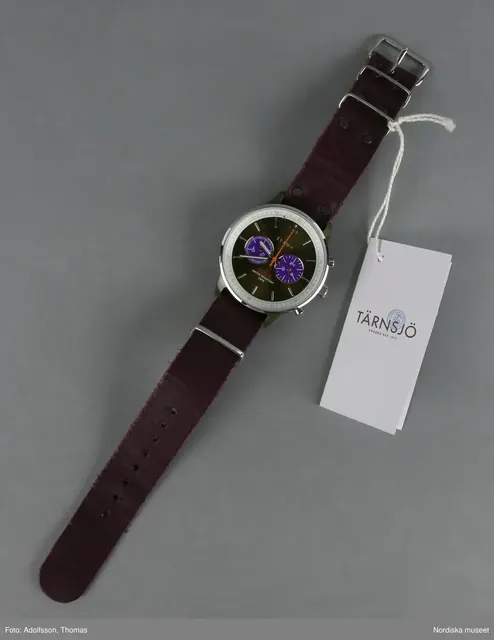
Wristwatches · 2011
Wristwatch by Triwa, Sweden, 2011
Nordic Museum Foundation
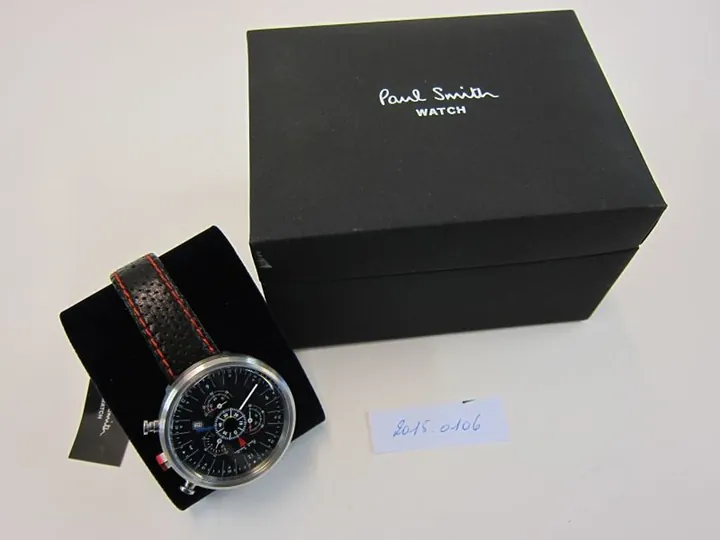
Wristwatches · 2010
Wristwatch, 2010
Modemuseum Hasselt
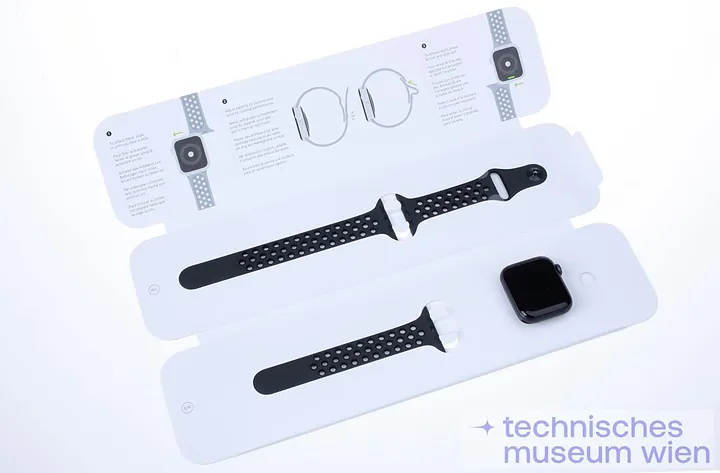
Wristwatches · 2018 (Series 4 released in September 2018; '1977' in the source is the model number A1977)
Apple Watch Series 4 (GPS, 40 mm, model A1977), 2018
Vienna Museum of Science and Technology
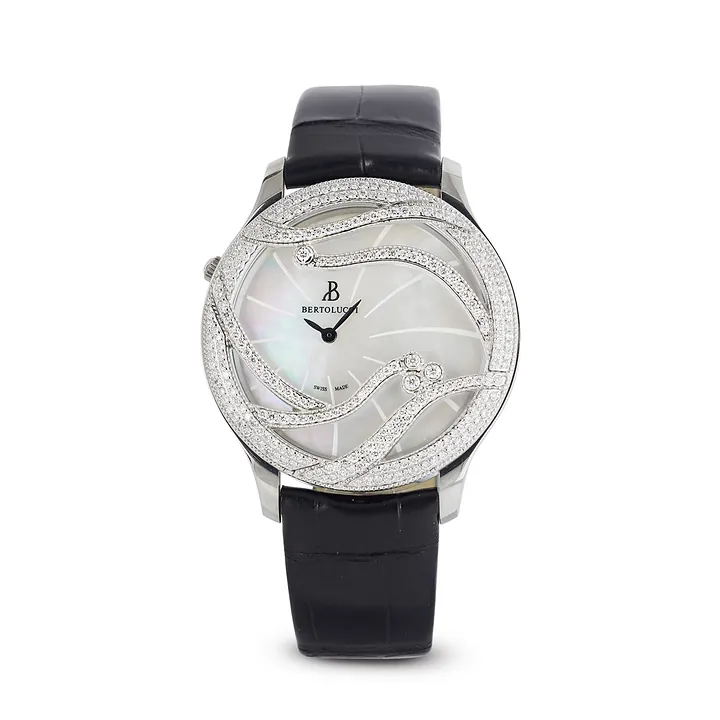
Wristwatches · c. 2010s
Bertolucci Stria III, ref. 11513.50.45.B88.6C1.501, c. 2010s
Antiquorum auction archive, Geneva
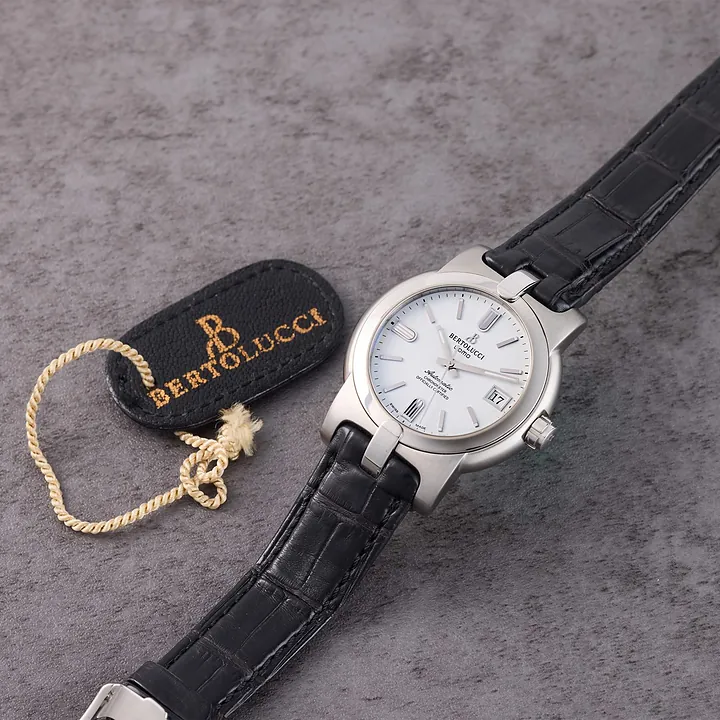
Wristwatches · c. 2010s
Bertolucci Uoma, ref. 824.51.41.10B, c. 2010s
Antiquorum auction archive, Geneva

Wristwatches · c. 2010s
Breguet Type XXI, ref. 3810, c. 2010s (Antiquorum Lot 381-24)
Antiquorum auction archive, Geneva

Wristwatches · c. 2010s
Breguet Type XXI, ref. 3810, c. 2010s (Antiquorum Lot 386-229)
Antiquorum auction archive, Geneva

Wristwatches · Sold in September 2010
Breitling Cosmonaute, ref. A 22322, Sold in September 2010
Antiquorum auction archive, Geneva