
Wristwatches · Wristwatch
Wristwatch, 1970–1989
- Maker / attribution
- Unrecorded in source
- Date
- 1970–1989
- Historical period
- Quartz Revolution (1969 – 1990)
- Country of origin
- Unrecorded in source
- Object type
- Wristwatch
- Dimensions
- length, min. 16.2 cm; diameter 3.5 cm
- Holding institution
- Turun kaupunginmuseo
- Accession / object no.
- TKM23103:30
- Credit line
- Turun kaupunginmuseo (via Finna)
- Catalogue title (original)
- kello; rannekello (Finnish)
View the source record ↗ (opens another website in a new tab)Suggest a correction
Record summary
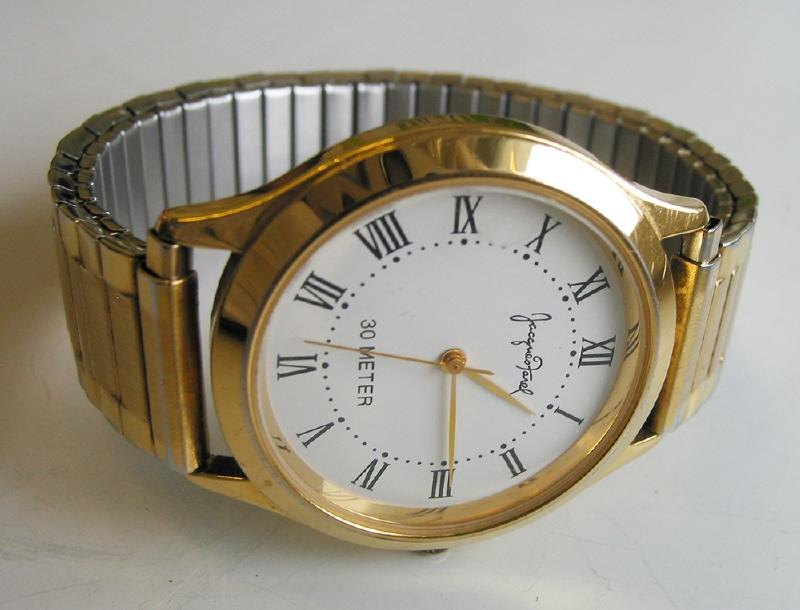
Held and catalogued by Turun kaupunginmuseo (object number TKM23103:30), this is a wristwatch, dated 1970–1989. The Atlas places it in the Quartz Revolution period (1969 – 1990) of its Wristwatches collection. Recorded dimensions: length, min. 16.2 cm; diameter 3.5 cm. The record is illustrated with 1 photograph.
Assembled from the source record's structured fields. Dates and attributions are given as the source states them; where a field is missing the Atlas leaves it blank rather than estimating.
Catalogue description
Description — Turun kaupunginmuseo
fyysinen kuvaus: Rannekello, jossa kullanvärinen kuori ja venyvä ranneke; rannekkeen jaokkeet ranteen puolella terästä, ulkopinnalla osittain kullanväriset. Kellon takakansi terästä. Etukannessa lasi. Valkoinen kellotaulu, jossa painetut roomalaiset numerot I -XII. Minuutteja osoittavat pienet mustat pisteet. Kuoressa numero 3:n kohdalla ruuvinuppi, jolla kello sekä vedetään että viisareita siirretään.
Shown in the original language of the source catalogue. An editor-reviewed English translation has not yet been published; we do not publish machine translations as authoritative text.
Inscriptions & marks
kellotaulussa musta painettu teksti Jacques Jarel 30 METER liikemerkki painatus; kuoren takakannessa syväleima STAINLESS STEEL BACK WATER RESISTANT Jacques Jarel SERIAL NO. 040689 liikemerkki leimaus
Historical context
Quartz Revolution (1969 – 1990)
Seiko's Astron begins mass quartz timekeeping; traditional industries contract sharply.
Quartz and digital watches transformed the market after 1969. Swiss employment collapsed, Japanese and Hong Kong production soared, and the Swatch (1983) helped the Swiss industry recover; mechanical watches survived as luxury goods.
Read the period in the timelineMore wristwatches from this periodEarlier: Modern Mechanical Horology
Atlas type guide
Wristwatches
Bracelet watches were worn by women from the early nineteenth century — Breguet made one for Caroline Murat, Queen of Naples, in 1810–12 — but the wristwatch only became a man's instrument with military use and aviation in the early twentieth century. Between the World Wars it overtook the pocket watch; the 1920s and 1930s brought rectangular Art Deco cases, water-resistant cases and the first automatic winding systems.
After 1945 the wristwatch became a carrier of identity — dress watches, sports and dive watches, chronographs, calendars — produced by Swiss, American, Japanese, German, Soviet and Chinese industries. The quartz revolution after 1969 and the mechanical renaissance since the 1990s, including the rise of independent watchmakers, complete the story.
What to look for
- The reference number (between the lugs or inside the case back) and serial number, the starting point for dating.
- The calibre: its maker and number are often stamped under the dial or on the bridge.
- Originality of dial, hands and crown — refinished ('redial') dials are common.
- Case material marks: 18K/750, 14K/585, stainless steel, gold-filled, plated.
Dating clues
- Wire-lug cases: before c. 1925.
- Water-resistant screw-down cases: from 1926.
- Quartz movements: from 1969; sapphire crystals widespread after c. 1980.
General guidance written by the Atlas editors about this kind of object. It is not a statement about this particular piece; for that, rely on the source record above and on physical examination.
Related records

Wristwatches · 1970
Wristwatch by Heno, Switzerland, 1970
Museum Rotterdam
Wristwatches · 1970s
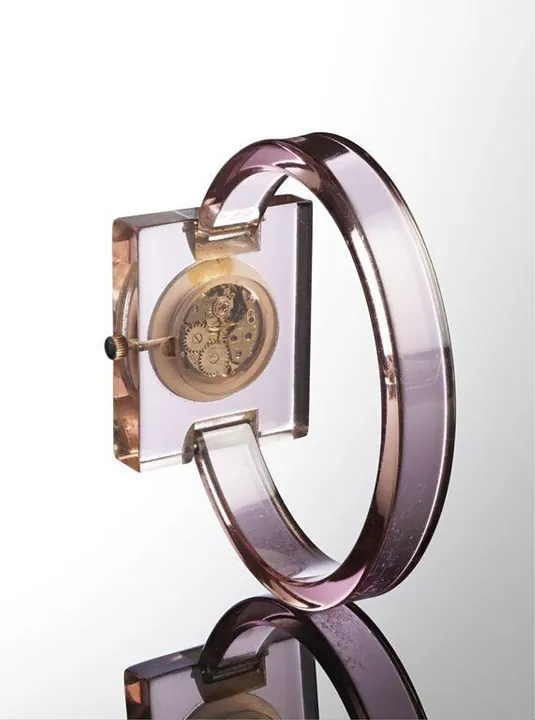
Wristwatch, plastic, by Gucci; Italy, 1970s.
Victoria and Albert Museum, London
Wristwatches · 1978
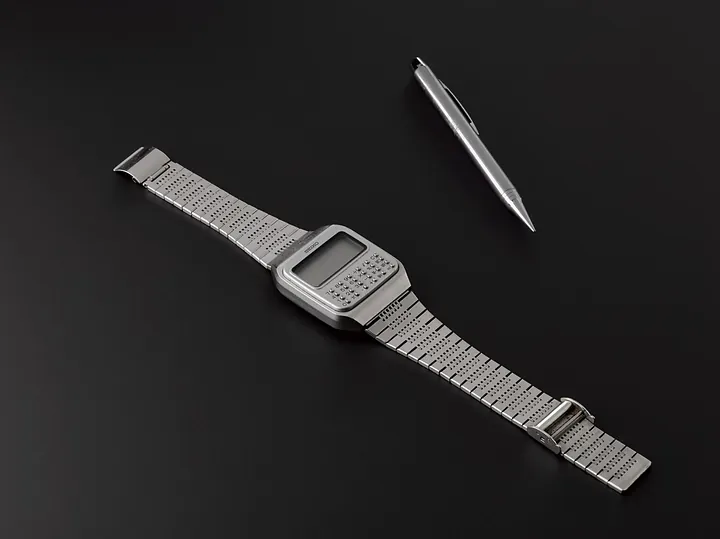
Calculator wristwatch by Suwa Seikosha Co. Limited, Japan, 1978
Science Museum Group, London
Wristwatches · 1980
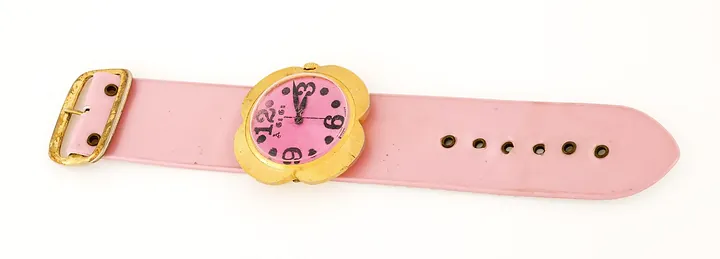
Wristwatch, 1980 (no. 71413)
Museum Rotterdam
Wristwatches · 1980
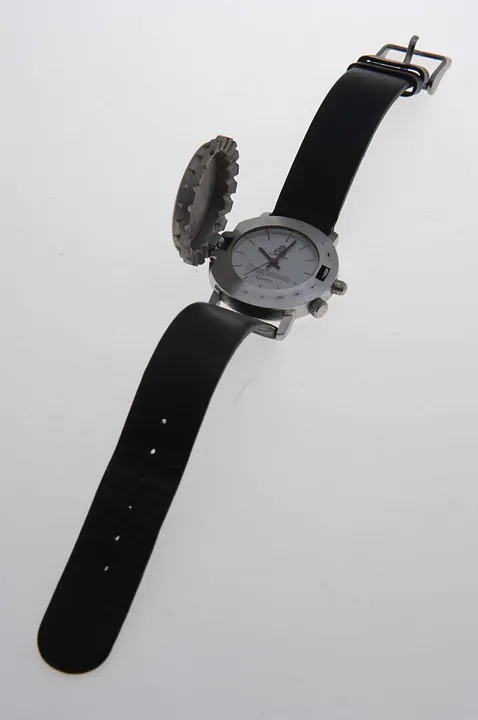
Wristwatch, 1980 (no. 91477)
Museum Rotterdam
Wristwatches · 1980–1982
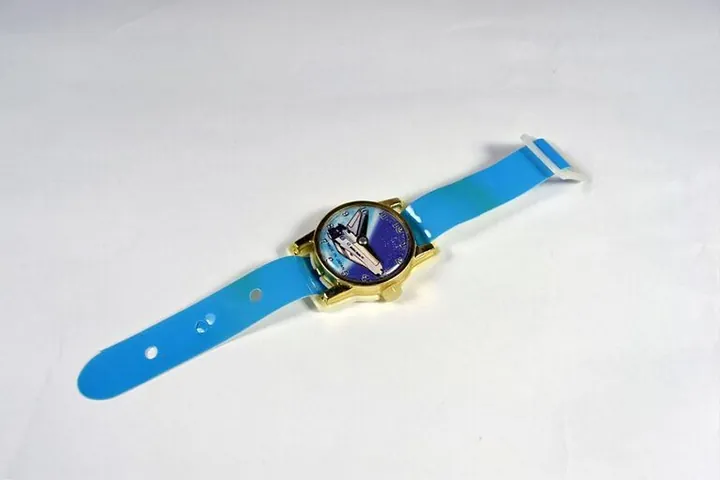
Wristwatch, Space Shuttle; plastic, Japan, 1970-1979?
Victoria and Albert Museum, London
Wristwatches · 1949–1992
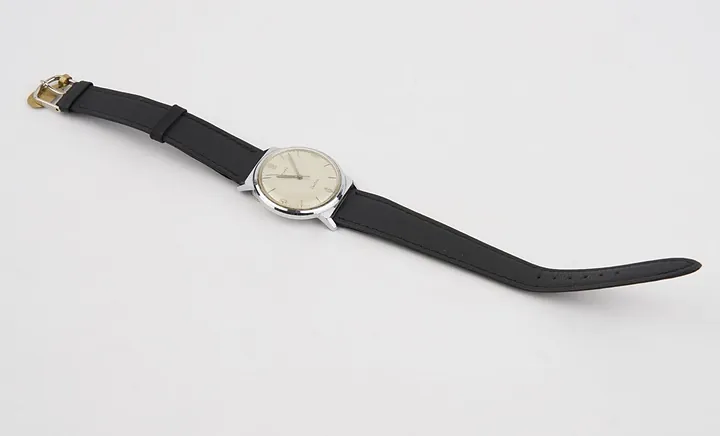
Timex `Electric' wristwatch, with electrically operated balance wheel mechanism, United States, 1949–1992
Science Museum Group, London

Wristwatches · 1960–1986
'Tri-Compax' calendar chronograph wristwatch in gold case, by Universal, Geneva, Switzerland, 1960–1986.
Science Museum Group, London