
Pocket Watches · Watch
Watch, France, 1583–1800
- Maker / attribution
- Unrecorded in source
- Date
- 1583 (pour la boîte); 1700–1800 (pour le dial and le movement)
- Historical period
- Renaissance Horology (1400 – 1600)
- Country of origin
- France
- Place
- France
- Object type
- Watch
- Materials / technique
- brass
- Dimensions
- height 8 cm; width 5,5 cm; thickness 2 cm
- Holding institution
- Musée du Louvre, Paris
- Accession / object no.
- OA 677
- Credit line
- Musée du Louvre, Département des Objets d'art du Moyen Age, de la Renaissance et des temps modernes
- Catalogue title (original)
- Montre en forme de croix (French)
View the source record ↗ (opens another website in a new tab)Suggest a correction
Record summary
Held and catalogued by Musée du Louvre, Paris (object number OA 677), this is a watch, made in France, dated 1583 (pour la boîte); 1700–1800 (pour le dial and le movement). The Atlas places it in the Renaissance Horology period (1400 – 1600) of its Pocket Watches collection. Materials and techniques recorded by the source: brass. Recorded dimensions: height 8 cm; width 5,5 cm; thickness 2 cm. The record is illustrated with 6 photographs.
Assembled from the source record's structured fields. Dates and attributions are given as the source states them; where a field is missing the Atlas leaves it blank rather than estimating.
Catalogue description
Catalogue description — Musée du Louvre (French)
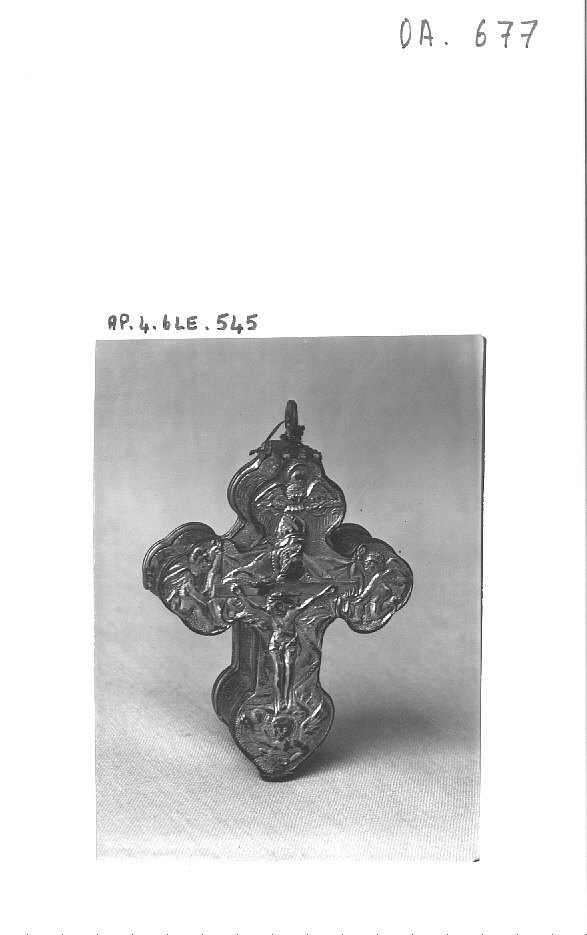
Montre en forme de croix latine à extrémités trilobées en laiton gravé et repoussé. Le couvercle de l'une des faces, monté à charnière, présente, à l'intersection des bras de la croix, une lentille de cristal laissant voir le cadran horaire. Il est décoré sur les bras : du Saint Esprit en haut, de l'ange Gabriel à gauche, de la Vierge de l'Annonciation à droite, et de la Nativité en bas. Son revers est gravé de la date 1583, des initiales H.M. (pour Myrmécide, horloger de Paris ?). La plaque du cadran horaire, munie d'un cercle d'argent et de deux aiguilles dorées, est gravée d'emblèmes du Temps, ainsi que de la Mort poursuivant un Amour. Sur la seconde face formant également couvercle, Dieu le Père entouré du Saint Esprit et de trois angelots, tient verticalement sur ses genoux le Christ en croix. A l'intérieur, le mouvement est masqué par une plaque découpée, sans signature d'horloger. La frise de l'épaisseur de la montre est gravée de têtes d'angelots au milieu de feuillages sur fond sablé. 1583 pour la boîte ; XVIIIe siècle (pour le cadran et le mouvement).
Shown in the original language of the source catalogue. An editor-reviewed English translation has not yet been published; we do not publish machine translations as authoritative text.
Dating and period as catalogued (French)
Date de création/fabrication : 1585 - 1600 et 1583 (pour la boîte) et 1700 - 1800 (pour le cadran et le mouvement)
Shown in the original language of the source catalogue. An editor-reviewed English translation has not yet been published; we do not publish machine translations as authoritative text.
Materials and techniques as catalogued (French)
Matériau : laiton · Technique : techniques métal (orfèvrerie / horlogerie)
Shown in the original language of the source catalogue. An editor-reviewed English translation has not yet been published; we do not publish machine translations as authoritative text.
Inscriptions & marks
Inscription : ; 1583 / HM (au revers du cadran)
Provenance
collection Alexandre-Charles Sauvageot (1781-1860) ; acquise en 1847, cf. le Livre d'achat n° 2243 : "Montre en cuivre doré repoussé, forme de croix avec sujets de sainteté, 1583 / 80 francs" ; minute de la donation Sauvageot 1DD139 série K n° 7 p. 175, mouvement incomplet ; donation acceptée en 1856, acte notarié le 6 mars 1857, n° 1362 : "Boîte de montre en cuivre doré et repoussé, forme de croix, cadran en argent, estimée cent cinquante francs".
Historical context
Renaissance Horology (1400 – 1600)
Spring power makes clocks portable; Nuremberg and Augsburg produce the first watches; the Prague Orloj is built.
The first portable spring-driven timepieces were made in southern Germany, France and Italy. They had iron or brass verge movements with a foliot or small balance and a stackfreed or fusee, indicated hours only, and were worn as pendants — luxury objects more than precise instruments.
Read the period in the timelineMore pocket watches from this periodEarlier: Medieval Period
Atlas type guide
Early spring-driven watches
Portable spring-driven timepieces appeared in southern Germany, France and Italy in the early sixteenth century; Peter Henlein of Nuremberg is traditionally credited, although the historical record is complex. These early watches were worn as pendants or carried, had iron or brass movements with a verge escapement and a foliot or small balance, and used a stackfreed or fusee to equalise spring force. They indicated hours only and were notoriously inaccurate.
From the later sixteenth century watches were made in Blois, Paris, Geneva, London and Augsburg in oval, octagonal, cruciform, skull and other 'form' cases of rock crystal, gilt brass, silver and enamel. They were jewellery and status objects as much as timekeepers.
What to look for
- A single hour hand and often a touch-pin hour ring for feeling the time.
- Stackfreed (a cam and spring) instead of a fusee on German watches.
- Pierced and engraved cocks over the balance, fine gut fusee lines.
- Rock-crystal, enamelled or engraved form cases.
Dating clues
- Drum-shaped German watches: c. 1530–1580.
- Oval and form watches: c. 1580–1650.
- Before c. 1675 there is no balance spring; watches can vary by many minutes a day.
General guidance written by the Atlas editors about this kind of object. It is not a statement about this particular piece; for that, rely on the source record above and on physical examination.
Related records
Pocket Watches · possibly 16th century
Watch by A.R., possibly 16th century
The Metropolitan Museum of Art, New York
Pocket Watches · 16th century
Watch by Nicolas Bernard, France, 16th century
The Metropolitan Museum of Art, New York
Pocket Watches · c. 1570
Watch by Nicolas Bernard, France, c. 1570
The Metropolitan Museum of Art, New York
Pocket Watches · c. 1590
Watch by Nicolas Galliard (or Gaillard), c. 1590
The Metropolitan Museum of Art, New York
Pocket Watches · c. 1590
Watch by R. Dieu, c. 1590
The Metropolitan Museum of Art, New York
Pocket Watches · c. 1592
Watch by François Hubert, c. 1592
The Metropolitan Museum of Art, New York
Pocket Watches · 1590–1600
Engraved Egg Watch
Cleveland Museum of Art
Pocket Watches · 1585–1600
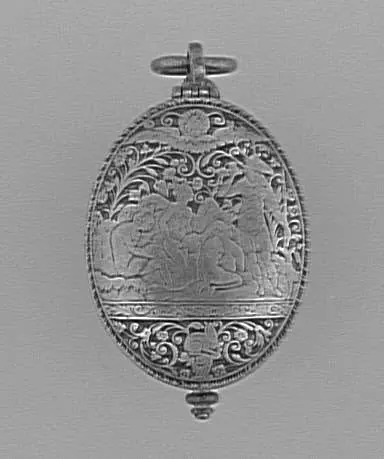
Watch by Pierre II Combret, France, 1585–1600
Musée du Louvre, Paris