
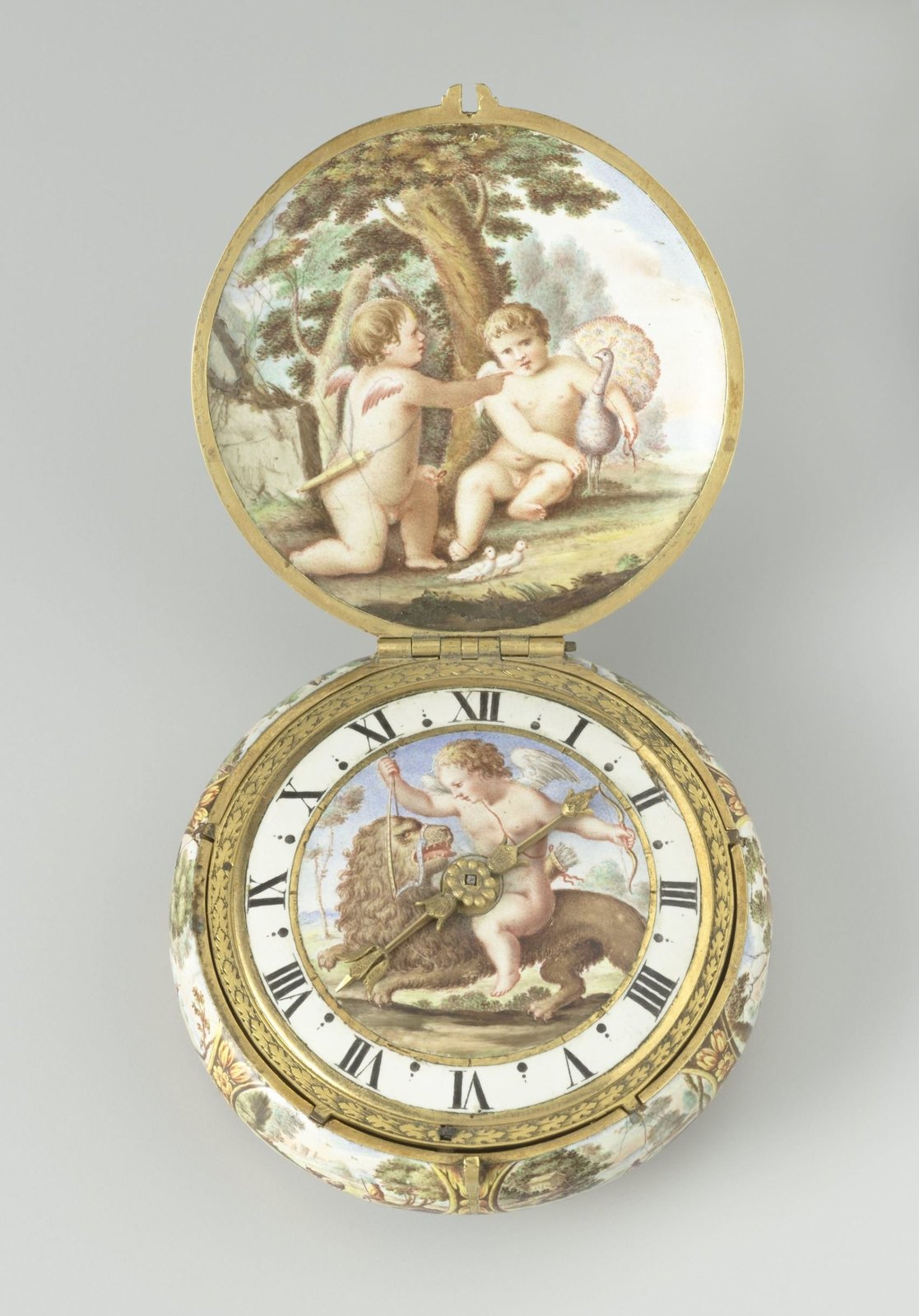
Pocket Watches · Watch
Watch by J. Vrijthoff le Jeune, c. 1650 - c. 1660
- Maker / attribution
- J. Vrijthoff le Jeune (clockmaker)
- Date
- c. 1650 - c. 1660
- Historical period
- Early Modern Horology (1600 – 1750)
- Country of origin
- Unrecorded in source
- Object type
- Watch
- Materials / technique
- gold (metal)
- Dimensions
- diameter 6.4 cm
- Holding institution
- Rijksmuseum
- Accession / object no.
- BK-15075
- Credit line
- Maurits Elzas collection, Arnhem
- Catalogue title (original)
- Horloge (English)
View the source record ↗ (opens another website in a new tab)Suggest a correction
Record summary
Held and catalogued by Rijksmuseum (object number BK-15075), this is a watch by J. Vrijthoff le Jeune, dated c. 1650 - c. 1660. The Atlas places it in the Early Modern Horology period (1600 – 1750) of its Pocket Watches collection. Materials and techniques recorded by the source: gold (metal). Recorded dimensions: diameter 6.4 cm. The record is illustrated with 1 photograph.
Assembled from the source record's structured fields. Dates and attributions are given as the source states them; where a field is missing the Atlas leaves it blank rather than estimating.
Catalogue description
Description — Rijksmuseum (Dutch)
Groot horloge met émailschildering in de trant van Huaud. Op de achterbodem een tafereel, voorstellende Paris, die de appel overhandigt aan Venus, die staat tussen Juno en Minerva. voor Venus is een Amor met boog. Op de convexe rand, zes landschappen in medaillons, die door rozetten zijn gescheiden. Op de voorbodem is de roof van Europa geschilderd en als contre-émail in de achterbodem een riviergezicht met een galei en vier kleinere schepen, aan de oever een jong paar met twee jonkvrouwen als gevolg. De wijzerplaat met wit geëmailleerde cijferring, waarop zwarte Romeinse uurcijfers , is voorzien van een émailschildering, voorstellende Amor met pijl-en-boog, rijdend op een leeuw. Spillegang; één wijzer. De platine met fraai bewerkte kloof is gesigneerd: J. Vrijthoff, Le Jeune, Maestricht.
Shown in the original language of the source catalogue. An editor-reviewed English translation has not yet been published; we do not publish machine translations as authoritative text.
Inscriptions & marks
signature: ‘J. Vrijtthoff le Jeune, Maestricht’
Historical context
Early Modern Horology (1600 – 1750)
Huygens' pendulum and balance spring transform accuracy; English makers develop the anchor and deadbeat escapements.
The balance spring (c. 1675) improved watches dramatically and introduced the minute hand. English pair-cased verge watches with pierced balance cocks and French oignons were typical; enamel painting at Blois and Geneva, and the repeating watch (1680s), made watches objects of great refinement.
Read the period in the timelineMore pocket watches from this periodEarlier: Renaissance Horology
Atlas type guide
Pocket watches
The pocket watch was the dominant personal timekeeper from the late seventeenth century until the First World War. Its development tracks the history of the escapement: verge watches with fusees until the late eighteenth century; Thomas Mudge's lever escapement (c. 1755) and the cylinder escapement popularised by George Graham and later by Swiss makers; and the Swiss and English lever watches of the nineteenth century. Lépine's bar-bridge calibre and keyless winding made watches thinner and easier to use.
Industrialisation transformed the trade: American factories such as Waltham (from 1850) and Elgin produced interchangeable parts by machine, and Swiss makers responded with their own mechanisation after the 1876 Philadelphia Exhibition. By 1900 a reliable watch was affordable to millions; the finest makers continued to produce complications and precision watches.
What to look for
- The escapement: verge (crown wheel), cylinder, duplex, English or Swiss lever.
- Key winding (a square arbor in dial or back) or keyless crown winding.
- Signatures and serial numbers on the movement, dial and inside case back.
- Hallmarks, case maker's marks and gold or silver standards stamped in the case.
- Dial material: enamel, silver, gold, later printed metal.
Dating clues
- Verge watches dominate before c. 1800; cylinder watches c. 1770–1900; lever watches after c. 1820.
- Keyless winding: increasingly common after c. 1860.
- Manufacturer serial number lists exist for Waltham, Elgin, Longines, Omega, Patek Philippe and others.
General guidance written by the Atlas editors about this kind of object. It is not a statement about this particular piece; for that, rely on the source record above and on physical examination.
Read next:Verge escapementDetached lever escapementFuseeIdentification Centre
Related records
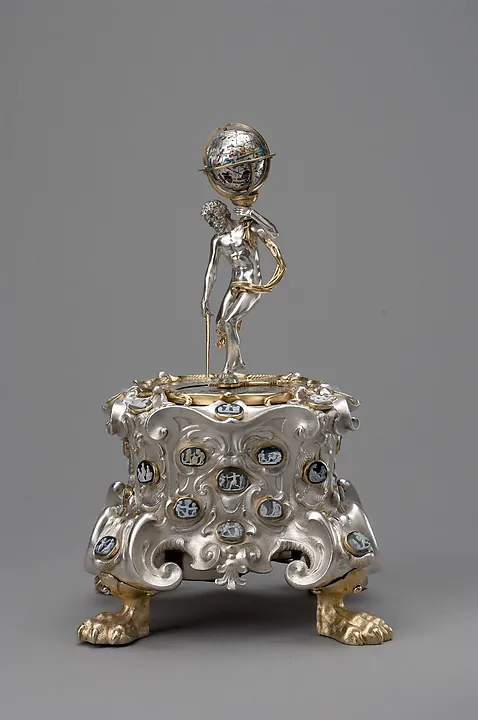
Pocket Watches · 1600–1699
Pocket watch by Georg Ernst, Germany, 1600–1699
Fine Arts Museum Vienna
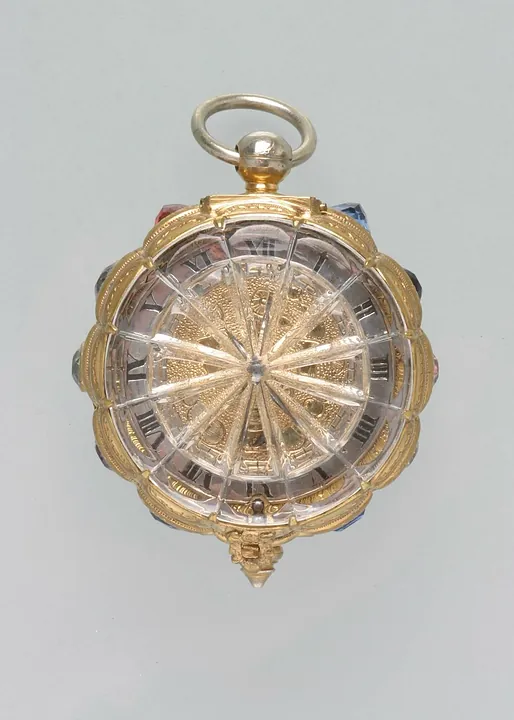
Pocket Watches · c. 1600
Pocket watch by Balthasar de Paep, Belgium, c. 1600
German Clock Museum
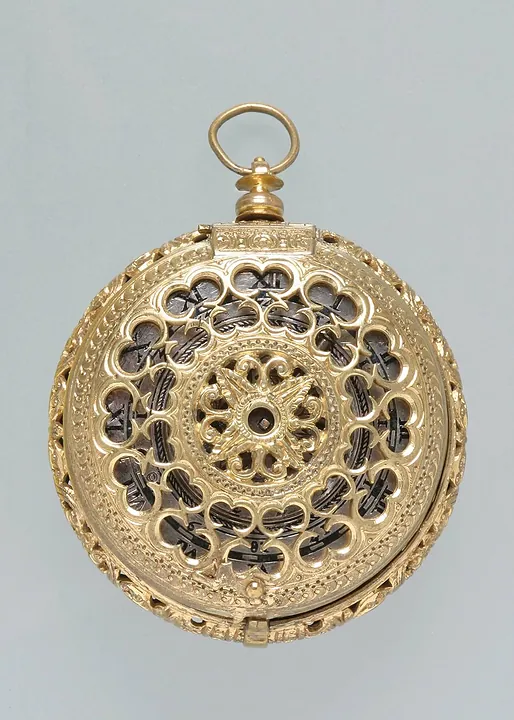
Pocket Watches · c. 1600
Pocket watch by Hans Reinboldt, France, c. 1600
German Clock Museum
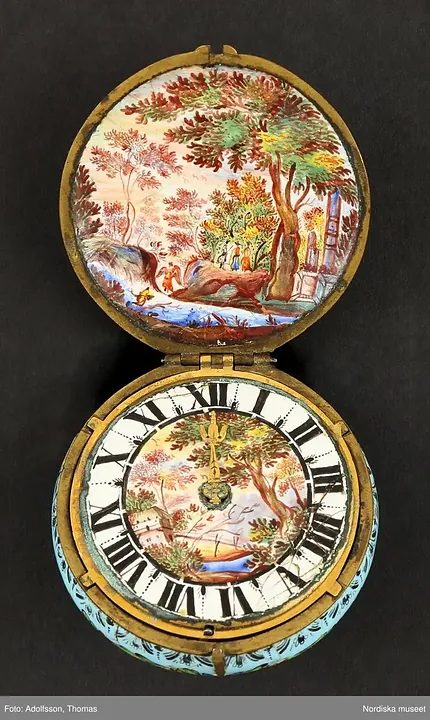
Pocket Watches · 1600–1699
Pocket watch by Johan Etmiller, Germany, 1600–1699
Nordic Museum Foundation
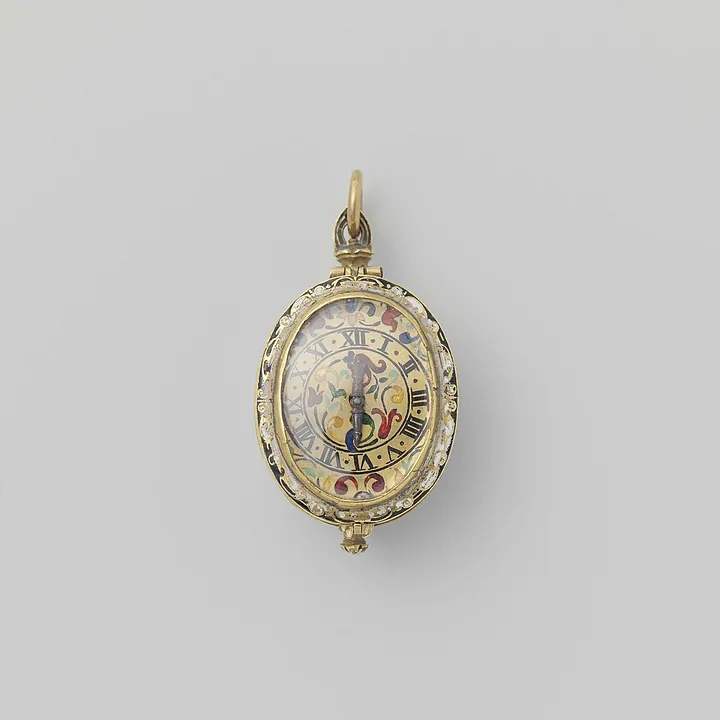
Pocket Watches · 1600
Pocket watch, France, 1600
Rijksmuseum
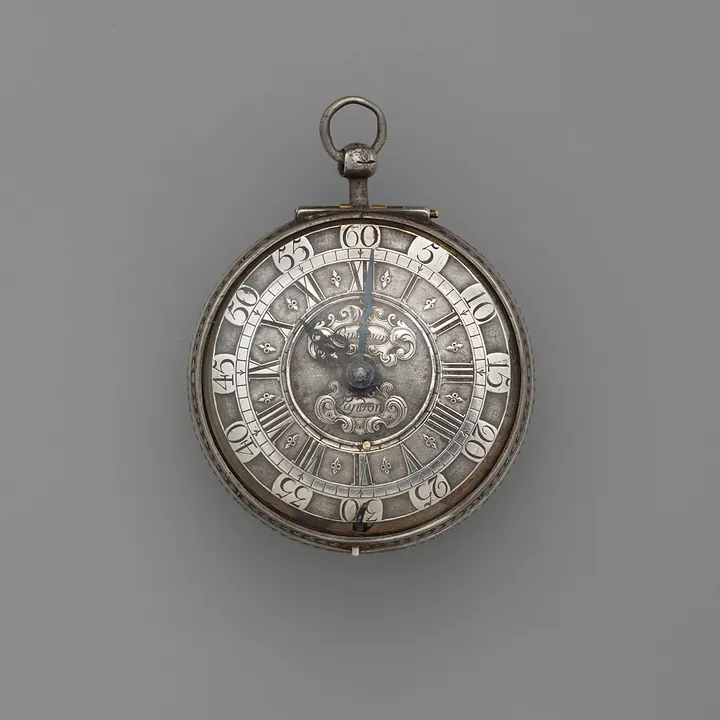
Pocket Watches · 17th century
Watch by John Bushman, England, 17th century
The Metropolitan Museum of Art, New York
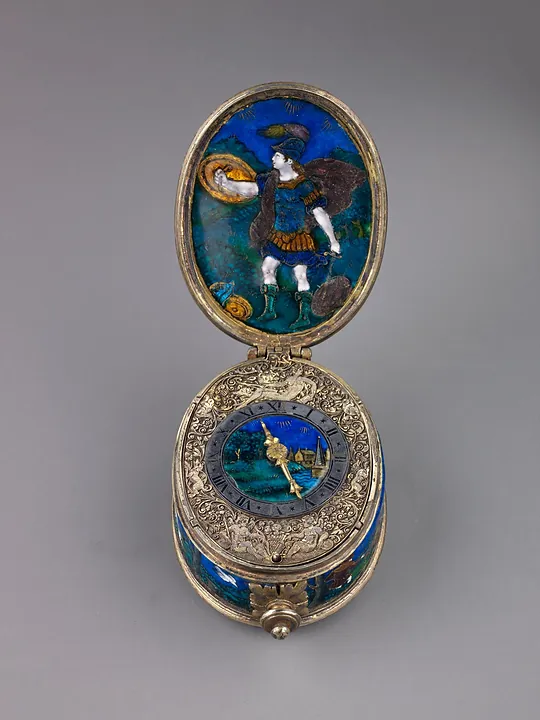
Pocket Watches · first quarter of 17th century
Watch by Suzanne de Court, France, first quarter of 17th century
The Metropolitan Museum of Art, New York
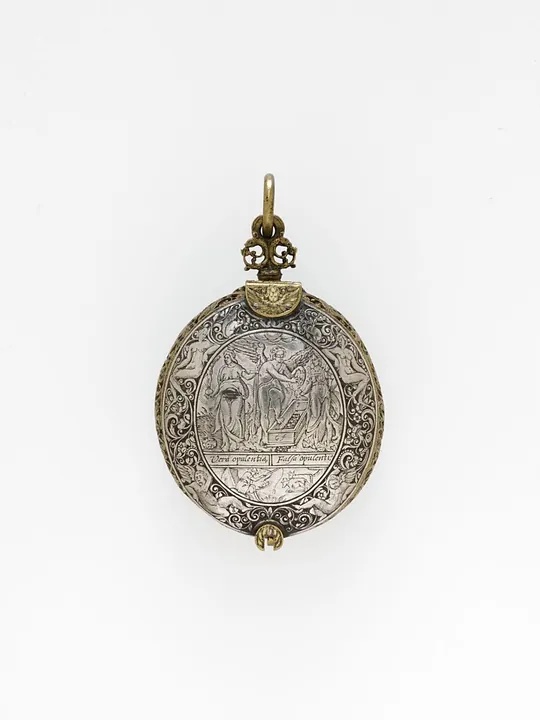
Pocket Watches · early 17th century
Watch of engraved and pierced silver and gilt brass, signed 'Noel Hubert A Rouen', France, early 17th century
Victoria and Albert Museum, London