
Wristwatches · Wristwatch
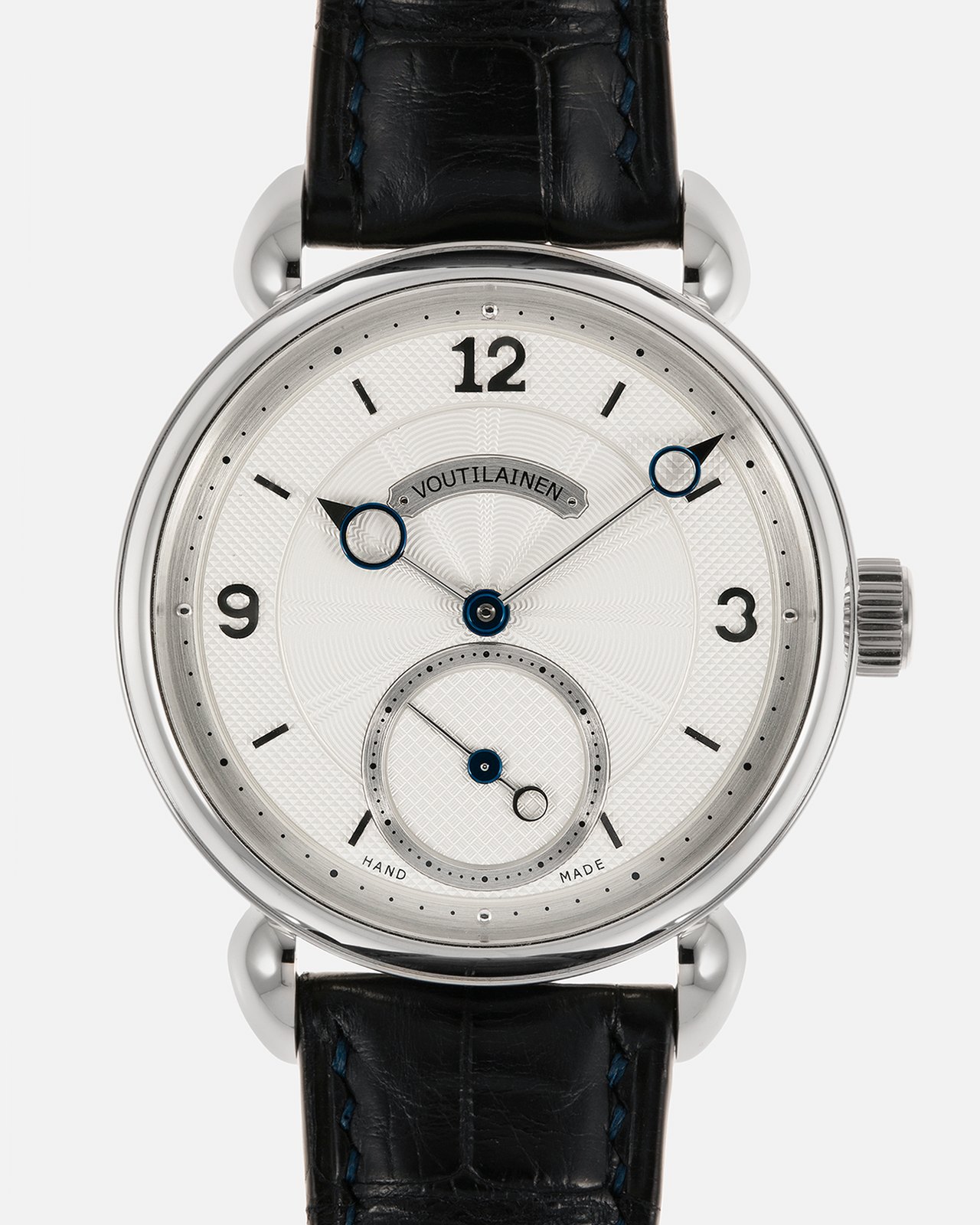
Voutilainen Vingt-8 Platinum, 2016
- Maker / attribution
- Kari Voutilainen (maker)
- Date
- 2016
- Historical period
- Contemporary Horology (2010 – Present)
- Country of origin
- Switzerland
- Object type
- Wristwatch
- Materials / technique
- platinum
- Dimensions
- Case 39 mm
- Stock no.
- Product 7309418135639
- Credit line
- Dealer listing, S.Song Watches (product 7309418135639)
- Catalogue title (original)
- Voutilainen Vingt-8 Platinum (English)
View the source record (dealer listing) ↗ (opens another website in a new tab)Suggest a correction
Record summary
Catalogued by S.Song Watches (dealer), Seattle (stock number Product 7309418135639), this is a wristwatch by Kari Voutilainen, made in Switzerland, dated 2016. The Atlas places it in the Contemporary Horology period (2010 – Present) of its Wristwatches collection. Materials and techniques recorded by the source: platinum. Recorded dimensions: Case 39 mm. The record is illustrated with 6 photographs.
Assembled from the source record's structured fields. Dates and attributions are given as the source states them; where a field is missing the Atlas leaves it blank rather than estimating.
Catalogue description
Dealer description — S.Song Watches
If you share my passion and enthusiasm for independent watch design, the Voutilainen Vingt-8 is a timepiece that truly speaks for itself. Renowned in the industry, the Vingt-8 was created by one of the most respected figures in independent watchmaking—the esteemed Kari Voutilainen, an accomplished Finnish watchmaker. Before founding his eponymous brand/watch atelier, Voutilainen trained at the restoration house of Michel Parmigiani and later took on a teaching position with the Watchmakers of Switzerland Training and Educational Program. The Vingt-8 first debuted in 2011 and has since become a pivotal reference, serving as a cornerstone in Voutilainen’s catalog of offerings and is today one of the most sought-after watches among collectors worldwide. If you’re familiar with Kari Voutilainen’s creations, you likely already recognize his signature case and dial design, which ranks among the finest in the realm of high-end independent watchmaking. While the overall aesthetic and construction may appear relatively simple from a glance, there are subtle nuances that make Voutilainen's pieces easily recognizable. In this particular model, the entire case features a three-part construction, all crafted from 950 platinum and mirror-polished for an elegant finish. At each end of the case, you’ll find one of Voutilainen’s hallmark design traits—pronounced teardrop lugs that seamlessly integrate into the mid-case section, adding a touch of visual intrigue and sensuality. Measuring 39mm x 11mm, the Vingt-8 is perfectly sized for modern wrists; it is neither too large nor too small and sits comfortably thanks to its gently curved lugs and ergonomic case. Moving on to the dial fitted on our example, the pristine ivory surface complements the ice-cold platinum case very well. The construction begins with a silver base adorned with an array of Voutilainen’s renowned hand-turned guilloché techniques. The hour markers, presented in two forms—Arabic numerals and baton-style markers—are carefully applied onto a hobnail guilloché chapter ring. Surrounding this section is a satiné circulaire (meaning a chapter ring with a circular-brushed finish applied using a spinning lathe) minute chapter ring, with each minute dot marker perfectly aligned with their respective hour indicators. At the center of the dial, you’ll see a pronounced rosette guilloché motif, while the small seconds sub-dial at 6:00 features a basketweave guilloché pattern. In line with the dial’s overall aesthetic, this register also showcases a similar satiné circulaire chapter ring for the seconds' markers. Completing the ensemble is a set of Voutilainen’s famous Observatoire-style hands in white gold, accented with thermally blued inserts that add a striking visual contrast to the meticulously crafted dial. At the heart of this Vingt-8 is Voutilainen’s in-house Cal. 28, a superbly finished manual-winding movement that is designed, fabricated, finished, and assembled within Voutilainen's workshops in Môtiers, near Geneva. It is regulated by a free-sprung balance with a Breguet overcoil, an internal Grossmann curve, and a direct impulse escapement equipped with two large escapement wheels. According to Voutilainen, this escapement configuration is highly efficient as it requires significantly less energy than traditional lever escapements, providing a technical advantage in terms of stability and longevity, perfect for everyday use. Needless to say, the overall aesthetic and visual appeal of the highly engineered Cal. 28 is second to none. It showcases an elaborate, multi-layered arrangement with generous depth and spacing between the bridges, all impeccably executed and embellished with exquisite Côtes de Genève (Geneva stripes), anglage , and sublime black polishing on the balance bridge. One aspect I particularly appreciate about the movement is its close visual proximity to the open display sapphire caseback, which allows for an up-close view of the synchronized movements of all the components. In terms of power reserve, the Cal. 28 can hold a charge of up to 50 hours when fully wound. A sensational horological masterpiece from every angle, this Voutilainen Vingt-8 in platinum is a true work of art that exemplifies the pinnacle of high-end independent watchmaking and exceptional hand-finishing techniques. For discerning collectors seeking truly unique independent watches with outstanding craftsmanship, I highly recommend taking a closer look at this piece. One final point I’d like to highlight, which I usually wouldn’t, is how fantastic the presentation of this example is. It comes with a beautiful wooden presentation box by Cédric Vichard, a renowned cabinetmaker from Neuchâtel, as it was originally retailed. While the focus is typically on the watches themselves, it’s also worth noting that tasteful packaging can be just as important, especially when trying to match the grandeur of a Haute Horlogerie piece like this Vingt-8. Anyway, I digress—I shall let the photos do the talking.
Historical context
Contemporary Horology (2010 – Present)
Silicon components, connected watches, optical-lattice research clocks and a thriving independent scene.
Smartwatches became the world's best-selling watches, while mechanical watchmaking focuses on craft, innovation (silicon components, new escapements) and independent makers.
Read the period in the timelineMore wristwatches from this periodEarlier: Mechanical Renaissance
Atlas type guide
Wristwatches
Bracelet watches were worn by women from the early nineteenth century — Breguet made one for Caroline Murat, Queen of Naples, in 1810–12 — but the wristwatch only became a man's instrument with military use and aviation in the early twentieth century. Between the World Wars it overtook the pocket watch; the 1920s and 1930s brought rectangular Art Deco cases, water-resistant cases and the first automatic winding systems.
After 1945 the wristwatch became a carrier of identity — dress watches, sports and dive watches, chronographs, calendars — produced by Swiss, American, Japanese, German, Soviet and Chinese industries. The quartz revolution after 1969 and the mechanical renaissance since the 1990s, including the rise of independent watchmakers, complete the story.
What to look for
- The reference number (between the lugs or inside the case back) and serial number, the starting point for dating.
- The calibre: its maker and number are often stamped under the dial or on the bridge.
- Originality of dial, hands and crown — refinished ('redial') dials are common.
- Case material marks: 18K/750, 14K/585, stainless steel, gold-filled, plated.
Dating clues
- Wire-lug cases: before c. 1925.
- Water-resistant screw-down cases: from 1926.
- Quartz movements: from 1969; sapphire crystals widespread after c. 1980.
General guidance written by the Atlas editors about this kind of object. It is not a statement about this particular piece; for that, rely on the source record above and on physical examination.
Read next:Identification Centre
Related records

Wristwatches · c. 2010s
Breguet Type XXI, ref. 3810, c. 2010s (Antiquorum Lot 381-24)
Antiquorum auction archive, Geneva

Wristwatches · c. 2010s
Breguet Type XXI, ref. 3810, c. 2010s (Antiquorum Lot 386-229)
Antiquorum auction archive, Geneva

Wristwatches · Sold in September 2010
Breitling Cosmonaute, ref. A 22322, Sold in September 2010
Antiquorum auction archive, Geneva

Wristwatches · c. 2010
Corum Bubble Chrono, ref. 396.150.20, c. 2010
Antiquorum auction archive, Geneva
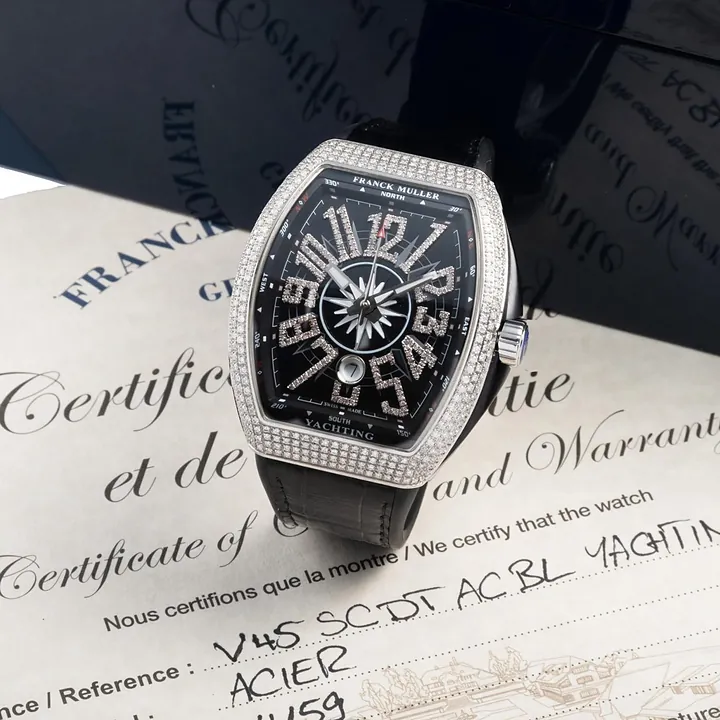
Wristwatches · c. 2010-2020
Franck Muller Vanguard Yachting, ref. V45SCDT, c. 2010-2020
Antiquorum auction archive, Geneva
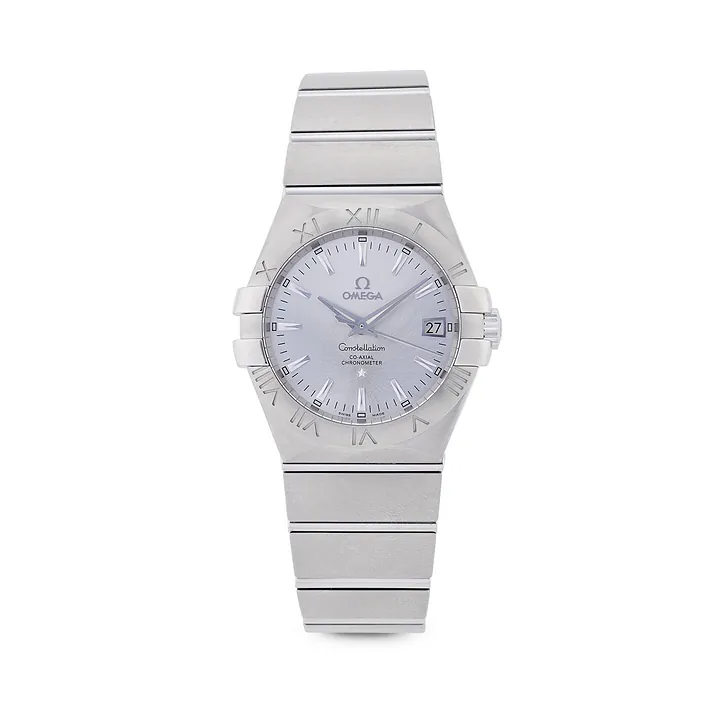
Wristwatches · c. 2010s
Omega Constellation, ref. 123.10.35.20.02.001, c. 2010s
Antiquorum auction archive, Geneva
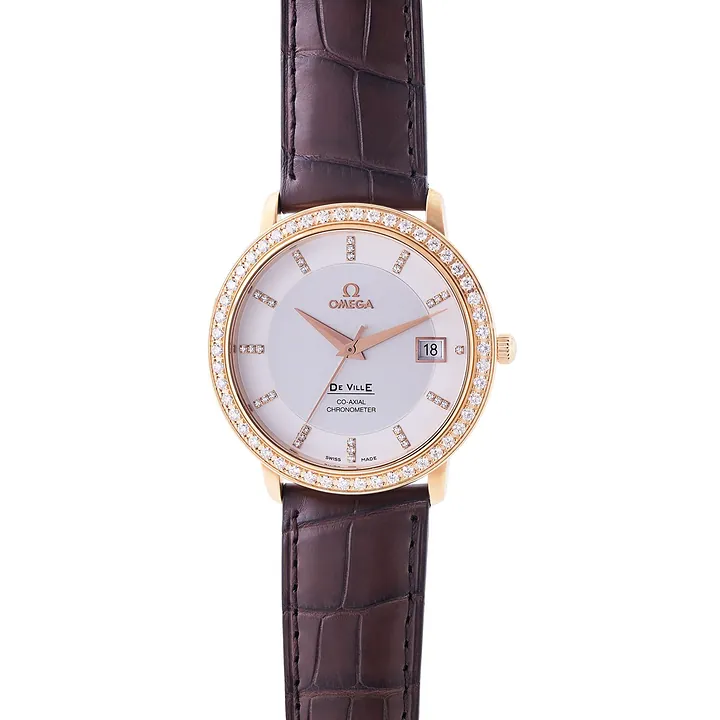
Wristwatches · c. 2010s
Omega De Ville, ref. 413.58.37.20.52.001, c. 2010s
Antiquorum auction archive, Geneva
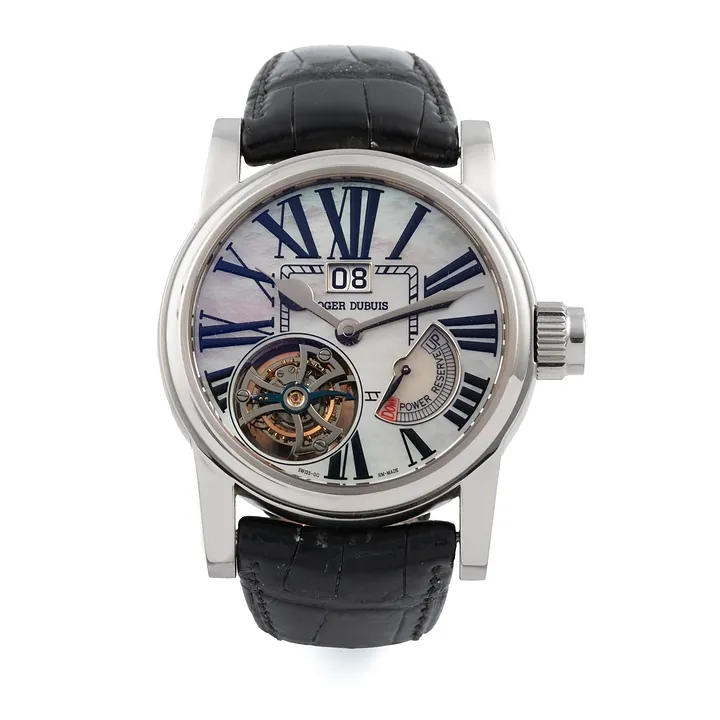
Wristwatches · c. 2010
Roger Dubuis Hommage Tourbillon Marine, ref. H043 03 0 N1C.7A, c. 2010
Antiquorum auction archive, Geneva