
Wristwatches · Wristwatch
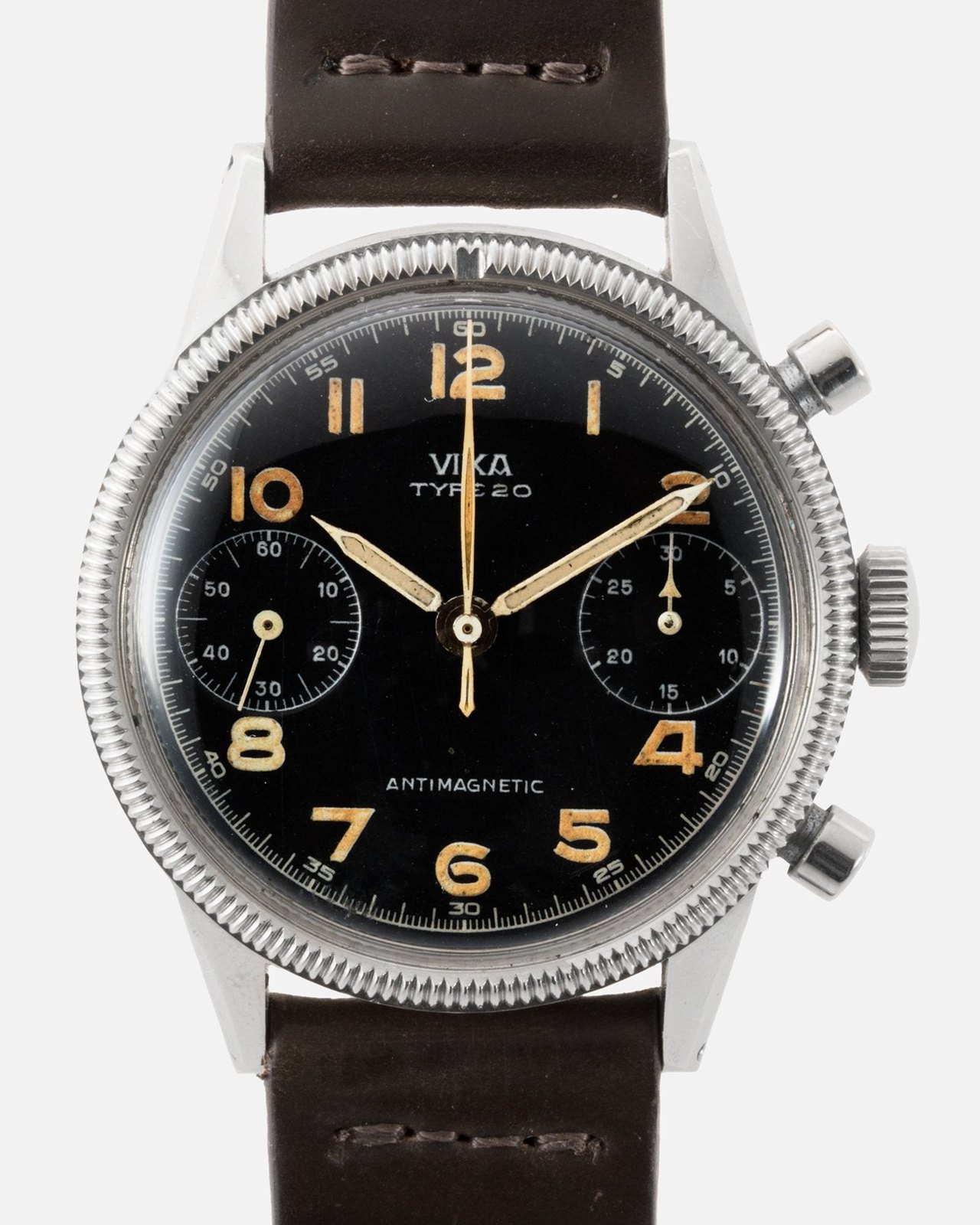
Vixa Flyback Type 20, 1956
- Maker / attribution
- Vixa (maker)
- Date
- 1956
- Historical period
- Modern Mechanical Horology (1945 – 1969)
- Country of origin
- Unrecorded in source
- Object type
- Wristwatch
- Stock no.
- Product 196726620185
- Credit line
- Dealer listing, S.Song Watches (product 196726620185)
- Catalogue title (original)
- Vixa Flyback Type 20 (English)
View the source record (dealer listing) ↗ (opens another website in a new tab)Suggest a correction
Record summary
Catalogued by S.Song Watches (dealer), Seattle (stock number Product 196726620185), this is a wristwatch by Vixa, dated 1956. The Atlas places it in the Modern Mechanical Horology period (1945 – 1969) of its Wristwatches collection. The record is illustrated with 6 photographs.
Assembled from the source record's structured fields. Dates and attributions are given as the source states them; where a field is missing the Atlas leaves it blank rather than estimating.
Catalogue description
Dealer description — S.Song Watches
When one thinks of iconic military pilot watches, a few spring to mind. The IWC and Jaeger-LeCoultre Mk 11 watches made for the British Royal Air Force and the Zenith CP-2 Cairelli issued to the Aeronautica Militaire Italiana are some of them, but right at the top of the heap would have to be the Type 20 watches issued to the French Air Force. Throughout the 20th century, the French military commissioned quite a few brands to produce their famed Type 20 wristwatches, including Auricoste, Airain, Vixa and Breguet. While the Breguet would certainly be the most desirable, the Vixa would have to come next. In my opinion, the Vixa still presents great value as the next comparable military chronograph would be the Zenith Cairelli which trades at multiples of this. What you get is a stainless steel chronograph with caseback markings issued to one of the greatest militaries in the world- not to mention it is a flyback chronograph. Only the French Type 20’s featured this specification. While some brands such as Auricoste used chrome plated cases, the Vixa has a full stainless steel case. Produced by Hanhart, a German company, it is estimated that around 4000-5000 pieces were made. It is not known how many have survived but many of these were used for a very long time. For instance, this one was used for just under 30 years, more on this further below. Flip the watch around and this is why I think the Type 20s are one of the most fun and interesting issued watches to collect. You will see that there are many markings- very unusual as normal military markings usually only feature a few lines. Well, most of the markings you see, which feature ‘FG’ as the prefix stands for ‘fin guarantee’ which were markings made by military watchmakers every time these watches were serviced. You can see that this watch has a total of 8 ‘FG’ stamp, showing it had a distinguished life in the military, amazingly being used from its issue date of 1956 all the way until 1982. This gives a great insight and historical provenance to these watches and I guess this is part of why I love military watches so much. Other than the ‘FG’ markings, the ‘P’ on the dial signifies that this was serviced by the aviation specialists Ateliers Pechoin, a workshop in Paris that serviced many Type 20 pieces. With all of this history literally engraved on the caseback of this watch, I think you would agree too that in regards to collecting from a purist point of view, this is what it's all about.
Historical context
Modern Mechanical Horology (1945 – 1969)
Tool watches for divers, pilots and astronauts; electric watches anticipate the electronic age.
The classic era of the mechanical wristwatch: dive watches, chronographs for motor racing and space flight, GMT watches for jet travel, slim dress watches, automatic calendars, and the rise of Japanese manufacturers alongside Swiss, American, German and Soviet industries.
Read the period in the timelineMore wristwatches from this periodEarlier: Golden Age of Mechanical Watchmaking
Atlas type guide
Chronographs and split-seconds watches
A chronograph is a watch with an additional seconds hand that can be started, stopped and returned to zero independently of the timekeeping. Louis Moinet built an early example in 1816 and Nicolas Rieussec a recording 'chronographe' in 1821; Adolphe Nicole's heart-shaped reset cam (patented 1862) made the modern return-to-zero possible. Split-seconds (rattrapante) chronographs add a second hand that can be stopped for intermediate times; flyback chronographs restart instantly.
Chronographs were essential tools for doctors (pulsometer scales), artillery (telemeter), engineers and sport. In wristwatches, Valjoux, Venus, Lemania and later the automatic chronographs of 1969 (Zenith El Primero, the Chronomatic Calibre 11 group and Seiko 6139) are milestones.
What to look for
- Push-pieces on the case band or a single button in the crown (monopusher).
- Subsidiary registers for minutes and hours; tachymeter, telemeter or pulsometer scales.
- Column wheel versus cam control visible in the movement.
- Calibre markings of specialist makers (Valjoux, Lemania, Venus, Landeron).
Dating clues
- Pocket chronographs with heart cam reset: after 1862.
- Wrist chronographs: from c. 1910; two-button designs from the 1930s.
- Automatic chronographs: from 1969.
General guidance written by the Atlas editors about this kind of object. It is not a statement about this particular piece; for that, rely on the source record above and on physical examination.
Read next:Chronograph
Related records
Wristwatches · 1960s
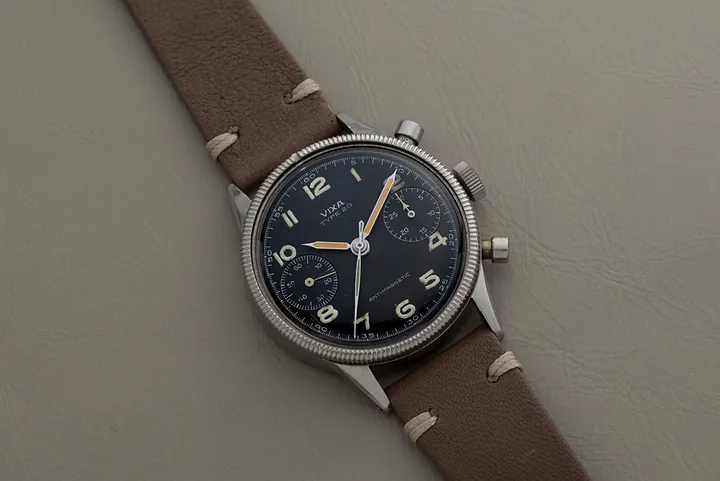
Vixa Type XX Flyback Chronograph, 1960s
Analog/Shift (dealer), New York
Wristwatches · c. 1954
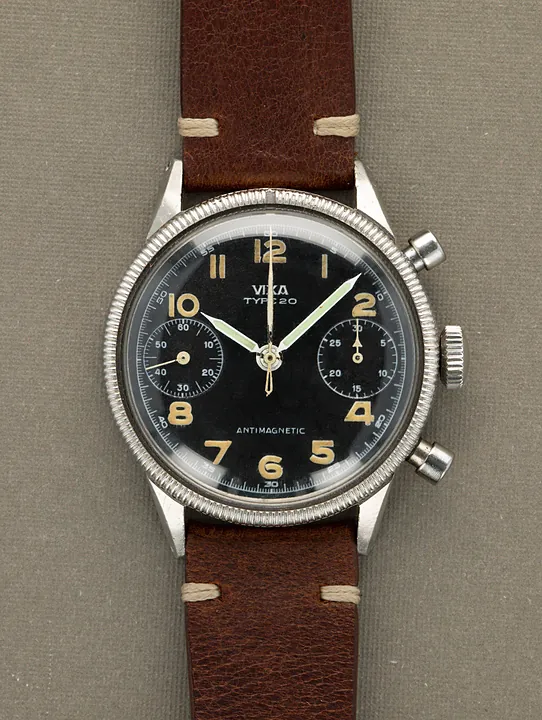
Vixa Type XX Flyback Chronograph, Matte Black Dial
Oliver & Clarke (dealer), United Kingdom
Wristwatches · 1950s
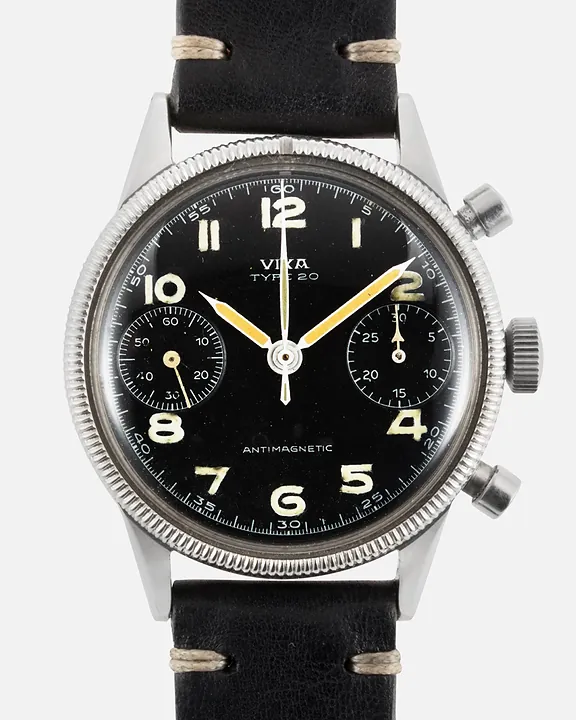
Vixa Flyback Type 20, 1950s
S.Song Watches (dealer), Seattle

Wristwatches · 1945
Wristwatch by Eterna, 1945
Museum Rotterdam

Wristwatches · c. 1945
Breitling Premier, ref. 790, c. 1945
Antiquorum auction archive, Geneva

Wristwatches · c. 1945
Universal Genève Uni-Compax, ref. 22492, c. 1945
Antiquorum auction archive, Geneva
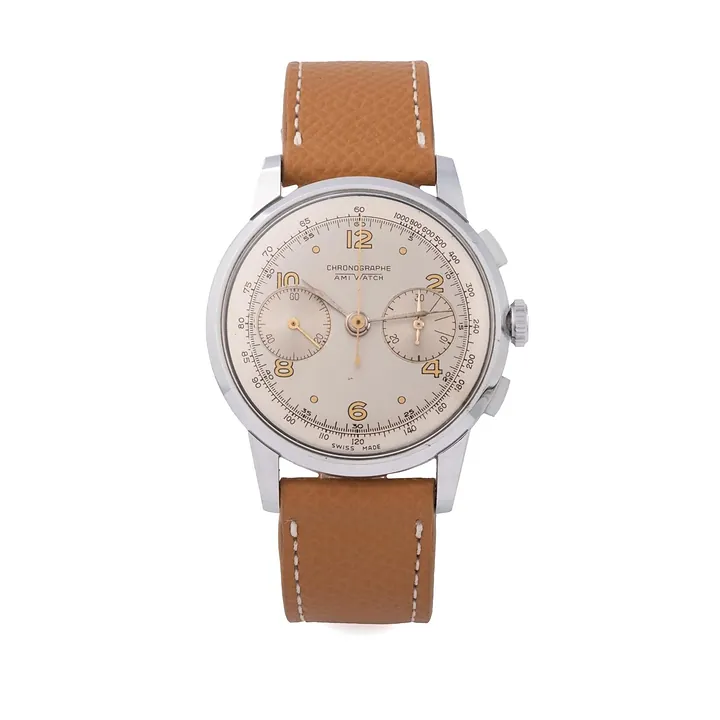
Wristwatches · c. 1950s
Ami Watch Chronographe, c. 1950s
Antiquorum auction archive, Geneva

Wristwatches · c. 1950s
Baume & Mercier wristwatch, c. 1950s
Antiquorum auction archive, Geneva