
Wristwatches · Wristwatch
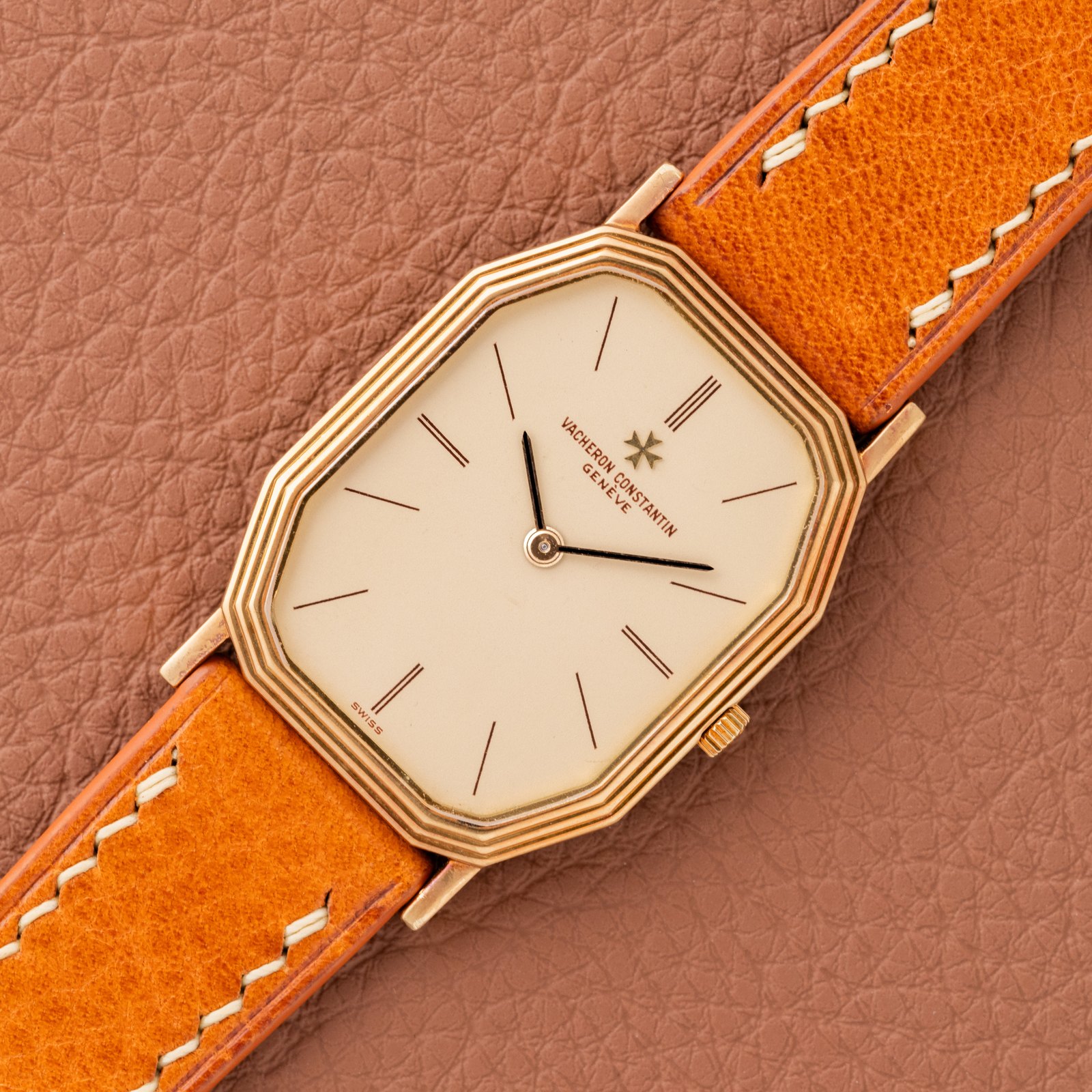
Vacheron Constantin Ultra-Thin Octagonal Dress Watch (Ref. 33080), 1970s
- Maker / attribution
- Vacheron Constantin (maker)
- Date
- 1970s
- Historical period
- Quartz Revolution (1969 – 1990)
- Country of origin
- Switzerland
- Object type
- Wristwatch
- Dimensions
- Case 25 mm
- Stock no.
- Product 8834759065783
- Credit line
- Dealer listing, Huntington Company (product 8834759065783)
- Catalogue title (original)
- 1970s Vacheron Constantin Ultra-Thin Octagonal Dress Watch (Ref. 33080) (English)
View the source record (dealer listing) ↗ (opens another website in a new tab)Suggest a correction
Record summary
Catalogued by Huntington Company (dealer) (stock number Product 8834759065783), this is a wristwatch by Vacheron Constantin, made in Switzerland, dated 1970s. The Atlas places it in the Quartz Revolution period (1969 – 1990) of its Wristwatches collection. Recorded dimensions: Case 25 mm. The record is illustrated with 6 photographs.
Assembled from the source record's structured fields. Dates and attributions are given as the source states them; where a field is missing the Atlas leaves it blank rather than estimating.
Catalogue description
Dealer description — Huntington Company
History and Significance Vacheron Constantin has a remarkable history of producing dress watches that extend far beyond the traditional round case. Throughout the twentieth century, the manufacture experimented with an extraordinary variety of shapes, proportions, and decorative techniques, often creating watches that were as much about design as mechanical achievement. The reference 33080 belongs to a particularly interesting period of this history, when Swiss watchmakers were embracing more architectural case designs while maintaining the traditions of classical watchmaking. Its distinctive octagonal shape reflects the creativity of the 1970s, a decade that produced some of the most recognizable and unconventional designs in horological history. The 1970s marked a significant shift in the way luxury watches were designed. Traditional round cases remained popular, but manufacturers increasingly explored geometric shapes, integrated constructions, and sharper architectural lines. Octagonal cases became particularly interesting during this period, offering a departure from conventional dress watches without abandoning the refinement associated with precious metal timepieces. The reference 33080 takes this idea in a more understated direction, incorporating a stepped case construction that gives the design additional depth and definition. Rather than relying on elaborate decoration, the case itself becomes the primary expression of the watch's personality. The stepped construction is especially important to understanding the appeal of this particular Vacheron Constantin. Each change in the case's profile introduces another geometric element, creating a layered appearance that is quite different from the smooth contours of traditional dress watches. This approach has historical roots in Art Deco design, where stepped forms, symmetry, and architectural details were frequently used in jewelry, clocks, and wristwatches. By incorporating these influences into a 1970s design, Vacheron Constantin created a watch that connects two distinct periods of decorative history. The result is an unusual combination of classical refinement and the more adventurous design language associated with the decade. Writer’s Thoughts The case is what makes the Vacheron Constantin reference 33080 such an interesting watch. Most traditional dress watches rely on a familiar round or rectangular shape, but this reference takes a completely different approach. The octagonal construction and stepped edges give the watch a distinctly architectural personality, almost resembling a small piece of Art Deco jewelry. It is an unusual design that feels much more interesting than a conventional dress watch, particularly because Vacheron Constantin managed to incorporate so much character into such a refined package. Another appealing quality of the reference 33080 is how clearly it reflects the design experimentation of the 1970s without becoming excessive. Many watches from the period embraced bold shapes and unconventional styling, sometimes at the expense of the classical elegance associated with traditional Swiss watchmaking. This Vacheron Constantin manages to capture the creativity of the decade while maintaining the refinement expected from the manufacture. The combination of an unusual case and a simple dial allows the design to feel distinctive without becoming overly complicated. Our Promise Every watch is thoroughly vetted, carefully described with complete transparency, and guaranteed authentic. Each piece is offered in honest condition, ensuring collectors receive a timepiece that reflects both originality and integrity. Specifications Brand: Vacheron Constantin Model: Ultra-Thin Octagonal Dress Watch Reference: 33080 Year: 1970s Case Material: 18k Yellow Gold Case Size: 25mm x 31mm Dial: Cream Dial Movement: Mechanical Manual Wind Strap/Buckle: New H.C. Leather Strap Buckle/Clasp: Generic Buckle Contents: Watch only Condition Case: Yellow gold case retains its distinctive octagonal shape and well-defined stepped construction. Dial: Cream dial retains its attractive vintage character and classical appearance. Hands: Hands remain consistent with the overall age and character of the watch. Crystal: Crystal remains clear. Strap/Buckle: Newly fitted H.C. leather strap is in excellent condition. Buckle/Clasp: Generic buckle is in good condition.
Historical context
Quartz Revolution (1969 – 1990)
Seiko's Astron begins mass quartz timekeeping; traditional industries contract sharply.
Quartz and digital watches transformed the market after 1969. Swiss employment collapsed, Japanese and Hong Kong production soared, and the Swatch (1983) helped the Swiss industry recover; mechanical watches survived as luxury goods.
Read the period in the timelineMore wristwatches from this periodEarlier: Modern Mechanical Horology
Atlas type guide
Wristwatches
Bracelet watches were worn by women from the early nineteenth century — Breguet made one for Caroline Murat, Queen of Naples, in 1810–12 — but the wristwatch only became a man's instrument with military use and aviation in the early twentieth century. Between the World Wars it overtook the pocket watch; the 1920s and 1930s brought rectangular Art Deco cases, water-resistant cases and the first automatic winding systems.
After 1945 the wristwatch became a carrier of identity — dress watches, sports and dive watches, chronographs, calendars — produced by Swiss, American, Japanese, German, Soviet and Chinese industries. The quartz revolution after 1969 and the mechanical renaissance since the 1990s, including the rise of independent watchmakers, complete the story.
What to look for
- The reference number (between the lugs or inside the case back) and serial number, the starting point for dating.
- The calibre: its maker and number are often stamped under the dial or on the bridge.
- Originality of dial, hands and crown — refinished ('redial') dials are common.
- Case material marks: 18K/750, 14K/585, stainless steel, gold-filled, plated.
Dating clues
- Wire-lug cases: before c. 1925.
- Water-resistant screw-down cases: from 1926.
- Quartz movements: from 1969; sapphire crystals widespread after c. 1980.
General guidance written by the Atlas editors about this kind of object. It is not a statement about this particular piece; for that, rely on the source record above and on physical examination.
Related records
Pocket Watches · c. 1896
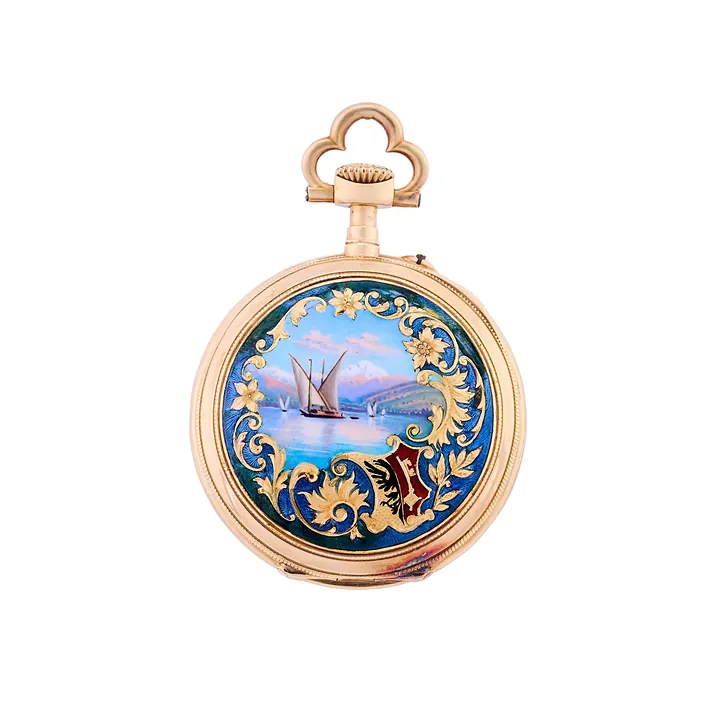
Vacheron Constantin “grand TIR de L’exposition Nationale, Genève 1896, c. 1896
Antiquorum auction archive, Geneva
Pocket Watches · c. 1940
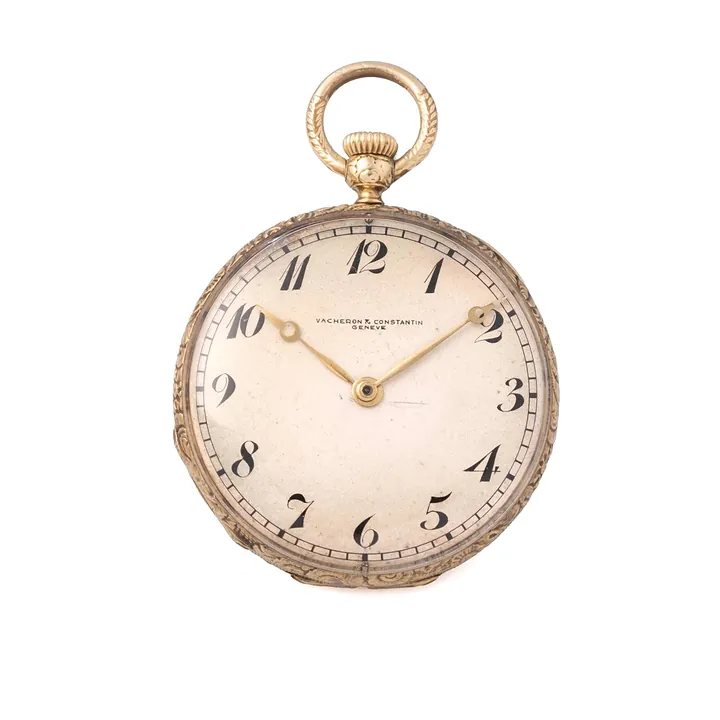
Vacheron Constantin pocket watch, ref. 345, c. 1940
Antiquorum auction archive, Geneva
Pocket Watches · c. 1945
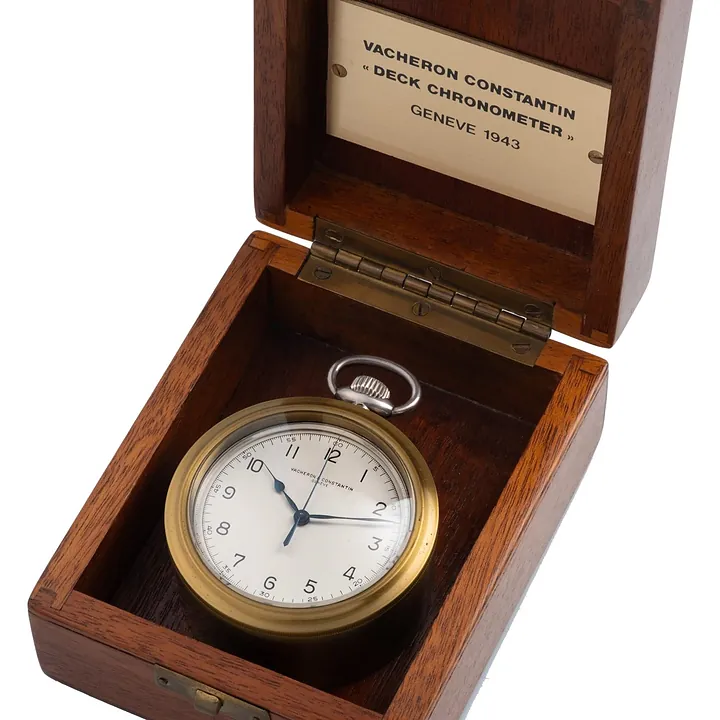
Vacheron Constantin pocket chronometer, c. 1945
Antiquorum auction archive, Geneva
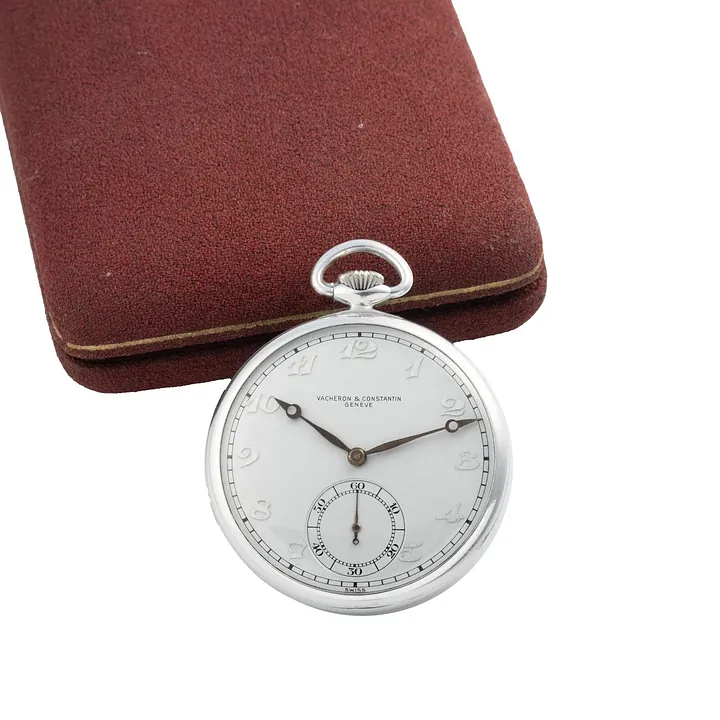
Pocket Watches · c. 1945
Vacheron Constantin watch, c. 1945
Antiquorum auction archive, Geneva

Wristwatches · 1970
Wristwatch by Heno, Switzerland, 1970
Museum Rotterdam

Wristwatches · 1960–1986
'Tri-Compax' calendar chronograph wristwatch in gold case, by Universal, Geneva, Switzerland, 1960–1986.
Science Museum Group, London

Wristwatches · 1969–1970
Beta 21 Quartz wristwatch movement, made in Switzerland, 1970.
Science Museum Group, London

Wristwatches · c. 1969
Omega Speedmaster Moonwatch, ref. 145022-69st, c. 1969
Antiquorum auction archive, Geneva