
Wristwatches · Wristwatch
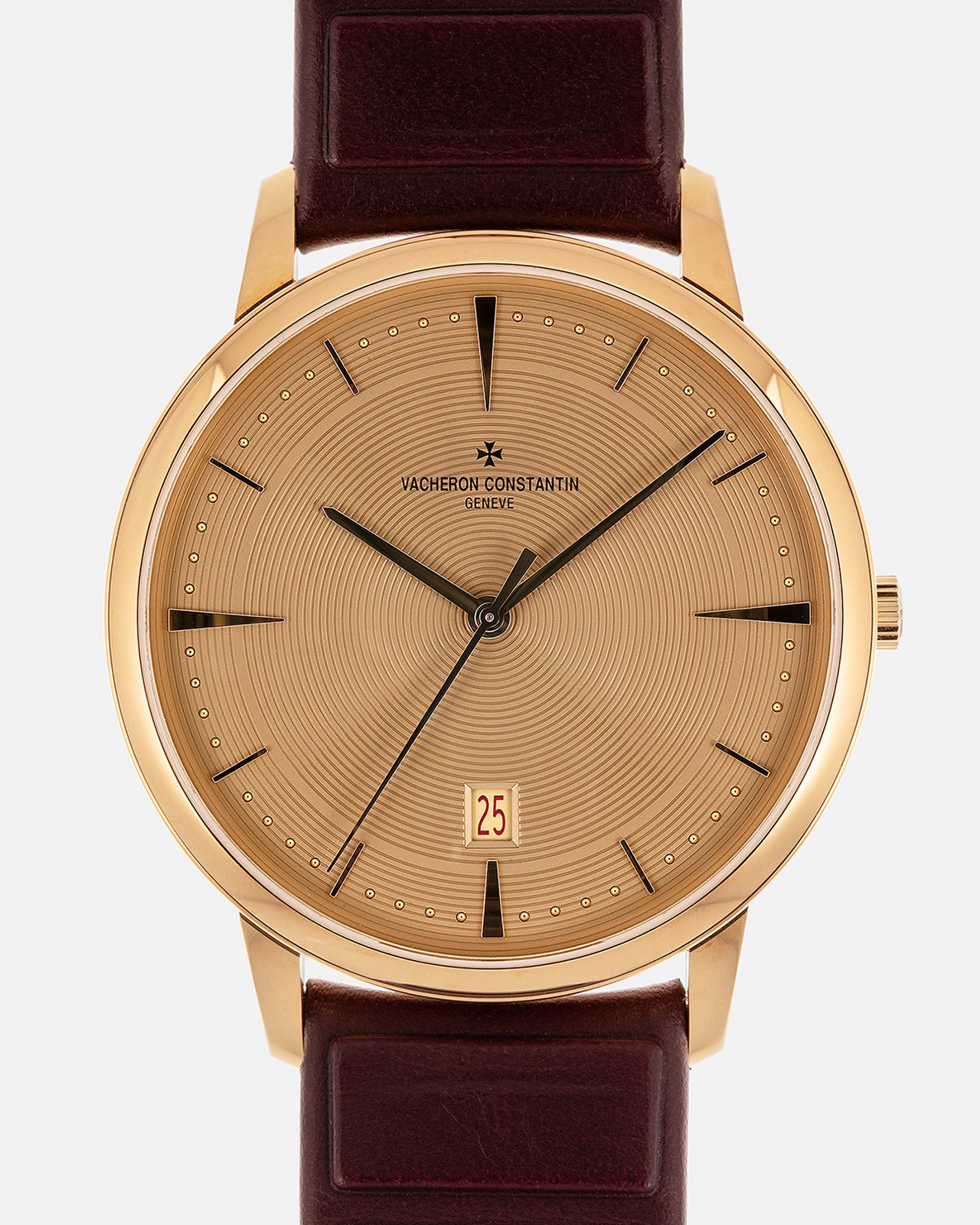
Vacheron Constantin Patrimony Ora ïto 20th Anniversary 85810, 2024
- Maker / attribution
- Vacheron Constantin (maker)
- Date
- 2024
- Historical period
- Contemporary Horology (2010 – Present)
- Country of origin
- Switzerland
- Object type
- Wristwatch
- Dimensions
- Case 40 mm
- Stock no.
- Product 7665826103383
- Credit line
- Dealer listing, S.Song Watches (product 7665826103383)
- Catalogue title (original)
- Vacheron Constantin Patrimony Ora ïto 20th Anniversary 85810 (English)
View the source record (dealer listing) ↗ (opens another website in a new tab)Suggest a correction
Record summary
Catalogued by S.Song Watches (dealer), Seattle (stock number Product 7665826103383), this is a wristwatch by Vacheron Constantin, made in Switzerland, dated 2024. The Atlas places it in the Contemporary Horology period (2010 – Present) of its Wristwatches collection. Recorded dimensions: Case 40 mm. The record is illustrated with 6 photographs.
Assembled from the source record's structured fields. Dates and attributions are given as the source states them; where a field is missing the Atlas leaves it blank rather than estimating.
Catalogue description
Dealer description — S.Song Watches
The Patrimony collection has long represented Vacheron Constantin at its purest. Inspired heavily by the brand’s ultra-thin dress watches of the 1950s, the line has always prioritised proportion, balance, and clarity over visual excess. Slim bezels, gently curved cases, understated dials, and elongated markers define the aesthetic, giving the Patrimony a quiet confidence that rarely relies on overt complication or decoration. That is precisely what makes the Patrimony Ora Ïto 20th Anniversary so interesting. Rather than departing from those principles, it reinterprets them through a more contemporary and design-conscious lens. In many ways, the watch feels like a subtle statement from Vacheron: that while traditional design codes still matter, there is equal value in pushing beyond them without losing the character that underpins the collection. Developed in collaboration with renowned French designer Ora Ïto to celebrate twenty years of the Patrimony collection, this limited edition of 100 pieces was created around the existing Patrimony Self-Winding platform, Vacheron Constantin’s automatic time-and-date dress watch within the lineup. In standard form, the Patrimony Self-Winding is known for its clean domed dial, slim profile, restrained styling, and balanced layout, serving as one of the clearest expressions of the brand’s dress watch language. The Ora Ïto edition retains that same underlying architecture and movement, though it distinguishes itself almost entirely through its hypnotic dial. Crafted from gilded brass, the surface is stamped with concentric patterns intended to evoke ripples across water, radiating outward from the centre towards the periphery with a subtle break to form the chapter ring for the hour markers. Under changing light, the monochromatic gold surface shifts dramatically in tone and reflection, giving the dial an almost liquid-like quality. Despite the textured surface, the overall aesthetic remains clean and composed, with the dial adding depth and texture without compromising the coherence of the watch itself. Even the Vacheron Constantin signature sits beneath the sapphire crystal rather than directly on the dial, preserving the continuity of the concentric surface below. The applied pearl minute markers, curved baton indices, and slim hands remain unmistakably Patrimony, while the yellow gold construction gives the watch a warmer and slightly softer overall tone. The case retains the elegant thinness that defines the line, measuring 40mm in diameter and just 8.55mm thick, with softly curved lugs and a mirror-polished bezel. On paper, the dimensions sound contemporary, though the watch wears slimmer than the numbers suggest, thanks to the wide dial opening and slim mid-case. Even the tone-on-tone date wheel at 6:00 has been integrated carefully enough to preserve the symmetry of the dial, something many minimalist dress watches still struggle to execute properly. Turning the watch over reveals the in-house automatic Cal. 2450 Q6 through an exhibition caseback. Composed of 196 components, the movement is impeccably decorated and bears the Poinçon de Genève . The calibre features Côtes de Genève , circular graining, and an openworked 22-carat gold rotor shaped around the Maltese cross motif. The movement feels well-suited to the character of the watch, offering a slim automatic architecture that preserves the elegant proportions of the Patrimony platform while remaining refined in execution. Completing the ensemble is a burgundy strap featuring an unusually padded rectangular pattern, a detail that works remarkably well within the overall composition. Without it, the monochromatic gold construction could have easily felt visually flat. Instead, the deep burgundy introduces a certain richness that softens the presentation while adding greater visual depth to the watch. As a whole, the Ora Ïto edition will likely not resonate universally, particularly among collectors who prefer the cleaner and more traditional Patrimony references, though I believe that is precisely what makes the watch so intriguing. For more design-minded collectors however, it represents a confident reinterpretation of one of Vacheron’s most conservative lines, showing that contemporary experimentation and classical restraint do not have to exist in opposition.
Historical context
Contemporary Horology (2010 – Present)
Silicon components, connected watches, optical-lattice research clocks and a thriving independent scene.
Smartwatches became the world's best-selling watches, while mechanical watchmaking focuses on craft, innovation (silicon components, new escapements) and independent makers.
Read the period in the timelineMore wristwatches from this periodEarlier: Mechanical Renaissance
Atlas type guide
Wristwatches
Bracelet watches were worn by women from the early nineteenth century — Breguet made one for Caroline Murat, Queen of Naples, in 1810–12 — but the wristwatch only became a man's instrument with military use and aviation in the early twentieth century. Between the World Wars it overtook the pocket watch; the 1920s and 1930s brought rectangular Art Deco cases, water-resistant cases and the first automatic winding systems.
After 1945 the wristwatch became a carrier of identity — dress watches, sports and dive watches, chronographs, calendars — produced by Swiss, American, Japanese, German, Soviet and Chinese industries. The quartz revolution after 1969 and the mechanical renaissance since the 1990s, including the rise of independent watchmakers, complete the story.
What to look for
- The reference number (between the lugs or inside the case back) and serial number, the starting point for dating.
- The calibre: its maker and number are often stamped under the dial or on the bridge.
- Originality of dial, hands and crown — refinished ('redial') dials are common.
- Case material marks: 18K/750, 14K/585, stainless steel, gold-filled, plated.
Dating clues
- Wire-lug cases: before c. 1925.
- Water-resistant screw-down cases: from 1926.
- Quartz movements: from 1969; sapphire crystals widespread after c. 1980.
General guidance written by the Atlas editors about this kind of object. It is not a statement about this particular piece; for that, rely on the source record above and on physical examination.
Related records
Pocket Watches · c. 1896
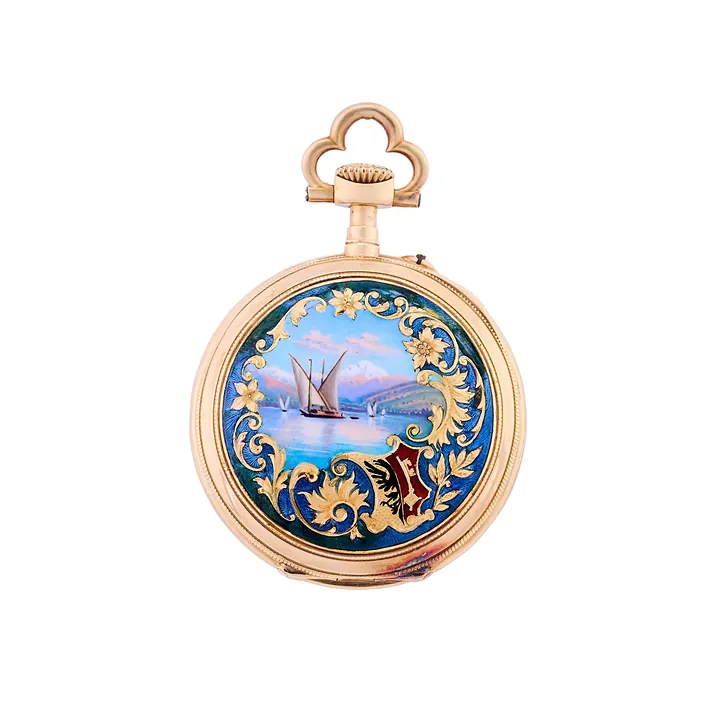
Vacheron Constantin “grand TIR de L’exposition Nationale, Genève 1896, c. 1896
Antiquorum auction archive, Geneva
Pocket Watches · c. 1940
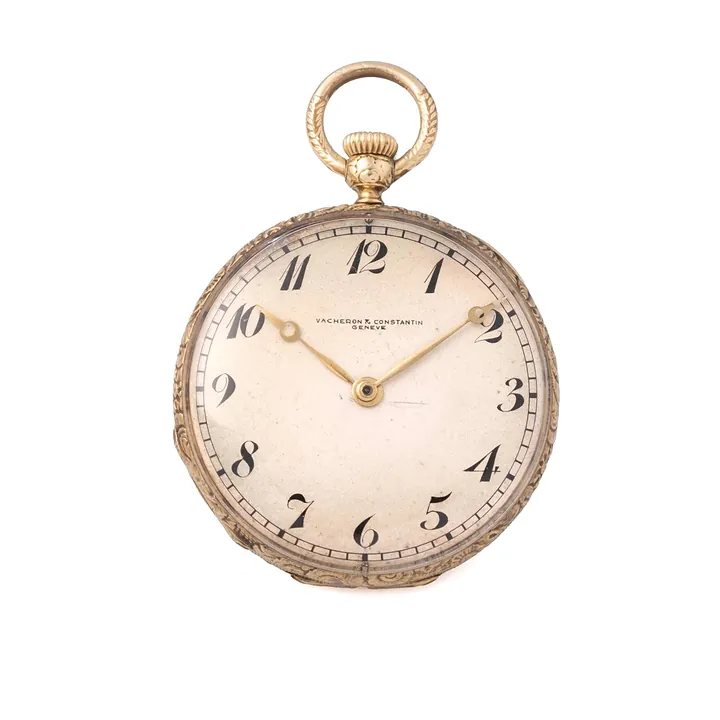
Vacheron Constantin pocket watch, ref. 345, c. 1940
Antiquorum auction archive, Geneva
Pocket Watches · c. 1945
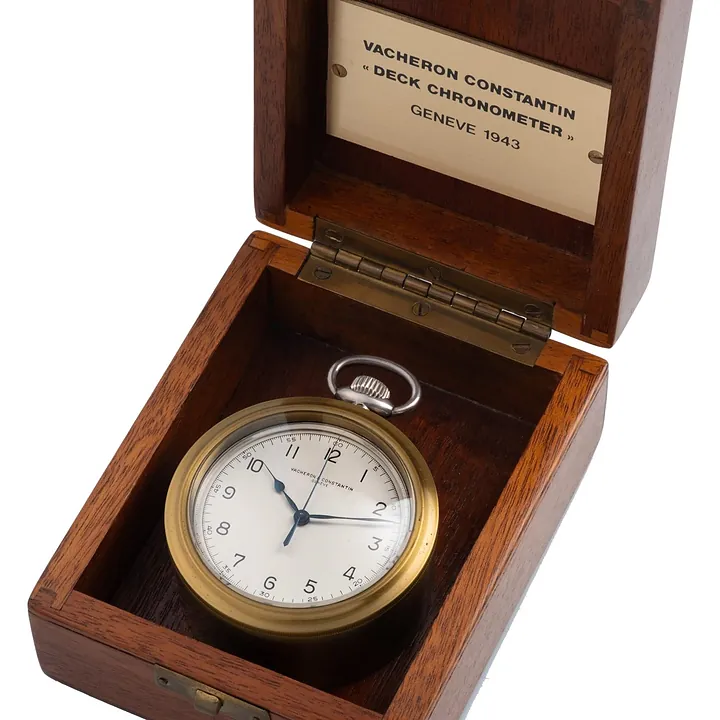
Vacheron Constantin pocket chronometer, c. 1945
Antiquorum auction archive, Geneva
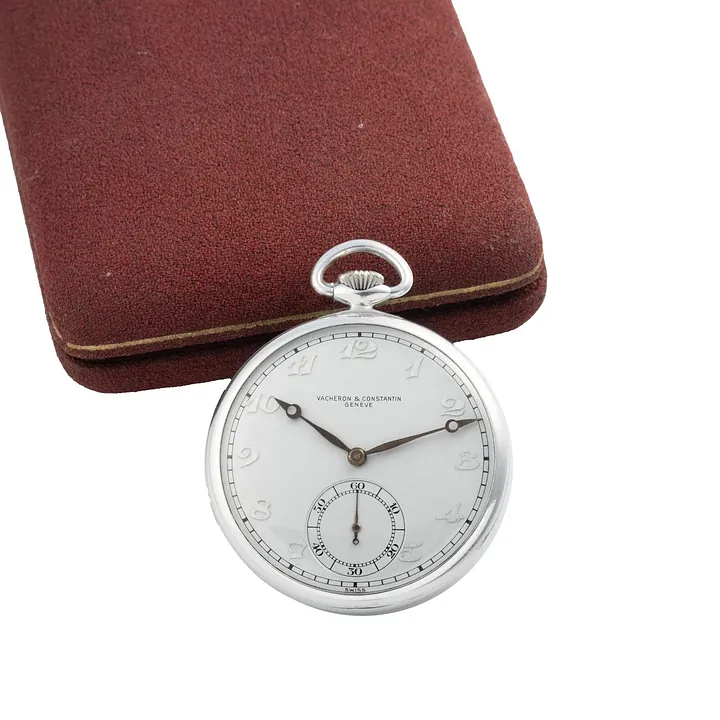
Pocket Watches · c. 1945
Vacheron Constantin watch, c. 1945
Antiquorum auction archive, Geneva

Wristwatches · c. 2010s
Breguet Type XXI, ref. 3810, c. 2010s (Antiquorum Lot 381-24)
Antiquorum auction archive, Geneva

Wristwatches · c. 2010s
Breguet Type XXI, ref. 3810, c. 2010s (Antiquorum Lot 386-229)
Antiquorum auction archive, Geneva

Wristwatches · Sold in September 2010
Breitling Cosmonaute, ref. A 22322, Sold in September 2010
Antiquorum auction archive, Geneva

Wristwatches · c. 2010
Corum Bubble Chrono, ref. 396.150.20, c. 2010
Antiquorum auction archive, Geneva