
Wristwatches · Wristwatch
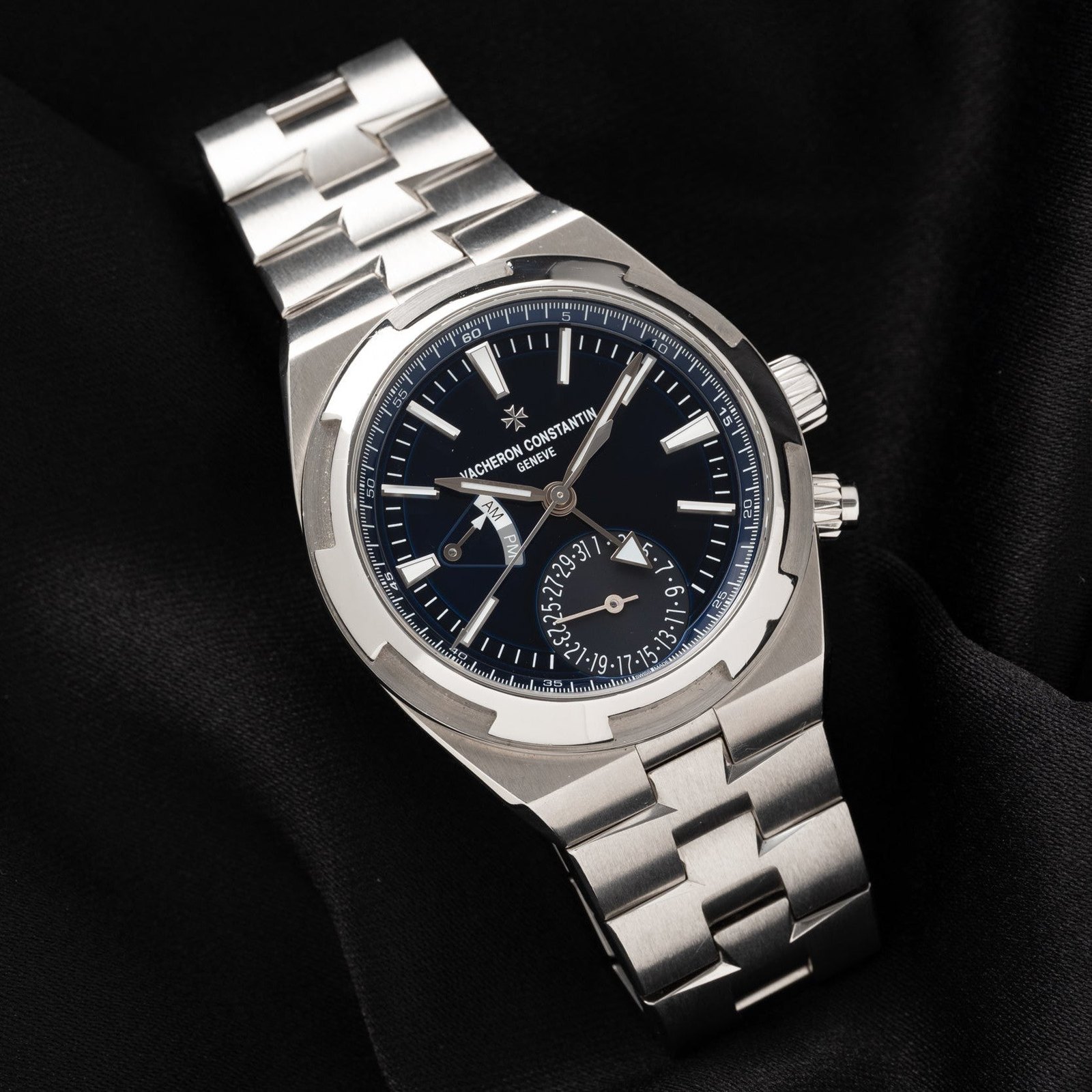
Vacheron Constantin Overseas Dual-Time, 2019
- Maker / attribution
- Vacheron Constantin (maker)
- Date
- 2019
- Historical period
- Contemporary Horology (2010 – Present)
- Country of origin
- Switzerland
- Object type
- Wristwatch
- Dimensions
- Case 41 mm
- Stock no.
- 40990530
- Credit line
- Dealer listing, Analog/Shift (40990530)
- Catalogue title (original)
- Vacheron Constantin Overseas Dual-Time (English)
View the source record (dealer listing) ↗ (opens another website in a new tab)Suggest a correction
Record summary
Catalogued by Analog/Shift (dealer), New York (stock number 40990530), this is a wristwatch by Vacheron Constantin, made in Switzerland, dated 2019. The Atlas places it in the Contemporary Horology period (2010 – Present) of its Wristwatches collection. Recorded dimensions: Case 41 mm. The record is illustrated with 6 photographs.
Assembled from the source record's structured fields. Dates and attributions are given as the source states them; where a field is missing the Atlas leaves it blank rather than estimating.
Catalogue description
Dealer description — Analog/Shift
From a value-packed Atlas GMT from humble microbrand Monta, to the Aquanaut ‘Travel Time’ from Patek Philippe , there are a slew of options that will serve as your trusty companion for travels abroad. O ne of our favorite luxury expressions of the travel watch is the Vacheron Constantin Overseas Dual-Time. This example, a Reference 7900V, dates to 2019 and features the Overseas' distinguishable case silhouette and integrated bracelet design with its barrel shaped midcase, polished, stylized bezel that subtly highlights the brand’s signature ‘Maltese cross’ and a screw-down date adjusting located at 4 o'clock. The stainless steel case measures 41mm in width and with its flat sapphire crystal, comes in a shade under 13mm in thickness, making for a damn good wearing experience. Its deep gloss blue dial alone is something worthy of admiration. Dynamic in all types of lighting, it features applied indices with polished luminous surrounds, a fully graduated rehaut , an AM/PM indicator at 9 o’clock, a recessed subsidiary date dial and a luminous ‘stick’ handset accompanied by an additional arrow hour hand to keep track of local time — which by the way features a a nifty function that allows it to sneak in under the main hour hand to keep the dial neat and tidy while you enjoy being grounded at home. It’s accompanied by a brilliantly designed - and infinitely comfortable - stainless steel bracelet with a signed deployant clasp. The Vacheron Constantin Dual-Time is already a modern classic, but the more intriguing thing about the model is that there’s still so much runway for the model to evolve. Maybe a regular production Overseas Dual-Time in titanium? Sign us up! But in the meantime, this 7900V with its fantastic blue dial is the best iteration yet and should absolutely not be missed.
Historical context
Contemporary Horology (2010 – Present)
Silicon components, connected watches, optical-lattice research clocks and a thriving independent scene.
Smartwatches became the world's best-selling watches, while mechanical watchmaking focuses on craft, innovation (silicon components, new escapements) and independent makers.
Read the period in the timelineMore wristwatches from this periodEarlier: Mechanical Renaissance
Atlas type guide
Wristwatches
Bracelet watches were worn by women from the early nineteenth century — Breguet made one for Caroline Murat, Queen of Naples, in 1810–12 — but the wristwatch only became a man's instrument with military use and aviation in the early twentieth century. Between the World Wars it overtook the pocket watch; the 1920s and 1930s brought rectangular Art Deco cases, water-resistant cases and the first automatic winding systems.
After 1945 the wristwatch became a carrier of identity — dress watches, sports and dive watches, chronographs, calendars — produced by Swiss, American, Japanese, German, Soviet and Chinese industries. The quartz revolution after 1969 and the mechanical renaissance since the 1990s, including the rise of independent watchmakers, complete the story.
What to look for
- The reference number (between the lugs or inside the case back) and serial number, the starting point for dating.
- The calibre: its maker and number are often stamped under the dial or on the bridge.
- Originality of dial, hands and crown — refinished ('redial') dials are common.
- Case material marks: 18K/750, 14K/585, stainless steel, gold-filled, plated.
Dating clues
- Wire-lug cases: before c. 1925.
- Water-resistant screw-down cases: from 1926.
- Quartz movements: from 1969; sapphire crystals widespread after c. 1980.
General guidance written by the Atlas editors about this kind of object. It is not a statement about this particular piece; for that, rely on the source record above and on physical examination.
Related records
Pocket Watches · c. 1896
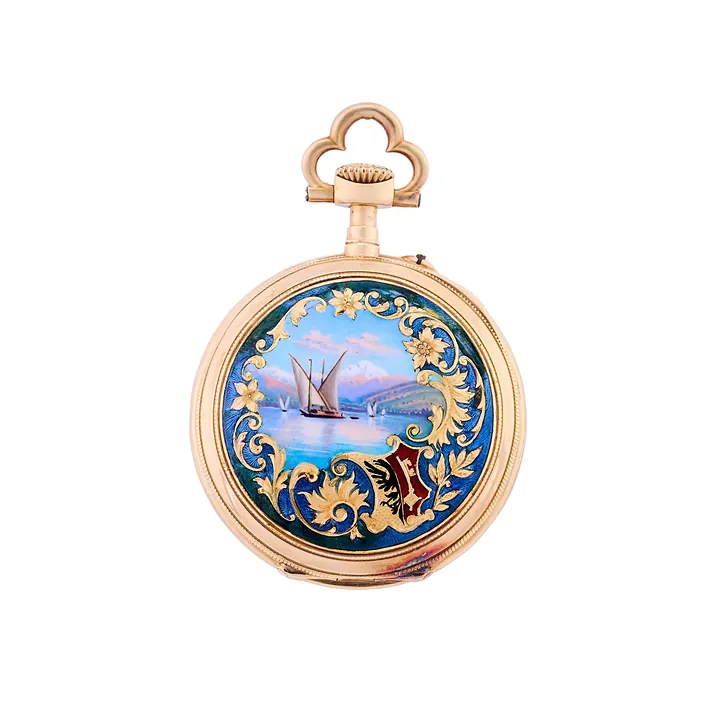
Vacheron Constantin “grand TIR de L’exposition Nationale, Genève 1896, c. 1896
Antiquorum auction archive, Geneva
Pocket Watches · c. 1940
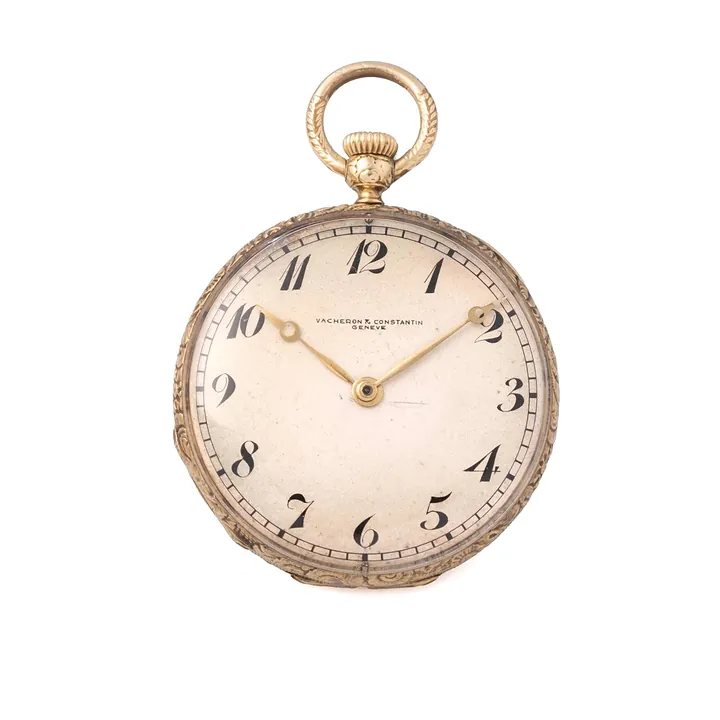
Vacheron Constantin pocket watch, ref. 345, c. 1940
Antiquorum auction archive, Geneva
Pocket Watches · c. 1945
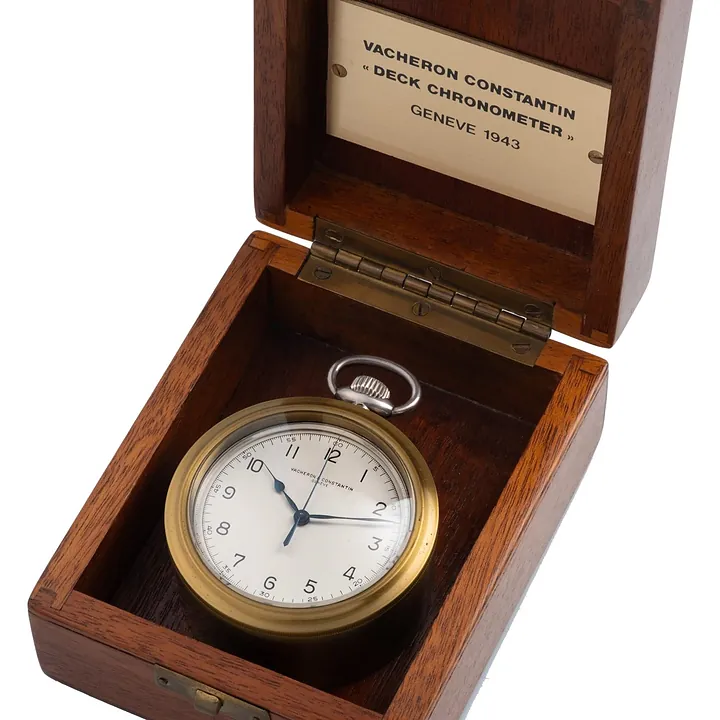
Vacheron Constantin pocket chronometer, c. 1945
Antiquorum auction archive, Geneva
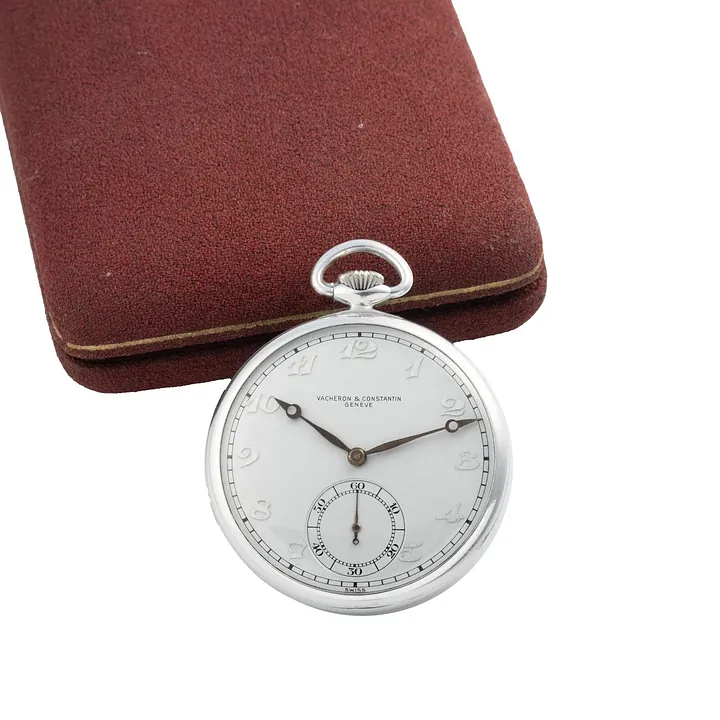
Pocket Watches · c. 1945
Vacheron Constantin watch, c. 1945
Antiquorum auction archive, Geneva

Wristwatches · c. 2010s
Breguet Type XXI, ref. 3810, c. 2010s (Antiquorum Lot 381-24)
Antiquorum auction archive, Geneva

Wristwatches · c. 2010s
Breguet Type XXI, ref. 3810, c. 2010s (Antiquorum Lot 386-229)
Antiquorum auction archive, Geneva

Wristwatches · Sold in September 2010
Breitling Cosmonaute, ref. A 22322, Sold in September 2010
Antiquorum auction archive, Geneva

Wristwatches · c. 2010
Corum Bubble Chrono, ref. 396.150.20, c. 2010
Antiquorum auction archive, Geneva