
Wristwatches · Wristwatch
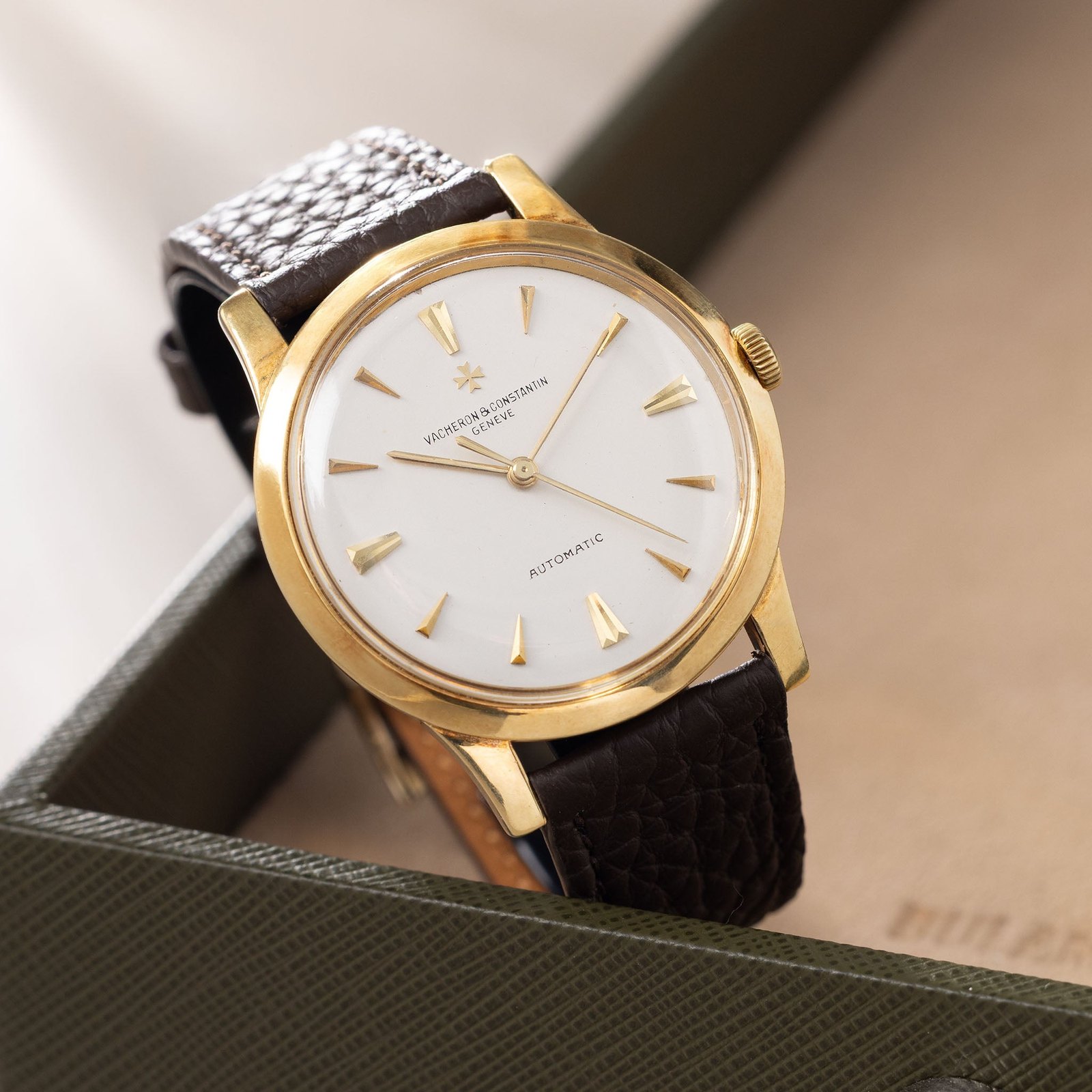
Vacheron Constantin Jubilé Automatic Ref 6038 - 18k Yellow Gold, c. 1957
- Maker / attribution
- Vacheron Constantin (maker)
- Date
- c. 1957
- Historical period
- Modern Mechanical Horology (1945 – 1969)
- Country of origin
- Switzerland
- Object type
- Wristwatch
- Materials / technique
- 18k yellow gold
- Dimensions
- Case 35 mm
- Stock no.
- W-3983
- Credit line
- Dealer listing, Bulang & Sons (W-3983)
- Catalogue title (original)
- Vacheron Constantin Jubilé Automatic Ref 6038 - 18k Yellow Gold (English)
View the source record (dealer listing) ↗ (opens another website in a new tab)Suggest a correction
Record summary
Catalogued by Bulang & Sons (dealer), Copenhagen (stock number W-3983), this is a wristwatch by Vacheron Constantin, made in Switzerland, dated c. 1957. The Atlas places it in the Modern Mechanical Horology period (1945 – 1969) of its Wristwatches collection. Materials and techniques recorded by the source: 18k yellow gold. Recorded dimensions: Case 35 mm. The record is illustrated with 6 photographs.
Assembled from the source record's structured fields. Dates and attributions are given as the source states them; where a field is missing the Atlas leaves it blank rather than estimating.
Catalogue description
Dealer description — Bulang & Sons
A beautiful 1950s Vacheron Constantin Automatic with elegant 35mm proportions, a lovely raised enamel dial signature and the kind of understated quality we have admired for years. We have been fans of Vacheron Constantin for as long as we can remember. There is something very appealing about the manufacture's approach to watchmaking: exceptional craftsmanship, thoughtful design and a certain quiet confidence that doesn't need much explanation. It is wonderful to see more collectors discovering and appreciating these classic vintage Vacherons today. For decades, the manufacture stood alongside the finest names in Swiss watchmaking, including Patek Philippe and Audemars Piguet, yet many of its beautiful vintage dress watches remain surprisingly approachable in comparison. And frankly, we hope they stay that way. This particular reference 6038, known as the Jubilé, is a lovely example of why we enjoy them so much. Dating to circa 1957, the watch features a beautifully proportioned 35mm case in 18k yellow gold, with elegantly curved lugs, a smooth polished bezel and a screw-down caseback. The case remains in lovely condition, retaining its attractive shape and well-defined details. At 35mm, it has a wonderful presence on the wrist, with proportions that feel just as relevant today as they did in the 1950s. The silvered dial is a real pleasure to look at. Beautifully faceted gold arrowhead hour markers, distinctive double markers at the quarters and slender gold hands give the otherwise restrained design plenty of character. Particularly lovely is the traditional raised enamel printing of the Vacheron & Constantin signature, a wonderful detail of fine vintage dial craftsmanship. Together with the applied Maltese Cross, it creates a beautifully balanced composition that has aged with great elegance. Inside beats the automatic calibre P1019/1, based on a Jaeger-LeCoultre movement and beautifully finished by Vacheron Constantin. The watch and movement have been fully serviced by an experienced professional watchmaker. We have paired this fine Jubilé with a Bulang & Sons leather strap, complemented by a genuine 18k yellow gold Vacheron Constantin Maltese Cross pin buckle. For us, this is exactly what makes vintage Vacheron Constantin so rewarding. Beautiful watchmaking, genuine history and a level of elegance that feels completely natural on the wrist. A wonderful reminder of why we have always had such a soft spot for these classic Geneva dress watches. Specifications: Vacheron Constantin Jubilé Automatic, reference 6038 Circa 1957, case no. 360xxx / movement no. 528xxx 35mm 18k yellow gold case with screw-down caseback Silvered no-lume dial with raised enamel signature and applied gold arrowhead markers Automatic calibre P1019/1 Bulang & Sons leather strap with genuine 18k yellow gold Vacheron Constantin Maltese Cross pin buckle Fully serviced by an experienced professional watchmaker Historical Context In 1955, Vacheron Constantin celebrated its 200th anniversary, an important milestone for one of Geneva's oldest continuously operating watch manufacturers. Among the watches associated with this occasion was the reference 6038, known to collectors as the Jubilé, combining classical mid-century design with an automatic movement. Its calibre P1019/1 belongs to a generation of finely finished automatic movements developed from Jaeger-LeCoultre architecture, reflecting the close technical relationships between leading Swiss manufactures during this period. The Jubilé represents a particularly appealing chapter in Vacheron Constantin's history, when traditional Genevan craftsmanship was combined with the convenience of automatic winding. Today, these elegant 1950s references offer collectors a fascinating insight into the manufacture's rich heritage beyond its more familiar modern collections.
Historical context
Modern Mechanical Horology (1945 – 1969)
Tool watches for divers, pilots and astronauts; electric watches anticipate the electronic age.
The classic era of the mechanical wristwatch: dive watches, chronographs for motor racing and space flight, GMT watches for jet travel, slim dress watches, automatic calendars, and the rise of Japanese manufacturers alongside Swiss, American, German and Soviet industries.
Read the period in the timelineMore wristwatches from this periodEarlier: Golden Age of Mechanical Watchmaking
Atlas type guide
Automatic (self-winding) watches
Self-winding watches use the wearer's motion to wind the mainspring. Abraham-Louis Perrelet and Breguet made 'perpétuelle' pocket watches with oscillating weights in the late eighteenth century, but the principle only became practical in the wristwatch. John Harwood patented a bumper automatic in 1923; Rolex's Perpetual rotor (1931) winding in one direction, and later bidirectional rotors (Eterna, Felsa Bidynator), established the modern form. Micro-rotors (Universal Genève, Buren) and peripheral rotors made automatic watches thinner.
What to look for
- A semicircular rotor turning 360° over the movement, or a 'bumper' weight that rebounds between springs.
- 'Automatic', 'Perpetual' or 'Self-winding' on the dial.
- A sealed screw-back case, since automatic watches are wound less often by the crown.
Dating clues
- Bumper automatics: 1923–c. 1955.
- Full rotors: from 1931 (Rolex); widespread after c. 1950.
- Micro-rotors: from 1954–1958.
General guidance written by the Atlas editors about this kind of object. It is not a statement about this particular piece; for that, rely on the source record above and on physical examination.
Related records
Pocket Watches · c. 1896
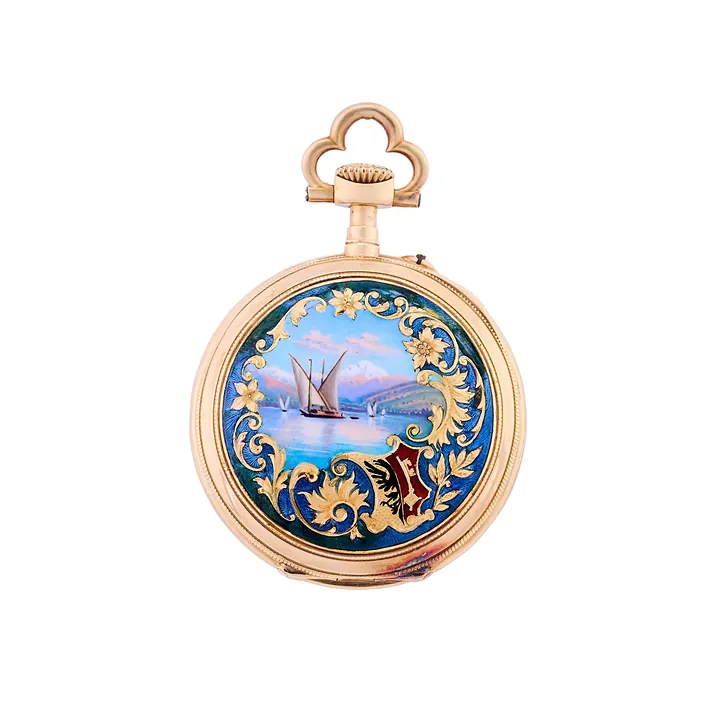
Vacheron Constantin “grand TIR de L’exposition Nationale, Genève 1896, c. 1896
Antiquorum auction archive, Geneva
Pocket Watches · c. 1940
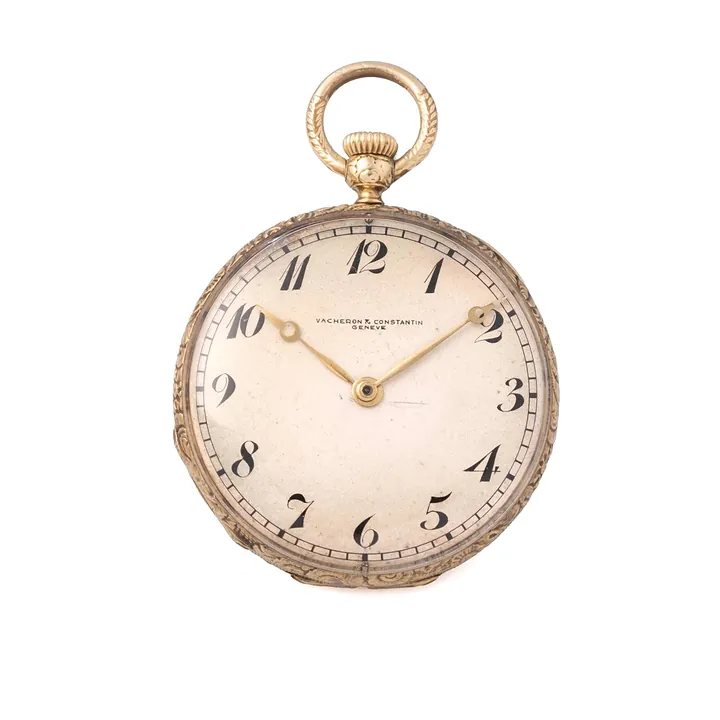
Vacheron Constantin pocket watch, ref. 345, c. 1940
Antiquorum auction archive, Geneva
Pocket Watches · c. 1945
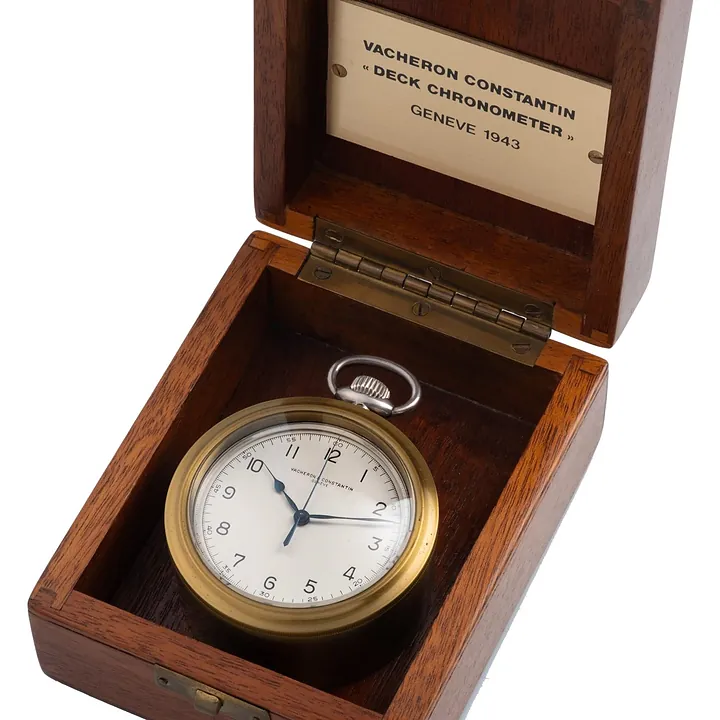
Vacheron Constantin pocket chronometer, c. 1945
Antiquorum auction archive, Geneva
Pocket Watches · c. 1945
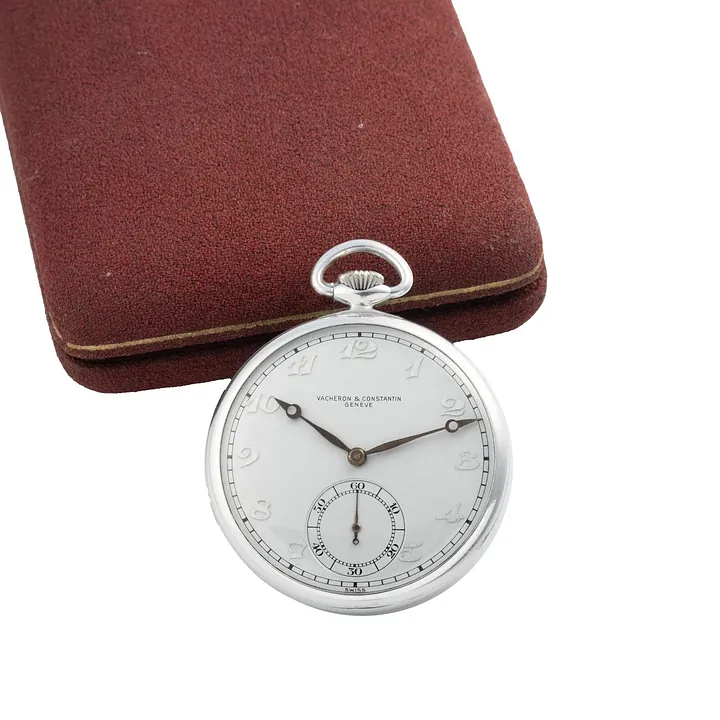
Vacheron Constantin watch, c. 1945
Antiquorum auction archive, Geneva

Wristwatches · 1945
Wristwatch by Eterna, 1945
Museum Rotterdam

Wristwatches · c. 1945
Breitling Premier, ref. 790, c. 1945
Antiquorum auction archive, Geneva

Wristwatches · c. 1945
Universal Genève Uni-Compax, ref. 22492, c. 1945
Antiquorum auction archive, Geneva

Wristwatches · c. 1950s
Baume & Mercier wristwatch, c. 1950s
Antiquorum auction archive, Geneva