
Wristwatches · Wristwatch
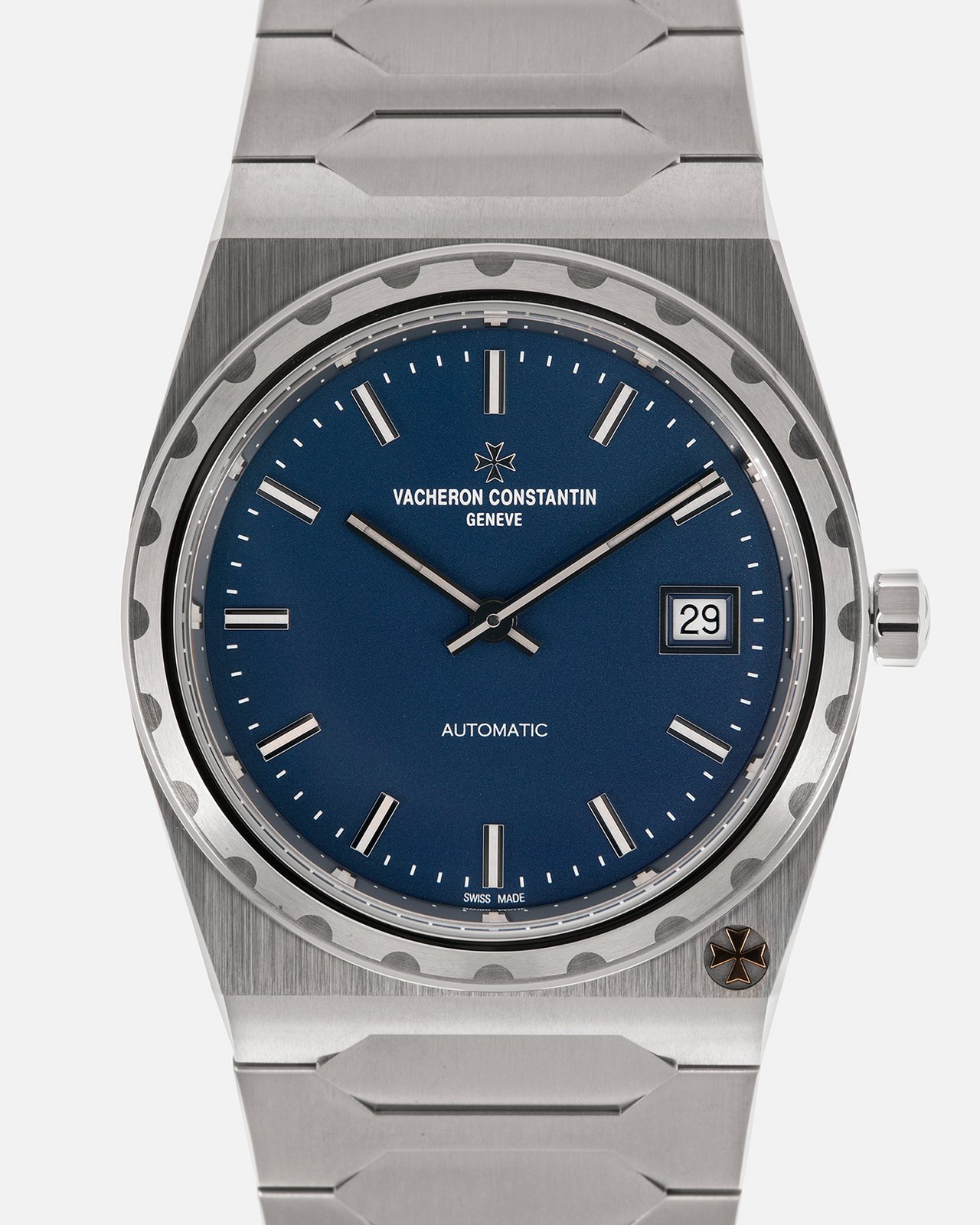
Vacheron Constantin Historiques Ref. 222 Stainless Steel, 2025
- Maker / attribution
- Vacheron Constantin (maker)
- Date
- 2025
- Historical period
- Contemporary Horology (2010 – Present)
- Country of origin
- Switzerland
- Object type
- Wristwatch
- Materials / technique
- stainless steel
- Dimensions
- Case 37 mm
- Stock no.
- Product 7665824530519
- Credit line
- Dealer listing, S.Song Watches (product 7665824530519)
- Catalogue title (original)
- Vacheron Constantin Historiques Ref. 222 Stainless Steel (English)
View the source record (dealer listing) ↗ (opens another website in a new tab)Suggest a correction
Record summary
Catalogued by S.Song Watches (dealer), Seattle (stock number Product 7665824530519), this is a wristwatch by Vacheron Constantin, made in Switzerland, dated 2025. The Atlas places it in the Contemporary Horology period (2010 – Present) of its Wristwatches collection. Materials and techniques recorded by the source: stainless steel. Recorded dimensions: Case 37 mm. The record is illustrated with 6 photographs.
Assembled from the source record's structured fields. Dates and attributions are given as the source states them; where a field is missing the Atlas leaves it blank rather than estimating.
Catalogue description
Dealer description — S.Song Watches
Originally introduced in 1977 to commemorate Vacheron Constantin’s 222nd anniversary, the 222 represented a dramatic departure from the brand’s traditionally conservative design language and marked its entry into the emerging luxury sports watch category. Designed by a young Jorg Hysek, the 222 arrived during an era when watchmakers were experimenting more boldly than ever before, producing a handful of designs that would ultimately define the industry for decades to come. While names such as the Audemars Piguet Royal Oak and Patek Philippe Nautilus dominate that conversation today, the Vacheron Constantin Historiques 222 has often remained the quieter alternative despite being no less significant. Following the overwhelming reception of the yellow gold Historiques 222 unveiled at Watches & Wonders 2022, Vacheron subsequently expanded the collection with what many collectors had quietly hoped for all along: a stainless steel variant. While the gold model celebrated the glamour and opulence of the late 1970s, the steel Historiques 222 shifts the watch into more contemporary territory, turning it into a wearable everyday proposition while remaining largely faithful to the spirit of the original Jumbo. Like its precious metal counterpart, the 222 belongs to the Historiques collection, a series dedicated to contemporary reinterpretations of the brand’s most important archival designs. Reviving an icon requires a careful balance between preservation and modernisation, and Vacheron strikes that balance exceptionally well here. The overall proportions remain faithful to the original, with the steel case measuring an ideal 37mm x 7.95mm. In an era where integrated bracelet sports watches continue to grow in size and presence, the Historiques 222 feels refreshingly elegant on the wrist. More importantly, it retains the thin, almost flush-wearing profile that defined the original Jumbo. That remarkable thinness largely comes down to the in-house self-winding Cal. 2455/2 powering the watch. Impeccably finished and beautifully proportioned, the movement features the now-iconic ‘222’-engraved solid gold rotor visible through the sapphire exhibition caseback. Unlike the monobloc construction of the original vintage reference, the modern Historiques 222 adopts a contemporary three-part case architecture while preserving defining elements such as the fluted bezel and the miniature Maltese Cross positioned at the lower right side of the case. The execution of the case and bracelet is especially impressive in stainless steel. The interplay between vertically brushed surfaces and polished bevels emphasizes the angularity of Jorg Hysek’s original design, lending the watch a distinctly architectural character. Just as importantly, the finishing flows continuously from the case into the integrated bracelet without visual interruption, creating a strong sense of cohesion. The blue dial further transforms the character of the Historiques 222. Where the gold variant leaned heavily into vintage warmth and nostalgia, the steel model feels noticeably sportier and more contemporary. Its matte blue surface retains the historical fonts, logo placement, and two-hand layout of the original while incorporating subtle technical updates expected of a modern reissue. The baton hands and hour markers now feature Super-LumiNova for improved low-light legibility, while the repositioned date aperture sits more naturally within the dial layout than it did on the original 1977 reference. What makes the steel Historiques 222 particularly compelling is that it does not attempt to compete directly with the Overseas despite inevitably inviting comparisons. While both occupy the integrated bracelet sports watch category, the two watches offer entirely different experiences on the wrist. The Overseas feels modern, technical, and overtly versatile, whereas the 222 remains elegant, restrained, and deeply rooted in 1970s design language. In today’s landscape, where vintage-inspired reissues have become increasingly common, the Historiques 222 still manages to feel genuinely special. Perhaps that comes down to the discipline of its execution, or simply the confidence Vacheron demonstrated in carrying the original design forward so faithfully. Either way, the result is one of the finest modern reinterpretations of a classic sports watch currently available. While not officially limited, the stainless steel Historiques 222 remains exceptionally difficult to obtain through boutiques, making examples like this increasingly desirable among collectors who appreciate understated icons.
Historical context
Contemporary Horology (2010 – Present)
Silicon components, connected watches, optical-lattice research clocks and a thriving independent scene.
Smartwatches became the world's best-selling watches, while mechanical watchmaking focuses on craft, innovation (silicon components, new escapements) and independent makers.
Read the period in the timelineMore wristwatches from this periodEarlier: Mechanical Renaissance
Atlas type guide
Wristwatches
Bracelet watches were worn by women from the early nineteenth century — Breguet made one for Caroline Murat, Queen of Naples, in 1810–12 — but the wristwatch only became a man's instrument with military use and aviation in the early twentieth century. Between the World Wars it overtook the pocket watch; the 1920s and 1930s brought rectangular Art Deco cases, water-resistant cases and the first automatic winding systems.
After 1945 the wristwatch became a carrier of identity — dress watches, sports and dive watches, chronographs, calendars — produced by Swiss, American, Japanese, German, Soviet and Chinese industries. The quartz revolution after 1969 and the mechanical renaissance since the 1990s, including the rise of independent watchmakers, complete the story.
What to look for
- The reference number (between the lugs or inside the case back) and serial number, the starting point for dating.
- The calibre: its maker and number are often stamped under the dial or on the bridge.
- Originality of dial, hands and crown — refinished ('redial') dials are common.
- Case material marks: 18K/750, 14K/585, stainless steel, gold-filled, plated.
Dating clues
- Wire-lug cases: before c. 1925.
- Water-resistant screw-down cases: from 1926.
- Quartz movements: from 1969; sapphire crystals widespread after c. 1980.
General guidance written by the Atlas editors about this kind of object. It is not a statement about this particular piece; for that, rely on the source record above and on physical examination.
Related records
Pocket Watches · c. 1896
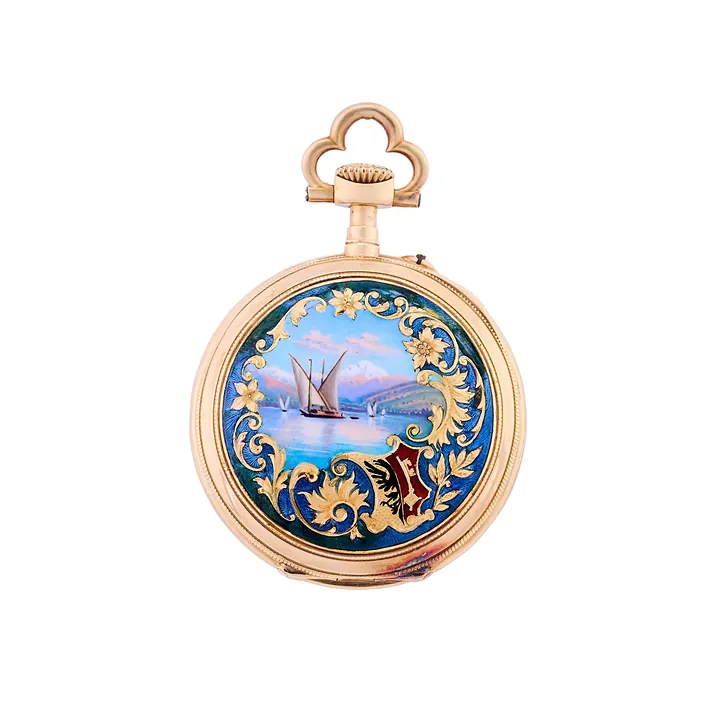
Vacheron Constantin “grand TIR de L’exposition Nationale, Genève 1896, c. 1896
Antiquorum auction archive, Geneva
Pocket Watches · c. 1940
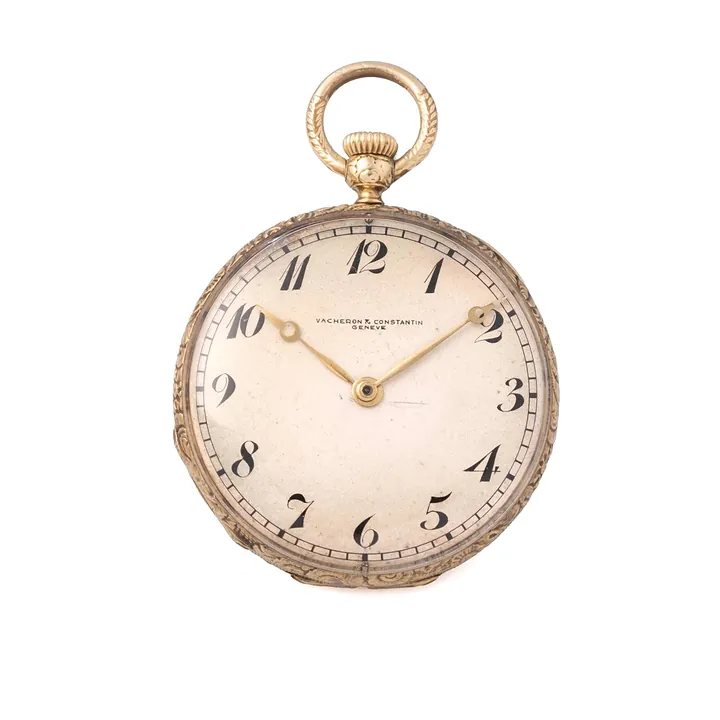
Vacheron Constantin pocket watch, ref. 345, c. 1940
Antiquorum auction archive, Geneva
Pocket Watches · c. 1945
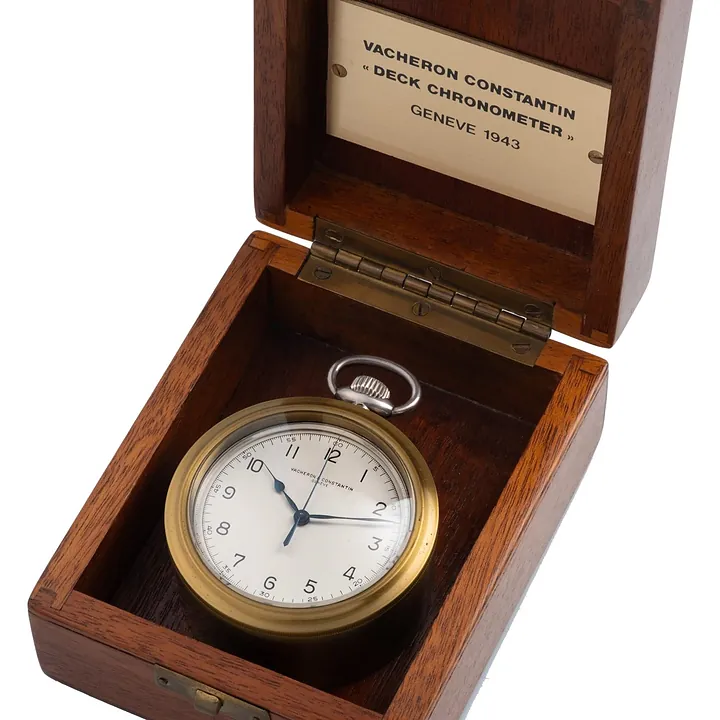
Vacheron Constantin pocket chronometer, c. 1945
Antiquorum auction archive, Geneva
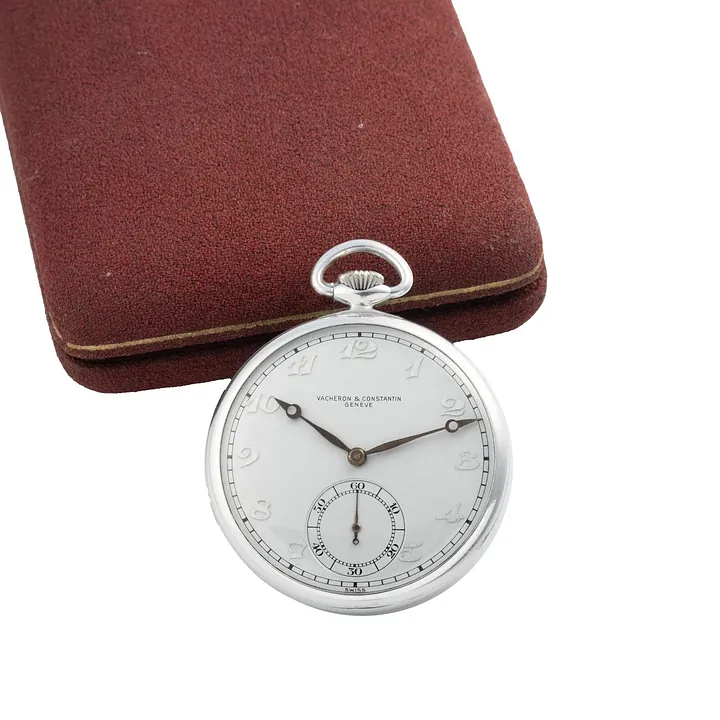
Pocket Watches · c. 1945
Vacheron Constantin watch, c. 1945
Antiquorum auction archive, Geneva

Wristwatches · c. 2010s
Breguet Type XXI, ref. 3810, c. 2010s (Antiquorum Lot 381-24)
Antiquorum auction archive, Geneva

Wristwatches · c. 2010s
Breguet Type XXI, ref. 3810, c. 2010s (Antiquorum Lot 386-229)
Antiquorum auction archive, Geneva

Wristwatches · Sold in September 2010
Breitling Cosmonaute, ref. A 22322, Sold in September 2010
Antiquorum auction archive, Geneva

Wristwatches · c. 2010
Corum Bubble Chrono, ref. 396.150.20, c. 2010
Antiquorum auction archive, Geneva