
Wristwatches · Wristwatch
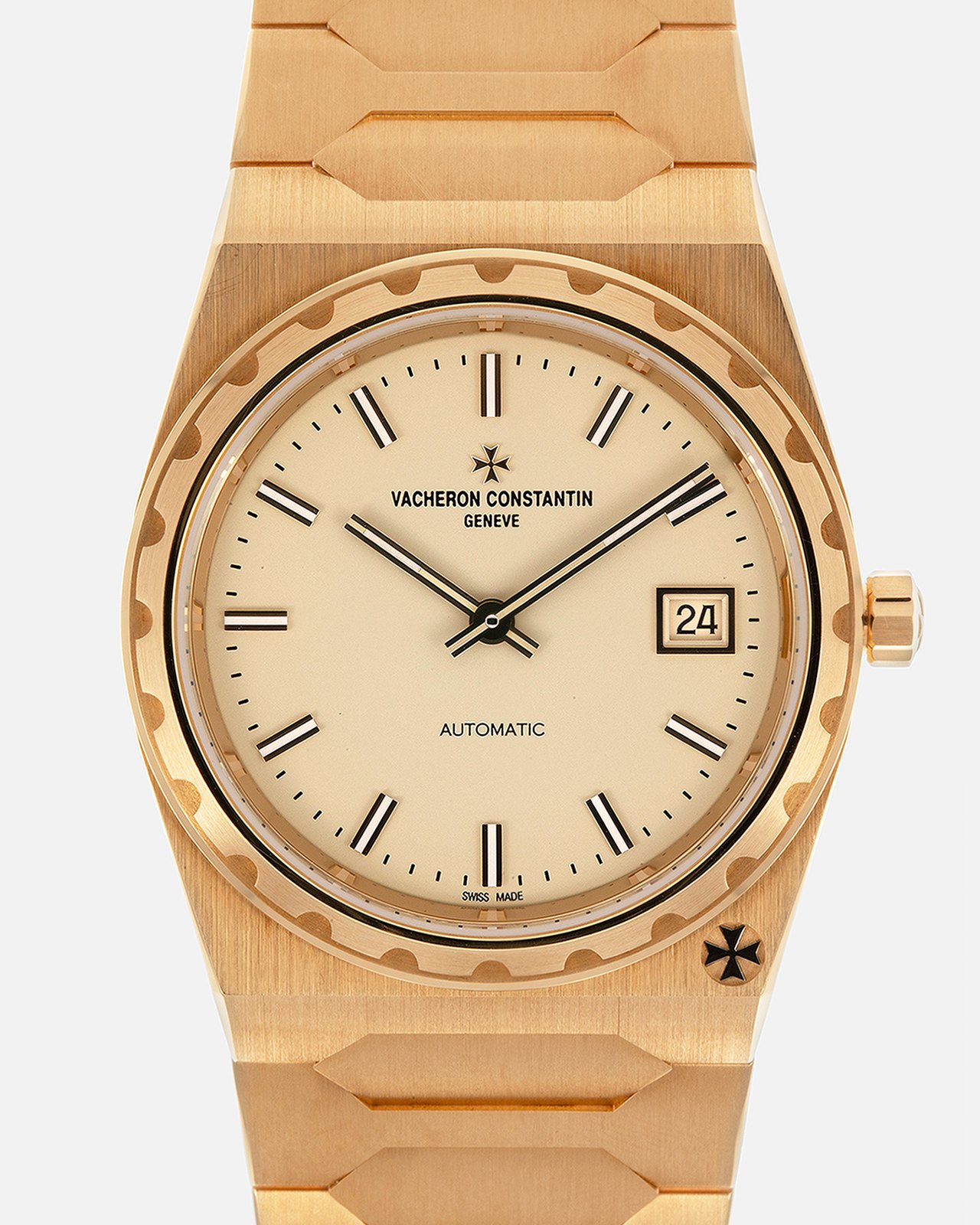
Vacheron Constantin Historiques Ref. 222, 2022
- Maker / attribution
- Vacheron Constantin (maker)
- Date
- 2022
- Historical period
- Contemporary Horology (2010 – Present)
- Country of origin
- Switzerland
- Object type
- Wristwatch
- Dimensions
- Case 37 mm
- Stock no.
- Product 7626617487447
- Credit line
- Dealer listing, S.Song Watches (product 7626617487447)
- Catalogue title (original)
- Vacheron Constantin Historiques Ref. 222 (English)
View the source record (dealer listing) ↗ (opens another website in a new tab)Suggest a correction
Record summary
Catalogued by S.Song Watches (dealer), Seattle (stock number Product 7626617487447), this is a wristwatch by Vacheron Constantin, made in Switzerland, dated 2022. The Atlas places it in the Contemporary Horology period (2010 – Present) of its Wristwatches collection. Recorded dimensions: Case 37 mm. The record is illustrated with 6 photographs.
Assembled from the source record's structured fields. Dates and attributions are given as the source states them; where a field is missing the Atlas leaves it blank rather than estimating.
Catalogue description
Dealer description — S.Song Watches
When we talk about iconic watch designs of the 20 th century, I typically gravitate towards the 1970s, as it was a time when watch brands were more experimental in their approach and took more risks. Despite many designs from that era being a complete flop as a result of said experimentation, some have gone on to become irreplaceable icons today. Obvious examples of such include the Patek Philippe Nautilus and the Audemars Piguet Royal Oak, but there is one other watch that is seldom discussed in the same conversation as the former two—the Vacheron Constantin 222. The 222, introduced in 1977 to commemorate Vacheron Constantin's 222nd anniversary, was a significant departure from their traditional ‘old world’ designs and served as their entry into the luxury sports watch market. Designed by a young Jorg Hysek, it brought a fresh perspective to the brand's traditional aesthetic. Though what we have here today is not the original 222 from 1977, this particular example is a brilliant reissue unveiled at Watches and Wonders 2022. There is not a single doubt that the Vacheron Constantin 222 was the star of the entire show that year—it was all anyone could talk about. This watch hails from the Vacheron Constantin Historiques Collection, which was established in the early 1990s to offer “contemporary reinterpretations” from the brand’s extensive design portfolio and heritage. The best of both worlds, I’d say, using a vintage-inspired design with modern technology and functionality. The Historiques 222 comes in a luxurious case crafted out of 18-carat 3N yellow gold, measuring at a perfect size of 37mm x 7.95mm, faithful to the original vintage Jumbo 222. The most amazing part is that while brands have been known to butcher contemporary reinterpretations, Vacheron Constantin managed to keep the 222’s thickness at an amazing 7.95mm. For me, integrated sport watches are all about how thin they can get, and the 222 takes the cake, significantly edging out the Audemars Piguet 15202’s 8.1mm and Patek Philippe 5711’s 8.3mm thickness. While it may not seem like much in numbers, I assure you, on the wrist, the difference is immediately noticeable as the 222 sits almost flush with your wrist. The aforementioned thinness of the 222 is largely attributed to the in-house self-winding Cal. 2455/2 powering the watch. Meticulously finished and decorated, it is topped off with its iconic ‘222’-engraved solid gold rotor. Despite retaining key design cues from the original, such as the emblematic fluted bezel and the miniature Maltese Cross at the lower right of the case, the modern Historiques 222 introduces a more contemporary three-part construction, now fitted with an exhibition caseback that gloriously reveals the movement within. This update does little to disturb the watch’s visual integrity, as the overall finishing remains impeccable, with finely brushed surfaces and crisp bevels flowing seamlessly into the bracelet without interruption. Turning our attention to the matte gold dial, it similarly mirrors the layout of the original with its historical fonts, logo placement, and two-hand configuration. However, as a Historiques reissue, there are some contemporary technical adaptations here. For instance, the hour markers and baton hands now feature Super-Luminova for improved legibility in low-light conditions. Additionally, the date window aperture has been repositioned, moving away from the outer periphery of the minute track, resulting in enhanced legibility compared to its predecessor. In today’s world, where reissues of an iconic design from the past are plentiful, I find the Historiques 222 to be a breath of fresh air for some reason, which is quite ironic in this case. Perhaps it is attributed to the fact that the Overseas line has taken centre stage in recent times. While similar to an integrated ‘sports’ watch, the 222, I assure you, is an entirely different proposition. Overall, Vacheron Constantin's execution of this reissue is exceptional, striking a perfect balance between incorporating modern technical enhancements and remaining faithful to the original design. While not a limited edition, this Vacheron Constantin 222 is notoriously difficult to purchase in-store and tightly allocated, making this available example a genuine pleasure for us to offer on the site today.
Historical context
Contemporary Horology (2010 – Present)
Silicon components, connected watches, optical-lattice research clocks and a thriving independent scene.
Smartwatches became the world's best-selling watches, while mechanical watchmaking focuses on craft, innovation (silicon components, new escapements) and independent makers.
Read the period in the timelineMore wristwatches from this periodEarlier: Mechanical Renaissance
Atlas type guide
Wristwatches
Bracelet watches were worn by women from the early nineteenth century — Breguet made one for Caroline Murat, Queen of Naples, in 1810–12 — but the wristwatch only became a man's instrument with military use and aviation in the early twentieth century. Between the World Wars it overtook the pocket watch; the 1920s and 1930s brought rectangular Art Deco cases, water-resistant cases and the first automatic winding systems.
After 1945 the wristwatch became a carrier of identity — dress watches, sports and dive watches, chronographs, calendars — produced by Swiss, American, Japanese, German, Soviet and Chinese industries. The quartz revolution after 1969 and the mechanical renaissance since the 1990s, including the rise of independent watchmakers, complete the story.
What to look for
- The reference number (between the lugs or inside the case back) and serial number, the starting point for dating.
- The calibre: its maker and number are often stamped under the dial or on the bridge.
- Originality of dial, hands and crown — refinished ('redial') dials are common.
- Case material marks: 18K/750, 14K/585, stainless steel, gold-filled, plated.
Dating clues
- Wire-lug cases: before c. 1925.
- Water-resistant screw-down cases: from 1926.
- Quartz movements: from 1969; sapphire crystals widespread after c. 1980.
General guidance written by the Atlas editors about this kind of object. It is not a statement about this particular piece; for that, rely on the source record above and on physical examination.
Related records
Pocket Watches · c. 1896
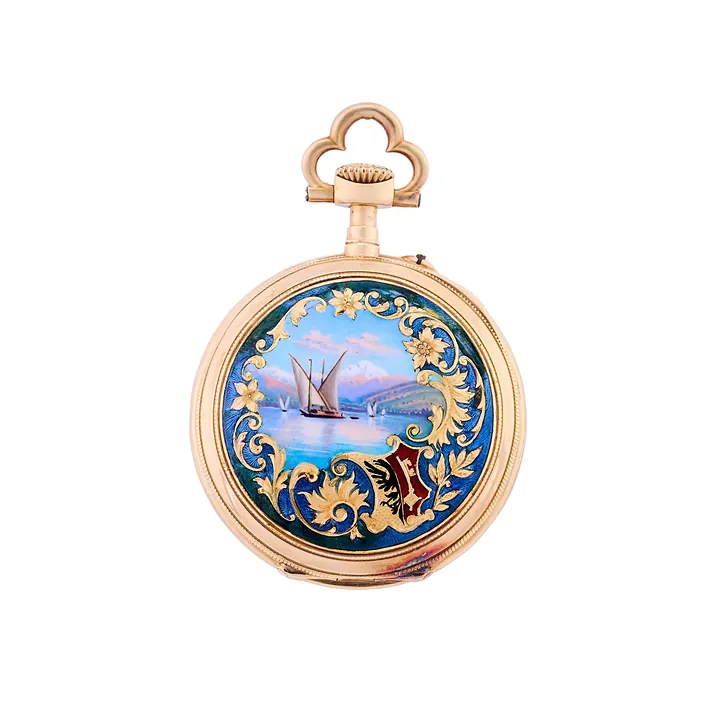
Vacheron Constantin “grand TIR de L’exposition Nationale, Genève 1896, c. 1896
Antiquorum auction archive, Geneva
Pocket Watches · c. 1940
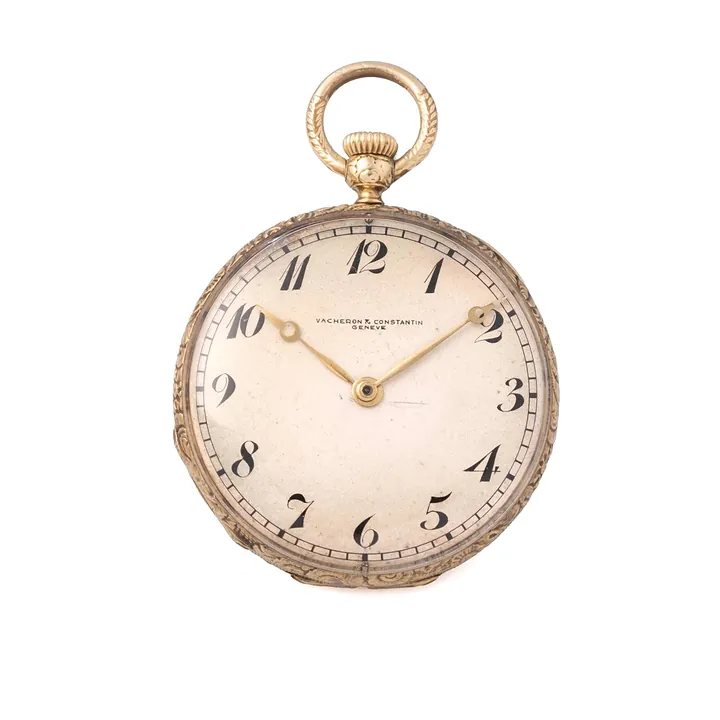
Vacheron Constantin pocket watch, ref. 345, c. 1940
Antiquorum auction archive, Geneva
Pocket Watches · c. 1945
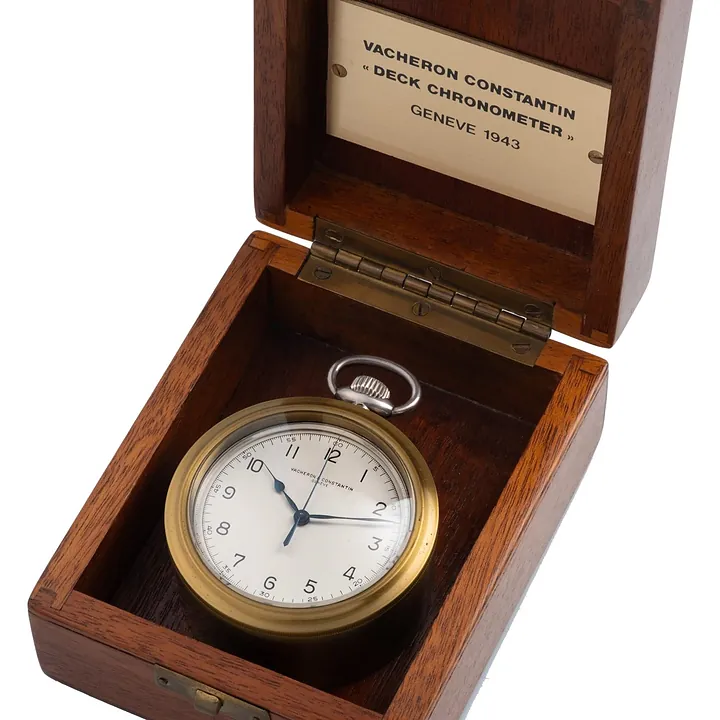
Vacheron Constantin pocket chronometer, c. 1945
Antiquorum auction archive, Geneva
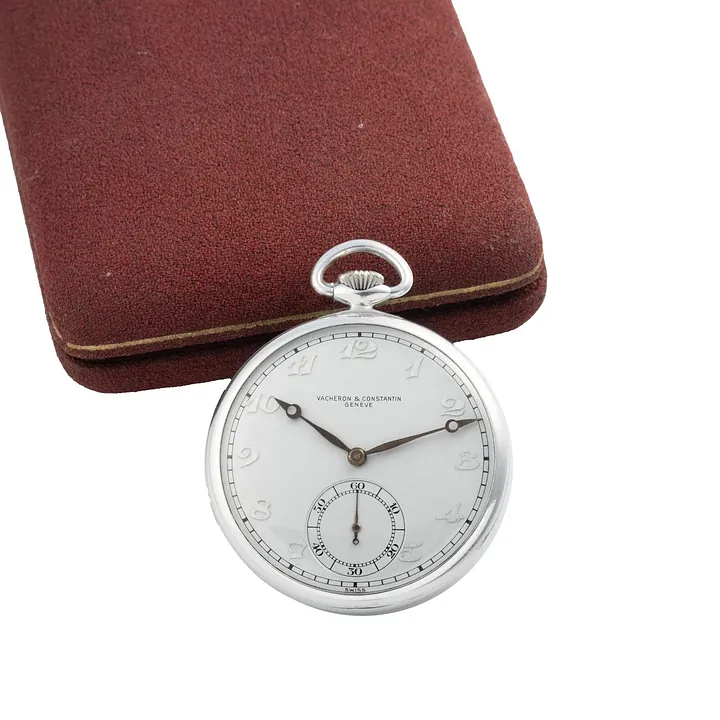
Pocket Watches · c. 1945
Vacheron Constantin watch, c. 1945
Antiquorum auction archive, Geneva

Wristwatches · c. 2010s
Breguet Type XXI, ref. 3810, c. 2010s (Antiquorum Lot 381-24)
Antiquorum auction archive, Geneva

Wristwatches · c. 2010s
Breguet Type XXI, ref. 3810, c. 2010s (Antiquorum Lot 386-229)
Antiquorum auction archive, Geneva

Wristwatches · Sold in September 2010
Breitling Cosmonaute, ref. A 22322, Sold in September 2010
Antiquorum auction archive, Geneva

Wristwatches · c. 2010
Corum Bubble Chrono, ref. 396.150.20, c. 2010
Antiquorum auction archive, Geneva