
Wristwatches · Wristwatch
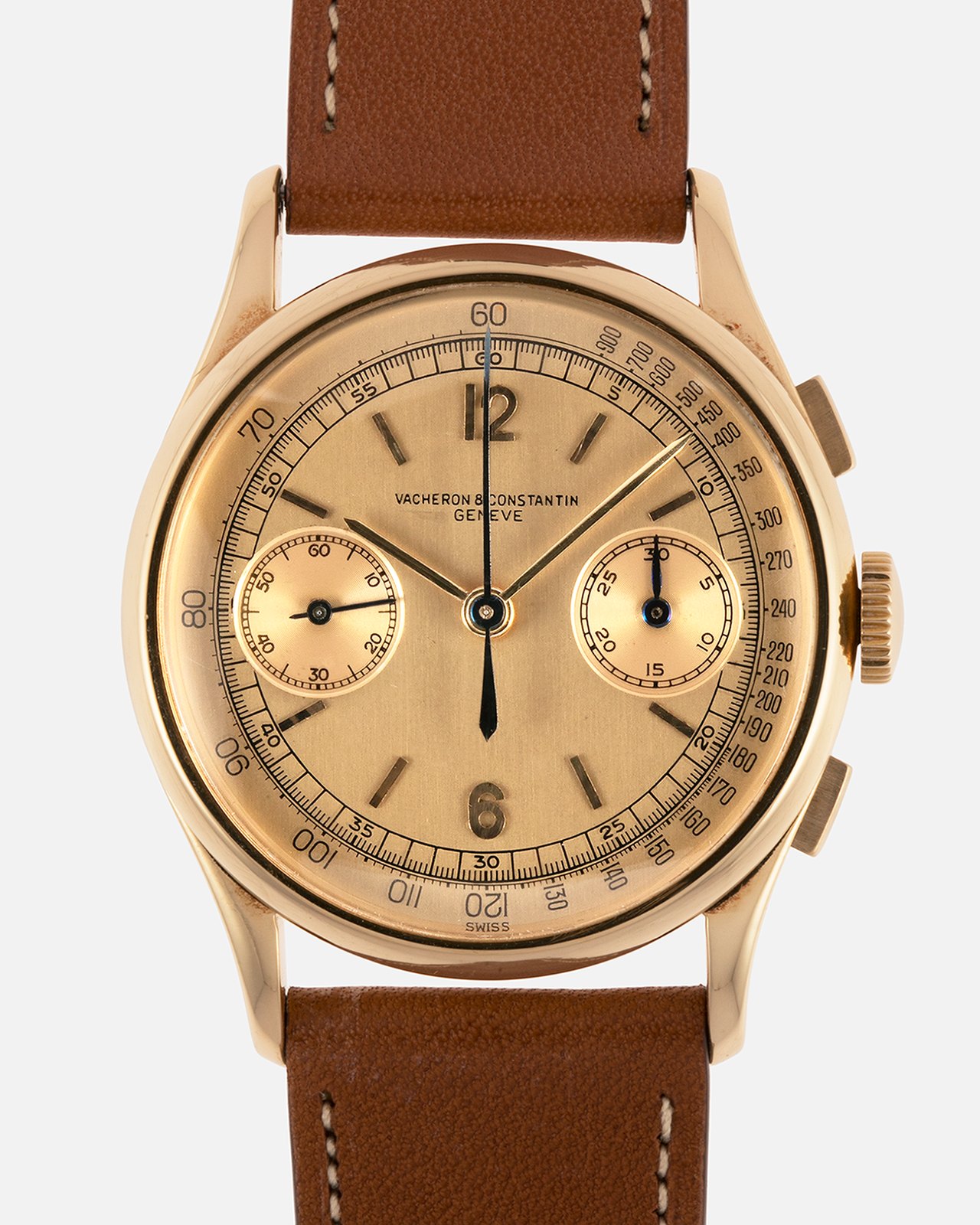
Vacheron Constantin Chronograph 4072 Yellow Gold, 1940s
- Maker / attribution
- Vacheron Constantin (maker)
- Date
- 1940s
- Historical period
- Golden Age of Mechanical Watchmaking (1900 – 1945)
- Country of origin
- Switzerland
- Object type
- Wristwatch
- Materials / technique
- yellow gold
- Dimensions
- Case 35 mm
- Stock no.
- Product 7834286686295
- Credit line
- Dealer listing, S.Song Watches (product 7834286686295)
- Catalogue title (original)
- Vacheron Constantin Chronograph 4072 Yellow Gold (English)
View the source record (dealer listing) ↗ (opens another website in a new tab)Suggest a correction
Record summary
Catalogued by S.Song Watches (dealer), Seattle (stock number Product 7834286686295), this is a wristwatch by Vacheron Constantin, made in Switzerland, dated 1940s. The Atlas places it in the Golden Age of Mechanical Watchmaking period (1900 – 1945) of its Wristwatches collection. Materials and techniques recorded by the source: yellow gold. Recorded dimensions: Case 35 mm. The record is illustrated with 6 photographs.
Assembled from the source record's structured fields. Dates and attributions are given as the source states them; where a field is missing the Atlas leaves it blank rather than estimating.
Catalogue description
Dealer description — S.Song Watches
Among the great Swiss manufactures, Vacheron Constantin has produced some of the most elegant chronograph wristwatches of the twentieth century. While the manufacture is perhaps best known for its complicated pocket watches and classical dress watches, its chronographs from the 1930s through to the 1960s represent a particularly important period in its history. Produced in relatively small quantities, these watches combined exceptional mechanical movements with beautifully proportioned cases and dials. Introduced in 1938, the reference 4072 would become one of Vacheron Constantin's most recognisable vintage chronographs, remaining in production until the early 1970s. Unlike the more elaborate reference 4178, with its distinctive flared lugs, the 4072 adopted a considerably more restrained design, featuring a relatively slim case, elongated lugs and a symmetrical two-register dial. Its longevity is particularly remarkable given the relatively small production numbers, with approximately 1,178 examples believed to have been manufactured across the different case materials and movement variations. Throughout its production, the 4072 was offered in yellow gold, pink gold, stainless steel and combinations of steel and gold, with numerous dial configurations. These ranged from relatively simple silvered dials to elaborate multi-tone examples featuring different combinations of Arabic numerals, baton markers, tachymeter and telemeter scales. This variety is part of what makes the reference particularly fascinating to collect, as seemingly small differences in dial design can substantially alter the appearance of the watch. Here, we have a particularly attractive example in 18-carat yellow gold, featuring a beautiful two-tone champagne dial with applied yellow gold Arabic numerals and baton hour markers. Dating to the 1940s, this configuration represents one of the more elegant interpretations of the reference, with its warm gold-on-gold appearance complemented by contrasting blued steel chronograph hands. Measuring approximately 35mm in diameter, the case features a relatively narrow bezel, slender elongated lugs and rectangular chronograph pushers. While modest by contemporary standards, the combination of the large dial opening and extended lugs gives the 4072 considerably more presence than its dimensions might suggest. The case design is particularly successful in its simplicity, allowing the dial to remain the principal focus of the watch. The dial is undoubtedly the most appealing aspect of this particular example. Finished in two subtly contrasting champagne tones, it features applied yellow gold Arabic numerals at the even hours, interspersed with slender baton markers. The two recessed subsidiary registers are decorated with fine concentric engine-turning, providing a wonderful contrast against the smoother surface of the main dial. Particularly attractive are the blued steel chronograph hands, which introduce a restrained touch of colour against the otherwise warm palette. Surrounding the dial is a finely printed black tachymeter scale, accompanied by an inner chronograph seconds track. The typography is exceptionally delicate, with elongated numerals and fine markings characteristic of the period. Despite the considerable amount of information displayed, the dial retains a remarkable sense of clarity, with the different scales and registers arranged in a way that never feels overly crowded. Powering the watch is Vacheron Constantin's manually wound calibre 434, a traditional column-wheel chronograph movement based on the celebrated Valjoux 23 architecture. Featuring 19 jewels and a 30-minute chronograph counter, the movement was extensively finished and modified to meet the manufacture's standards. The calibre 434 was one of three chronograph movements employed throughout the production of the 4072, alongside the earlier calibre 295 and later calibre 492.
Historical context
Golden Age of Mechanical Watchmaking (1900 – 1945)
The wristwatch displaces the pocket watch; waterproof cases, self-winding and grand complications.
The wristwatch overtook the pocket watch. Military use in the First World War, aviation, water-resistant cases (1926), automatic winding (1923–31), rectangular Art Deco designs and early chronographs and calendars defined the period.
Read the period in the timelineMore wristwatches from this periodEarlier: Industrial Revolution
Atlas type guide
Chronographs and split-seconds watches
A chronograph is a watch with an additional seconds hand that can be started, stopped and returned to zero independently of the timekeeping. Louis Moinet built an early example in 1816 and Nicolas Rieussec a recording 'chronographe' in 1821; Adolphe Nicole's heart-shaped reset cam (patented 1862) made the modern return-to-zero possible. Split-seconds (rattrapante) chronographs add a second hand that can be stopped for intermediate times; flyback chronographs restart instantly.
Chronographs were essential tools for doctors (pulsometer scales), artillery (telemeter), engineers and sport. In wristwatches, Valjoux, Venus, Lemania and later the automatic chronographs of 1969 (Zenith El Primero, the Chronomatic Calibre 11 group and Seiko 6139) are milestones.
What to look for
- Push-pieces on the case band or a single button in the crown (monopusher).
- Subsidiary registers for minutes and hours; tachymeter, telemeter or pulsometer scales.
- Column wheel versus cam control visible in the movement.
- Calibre markings of specialist makers (Valjoux, Lemania, Venus, Landeron).
Dating clues
- Pocket chronographs with heart cam reset: after 1862.
- Wrist chronographs: from c. 1910; two-button designs from the 1930s.
- Automatic chronographs: from 1969.
General guidance written by the Atlas editors about this kind of object. It is not a statement about this particular piece; for that, rely on the source record above and on physical examination.
Read next:Flyback chronographChronograph
Related records
Pocket Watches · c. 1896
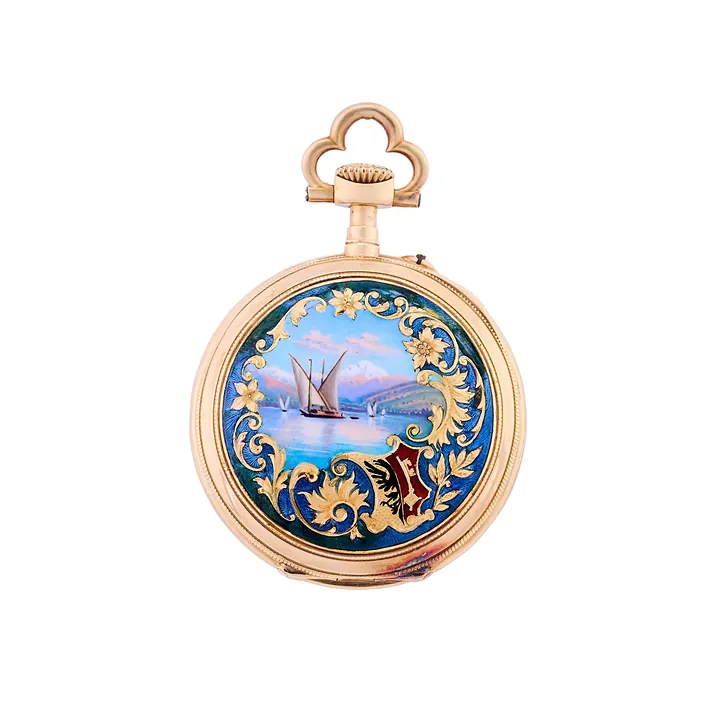
Vacheron Constantin “grand TIR de L’exposition Nationale, Genève 1896, c. 1896
Antiquorum auction archive, Geneva
Pocket Watches · c. 1940
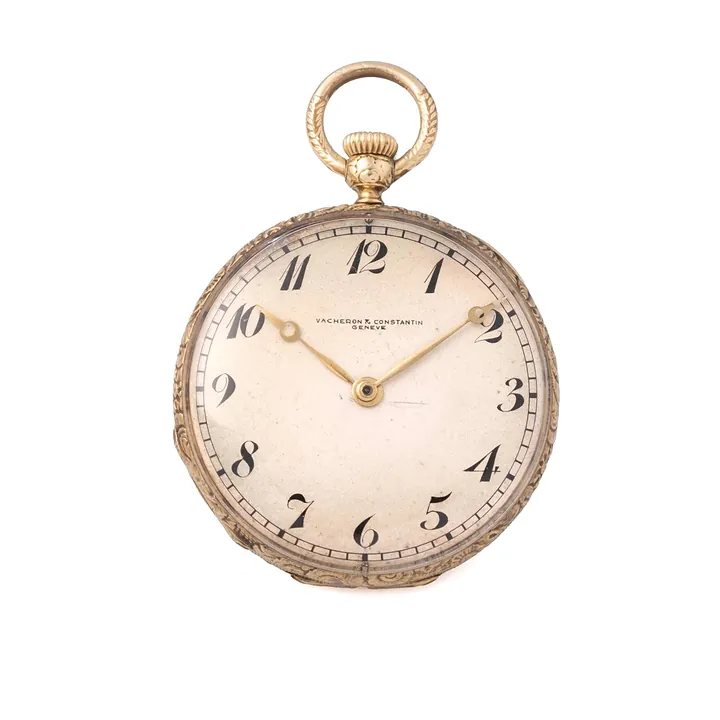
Vacheron Constantin pocket watch, ref. 345, c. 1940
Antiquorum auction archive, Geneva
Pocket Watches · c. 1945
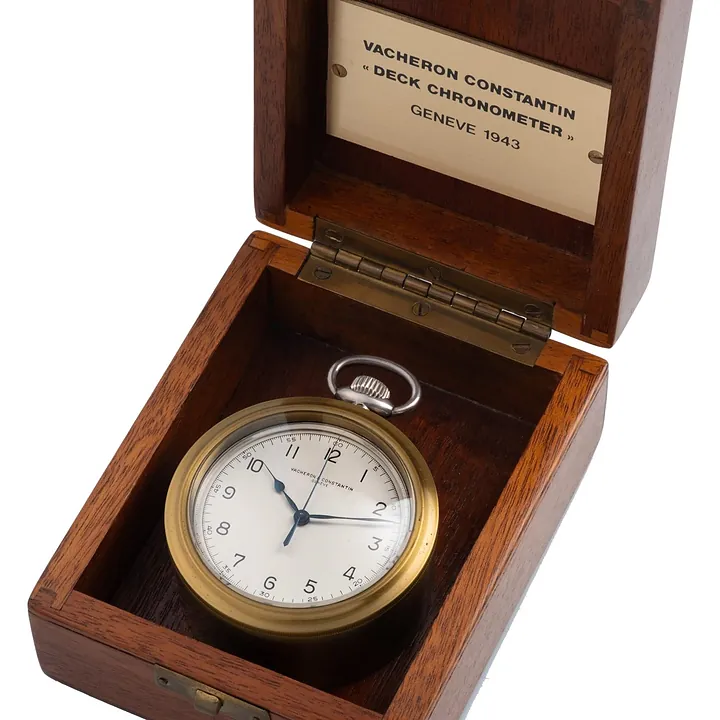
Vacheron Constantin pocket chronometer, c. 1945
Antiquorum auction archive, Geneva
Pocket Watches · c. 1945
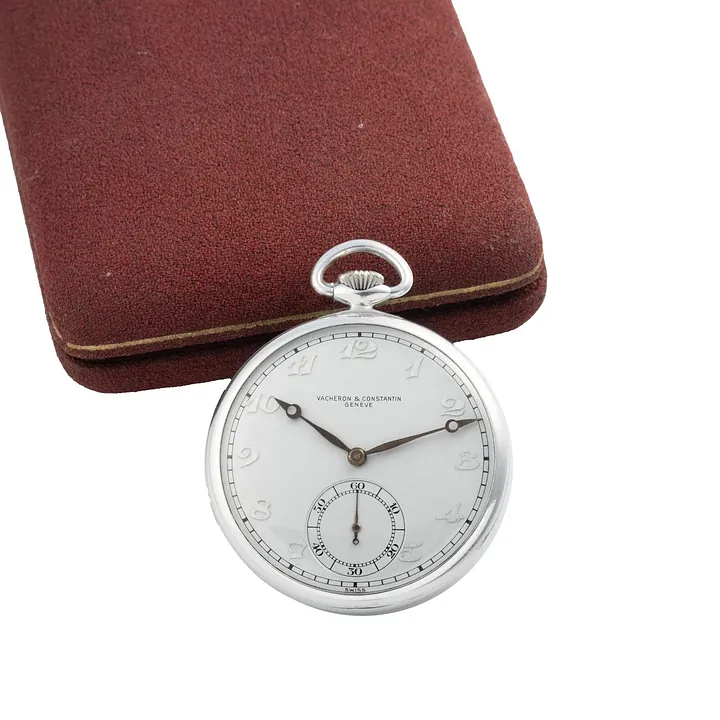
Vacheron Constantin watch, c. 1945
Antiquorum auction archive, Geneva

Wristwatches · 1931
Rolex 'Oyster Perpetual' rotor self-winding wrist-watch, lever escapement, in steel case with glass in back, Montres Rolex SA, Geneva, Switzerland, 1931
Science Museum Group, London

Wristwatches · 1900–1999
Wristwatch by Certina, Switzerland, 1900–1999
Nordic Museum Foundation

Wristwatches · 1900–1999
Wristwatch by Omega, Västerås, 1900–1999
Nordic Museum Foundation

Wristwatches · 1900–1999
Wristwatch by Universal, Switzerland, 1900–1999
Nordic Museum Foundation