
Wristwatches · Wristwatch
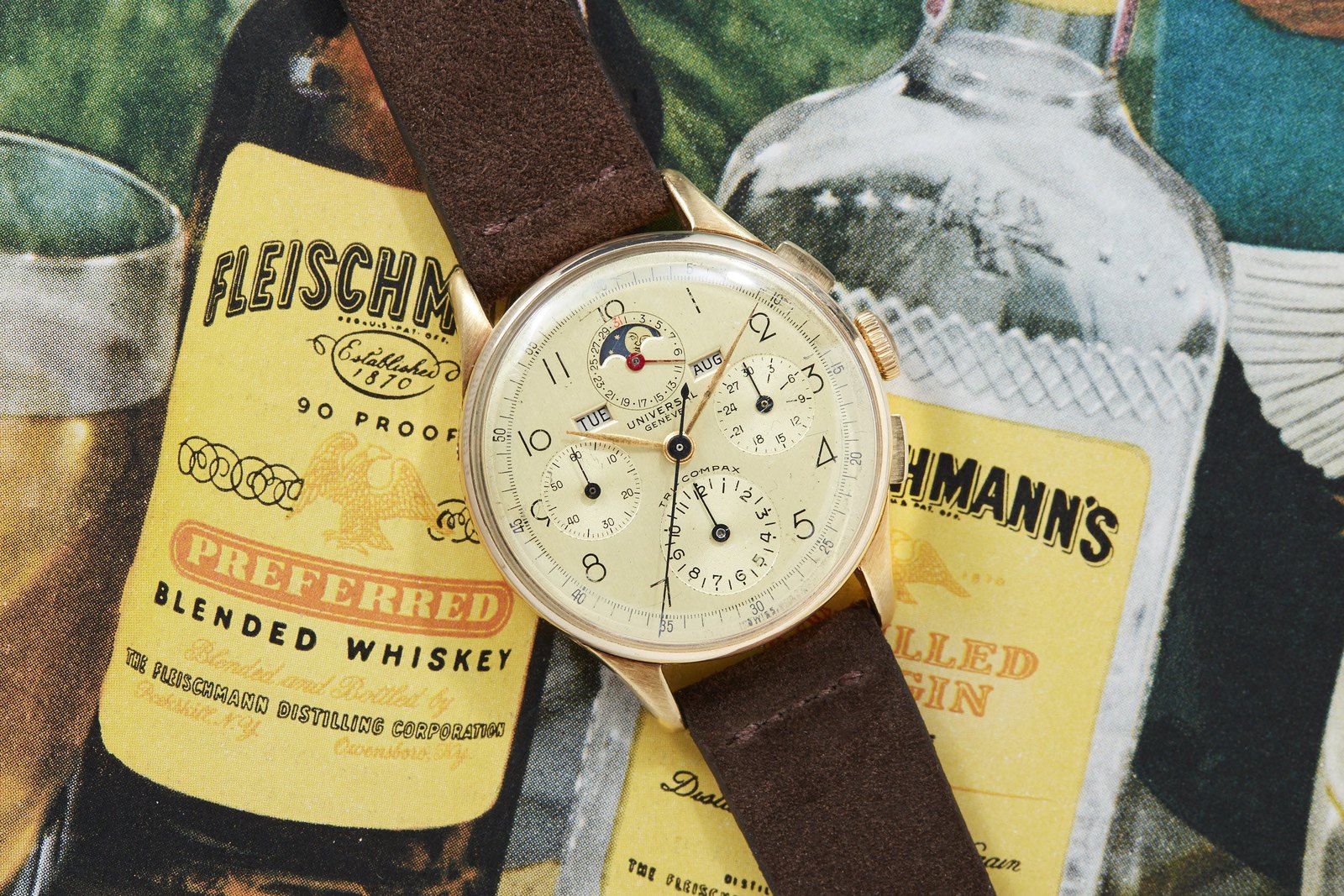
Universal Geneve Tri-Compax Solid Yellow Gold, 1940s
- Maker / attribution
- Universal Geneve (maker)
- Date
- 1940s
- Historical period
- Golden Age of Mechanical Watchmaking (1900 – 1945)
- Country of origin
- Switzerland
- Object type
- Wristwatch
- Materials / technique
- yellow gold
- Stock no.
- Product 9834607297
- Credit line
- Dealer listing, Analog/Shift (product 9834607297)
- Catalogue title (original)
- Universal Geneve Tri-Compax Solid Yellow Gold (English)
View the source record (dealer listing) ↗ (opens another website in a new tab)Suggest a correction
Record summary
Catalogued by Analog/Shift (dealer), New York (stock number Product 9834607297), this is a wristwatch by Universal Geneve, made in Switzerland, dated 1940s. The Atlas places it in the Golden Age of Mechanical Watchmaking period (1900 – 1945) of its Wristwatches collection. Materials and techniques recorded by the source: yellow gold. The record is illustrated with 6 photographs.
Assembled from the source record's structured fields. Dates and attributions are given as the source states them; where a field is missing the Atlas leaves it blank rather than estimating.
Catalogue description
Dealer description — Analog/Shift
In 1945, the leaders of the Allied Powers met in Potsdam, Germany at the home of Crown Prince Wilhelm. Nazi Germany had agreed to unconditional surrender just nine weeks earlier. At Potsdam, the Big Three—the U.S., the Soviet Union, and the U.K.—debated what to do with Germany after the cessation of hostilities. Once more, nearly thirty years after the Allies had met at Versailles to discuss reparation for the First World War, they found themselves with the fate of a country—and Europe—in their hands. Some considered the uneasy peace following World War I to be needlessly harsh. The economist John Maynard Keynes, for example, likened it to the destruction of Carthage by the Romans. However, unlike Carthage, whose earth was salted so that nothing could grow there again, an angry Germany rebuilt and renewed itself as a far deadlier power. Wary of history repeating itself, the Big Three gathered at Potsdam. It was the third time the leaders of the Allied powers had met during the course of the Second World War, but at Potsdam the dynamics had changed. Stalin was still in power, but the Red Army controlled much of Eastern Europe, and after VE Day refugees began to stream into the West. Churchill, his counterpart in the UK, was still Prime Minister, but he was joined by Clement Attlee (who was to be his successor) while the country awaited the outcome of the general election. And Franklin Delano Roosevelt, who many considered to be the glue that held the Allies together, had died, leaving his successor—Harry S Truman—to attend in his stead. The Agreement laid out these aims for the Allies’ occupation of Germany: demilitarization, decentralization, and denazification. The map of Europe was redrawn to its pre-war dimensions, with Germany losing the territories it had seized in 1939. Nazi leaders would be tried as war criminals, and, perhaps most importantly, civilian shipyards and aircraft factories in Germany would be destroyed, removing the country’s potential to rise up in arms again. On July 20, 1945, Truman delivered an address to General Eisenhower and the U.S. Army in Berlin in which he said: “We have conclusively proven that a free people can successfully look after the affairs of the world.” The previous year, a watch was released at the Basel Fair that would be inextricably linked to the luminaries of the world, including Truman: the Universal Genève Tri-Compax. Switzerland’s neutrality during the Second World War meant that the country could continue to export watches. Accordingly, watches made by Universal Genève found their way to the wrists of Axis and Allies alike. Hermann Göring, the second-most powerful man in Nazi Germany, owned one, as did Harry S Truman. Though the later 1960s models of Tri-Compax perhaps command the most collector attention out of all of Universal Genève’s chronograph offerings, there’s a quiet, dignified beauty about models from the 1940s and 1950s. This particular piece, a Reference 12555 dating from the 1940s, is simply elegant. While the Tri-Compaxes of the 1960s are known for their sporty, twisted-lug steel cases, this one is clad in solid 18k yellow gold. The soft hue of the case brings out the warm glow of the dial, rich with a creamy patina and featuring stunning Art Deco hour markers. With looks like this, there’s no question why the Tri-Compax was—and continues to be—such a universal favorite.
Historical context
Golden Age of Mechanical Watchmaking (1900 – 1945)
The wristwatch displaces the pocket watch; waterproof cases, self-winding and grand complications.
The wristwatch overtook the pocket watch. Military use in the First World War, aviation, water-resistant cases (1926), automatic winding (1923–31), rectangular Art Deco designs and early chronographs and calendars defined the period.
Read the period in the timelineMore wristwatches from this periodEarlier: Industrial Revolution
Atlas type guide
Wristwatches
Bracelet watches were worn by women from the early nineteenth century — Breguet made one for Caroline Murat, Queen of Naples, in 1810–12 — but the wristwatch only became a man's instrument with military use and aviation in the early twentieth century. Between the World Wars it overtook the pocket watch; the 1920s and 1930s brought rectangular Art Deco cases, water-resistant cases and the first automatic winding systems.
After 1945 the wristwatch became a carrier of identity — dress watches, sports and dive watches, chronographs, calendars — produced by Swiss, American, Japanese, German, Soviet and Chinese industries. The quartz revolution after 1969 and the mechanical renaissance since the 1990s, including the rise of independent watchmakers, complete the story.
What to look for
- The reference number (between the lugs or inside the case back) and serial number, the starting point for dating.
- The calibre: its maker and number are often stamped under the dial or on the bridge.
- Originality of dial, hands and crown — refinished ('redial') dials are common.
- Case material marks: 18K/750, 14K/585, stainless steel, gold-filled, plated.
Dating clues
- Wire-lug cases: before c. 1925.
- Water-resistant screw-down cases: from 1926.
- Quartz movements: from 1969; sapphire crystals widespread after c. 1980.
General guidance written by the Atlas editors about this kind of object. It is not a statement about this particular piece; for that, rely on the source record above and on physical examination.
Related records
Wristwatches · 1970s
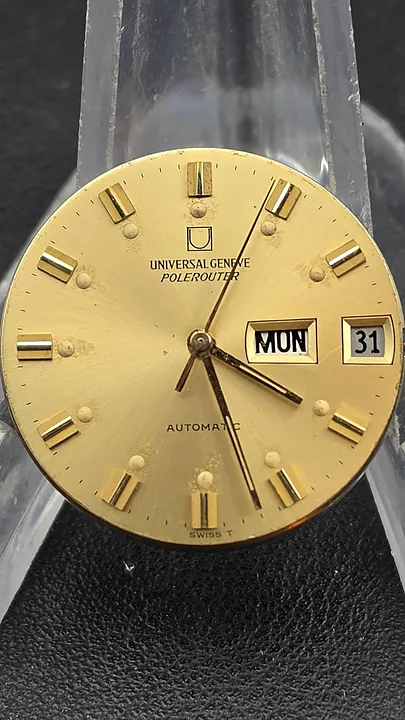
1970s Universal Geneve Polerouter Day-Date Movement Dial Cal 72 Microtor 17J 29mm Auto
LiveAuctioneers auction archive
Wristwatches · 1960s
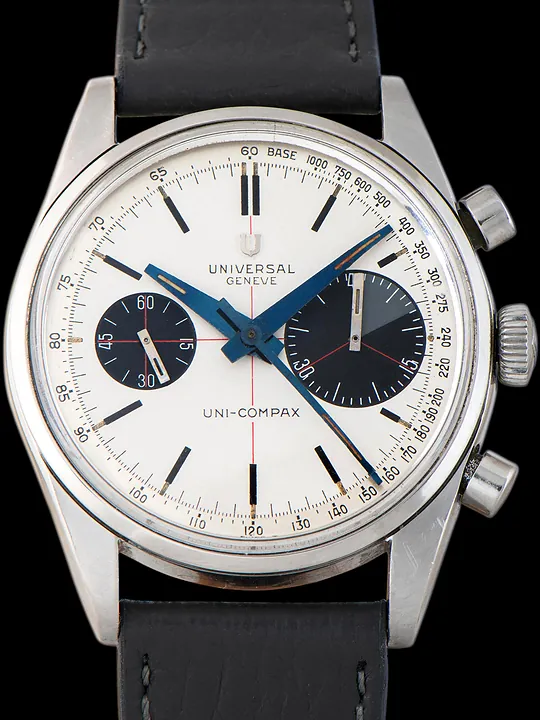
Universal Geneve Uni- Compax (Ref. 884100/02) “Big Eye”, 1960s
Craft & Tailored (dealer), Los Angeles
Wristwatches · 1960s
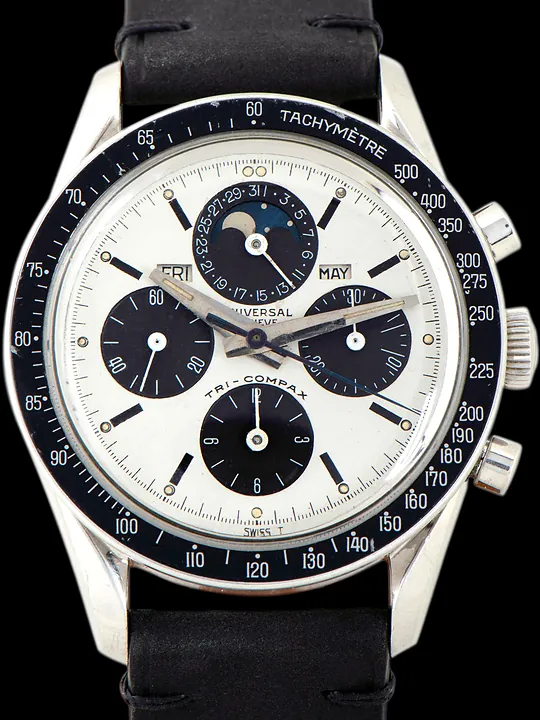
Universal Genève Tri-Compax (Ref. 881101/01) "Eric Clapton", 1960s
Craft & Tailored (dealer), Los Angeles
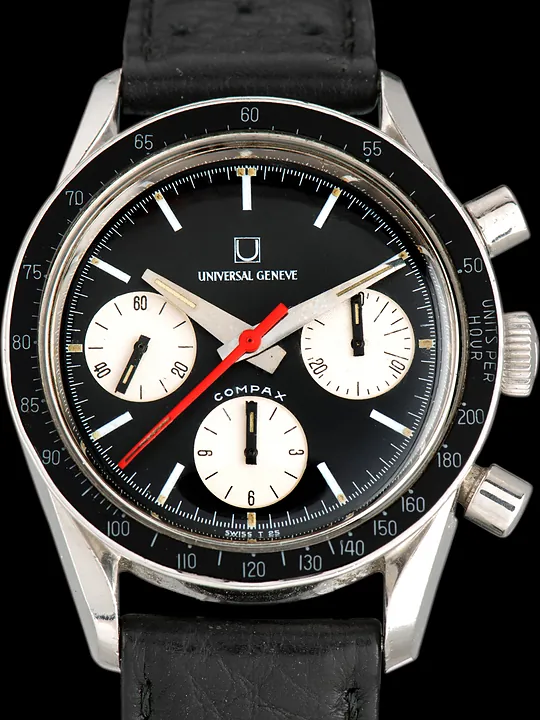
Wristwatches · 1960s
Universal Geneve Compax (Ref. 885103/01) "Evil Nina" W/ Base 200 UPH Bezel, 1960s
Craft & Tailored (dealer), Los Angeles

Wristwatches · 1931
Rolex 'Oyster Perpetual' rotor self-winding wrist-watch, lever escapement, in steel case with glass in back, Montres Rolex SA, Geneva, Switzerland, 1931
Science Museum Group, London

Wristwatches · 1900–1999
Wristwatch by Certina, Switzerland, 1900–1999
Nordic Museum Foundation
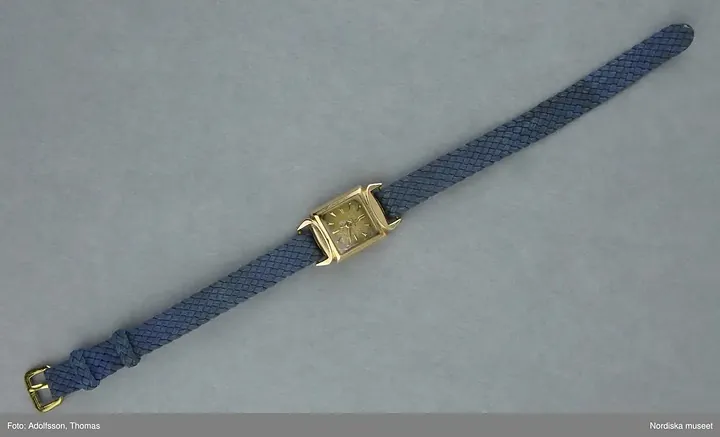
Wristwatches · 1900–1999
Wristwatch by Omega, Västerås, 1900–1999
Nordic Museum Foundation
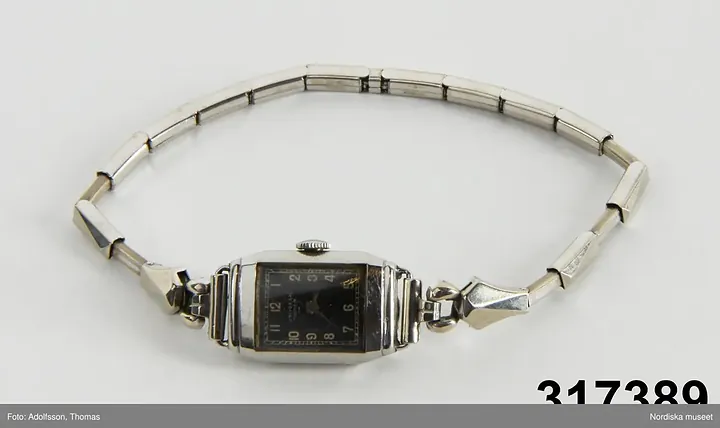
Wristwatches · 1900–1999
Wristwatch by Universal, Switzerland, 1900–1999
Nordic Museum Foundation