
Wristwatches · Wristwatch
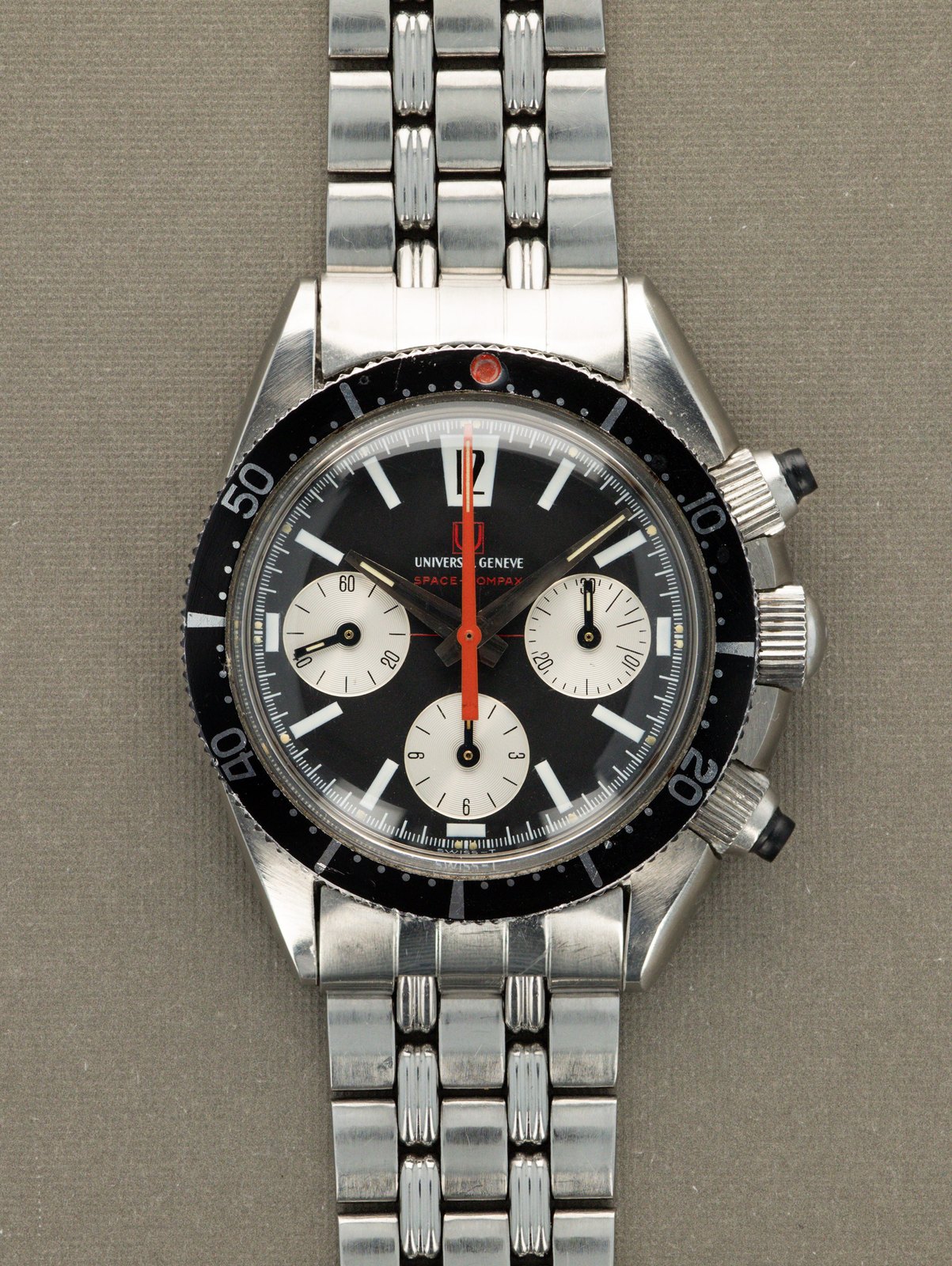
Universal Genève Space-Compax ref. 885104/01, 'Mk1' Reverse-Panda Dial
- Maker / attribution
- Universal Genève (maker)
- Date
- c. 1967
- Historical period
- Modern Mechanical Horology (1945 – 1969)
- Country of origin
- Switzerland
- Object type
- Wristwatch
- Dimensions
- Case 40 mm
- Stock no.
- OC3199
- Credit line
- Dealer listing, Oliver & Clarke (OC3199)
- Catalogue title (original)
- Universal Genève Space-Compax Ref. 885104/01 - 'Mk1' Reverse-Panda Dial (English)
View the source record (dealer listing) ↗ (opens another website in a new tab)Suggest a correction
Record summary
Catalogued by Oliver & Clarke (dealer), United Kingdom (stock number OC3199), this is a wristwatch by Universal Genève, made in Switzerland, dated c. 1967. The Atlas places it in the Modern Mechanical Horology period (1945 – 1969) of its Wristwatches collection. Recorded dimensions: Case 40 mm. The record is illustrated with 6 photographs.
Assembled from the source record's structured fields. Dates and attributions are given as the source states them; where a field is missing the Atlas leaves it blank rather than estimating.
Catalogue description
Dealer description — Oliver & Clarke
Universal Genève was one of the many great brands that succumbed to the quartz crisis of the 1970s. While they disappeared, it was not for their lack of impressive watches. To underscore that fact, keep in mind that Henri Stern Watch Agency in their nearly 80-year history has only ever sold two brands: Patek Philippe, and Universal Genève. Building upon the brand’s long-established Compax lineage, the Space-Compax was i ntroduced during the 1960s at the height of the Space Age and represented Universal Genève’s answer to the growing demand for technically sophisticated, modern chronographs. And the Space-Compax sure delivered, combining a highly legible three-register chronograph layout with a distinctive design language with a technically forward-thinking form. The asymmetrical case measures in at 40mm in diameter and utilized a screw-down caseback, screw-down crown, and even a water-resistant pusher design. Rather than simple 'pump' pushers, the mechanisms are capped with rubber and secured by a screw-down 'collar,' effectively providing a sealed pusher. The bezel is a single piece rather than an assembly with an insert, and doubles-down on the timing functionality with 60-minute marks and a colored market at the 12 o'clock position. Inside, the dial is characterized by bold indices, contrasting 'concentric' subsidiary registers, and colorful accents with a both colorful and bold handset tying it all together. These pieces were all powered by UG's Cal. 85 manual-winding movement. The example that we have here, a Ref. 885104/02, dates to circa 1967 and is offered in fantastic overall condition. The case shows signs of very light previous polished, perhaps on the case profiles only, with normal signs of wear and no damage or excess wear of note. The pushers, crown, and bezel all show light wear and present beautifully. The dial within, likely due to its resistance to the elements, is also wonderfully preserved, with a nice clean surface, crisp subsidiary registers, and fully-intact luminous elements. Additionally, it comes fitted to its correct and exceedingly rare, 'double-grain beads-of-rice' Gay Frères bracelet with the correct endlinks and signed fliplock clasp. Design details like the dynamic and modern sizing of the case, the calibre within, and the thoughtful, bold dial layout, amount to a piece that clearly shows why Universal Genève was ultimately considered to be one of the finest manufactures in the era. In any condition, Space-Compaxes simply do not surface on the open market all that often — let alone in this condition and with its correct bracelet.... and with the recent re-launch of the brand, collectors seem to be holding on to pieces like this, making for a great opportunity to grab this one.
Historical context
Modern Mechanical Horology (1945 – 1969)
Tool watches for divers, pilots and astronauts; electric watches anticipate the electronic age.
The classic era of the mechanical wristwatch: dive watches, chronographs for motor racing and space flight, GMT watches for jet travel, slim dress watches, automatic calendars, and the rise of Japanese manufacturers alongside Swiss, American, German and Soviet industries.
Read the period in the timelineMore wristwatches from this periodEarlier: Golden Age of Mechanical Watchmaking
Atlas type guide
Wristwatches
Bracelet watches were worn by women from the early nineteenth century — Breguet made one for Caroline Murat, Queen of Naples, in 1810–12 — but the wristwatch only became a man's instrument with military use and aviation in the early twentieth century. Between the World Wars it overtook the pocket watch; the 1920s and 1930s brought rectangular Art Deco cases, water-resistant cases and the first automatic winding systems.
After 1945 the wristwatch became a carrier of identity — dress watches, sports and dive watches, chronographs, calendars — produced by Swiss, American, Japanese, German, Soviet and Chinese industries. The quartz revolution after 1969 and the mechanical renaissance since the 1990s, including the rise of independent watchmakers, complete the story.
What to look for
- The reference number (between the lugs or inside the case back) and serial number, the starting point for dating.
- The calibre: its maker and number are often stamped under the dial or on the bridge.
- Originality of dial, hands and crown — refinished ('redial') dials are common.
- Case material marks: 18K/750, 14K/585, stainless steel, gold-filled, plated.
Dating clues
- Wire-lug cases: before c. 1925.
- Water-resistant screw-down cases: from 1926.
- Quartz movements: from 1969; sapphire crystals widespread after c. 1980.
General guidance written by the Atlas editors about this kind of object. It is not a statement about this particular piece; for that, rely on the source record above and on physical examination.
Related records
Clocks · c. 1960-1970s
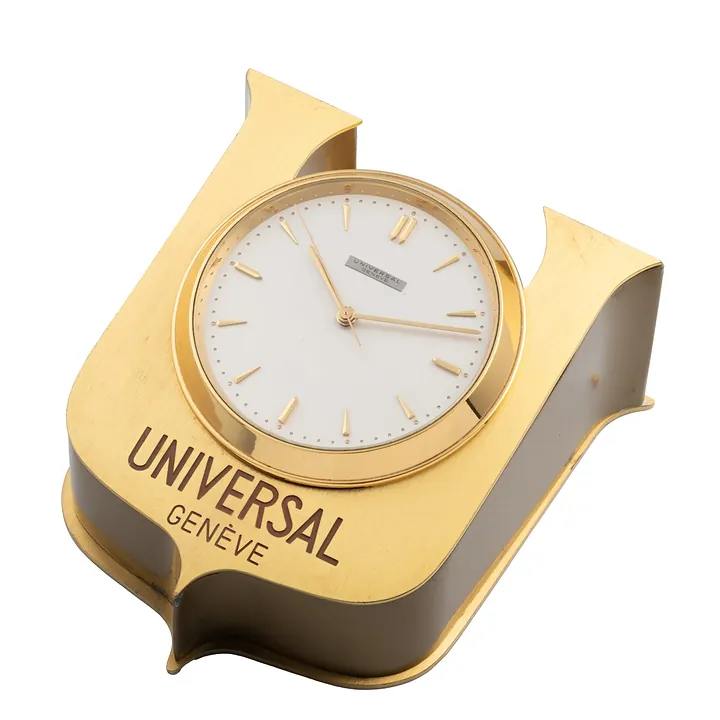
Universal Genève clock, ref. 999.116.01, c. 1960-1970s
Antiquorum auction archive, Geneva
Pocket Watches · c. 1950s
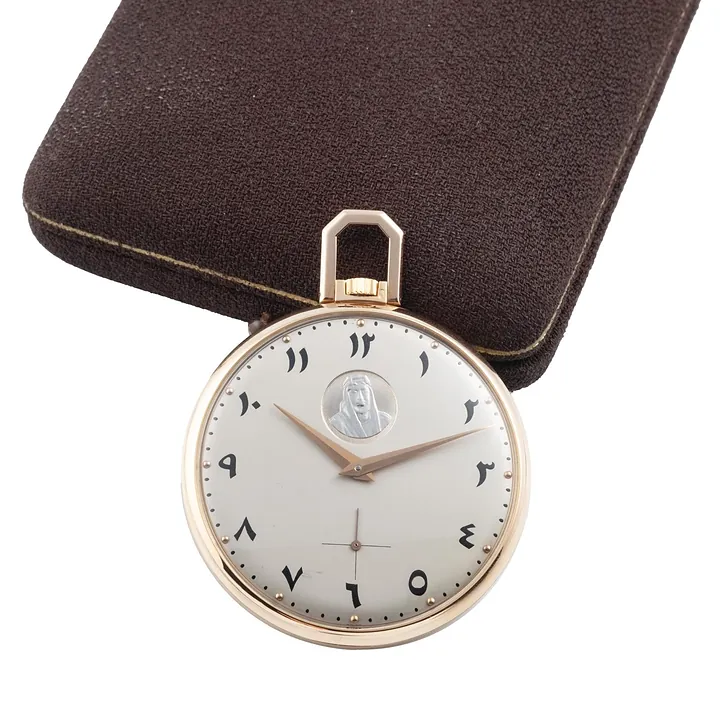
Universal Genève pocket watch, ref. 11746 3/ 11746 1, c. 1950s
Antiquorum auction archive, Geneva
Wristwatches · c. 1941
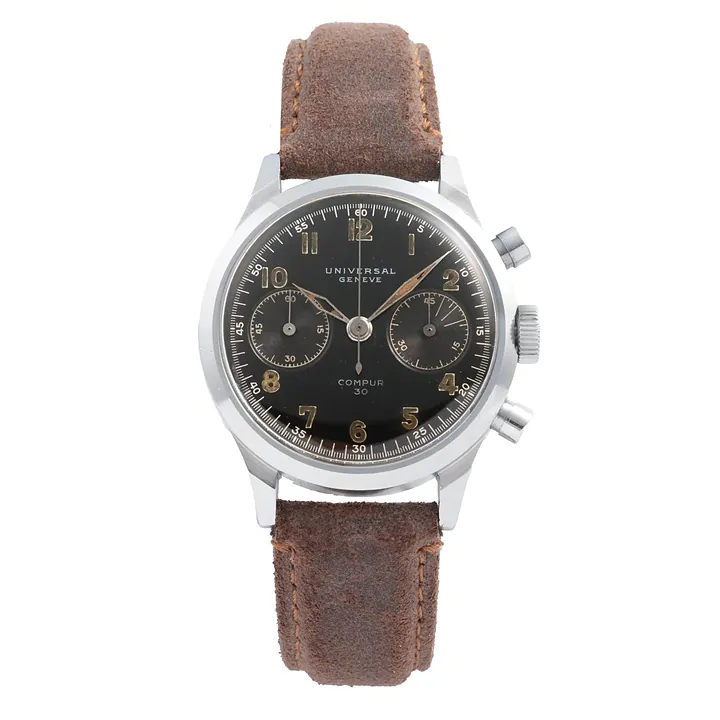
Universal Genève Compur 30, ref. 22409, c. 1941
Antiquorum auction archive, Geneva

Wristwatches · c. 1945
Universal Genève Uni-Compax, ref. 22492, c. 1945
Antiquorum auction archive, Geneva

Wristwatches · 1945
Wristwatch by Eterna, 1945
Museum Rotterdam

Wristwatches · c. 1945
Breitling Premier, ref. 790, c. 1945
Antiquorum auction archive, Geneva

Wristwatches · c. 1950s
Baume & Mercier wristwatch, c. 1950s
Antiquorum auction archive, Geneva
Wristwatches · c. 1950
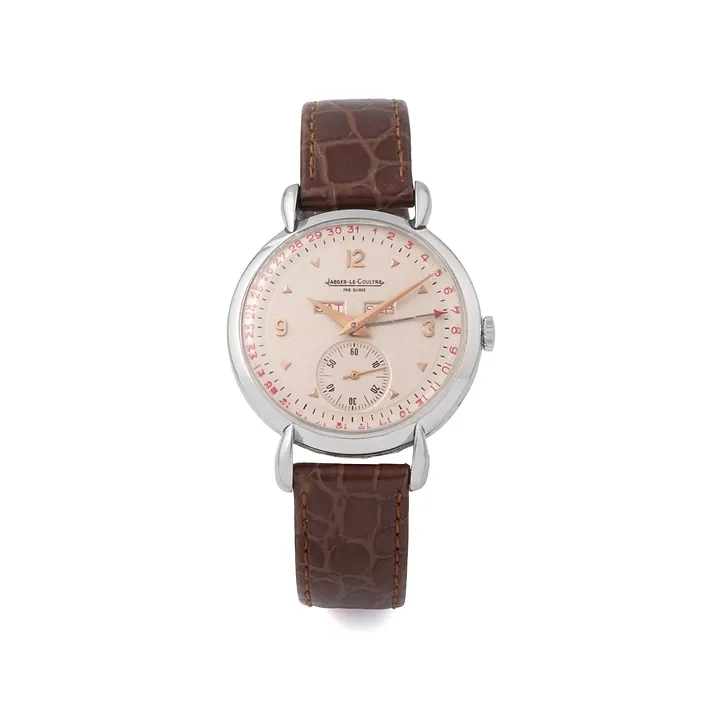
Jaeger Lecoultre Triple Calendar, c. 1950
Antiquorum auction archive, Geneva