
Wristwatches · Wristwatch
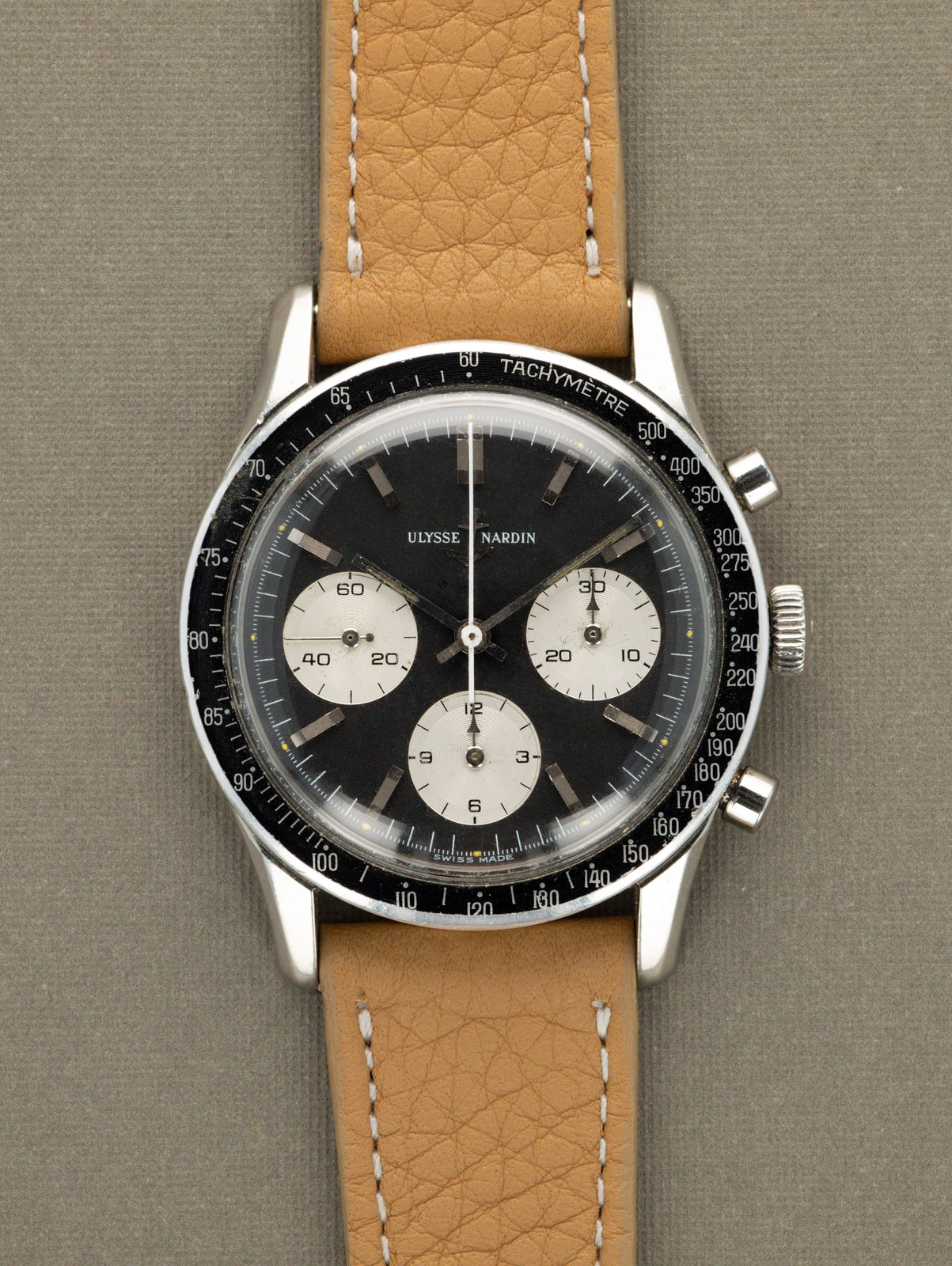
Ulysse Nardin Chronograph ref. 7536, Matte Black 'Reverse-Panda' Dial
- Maker / attribution
- Ulysse Nardin (maker)
- Date
- c. 1970
- Historical period
- Quartz Revolution (1969 – 1990)
- Country of origin
- Switzerland
- Object type
- Wristwatch
- Dimensions
- Case 38 mm
- Stock no.
- OC3422
- Credit line
- Dealer listing, Oliver & Clarke (OC3422)
- Catalogue title (original)
- Ulysse Nardin Chronograph Ref. 7536 - Matte Black 'Reverse-Panda' Dial (English)
View the source record (dealer listing) ↗ (opens another website in a new tab)Suggest a correction
Record summary
Catalogued by Oliver & Clarke (dealer), United Kingdom (stock number OC3422), this is a wristwatch by Ulysse Nardin, made in Switzerland, dated c. 1970. The Atlas places it in the Quartz Revolution period (1969 – 1990) of its Wristwatches collection. Recorded dimensions: Case 38 mm. The record is illustrated with 6 photographs.
Assembled from the source record's structured fields. Dates and attributions are given as the source states them; where a field is missing the Atlas leaves it blank rather than estimating.
Catalogue description
Dealer description — Oliver & Clarke
Ulysse Nardin was founded in 1846 by its namesake, a twenty-three-year-old watchmaker who set up shop in Le Locle, Switzerland. From the very beginning, Nardin was interested in producing high-functioning instruments that could be trusted at sea. That focus on precision soon turned the company into a quiet powerhouse among navigators. The marine chronometer became the brand's calling card, and it proved to be a serious business. Ulysse Nardin's chronometers were adopted by more than fifty navies around the world, and the company collected award after award for accuracy along the way. By the late nineteenth century, the name was synonymous with reliable timekeeping on the open water. With the rising popularity of wrist watches in the early twentieth century, UN adapted to the shift and carried much of what they had previously been known for into their wrist-bound timepieces. The piece that we have here is a chronograph Ref. 7536 dating to circa 1970. You may have noticed that it bears a close resemblance another chronograph from this era: the Rolex Daytona . Because of its striking similarities to the Ref. 6421, these have become known to collectors as 'UN Daytonas.' The similarities are not just limited to looks alone, inside these pieces utilize the same Valjoux 72 manual-winding movement as Daytonas from this era. The case comes in at 38mm in diameter and features very nice lug chamfers, 'pump' pushers, a screw-down caseback, and an externally-mounted black 'tachy' bezel. The black dial within has a matte surface with Ulysse Nardin scrip flanking an applied logo, applied 'faceted' indices, and silver 'concentric' subsidiary registers which lend themselves to that highly desirable contrast that we love about 'reverse-panda' dials. The Tritium plots exhibit a light and uniform patina and are matched within the 'stick' handset. Even in the world of vintage , UN flies under the radar and remain largely overlooked. A shame, because if you dig deep enough into their catalog, there are absolute stunners to be found. This piece offers looks, pedigree, and versatility and theres no saying when another like it may surface on the open market.
Historical context
Quartz Revolution (1969 – 1990)
Seiko's Astron begins mass quartz timekeeping; traditional industries contract sharply.
Quartz and digital watches transformed the market after 1969. Swiss employment collapsed, Japanese and Hong Kong production soared, and the Swatch (1983) helped the Swiss industry recover; mechanical watches survived as luxury goods.
Read the period in the timelineMore wristwatches from this periodEarlier: Modern Mechanical Horology
Atlas type guide
Chronographs and split-seconds watches
A chronograph is a watch with an additional seconds hand that can be started, stopped and returned to zero independently of the timekeeping. Louis Moinet built an early example in 1816 and Nicolas Rieussec a recording 'chronographe' in 1821; Adolphe Nicole's heart-shaped reset cam (patented 1862) made the modern return-to-zero possible. Split-seconds (rattrapante) chronographs add a second hand that can be stopped for intermediate times; flyback chronographs restart instantly.
Chronographs were essential tools for doctors (pulsometer scales), artillery (telemeter), engineers and sport. In wristwatches, Valjoux, Venus, Lemania and later the automatic chronographs of 1969 (Zenith El Primero, the Chronomatic Calibre 11 group and Seiko 6139) are milestones.
What to look for
- Push-pieces on the case band or a single button in the crown (monopusher).
- Subsidiary registers for minutes and hours; tachymeter, telemeter or pulsometer scales.
- Column wheel versus cam control visible in the movement.
- Calibre markings of specialist makers (Valjoux, Lemania, Venus, Landeron).
Dating clues
- Pocket chronographs with heart cam reset: after 1862.
- Wrist chronographs: from c. 1910; two-button designs from the 1930s.
- Automatic chronographs: from 1969.
General guidance written by the Atlas editors about this kind of object. It is not a statement about this particular piece; for that, rely on the source record above and on physical examination.
Read next:Flyback chronographChronograph
Related records
Pocket Watches · c. 1880
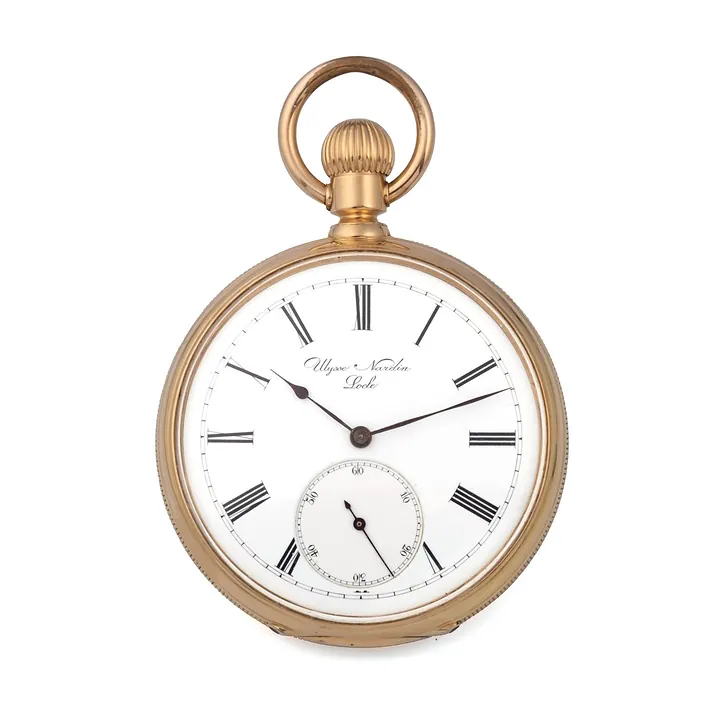
Ulysse Nardin pocket watch, c. 1880 (Antiquorum Lot 374-168)
Antiquorum auction archive, Geneva
Pocket Watches · c. 1880
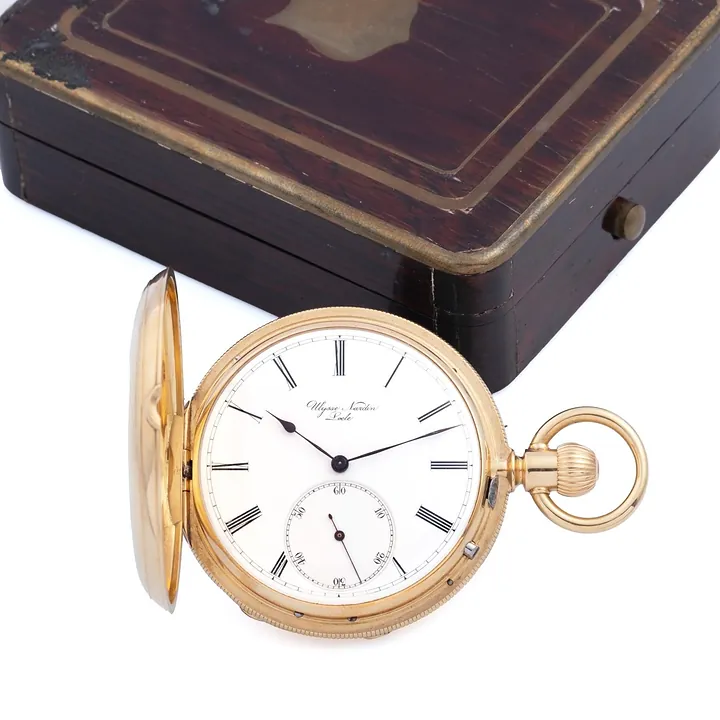
Ulysse Nardin pocket watch, c. 1880 (Antiquorum Lot 374-197)
Antiquorum auction archive, Geneva
Pocket Watches · c. 1920
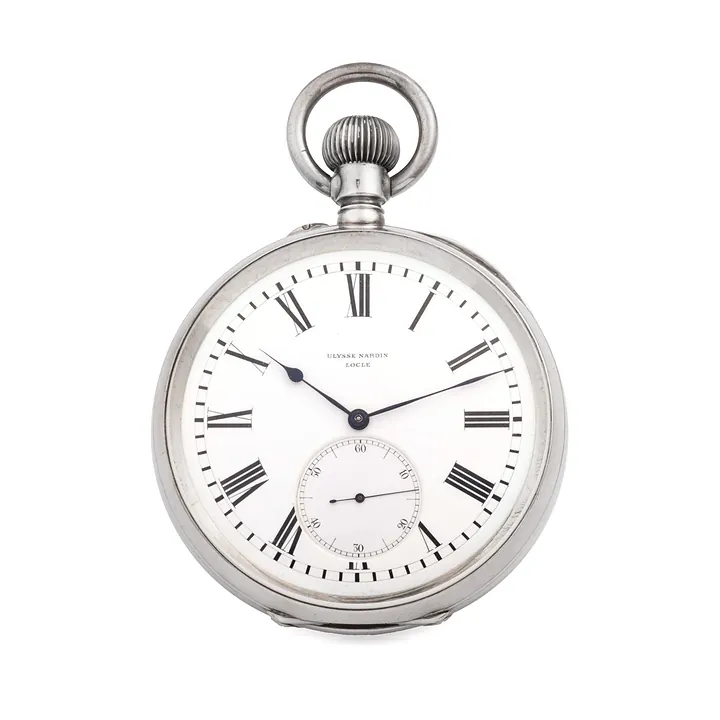
Ulysse Nardin Chronometer, c. 1920 (Antiquorum Lot 374-162)
Antiquorum auction archive, Geneva
Pocket Watches · c. 1920
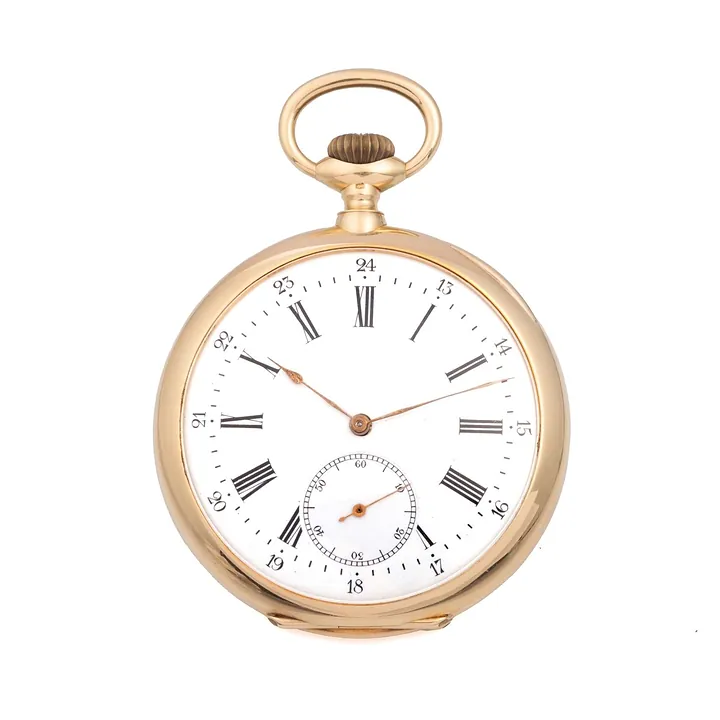
Ulysse Nardin Chronometer, c. 1920 (Antiquorum Lot 374-169)
Antiquorum auction archive, Geneva

Wristwatches · 1970
Wristwatch by Heno, Switzerland, 1970
Museum Rotterdam

Wristwatches · 1960–1986
'Tri-Compax' calendar chronograph wristwatch in gold case, by Universal, Geneva, Switzerland, 1960–1986.
Science Museum Group, London

Wristwatches · 1969–1970
Beta 21 Quartz wristwatch movement, made in Switzerland, 1970.
Science Museum Group, London

Wristwatches · c. 1969
Omega Speedmaster Moonwatch, ref. 145022-69st, c. 1969
Antiquorum auction archive, Geneva