
Wristwatches · Wristwatch
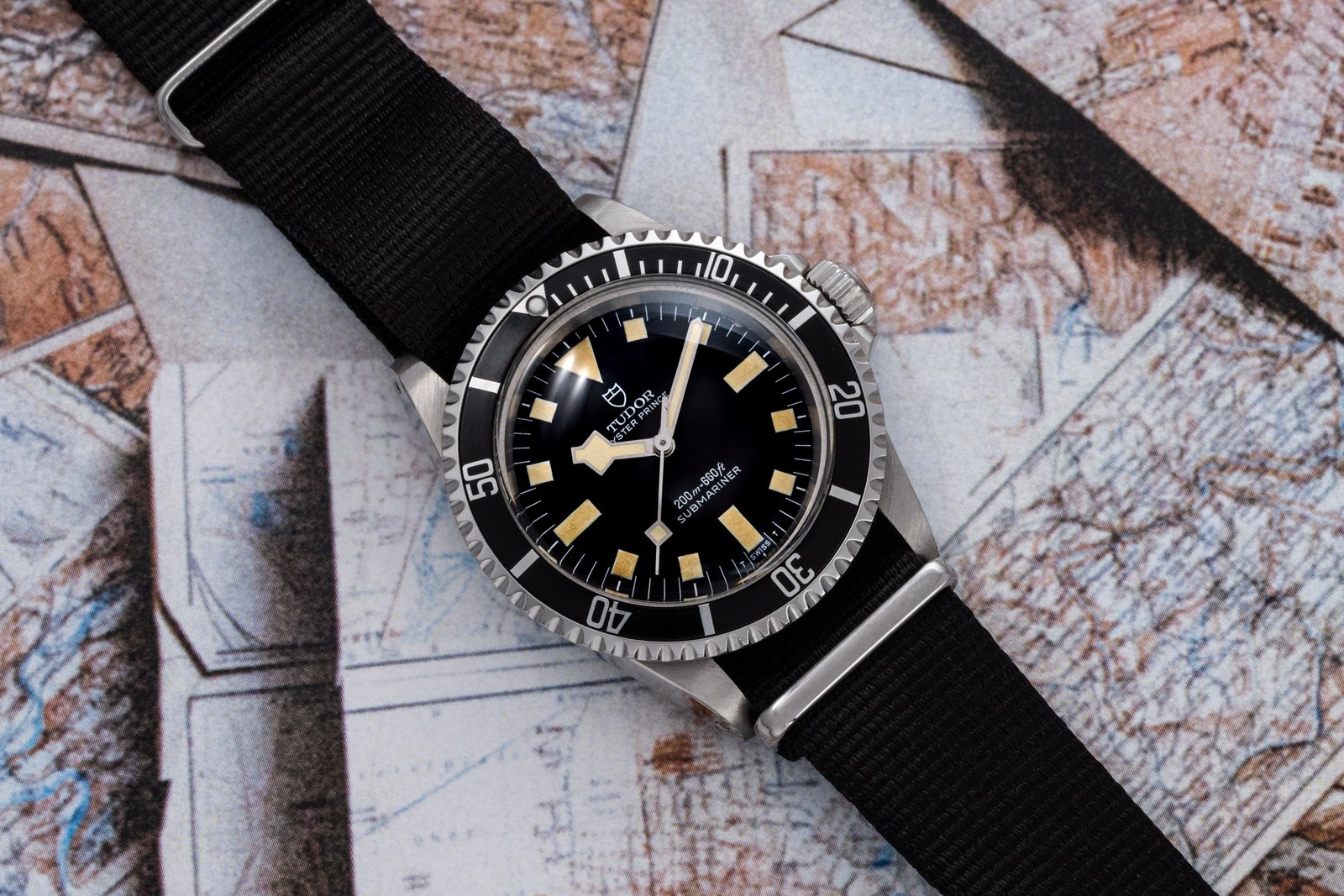
Tudor Submariner 'Snowflake', c. 1984
- Maker / attribution
- Tudor (maker)
- Date
- c. 1984
- Historical period
- Quartz Revolution (1969 – 1990)
- Country of origin
- Switzerland
- Object type
- Wristwatch
- Stock no.
- 40990088
- Credit line
- Dealer listing, Analog/Shift (40990088)
- Catalogue title (original)
- Tudor Submariner 'Snowflake' (English)
View the source record (dealer listing) ↗ (opens another website in a new tab)Suggest a correction
Record summary
Catalogued by Analog/Shift (dealer), New York (stock number 40990088), this is a wristwatch by Tudor, made in Switzerland, dated c. 1984. The Atlas places it in the Quartz Revolution period (1969 – 1990) of its Wristwatches collection. The record is illustrated with 6 photographs.
Assembled from the source record's structured fields. Dates and attributions are given as the source states them; where a field is missing the Atlas leaves it blank rather than estimating.
Catalogue description
Dealer description — Analog/Shift
Tudor had its genesis as a subsidiary of Rolex. Its watches were Rolexes in all but name: same Rolex Oyster case, same crowns, and Rolex crystals. The only difference was what beat inside the Oyster cases — Swiss ETA movements rather than movements that Rolex built in-house. However, as the decades progressed, Tudor took steps to step out of its big brother’s shadow. As time wears on, more and more watch collectors and enthusiasts begin to appreciate the designs that were exclusive to Tudor's Submariner line. Though to some the Tudor Submariner was a pale imitation of its Rolex counterpart, by the 1960s and 1970s the model underwent a metamorphosis with a new design language that has become just as iconic. It started with the hands and indices—triangular in shape, giving rise to the nickname “Snowflake.” This particular example, a Reference 94010, is among the last of its kind. Dating to circa 1984, this black matte no-date model was produced towards the end of the Snowflake era, making it a proper neo-vintage sports watch worthy of attention. A contemporary to the Rolex 5513, the 94010 carried the matte dial layout 'til the end, and this one has developed a gorgeous light even patination throughout, with only minor edge wear and no dial stippling to speak of - a common type of patina seen in Snowflakes from the 1980s. Featuring a professionally refinished Oyster case, domed crystal, Rolex signed Triplock crown and fitted to one of our new Analog:Shift branded leathers, this is a dive watch alternative with just as much history -- and perhaps even more style -- than its older brother!
Historical context
Quartz Revolution (1969 – 1990)
Seiko's Astron begins mass quartz timekeeping; traditional industries contract sharply.
Quartz and digital watches transformed the market after 1969. Swiss employment collapsed, Japanese and Hong Kong production soared, and the Swatch (1983) helped the Swiss industry recover; mechanical watches survived as luxury goods.
Read the period in the timelineMore wristwatches from this periodEarlier: Modern Mechanical Horology
Atlas type guide
Dive and water-resistant watches
Keeping water and dust out of a wristwatch was a long-standing challenge. Rolex's screw-down Oyster case (1926) and Omega's Marine (1932) were landmarks; in the early 1950s Blancpain's Fifty Fathoms and Rolex's Submariner defined the professional dive watch with rotating bezels for timing dives, luminous dials and high water resistance. The ISO 6425 standard (1982) later codified what a 'diver's watch' must do.
Dive watches became icons of post-war design and exploration, and their evolution — helium escape valves, ceramic bezels, saturation-diving depth ratings — records the history of underwater work.
What to look for
- Unidirectional or bidirectional rotating bezel with minute markings.
- Screw-down crown and case back; depth rating printed on the dial.
- Luminous hands and markers (radium before c. 1960, tritium c. 1960–1998, then Super-LumiNova).
- Reference numbers on the case between the lugs or inside the back.
Dating clues
- Screw-down Oyster cases: from 1926.
- Professional dive watches: from 1953.
- Tritium 'T' marks on dials: c. 1960–1998.
General guidance written by the Atlas editors about this kind of object. It is not a statement about this particular piece; for that, rely on the source record above and on physical examination.
Related records
Wristwatches · c. 1973
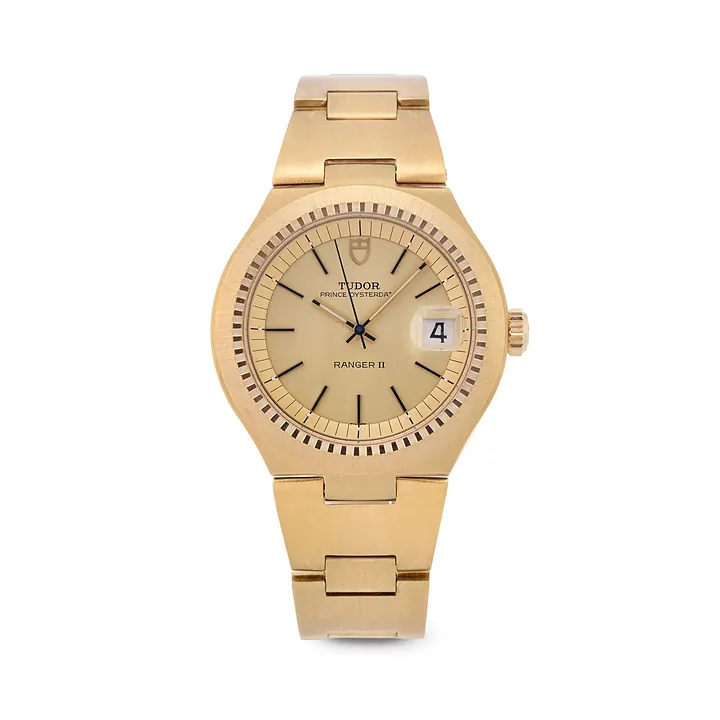
Tudor Prince Oysterdate Ranger II, ref. 9101/1, c. 1973
Antiquorum auction archive, Geneva
Wristwatches · c. 1973
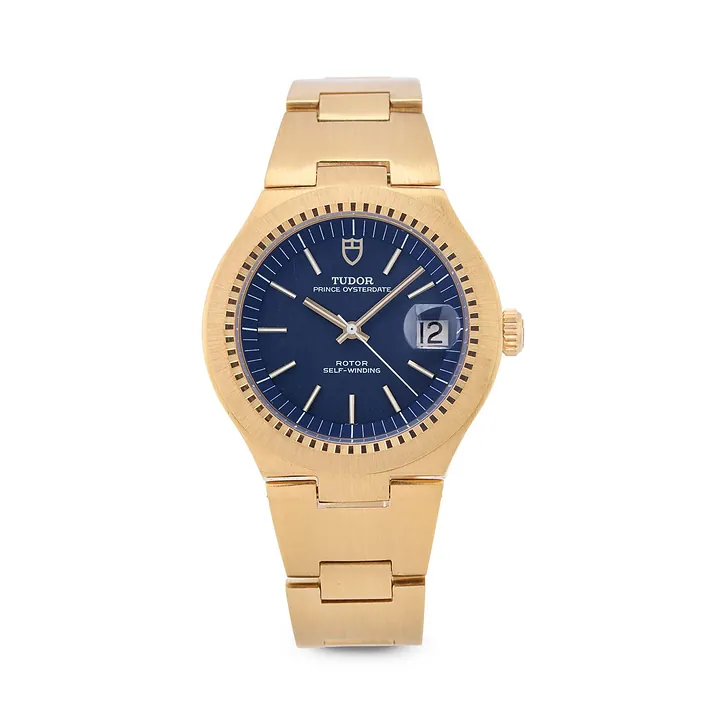
Tudor Prince Oysterdate, ref. 9101/1, c. 1973 (Antiquorum Lot 389-114)
Antiquorum auction archive, Geneva
Wristwatches · c. 1973
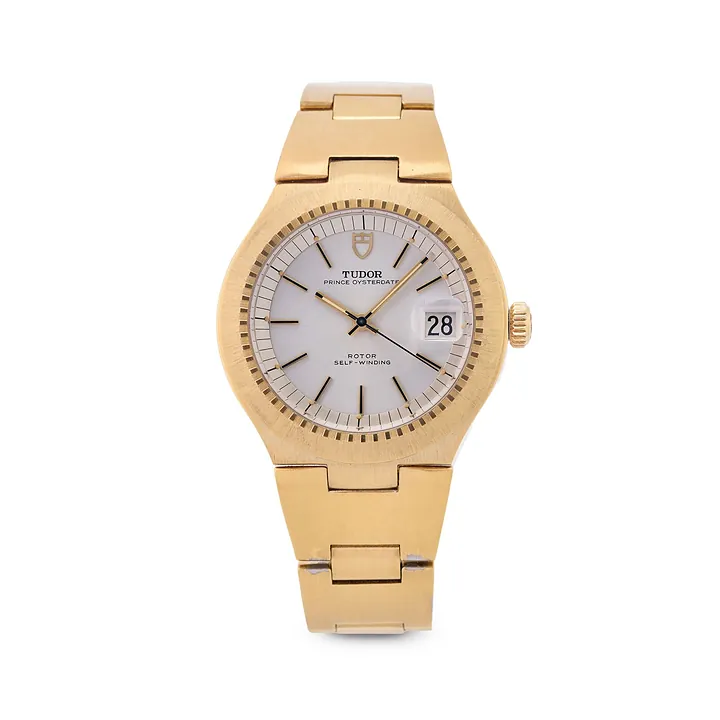
Tudor Prince Oysterdate, ref. 9101/1, c. 1973 (Antiquorum Lot 389-115)
Antiquorum auction archive, Geneva
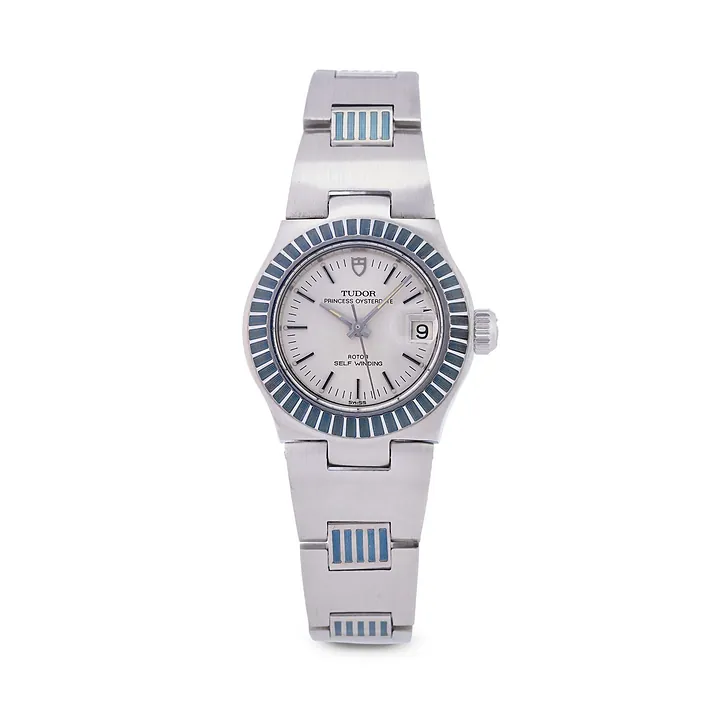
Wristwatches · c. 1974
Tudor Princess Oysterdate, ref. 9311/0, c. 1974
Antiquorum auction archive, Geneva

Wristwatches · 1970
Wristwatch by Heno, Switzerland, 1970
Museum Rotterdam

Wristwatches · 1960–1986
'Tri-Compax' calendar chronograph wristwatch in gold case, by Universal, Geneva, Switzerland, 1960–1986.
Science Museum Group, London

Wristwatches · 1969–1970
Beta 21 Quartz wristwatch movement, made in Switzerland, 1970.
Science Museum Group, London

Wristwatches · c. 1969
Omega Speedmaster Moonwatch, ref. 145022-69st, c. 1969
Antiquorum auction archive, Geneva