
Wristwatches · Wristwatch
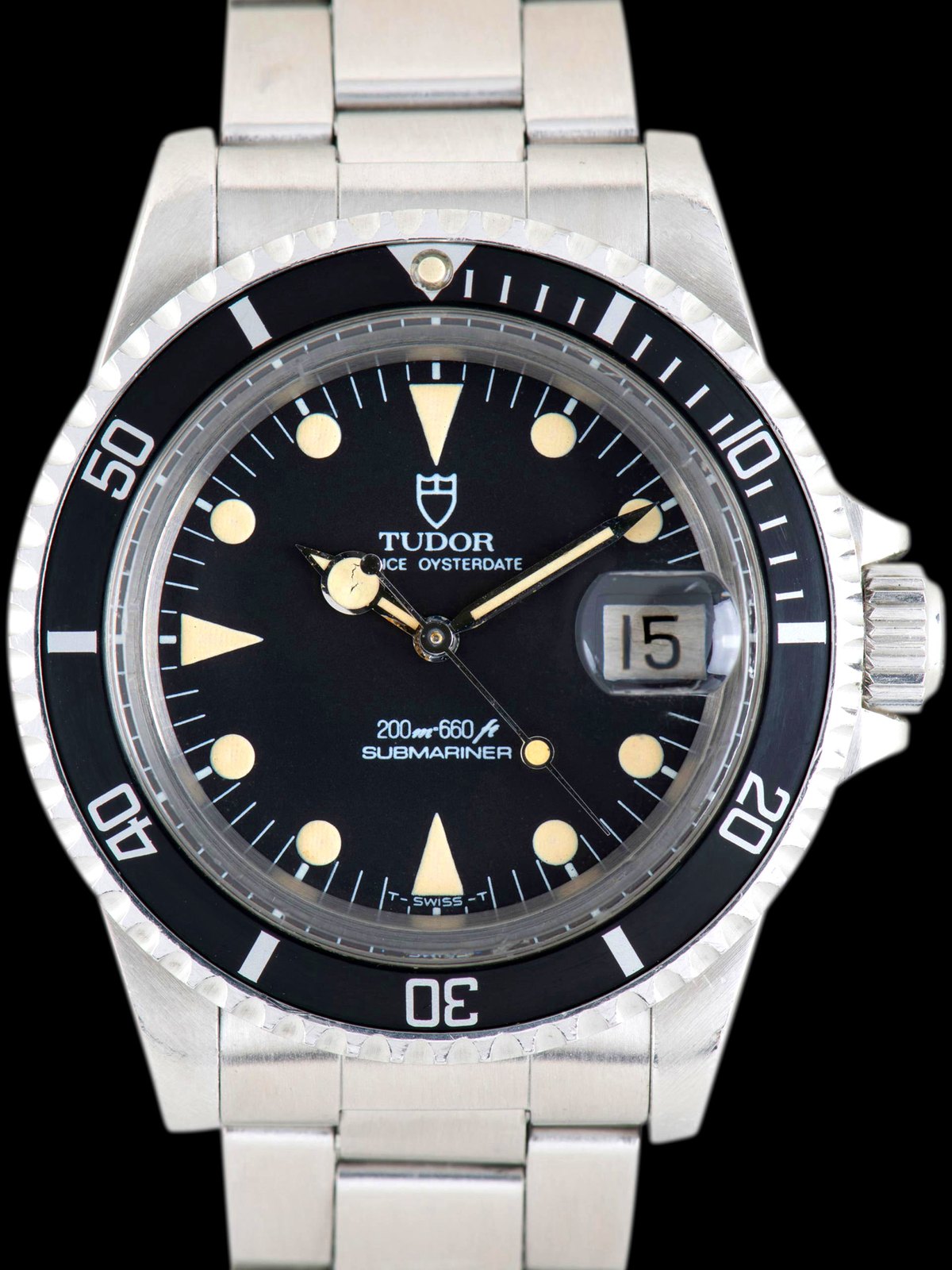
Tudor Submariner (Ref. 76100) "Lollipop", 1988
- Maker / attribution
- Tudor (maker)
- Date
- 1988
- Historical period
- Quartz Revolution (1969 – 1990)
- Country of origin
- Switzerland
- Object type
- Wristwatch
- Stock no.
- TDRSUB76100-3
- Credit line
- Dealer listing, Craft & Tailored (TDRSUB76100-3)
- Catalogue title (original)
- 1988 Tudor Submariner (Ref. 76100) "Lollipop" (English)
View the source record (dealer listing) ↗ (opens another website in a new tab)Suggest a correction
Record summary
Catalogued by Craft & Tailored (dealer), Los Angeles (stock number TDRSUB76100-3), this is a wristwatch by Tudor, made in Switzerland, dated 1988. The Atlas places it in the Quartz Revolution period (1969 – 1990) of its Wristwatches collection. The record is illustrated with 6 photographs.
Assembled from the source record's structured fields. Dates and attributions are given as the source states them; where a field is missing the Atlas leaves it blank rather than estimating.
Catalogue description
Dealer description — Craft & Tailored
The Rolex/Tudor relationship dates back to 1926 when Hans Wilsdorf, the founder of Rolex SA, wanted to create a more affordable alternative. Tudor manufactured Submariners adjacent to the Rolex submariner for many many years. In 1954, the year following the release of Rolex's Submariner, Tudor released their first Submariner as an affordable alternative that didn't lack in quality or craftsmanship yet leveraged a non-inhouse Rolex movement. Although Tudor made Submariner references containing the "Snowflake" dial well into the mid-1980s, in 1978 Tudor introduced a new dial format of the Oyster Prince Submariner which included round and triangular indexes as seen on the ref. 76100 and the subsequent ref 79090. Ultimately this new dial format would replace the "Snowflake" configuration and would last well into the late 1990s on the Tudor Submariner line of timepieces. This would make a great addition to a growing collection or be a great first piece as it retains the classic and timeless look of the Submariner while being unique as a result of the original Tudor design elements. Stock # TDRSUB76100-3 Brand Tudor Style Submariner Model 76100 Serial .22XXXX Size Men's Material Stainless Steel Dial Matte Black Millimeters 40 Bracelet Tudor 9315 Folded-Link Oyster Bracelet W/ 380 B End Pieces CASE & BRACELET The impressive case appears to have been gently polished once in the past as the original case dimensions remain extremely thick and symmetrical through the lugs and crown guards while showing slight chamfers on the lugs and honest signs of use. The original black bezel insert is in exceptional condition, showing virtually no signs of use or fading, and retains a tritium pearl at 12 o'clock that matches the dial perfectly. The case retains its original Rolex signed trip-lock crown. The case back retains all of its factory markings in crisp and visible condition. The original Tudor 9315 folded-link Oyster bracelet with 380B end pieces retains 13 links that show almost no stretch and will fit up to an 8 1/2-inch wrist. DIAL & HANDS The original matte black dial is in virtually flawless condition with no damage and age present. The tritium lume plots have achieved a wonderful creamy-golden patina and exhibit no degradation when inspected under U.V. light. The original tritium hands match the dial perfectly, under U.V. light inspection the hour hand exhibits some very minor cracking and remains stable which is extremely common in this reference, the minute and seconds hands are fully intact. ACCESSORIES
Historical context
Quartz Revolution (1969 – 1990)
Seiko's Astron begins mass quartz timekeeping; traditional industries contract sharply.
Quartz and digital watches transformed the market after 1969. Swiss employment collapsed, Japanese and Hong Kong production soared, and the Swatch (1983) helped the Swiss industry recover; mechanical watches survived as luxury goods.
Read the period in the timelineMore wristwatches from this periodEarlier: Modern Mechanical Horology
Atlas type guide
Dive and water-resistant watches
Keeping water and dust out of a wristwatch was a long-standing challenge. Rolex's screw-down Oyster case (1926) and Omega's Marine (1932) were landmarks; in the early 1950s Blancpain's Fifty Fathoms and Rolex's Submariner defined the professional dive watch with rotating bezels for timing dives, luminous dials and high water resistance. The ISO 6425 standard (1982) later codified what a 'diver's watch' must do.
Dive watches became icons of post-war design and exploration, and their evolution — helium escape valves, ceramic bezels, saturation-diving depth ratings — records the history of underwater work.
What to look for
- Unidirectional or bidirectional rotating bezel with minute markings.
- Screw-down crown and case back; depth rating printed on the dial.
- Luminous hands and markers (radium before c. 1960, tritium c. 1960–1998, then Super-LumiNova).
- Reference numbers on the case between the lugs or inside the back.
Dating clues
- Screw-down Oyster cases: from 1926.
- Professional dive watches: from 1953.
- Tritium 'T' marks on dials: c. 1960–1998.
General guidance written by the Atlas editors about this kind of object. It is not a statement about this particular piece; for that, rely on the source record above and on physical examination.
Related records
Wristwatches · c. 1973
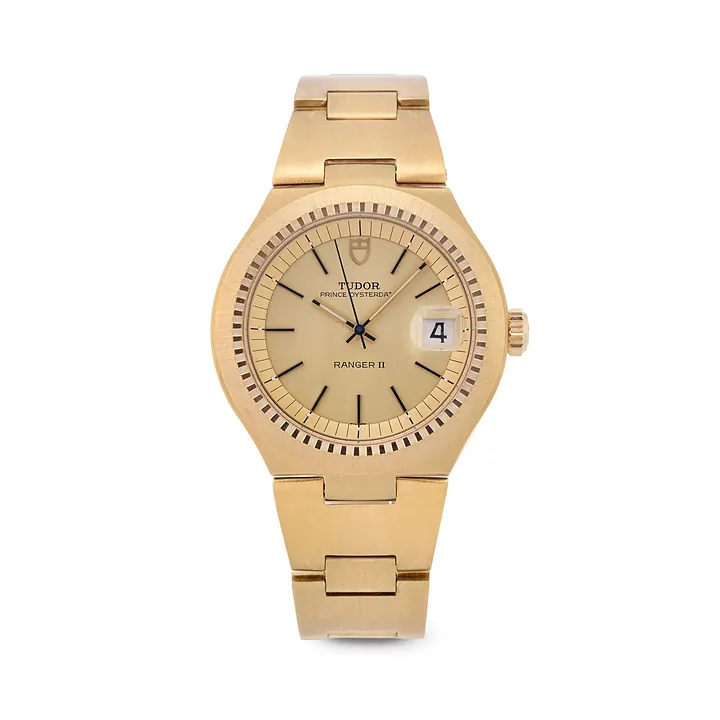
Tudor Prince Oysterdate Ranger II, ref. 9101/1, c. 1973
Antiquorum auction archive, Geneva
Wristwatches · c. 1973
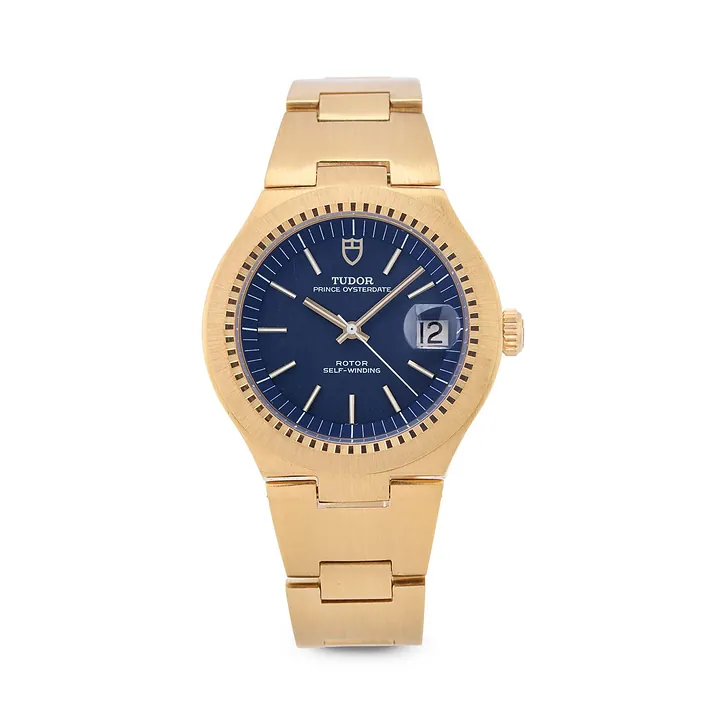
Tudor Prince Oysterdate, ref. 9101/1, c. 1973 (Antiquorum Lot 389-114)
Antiquorum auction archive, Geneva
Wristwatches · c. 1973
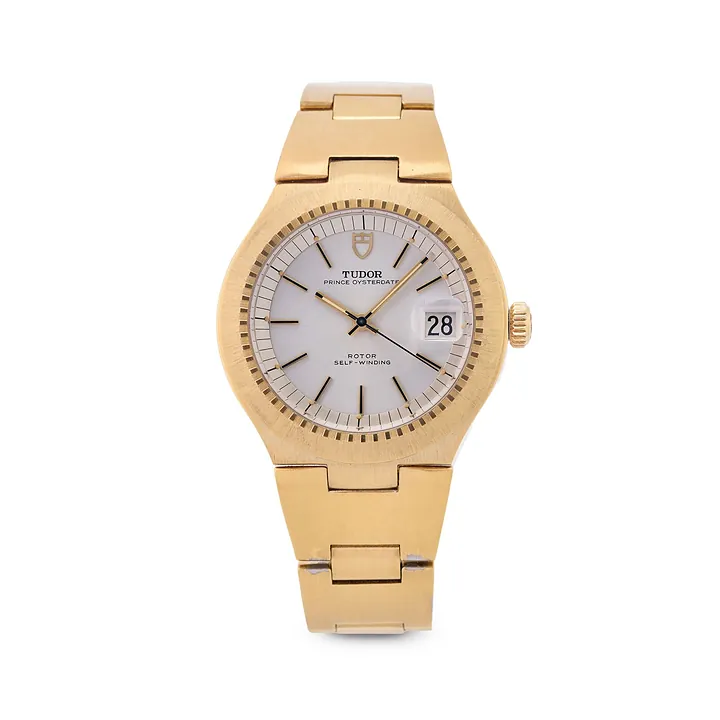
Tudor Prince Oysterdate, ref. 9101/1, c. 1973 (Antiquorum Lot 389-115)
Antiquorum auction archive, Geneva
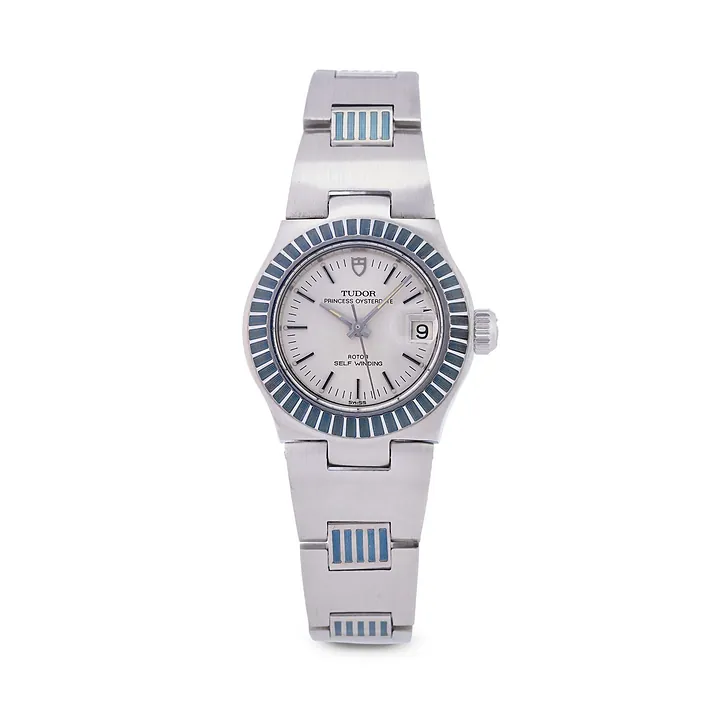
Wristwatches · c. 1974
Tudor Princess Oysterdate, ref. 9311/0, c. 1974
Antiquorum auction archive, Geneva

Wristwatches · 1970
Wristwatch by Heno, Switzerland, 1970
Museum Rotterdam

Wristwatches · 1960–1986
'Tri-Compax' calendar chronograph wristwatch in gold case, by Universal, Geneva, Switzerland, 1960–1986.
Science Museum Group, London

Wristwatches · 1969–1970
Beta 21 Quartz wristwatch movement, made in Switzerland, 1970.
Science Museum Group, London

Wristwatches · c. 1969
Omega Speedmaster Moonwatch, ref. 145022-69st, c. 1969
Antiquorum auction archive, Geneva