
Wristwatches · Wristwatch
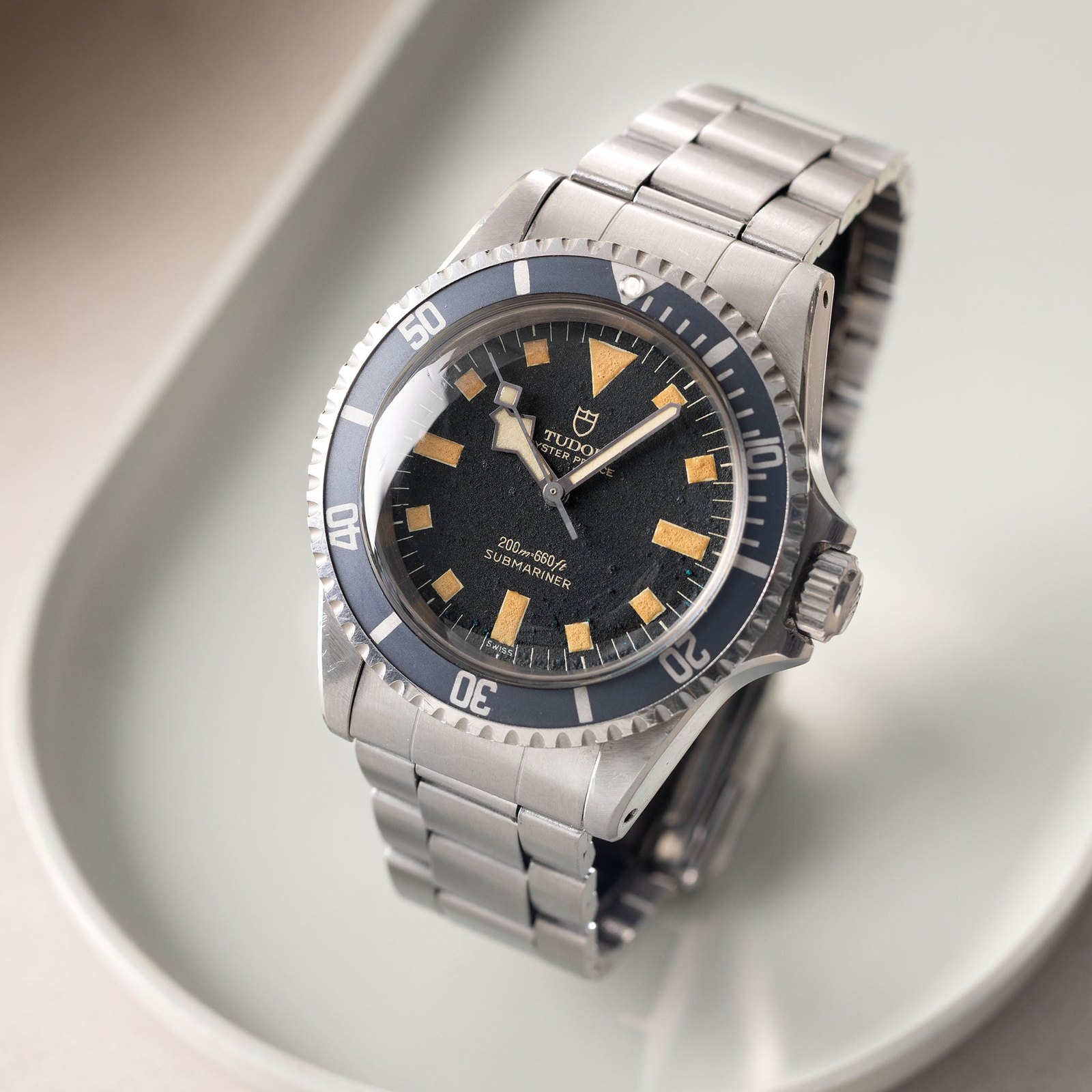
Tudor Submariner No Date Black Snowflake Swiss only dial with original box and paper ref 7016/0, 1970
- Maker / attribution
- Tudor (maker)
- Date
- 1970
- Historical period
- Quartz Revolution (1969 – 1990)
- Country of origin
- Switzerland
- Object type
- Wristwatch
- Dimensions
- Case 40 mm
- Stock no.
- W-3830
- Credit line
- Dealer listing, Bulang & Sons (W-3830)
- Catalogue title (original)
- Tudor Submariner No Date Black Snowflake SWISS only dial with original box and paper ref 7016/0 (English)
View the source record (dealer listing) ↗ (opens another website in a new tab)Suggest a correction
Record summary
Catalogued by Bulang & Sons (dealer), Copenhagen (stock number W-3830), this is a wristwatch by Tudor, made in Switzerland, dated 1970. The Atlas places it in the Quartz Revolution period (1969 – 1990) of its Wristwatches collection. Recorded dimensions: Case 40 mm. The record is illustrated with 6 photographs.
Assembled from the source record's structured fields. Dates and attributions are given as the source states them; where a field is missing the Atlas leaves it blank rather than estimating.
Catalogue description
Dealer description — Bulang & Sons
Introduced in 1969, the Tudor Submariner "Snowflake" is a legendary watch design featuring distinctive angular hands and square hour markers. Originally created to maximize legibility for professional divers, this iconic aesthetic has since become the cornerstone of Tudor’s modern identity. The Snowflake design was born from a close collaboration between Tudor and the French Navy (Marine Nationale), which requested a highly legible dive watch for use in murky, deep-water conditions. Standard Rolex "Mercedes" hands could be difficult to distinguish in low-light environments. The angular, flat surfaces of the Snowflake hands allowed for a generous application of luminous material, ensuring that the hour and minute hands were easily distinguishable from one another. The introduction of the Snowflake hands, along with the square hour markers, coincided with Tudor's transition from the Rose logo to the Shield logo, helping the brand step out of Rolex's shadow and establish its own utilitarian identity. This particular black-dial example boasts several highly desirable and rare features. The earliest Snowflakes are what collectors refer to as "SWISS only" dials, due to "SWISS" being the only text printed between the hash marks at six o’clock. These dials can be found in both black and, much more rarely, blue. The blue dials were introduced first, around 1969 (approximately in the 62xxxx serial range), followed shortly thereafter by the black dials. Black-dial examples are generally found within the 74xxxx to 815xxx serial range, while blue dials are typically associated with the earlier 62xxxx range. The case on this watch is superb. We rarely use the term "unpolished" and prefer to let the photographs speak for themselves, allowing you to form your own opinion. Just look at the shoulders on this beauty. The bezel insert has faded to a gorgeous midnight blue and is the highly sought-after "Kissing 40" variation, so named because the font is so thick that the numerals 4 and 0 actually touch one another. The dial displays the familiar and entirely sympathetic "bubbling" often seen on Snowflake dials. This is an extremely common characteristic, and many dials were replaced by Tudor during routine servicing as a result.The lume collar has gotten a lovely yellow colour over the years. The hands have been "stabilised," meaning that a watchmaker applied a form of lacquer during a service to secure the original lume. This is also a very common period-correct practice, as the wide Snowflake hands often lost lume over decades of use. The watch is fitted with a lovely folded Oyster reference 9315 bracelet with 380 end links and the famous "Pateted" dive extension. This refers to a well-known and highly collectible spelling error found on vintage Rolex and Tudor dive extensions. Instead of "PATENTED," the clasp was stamped "PATETED," omitting the letter "N." What was once a simple factory error has become a prized detail among vintage watch enthusiasts. The watch has been fully serviced by our watchmaker and is ready to be enjoyed on the wrist. Completing the package is the seldom-seen white Tudor presentation box and the original guarantee paper, documenting a sale in Germany in 1974. With its early "SWISS only" dial, sharp case, rare "Kissing 40" bezel insert, desirable 9315 bracelet, and complete box-and-papers set, this Tudor Snowflake represents an exceptionally attractive and collectible example of one of the most important vintage dive watches ever produced ! Specifications: Tudor Submariner no date Reference 7016 /0 40mm steel case Serial 742XXX dating to 1970 Super fat font “kissing 40” bezel insert Black dial Snowflake configuration , hands stabilised Rolex 9315 Oyster bracelet with 380 end links , rare error “ Pateted “ dive extension Rare Tudor box, guarantee paper and red Tudor paper holder Fully serviced by our watchmaker
Historical context
Quartz Revolution (1969 – 1990)
Seiko's Astron begins mass quartz timekeeping; traditional industries contract sharply.
Quartz and digital watches transformed the market after 1969. Swiss employment collapsed, Japanese and Hong Kong production soared, and the Swatch (1983) helped the Swiss industry recover; mechanical watches survived as luxury goods.
Read the period in the timelineMore wristwatches from this periodEarlier: Modern Mechanical Horology
Atlas type guide
Dive and water-resistant watches
Keeping water and dust out of a wristwatch was a long-standing challenge. Rolex's screw-down Oyster case (1926) and Omega's Marine (1932) were landmarks; in the early 1950s Blancpain's Fifty Fathoms and Rolex's Submariner defined the professional dive watch with rotating bezels for timing dives, luminous dials and high water resistance. The ISO 6425 standard (1982) later codified what a 'diver's watch' must do.
Dive watches became icons of post-war design and exploration, and their evolution — helium escape valves, ceramic bezels, saturation-diving depth ratings — records the history of underwater work.
What to look for
- Unidirectional or bidirectional rotating bezel with minute markings.
- Screw-down crown and case back; depth rating printed on the dial.
- Luminous hands and markers (radium before c. 1960, tritium c. 1960–1998, then Super-LumiNova).
- Reference numbers on the case between the lugs or inside the back.
Dating clues
- Screw-down Oyster cases: from 1926.
- Professional dive watches: from 1953.
- Tritium 'T' marks on dials: c. 1960–1998.
General guidance written by the Atlas editors about this kind of object. It is not a statement about this particular piece; for that, rely on the source record above and on physical examination.
Related records
Wristwatches · c. 1973
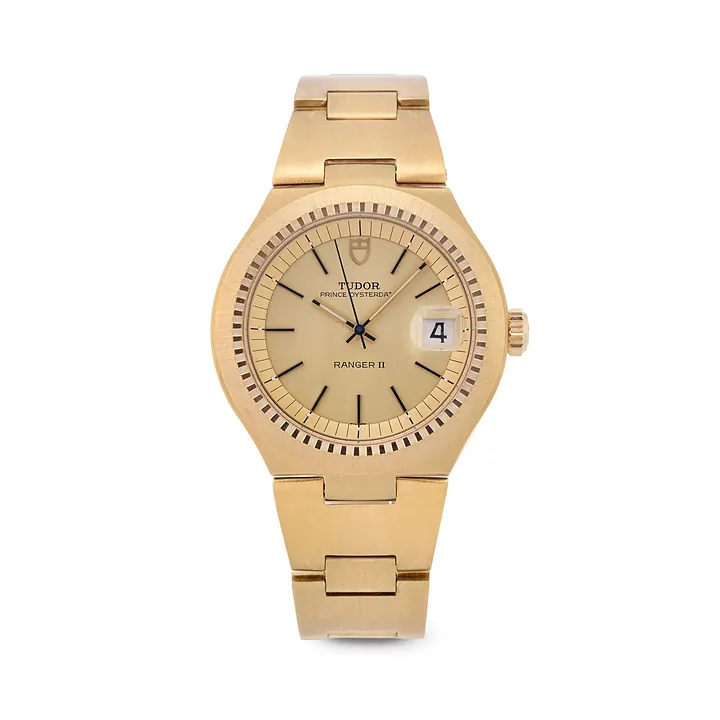
Tudor Prince Oysterdate Ranger II, ref. 9101/1, c. 1973
Antiquorum auction archive, Geneva
Wristwatches · c. 1973
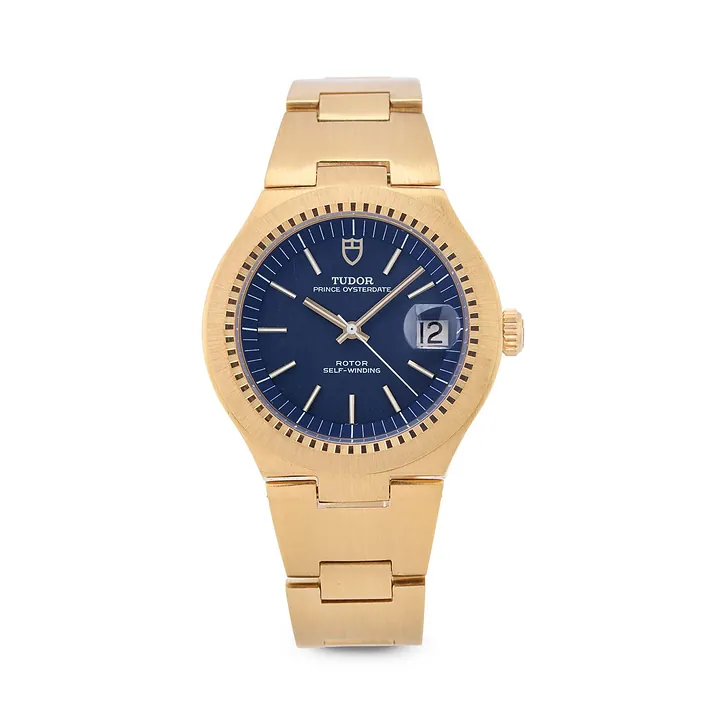
Tudor Prince Oysterdate, ref. 9101/1, c. 1973 (Antiquorum Lot 389-114)
Antiquorum auction archive, Geneva
Wristwatches · c. 1973
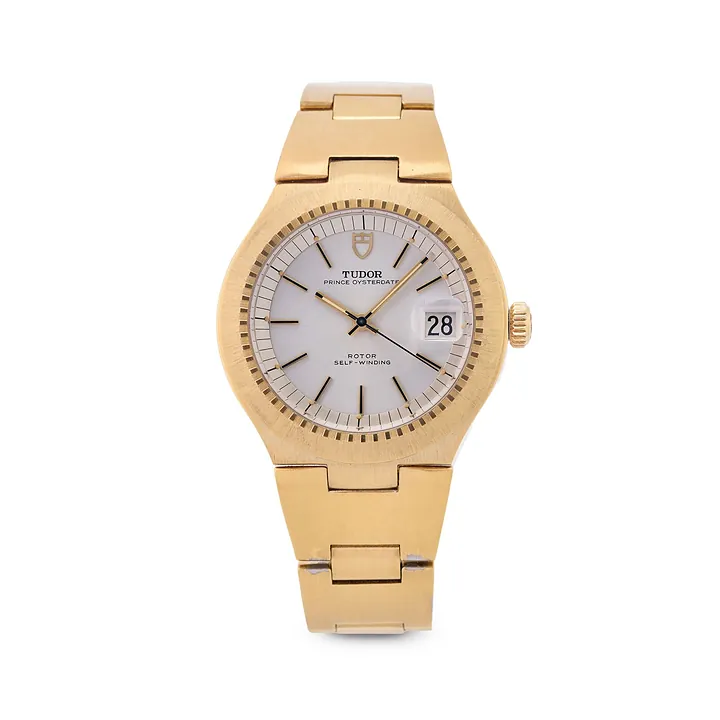
Tudor Prince Oysterdate, ref. 9101/1, c. 1973 (Antiquorum Lot 389-115)
Antiquorum auction archive, Geneva
Wristwatches · c. 1974
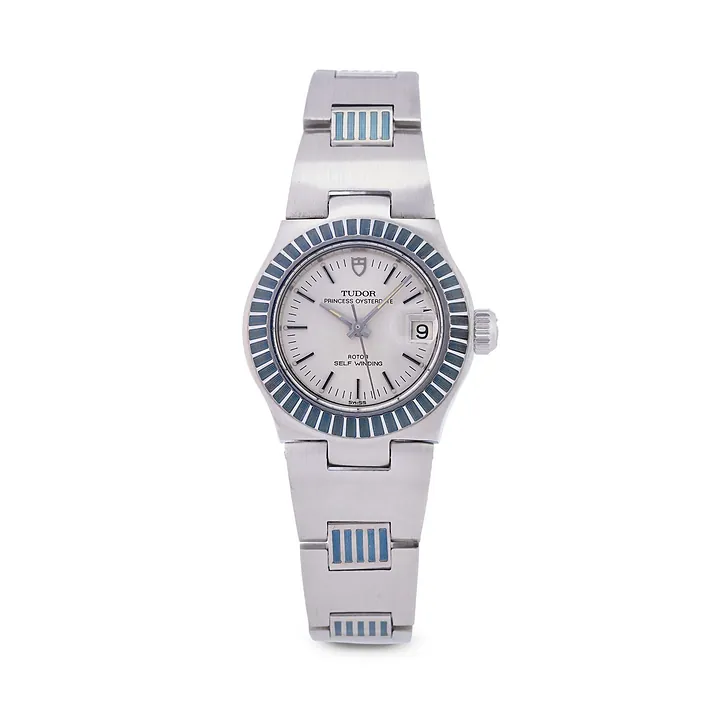
Tudor Princess Oysterdate, ref. 9311/0, c. 1974
Antiquorum auction archive, Geneva

Wristwatches · 1970
Wristwatch by Heno, Switzerland, 1970
Museum Rotterdam

Wristwatches · 1960–1986
'Tri-Compax' calendar chronograph wristwatch in gold case, by Universal, Geneva, Switzerland, 1960–1986.
Science Museum Group, London

Wristwatches · 1969–1970
Beta 21 Quartz wristwatch movement, made in Switzerland, 1970.
Science Museum Group, London

Wristwatches · c. 1969
Omega Speedmaster Moonwatch, ref. 145022-69st, c. 1969
Antiquorum auction archive, Geneva