
Wristwatches · Wristwatch
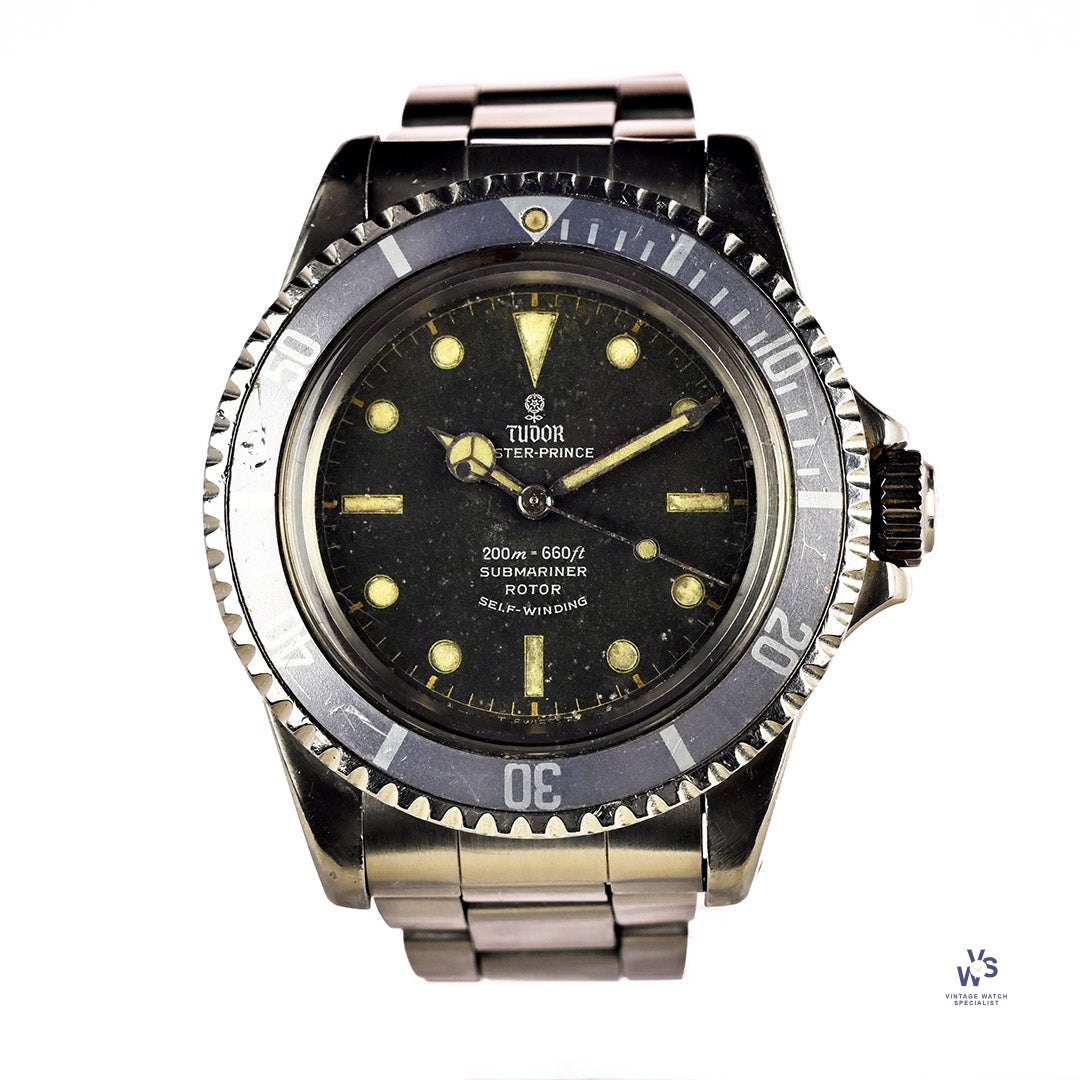
Tudor Oyster Prince Submariner 7928 with Ghost Bezel, circa 1964
- Maker / attribution
- Tudor (maker)
- Date
- c. 1964
- Historical period
- Modern Mechanical Horology (1945 – 1969)
- Country of origin
- Switzerland
- Object type
- Wristwatch
- Dimensions
- Case 40 mm
- Stock no.
- vws0462
- Credit line
- Dealer listing, Vintage Watch Specialist (vws0462)
- Catalogue title (original)
- Tudor Oyster Prince Submariner 7928 with Ghost Bezel – c.1964 (English)
View the source record (dealer listing) ↗ (opens another website in a new tab)Suggest a correction
Record summary
Catalogued by Vintage Watch Specialist (dealer), United Kingdom (stock number vws0462), this is a wristwatch by Tudor, made in Switzerland, dated c. 1964. The Atlas places it in the Modern Mechanical Horology period (1945 – 1969) of its Wristwatches collection. Recorded dimensions: Case 40 mm. The record is illustrated with 6 photographs.
Assembled from the source record's structured fields. Dates and attributions are given as the source states them; where a field is missing the Atlas leaves it blank rather than estimating.
Catalogue description
Dealer description — Vintage Watch Specialist
A Very Rare and Collectable Tudor Oyster Prince Submariner 7928, with Original Lume and a Beautifully Ghosted Bezel, 1964 Introduced in 1959, the Tudor Submariner Reference 7928 marked an important development in the brand's professional diving watches. Building upon earlier Tudor Submariner models, the 7928 introduced crown guards to the collection, providing additional protection for the winding crown during demanding use. The reference remained in production throughout much of the 1960s, undergoing several changes to its case and dial design. Early examples featured pointed crown guards, while later versions adopted the more rounded profile familiar to collectors today. Like other Tudor watches of the period, the Submariner benefited from the close relationship between Tudor and Rolex, combining Rolex-style Oyster case construction with reliable Swiss mechanical movements. The Reference 7928 was powered by the self-winding Fleurier Calibre 390, a reliable automatic movement that became closely associated with Tudor's early professional diving watches Tudor Submariners also developed a strong military following, with examples supplied to naval organisations, including the French Marine Nationale, during the wider history of the collection. Today, the Reference 7928 is especially appreciated for its distinctive Tudor Rose dial, robust construction and the variety of attractive ageing characteristics found among surviving examples. What's on Offer Here we have a wonderful Tudor Oyster Prince Submariner Reference 7928 , dating to approximately 1964, featuring a beautifully aged black dial and a striking faded grey bezel. This is a watch with considerable vintage character, combining the classic proportions of an early Tudor Submariner with the appealing patina that collectors often seek in watches of this period. The stainless steel Oyster case measures approximately 40mm across and features the rounded crown guards associated with later examples of the Reference 7928. Its substantial yet balanced proportions give the watch an unmistakable presence on the wrist, while retaining the practical elegance of a classic 1960s diving watch. The case displays marks of wear consistent with its age, with the original-style lines and distinctive crown guard profile remaining clearly visible. The Dial The black dial is particularly attractive, displaying the traditional Tudor Rose beneath 12 o'clock, with the Oyster Prince designation positioned immediately below. At 6 o'clock, the dial carries the depth rating of 200 metres / 660 feet, followed by the Submariner name and the Rotor Self-Winding designation. The large luminous hour markers have developed a warm cream patina, beautifully complemented by the similarly aged Mercedes-style hands. The combination of circular markers, rectangular markers at 6 and 9 o'clock, and the prominent triangular marker at 12 creates the highly legible arrangement associated with classic Submariner watches. The dial also displays attractive signs of age, lending the watch an authentic vintage appearance. Although the luminous material appears consistent in colour across the dial and hands, its originality would require specialist verification. The Ghost Bezel One of the most appealing features of this example is its wonderfully faded ghost bezel . Originally much darker, the bezel insert has developed a soft grey tone over the decades, creating a striking contrast against the black dial. The fading is particularly attractive, with the minute markings remaining clearly visible and the bezel retaining its distinctive vintage appearance. Such changes in colour can occur as a result of prolonged environmental exposure and ageing, although the precise circumstances responsible for this example's patina are unknown. The bezel displays marks of wear consistent with its age, adding to the overall character of the watch. Movement and Bracelet Inside is the Fleurier Calibre 390, a self-winding mechanical movement that powered Tudor's early Submariner watches. The movement has been serviced and is running well, with a recorded timegrapher reading of approximately -6 seconds per day and an amplitude of 275 degrees. The movement has been serviced and is running well, with a recorded timegrapher reading of approximately -6 seconds per day and an amplitude of 275 degrees. The watch is fitted with a stainless steel Tudor Oyster-style folded-link bracelet, featuring a Tudor-branded clasp. The bracelet complements the watch beautifully and remains in very good condition. A Classic Vintage Tudor The Reference 7928 represents an important chapter in Tudor's history, bridging the earlier Submariner models and the increasingly recognisable professional diving watches of the late 1960s. With its Tudor Rose dial, beautifully faded bezel, rounded crown guards and serviced automatic movement, this example has all the character that makes vintage Tudor Submariners so desirable. For collectors who appreciate watches that wear their history openly, this is a particularly appealing example. Condition Report: Crystal: Excellent Dial: Very Good Bezel: Very Good Case: Good Bracelet: Very Good Movement: Serviced -6s/d 275° Overall: Good
Historical context
Modern Mechanical Horology (1945 – 1969)
Tool watches for divers, pilots and astronauts; electric watches anticipate the electronic age.
The classic era of the mechanical wristwatch: dive watches, chronographs for motor racing and space flight, GMT watches for jet travel, slim dress watches, automatic calendars, and the rise of Japanese manufacturers alongside Swiss, American, German and Soviet industries.
Read the period in the timelineMore wristwatches from this periodEarlier: Golden Age of Mechanical Watchmaking
Atlas type guide
Dive and water-resistant watches
Keeping water and dust out of a wristwatch was a long-standing challenge. Rolex's screw-down Oyster case (1926) and Omega's Marine (1932) were landmarks; in the early 1950s Blancpain's Fifty Fathoms and Rolex's Submariner defined the professional dive watch with rotating bezels for timing dives, luminous dials and high water resistance. The ISO 6425 standard (1982) later codified what a 'diver's watch' must do.
Dive watches became icons of post-war design and exploration, and their evolution — helium escape valves, ceramic bezels, saturation-diving depth ratings — records the history of underwater work.
What to look for
- Unidirectional or bidirectional rotating bezel with minute markings.
- Screw-down crown and case back; depth rating printed on the dial.
- Luminous hands and markers (radium before c. 1960, tritium c. 1960–1998, then Super-LumiNova).
- Reference numbers on the case between the lugs or inside the back.
Dating clues
- Screw-down Oyster cases: from 1926.
- Professional dive watches: from 1953.
- Tritium 'T' marks on dials: c. 1960–1998.
General guidance written by the Atlas editors about this kind of object. It is not a statement about this particular piece; for that, rely on the source record above and on physical examination.
Related records
Wristwatches · c. 1973
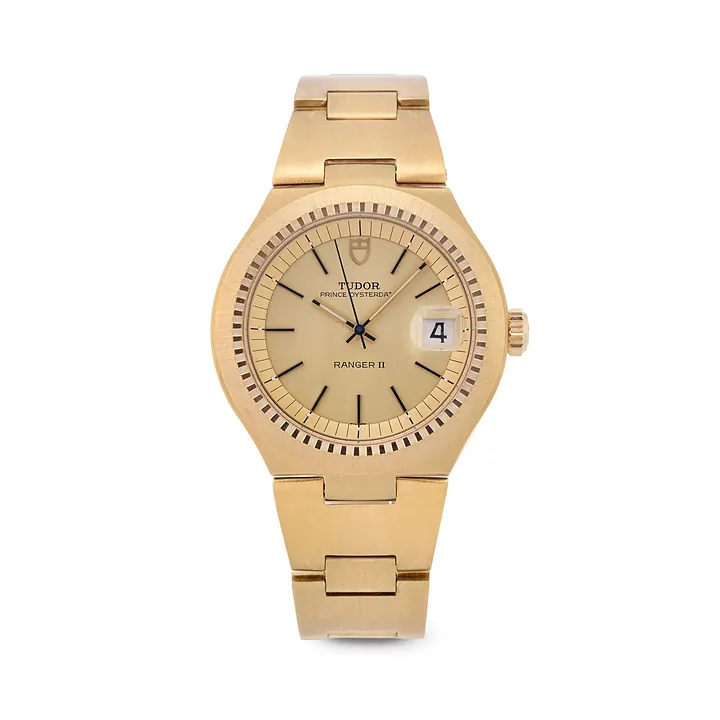
Tudor Prince Oysterdate Ranger II, ref. 9101/1, c. 1973
Antiquorum auction archive, Geneva

Wristwatches · c. 1973
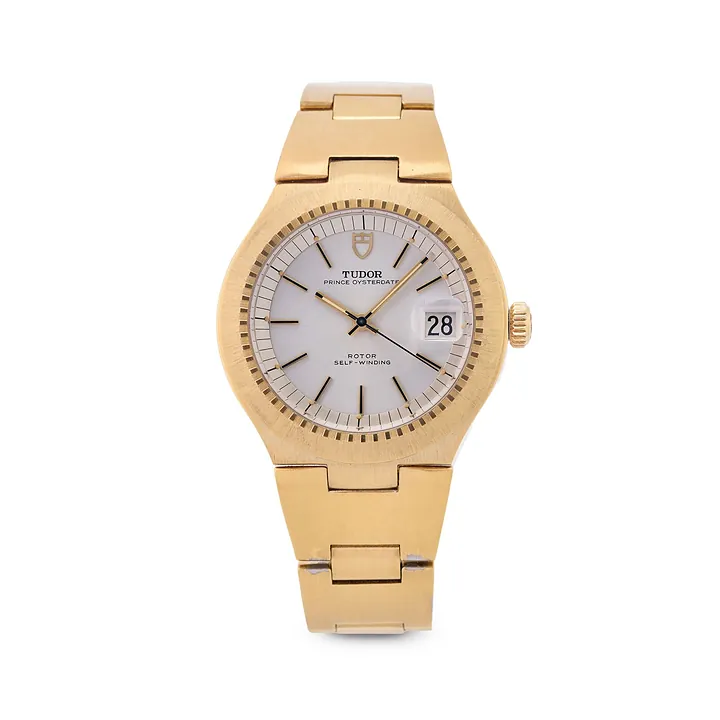
Tudor Prince Oysterdate, ref. 9101/1, c. 1973 (Antiquorum Lot 389-114)
Antiquorum auction archive, Geneva
Wristwatches · c. 1973
Tudor Prince Oysterdate, ref. 9101/1, c. 1973 (Antiquorum Lot 389-115)
Antiquorum auction archive, Geneva
Wristwatches · c. 1974
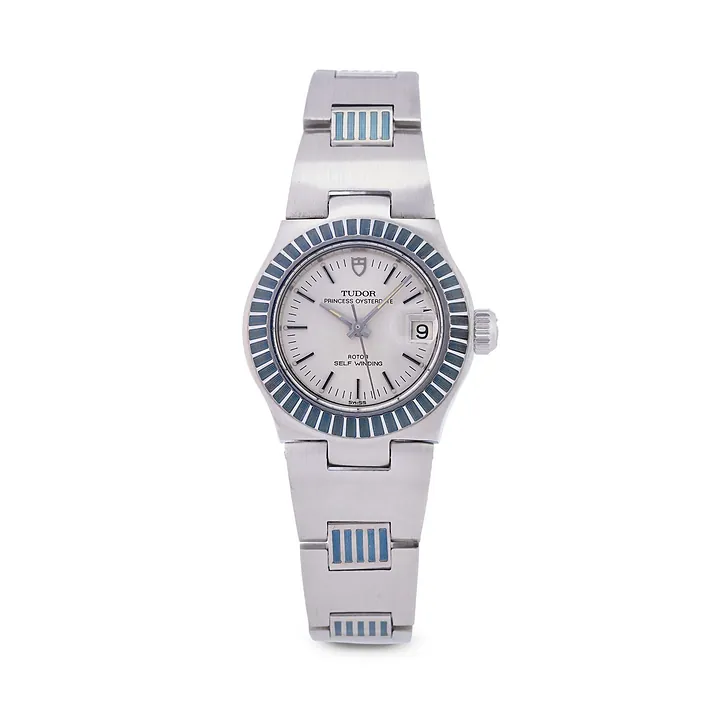
Tudor Princess Oysterdate, ref. 9311/0, c. 1974
Antiquorum auction archive, Geneva

Wristwatches · 1945
Wristwatch by Eterna, 1945
Museum Rotterdam

Wristwatches · c. 1945
Breitling Premier, ref. 790, c. 1945
Antiquorum auction archive, Geneva

Wristwatches · c. 1945
Universal Genève Uni-Compax, ref. 22492, c. 1945
Antiquorum auction archive, Geneva

Wristwatches · c. 1950s
Baume & Mercier wristwatch, c. 1950s
Antiquorum auction archive, Geneva