
Wristwatches · Wristwatch
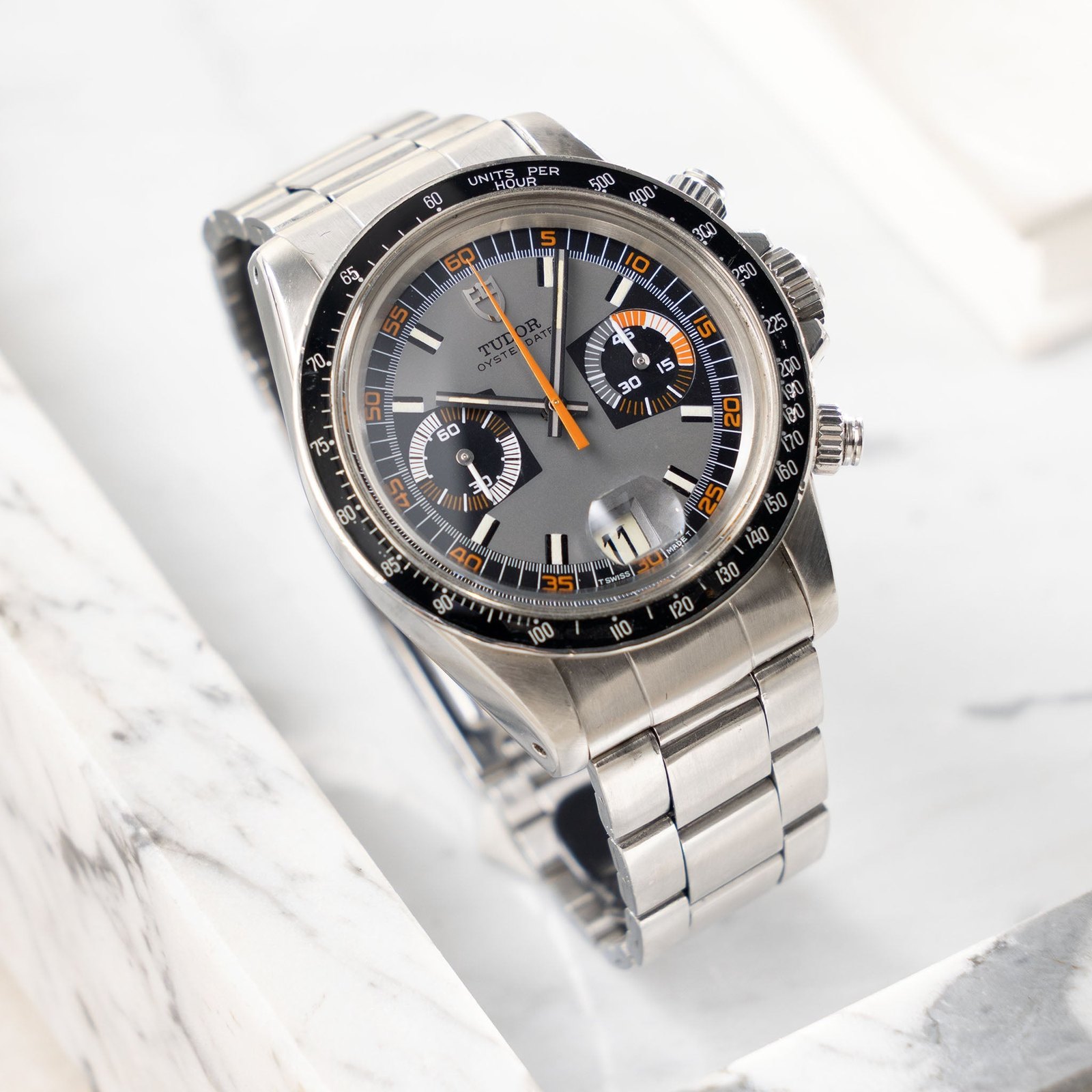
Tudor "Monte Carlo " chronograph grey dial ref 7149 / 0 “mystery engraving “, 1972
- Maker / attribution
- Tudor (maker)
- Date
- 1972
- Historical period
- Quartz Revolution (1969 – 1990)
- Country of origin
- Switzerland
- Object type
- Wristwatch
- Dimensions
- Case 40 mm
- Stock no.
- W-3164
- Credit line
- Dealer listing, Bulang & Sons (W-3164)
- Catalogue title (original)
- Tudor "Monte Carlo " chronograph grey dial ref 7149 / 0 “mystery engraving “ (English)
View the source record (dealer listing) ↗ (opens another website in a new tab)Suggest a correction
Record summary
Catalogued by Bulang & Sons (dealer), Copenhagen (stock number W-3164), this is a wristwatch by Tudor, made in Switzerland, dated 1972. The Atlas places it in the Quartz Revolution period (1969 – 1990) of its Wristwatches collection. Recorded dimensions: Case 40 mm. The record is illustrated with 6 photographs.
Assembled from the source record's structured fields. Dates and attributions are given as the source states them; where a field is missing the Atlas leaves it blank rather than estimating.
Catalogue description
Dealer description — Bulang & Sons
Tudor's second series of chronographs earned the nickname "Monte Carlos" from collectors due to the dial layout, which resembled the gaming tables seen in the casinos of Monaco's famous gaming center. This stunning chronograph features a grey and orange dial in superb condition. The orange remains striking and vibrant, with no spotting on the grey areas, which is often seen on these watches. The case, including the lugs and crown guards, is thick and in great shape all around. The caseback has a fascinating engraving: C. Harris M.N.-U.K. 025557 . We love these little mysteries: Who was this “C. Harris”? Was this from the UK military ? Was this a military-issued watch? And what does the number signify ??! The folded link Oyster bracelet, ref 7836 with 382 endlinks, is in excellent condition with minimal stretch.The manual wind chronograph movement has been fully checked and regulated by our watchmaker. Get in touch if you want to learn more about this original grandfather of the Tudor Black Bay chronograph! Specifications: - Tudor Monte Carlo Chrono 7149 /0 - 40mm steel case - Serial 775xx dating to 1972 - Black tachymeter bezel - Grey and orange dial - “Mystery “ caseback engraving “: C.Harris M.N.-U.K. 025557 - Bracelet reference 78360 with 580 endlinks - Fully serviced by our watchmaker
Historical context
Quartz Revolution (1969 – 1990)
Seiko's Astron begins mass quartz timekeeping; traditional industries contract sharply.
Quartz and digital watches transformed the market after 1969. Swiss employment collapsed, Japanese and Hong Kong production soared, and the Swatch (1983) helped the Swiss industry recover; mechanical watches survived as luxury goods.
Read the period in the timelineMore wristwatches from this periodEarlier: Modern Mechanical Horology
Atlas type guide
Chronographs and split-seconds watches
A chronograph is a watch with an additional seconds hand that can be started, stopped and returned to zero independently of the timekeeping. Louis Moinet built an early example in 1816 and Nicolas Rieussec a recording 'chronographe' in 1821; Adolphe Nicole's heart-shaped reset cam (patented 1862) made the modern return-to-zero possible. Split-seconds (rattrapante) chronographs add a second hand that can be stopped for intermediate times; flyback chronographs restart instantly.
Chronographs were essential tools for doctors (pulsometer scales), artillery (telemeter), engineers and sport. In wristwatches, Valjoux, Venus, Lemania and later the automatic chronographs of 1969 (Zenith El Primero, the Chronomatic Calibre 11 group and Seiko 6139) are milestones.
What to look for
- Push-pieces on the case band or a single button in the crown (monopusher).
- Subsidiary registers for minutes and hours; tachymeter, telemeter or pulsometer scales.
- Column wheel versus cam control visible in the movement.
- Calibre markings of specialist makers (Valjoux, Lemania, Venus, Landeron).
Dating clues
- Pocket chronographs with heart cam reset: after 1862.
- Wrist chronographs: from c. 1910; two-button designs from the 1930s.
- Automatic chronographs: from 1969.
General guidance written by the Atlas editors about this kind of object. It is not a statement about this particular piece; for that, rely on the source record above and on physical examination.
Read next:Flyback chronographChronograph
Related records
Wristwatches · c. 1973
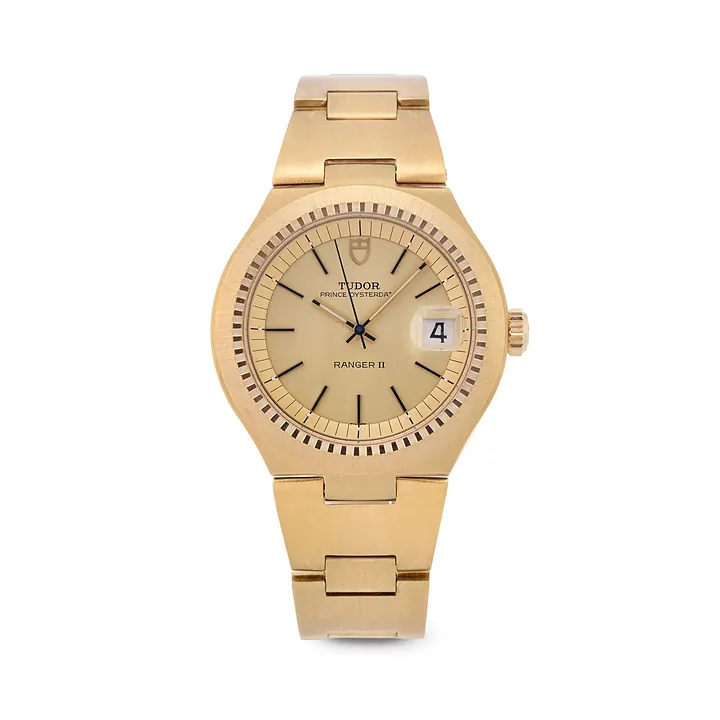
Tudor Prince Oysterdate Ranger II, ref. 9101/1, c. 1973
Antiquorum auction archive, Geneva
Wristwatches · c. 1973
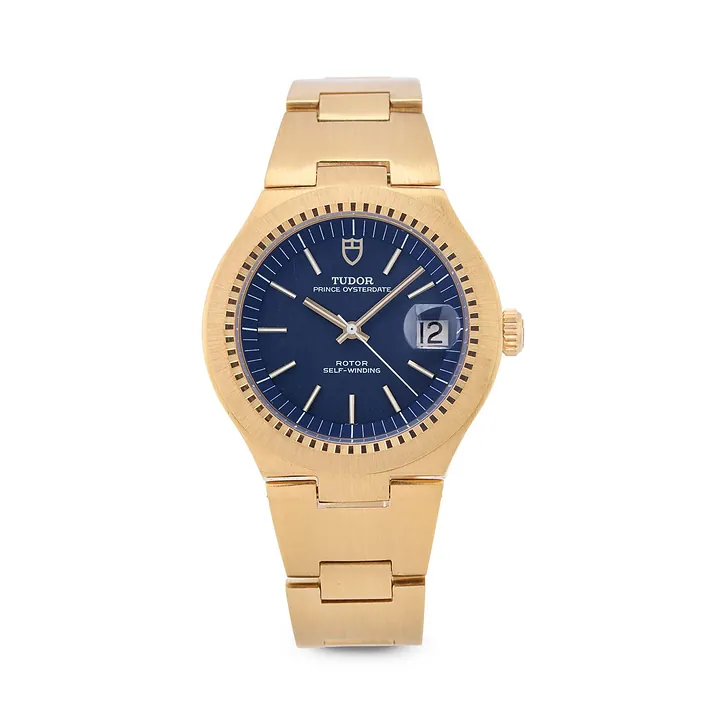
Tudor Prince Oysterdate, ref. 9101/1, c. 1973 (Antiquorum Lot 389-114)
Antiquorum auction archive, Geneva
Wristwatches · c. 1973
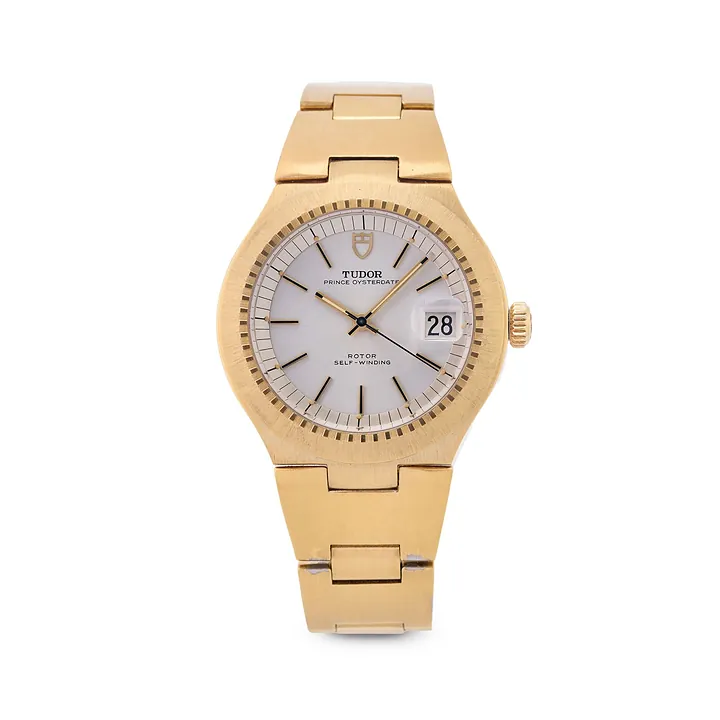
Tudor Prince Oysterdate, ref. 9101/1, c. 1973 (Antiquorum Lot 389-115)
Antiquorum auction archive, Geneva
Wristwatches · c. 1974
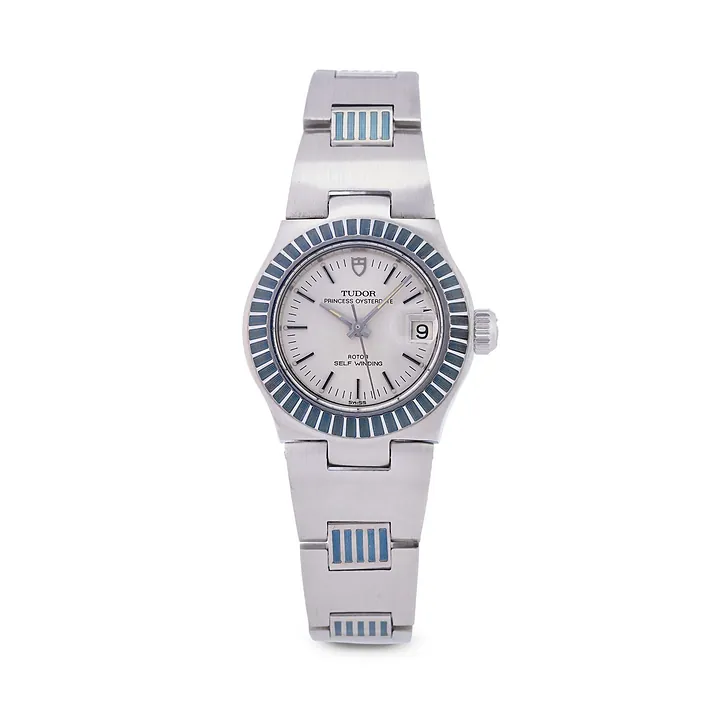
Tudor Princess Oysterdate, ref. 9311/0, c. 1974
Antiquorum auction archive, Geneva

Wristwatches · 1970
Wristwatch by Heno, Switzerland, 1970
Museum Rotterdam

Wristwatches · 1960–1986
'Tri-Compax' calendar chronograph wristwatch in gold case, by Universal, Geneva, Switzerland, 1960–1986.
Science Museum Group, London

Wristwatches · 1969–1970
Beta 21 Quartz wristwatch movement, made in Switzerland, 1970.
Science Museum Group, London

Wristwatches · c. 1969
Omega Speedmaster Moonwatch, ref. 145022-69st, c. 1969
Antiquorum auction archive, Geneva