
Wristwatches · Wristwatch
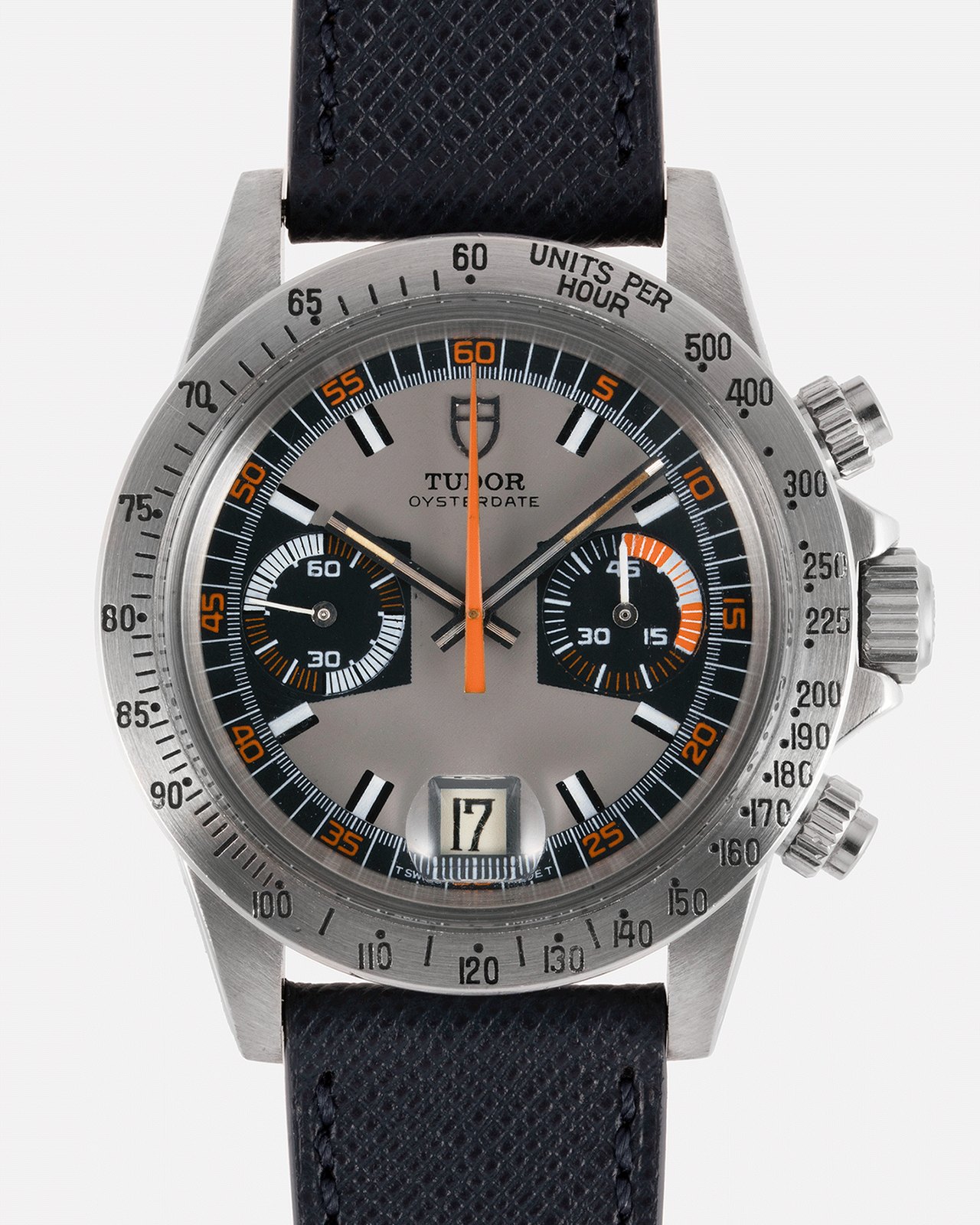
Tudor Monte Carlo 7159, 1974
- Maker / attribution
- Tudor (maker)
- Date
- 1974
- Historical period
- Quartz Revolution (1969 – 1990)
- Country of origin
- Switzerland
- Object type
- Wristwatch
- Dimensions
- Case 40 mm
- Stock no.
- Product 6562113486935
- Credit line
- Dealer listing, S.Song Watches (product 6562113486935)
- Catalogue title (original)
- Tudor Monte Carlo 7159 (English)
View the source record (dealer listing) ↗ (opens another website in a new tab)Suggest a correction
Record summary
Catalogued by S.Song Watches (dealer), Seattle (stock number Product 6562113486935), this is a wristwatch by Tudor, made in Switzerland, dated 1974. The Atlas places it in the Quartz Revolution period (1969 – 1990) of its Wristwatches collection. Recorded dimensions: Case 40 mm. The record is illustrated with 6 photographs.
Assembled from the source record's structured fields. Dates and attributions are given as the source states them; where a field is missing the Atlas leaves it blank rather than estimating.
Catalogue description
Dealer description — S.Song Watches
Launched in the early 1970s, the Tudor Monte Carlo has developed as one of Tudor's most recognizable models thanks to its unique aesthetic and similarities to its sibling, the Rolex Daytona. With Tudor becoming an increasingly independent brand, these vintage models have experienced a surge in popularity over the last few years as collectors begin to appreciate them for what they are as unique timepieces that deserve to be enjoyed without comparison to their big brother brand. Built from Rolex parts, it is no surprise that the Monte Carlo ref. 7159 is an incredibly robust timepiece, even considering its age. With a trip-lock Rolex crown, substantial crown guards, screw-down pushers, and stainless steel bezel, the Monte Carlo can withstand daily wear and tear much unlike the fragile chronographs from its period. Featuring a 40mm stainless steel case, it carries the wrist presence and substance that fits modern tastes perfectly, but with a vintage charm that is often searched for by brands in the countless re-editions, we have seen as of late. With value at the heart of Tudor's mission, the Monte Carlo ref. 7159, much like every other Tudor, features a third-party movement, the manual-wind Valjoux cal. 234. A column-wheel chronograph with a running seconds subdial at 9 o'clock and a 45-minute subdial at 3 o'clock, this robust movement provided utility and a visual break from the Daytona's triple register design. Furthermore, with a date aperture at 6 o'clock and accompanying cyclops lens, the Monte Carlo forges its own identity on the wrist rather confidently. Perhaps the Monte Carlo's most unique aspect is its dial, with its "Monte Carlo" nickname inspired by it. Sharing visual similarities to a roulette wheel, the Monte Carlo's dial injects personality and color into the timepiece with precision and accuracy. A calculated aesthetic, the Monte Carlo's dial uses color in a useful fashion while also providing a unique character to the timepiece overall. Offered on a leather strap and a grey dial that lends a somewhat toned-down aesthetic, the example I have here is understated while also capable of projecting confident belief in itself, a balance that so many modern timepieces fail to strike.
Historical context
Quartz Revolution (1969 – 1990)
Seiko's Astron begins mass quartz timekeeping; traditional industries contract sharply.
Quartz and digital watches transformed the market after 1969. Swiss employment collapsed, Japanese and Hong Kong production soared, and the Swatch (1983) helped the Swiss industry recover; mechanical watches survived as luxury goods.
Read the period in the timelineMore wristwatches from this periodEarlier: Modern Mechanical Horology
Atlas type guide
Wristwatches
Bracelet watches were worn by women from the early nineteenth century — Breguet made one for Caroline Murat, Queen of Naples, in 1810–12 — but the wristwatch only became a man's instrument with military use and aviation in the early twentieth century. Between the World Wars it overtook the pocket watch; the 1920s and 1930s brought rectangular Art Deco cases, water-resistant cases and the first automatic winding systems.
After 1945 the wristwatch became a carrier of identity — dress watches, sports and dive watches, chronographs, calendars — produced by Swiss, American, Japanese, German, Soviet and Chinese industries. The quartz revolution after 1969 and the mechanical renaissance since the 1990s, including the rise of independent watchmakers, complete the story.
What to look for
- The reference number (between the lugs or inside the case back) and serial number, the starting point for dating.
- The calibre: its maker and number are often stamped under the dial or on the bridge.
- Originality of dial, hands and crown — refinished ('redial') dials are common.
- Case material marks: 18K/750, 14K/585, stainless steel, gold-filled, plated.
Dating clues
- Wire-lug cases: before c. 1925.
- Water-resistant screw-down cases: from 1926.
- Quartz movements: from 1969; sapphire crystals widespread after c. 1980.
General guidance written by the Atlas editors about this kind of object. It is not a statement about this particular piece; for that, rely on the source record above and on physical examination.
Related records
Wristwatches · c. 1973
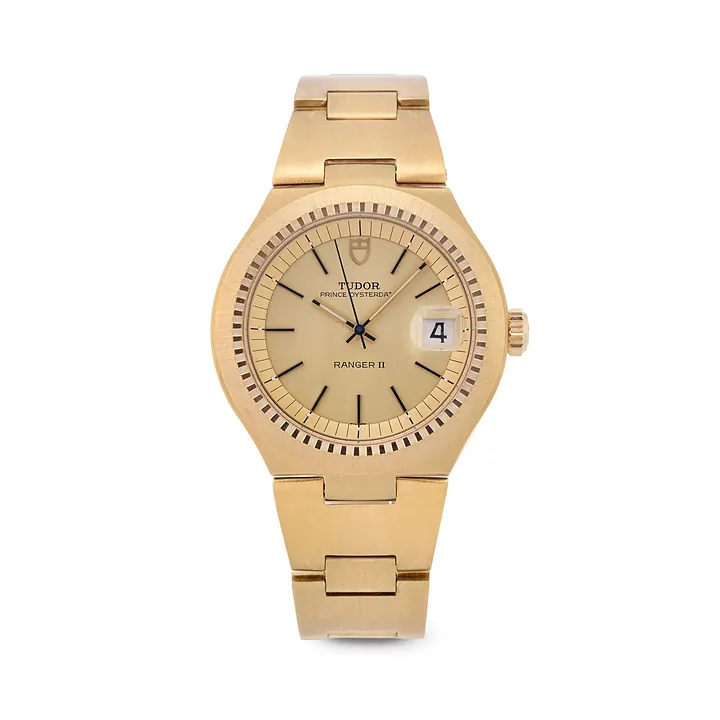
Tudor Prince Oysterdate Ranger II, ref. 9101/1, c. 1973
Antiquorum auction archive, Geneva
Wristwatches · c. 1973
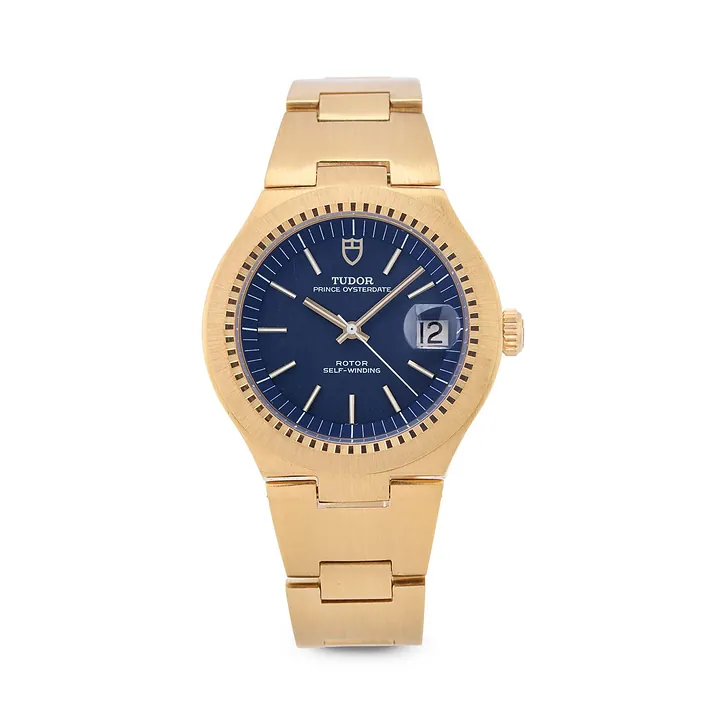
Tudor Prince Oysterdate, ref. 9101/1, c. 1973 (Antiquorum Lot 389-114)
Antiquorum auction archive, Geneva
Wristwatches · c. 1973
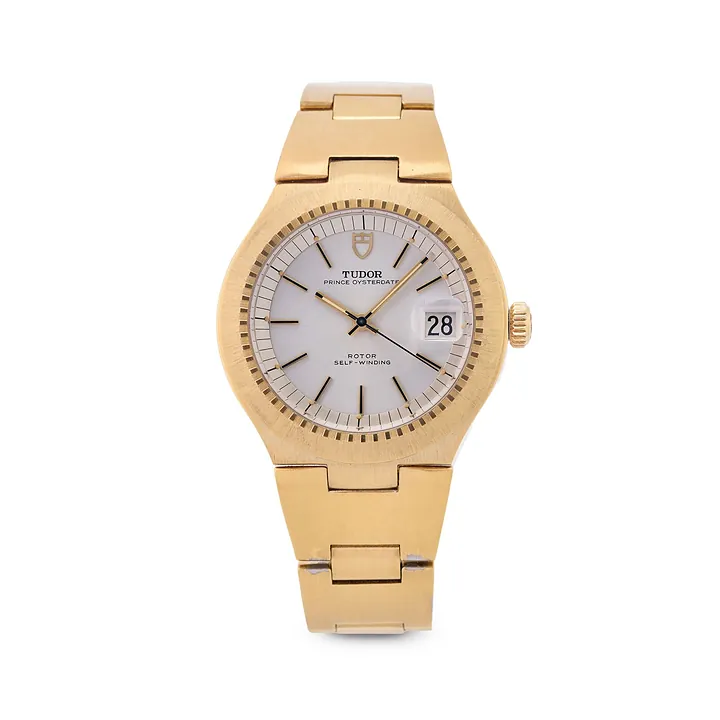
Tudor Prince Oysterdate, ref. 9101/1, c. 1973 (Antiquorum Lot 389-115)
Antiquorum auction archive, Geneva
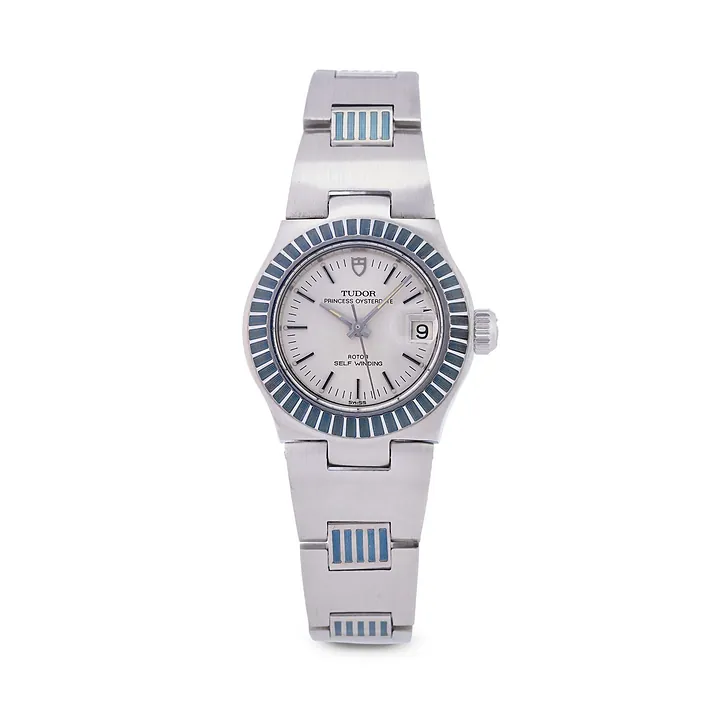
Wristwatches · c. 1974
Tudor Princess Oysterdate, ref. 9311/0, c. 1974
Antiquorum auction archive, Geneva

Wristwatches · 1970
Wristwatch by Heno, Switzerland, 1970
Museum Rotterdam

Wristwatches · 1960–1986
'Tri-Compax' calendar chronograph wristwatch in gold case, by Universal, Geneva, Switzerland, 1960–1986.
Science Museum Group, London

Wristwatches · 1969–1970
Beta 21 Quartz wristwatch movement, made in Switzerland, 1970.
Science Museum Group, London

Wristwatches · c. 1969
Omega Speedmaster Moonwatch, ref. 145022-69st, c. 1969
Antiquorum auction archive, Geneva