
Instruments · Time clock
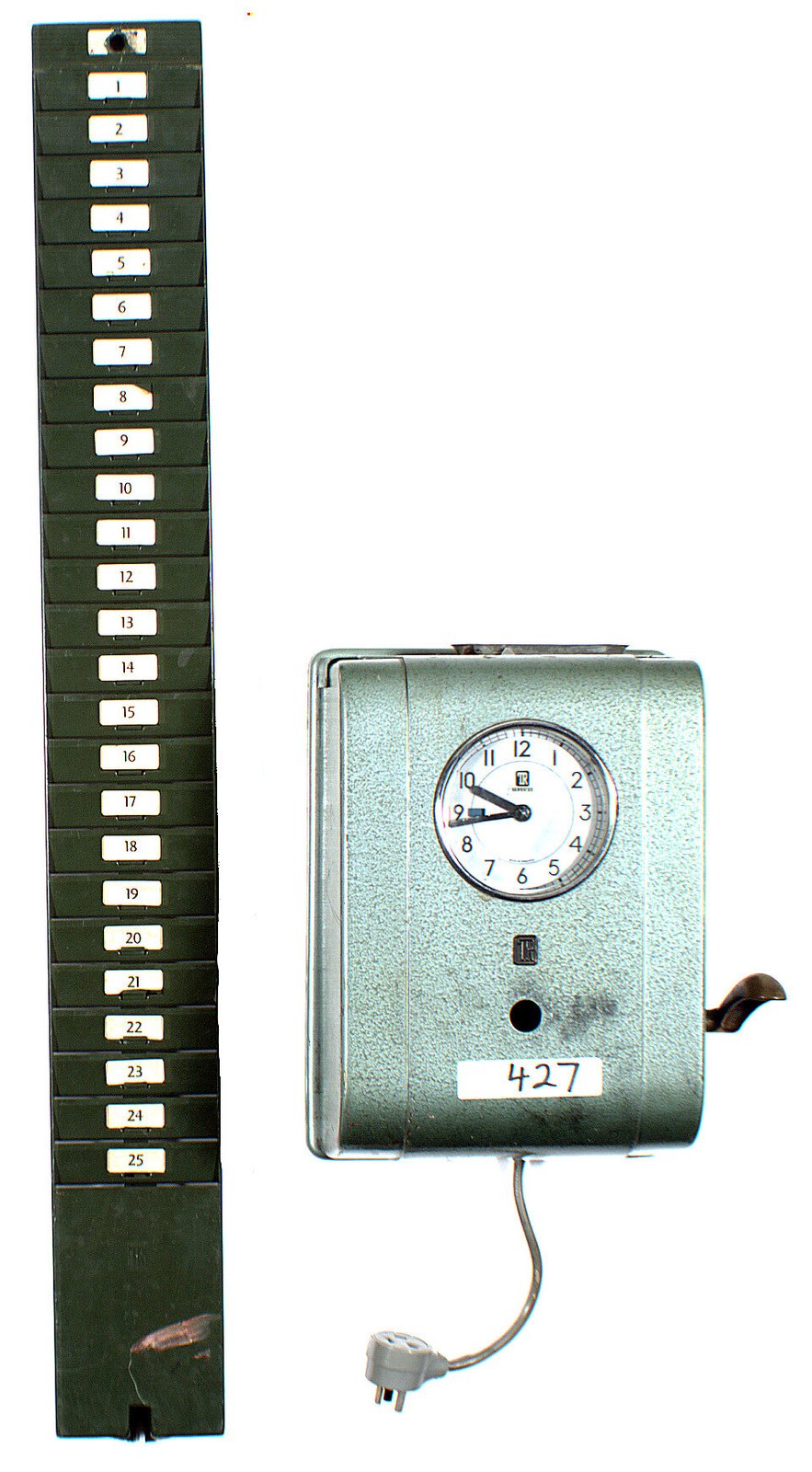
Time Clock - T.R. Services, London, c. 1960
- Maker / attribution
- Unrecorded in source
- Date
- c. 1960
- Historical period
- Modern Mechanical Horology (1945 – 1969)
- Country of origin
- England
- Object type
- Time clock
- Dimensions
- 22.3 cm (Length), 15.4 cm (Width), 33.3 cm (Height); 22.3 mm (Length), 15.4 mm (Width), 33.3 mm (Height)
- Holding institution
- Museums Victoria, Melbourne
- Accession / object no.
- SH 922683
- Catalogue title (original)
- Time Clock - T.R. Services, London, circa 1960 (English)
View the source record ↗ (opens another website in a new tab)Suggest a correction
Record summary
Held and catalogued by Museums Victoria, Melbourne (object number SH 922683), this is a time clock, made in England, dated c. 1960. The Atlas places it in the Modern Mechanical Horology period (1945 – 1969) of its Instruments collection. Recorded dimensions: 22.3 cm (Length), 15.4 cm (Width), 33.3 cm (Height); 22.3 mm (Length), 15.4 mm (Width), 33.3 mm (Height). The record is illustrated with 1 photograph.
Assembled from the source record's structured fields. Dates and attributions are given as the source states them; where a field is missing the Atlas leaves it blank rather than estimating.
Catalogue description
Summary — Museums Victoria
Time clock and time card holder, made by TR Services, London, circa 1960. Large green electric time clock used to record workers' hours. Green plastic ticket holder with 25 slanting pockets for tickets.
Physical description — Museums Victoria
Large green metal time clock used to record workers' hours. Rectangular box which fits onto wall. Top has black oblong metal plate numbered 1-7, R-L. Raised grey metal slot in C which time cards were placed. Front of box has a plastic covered clock face in the U half. Next to the number nine is a small blue rectangle, probably denoting the works' starting time. Underneath the clock a raised stamp with the rental properties initials has been attached, made of brown plastic. A hole underneath the initials, L.C., vaguely shows the internal mechanics of the machine. R side of box has a browny-gold metal handle attached in the L.C., used to punch the cards. Bottom of box slopes from the front and has a red, white and black sticker describing property ownership in L.C. Electrical lead and plug comes from gap in backing metal. Metal case can be lifted to view internal structure of machine by lifting bottom edges. Green plastic ticket holder with 25 slanting pockets for tickets, and which is also fixed to the wall. Each pocket is numbered in black print on a white sticker. Venetian-blind like backing which stops cards from falling.
Inscriptions & marks
Top of box on black oblong with silver nos. from R-L:" 1/2/3/4/5/6/ 7". Front of box on clock face: "TR/ SERVICES" printed in black and silver. Below, near no.6, "MADE IN ENGLAND" printed in black. Brand name underneath clock: "TR". Sticker on bottom edge printed in black on white background and white on red background: "PROPERTY OF/ Telephone Rentals? LIMITED/ HEAD OFFICE/ 193, KNIGHTSBRIDGE, LONDON SW7". Engraved on L. third of back: "MADE IN SWEDEN".
Provenance
Purchase
Historical context
Modern Mechanical Horology (1945 – 1969)
Tool watches for divers, pilots and astronauts; electric watches anticipate the electronic age.
Electronic instruments, quartz frequency standards and the first atomic clocks transformed precision timing in laboratories and broadcasting.
Read the period in the timelineMore instruments from this periodEarlier: Golden Age of Mechanical Watchmaking
Atlas type guide
Timers, stopwatches, chronoscopes and time recorders
Instruments for measuring short intervals or recording when something happened form a large and practical branch of horology. Sports stopwatches and split-seconds timers, laboratory chronoscopes (such as Hipp's, which measured thousandths of a second for psychology and ballistics experiments), metronomes for music, watchmen's clocks that recorded patrol rounds, and the time recorders that clocked factory workers in and out all derive from clock and watch technology.
These objects matter historically because they show timekeeping leaving the observatory and the drawing room and entering industry, science and sport. Many were mass-produced, and their dials, scales and patents chart the rise of electrification and industrial management.
What to look for
- Scales graduated in fifths, tenths or hundredths of a second, or decimal minutes for industrial use.
- Start, stop and reset push-pieces; a second hand that can be stopped independently (split seconds).
- Recording devices: paper discs or tapes, printing mechanisms, keys or punches.
- Patent numbers and dates on the dial or case, which give a terminus post quem.
Dating clues
- Hipp chronoscopes were made from the 1840s into the twentieth century.
- Employee time recorders spread from the 1890s (Bundy, IBM, International Time Recording Co.).
- Quartz and electronic timers replaced mechanical stopwatches in sport from the 1970s.
General guidance written by the Atlas editors about this kind of object. It is not a statement about this particular piece; for that, rely on the source record above and on physical examination.
Read next:ChronographFlyback chronograph
Related records
Instruments · 1930–1960
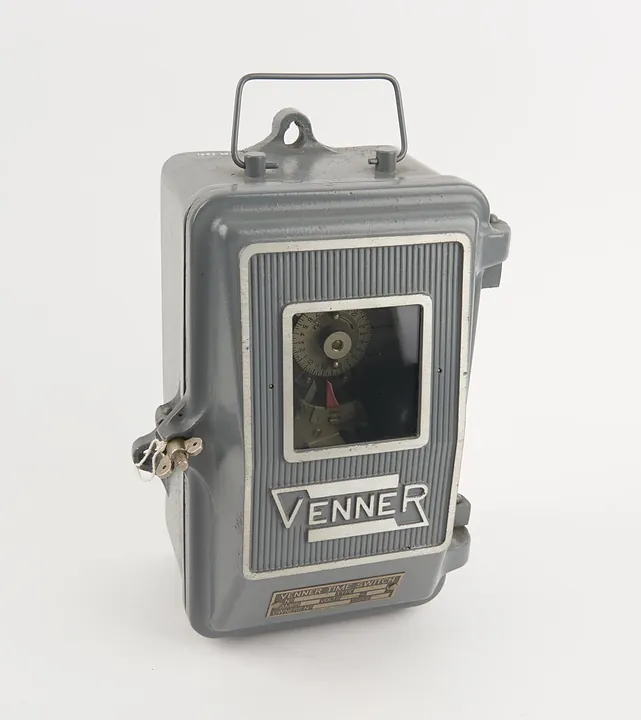
Electronically wound triple-pole changeover time-switch, type MWDGPS, by Venner Limited, New Malden, Kingston-upon-Thames, London, England, 1930–1960.
Science Museum Group, London
Instruments · 1940–1976
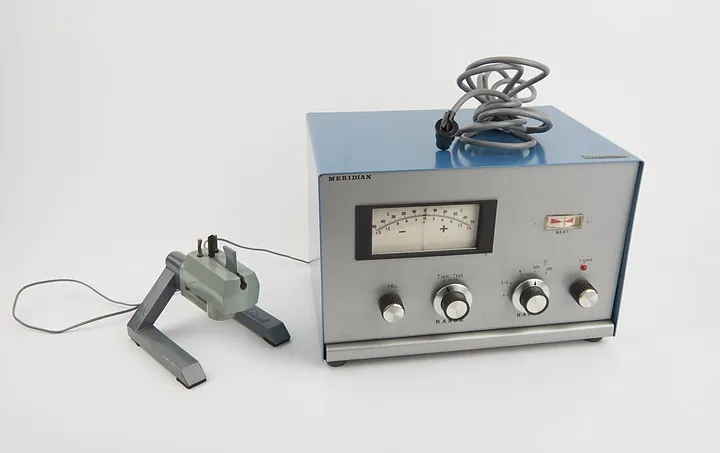
'Meridian' watch timer, by Walker Electronics, Newark-on-Trent, Nottinghamshire, England, 1940–1976.
Science Museum Group, London
Instruments · 1940–1980
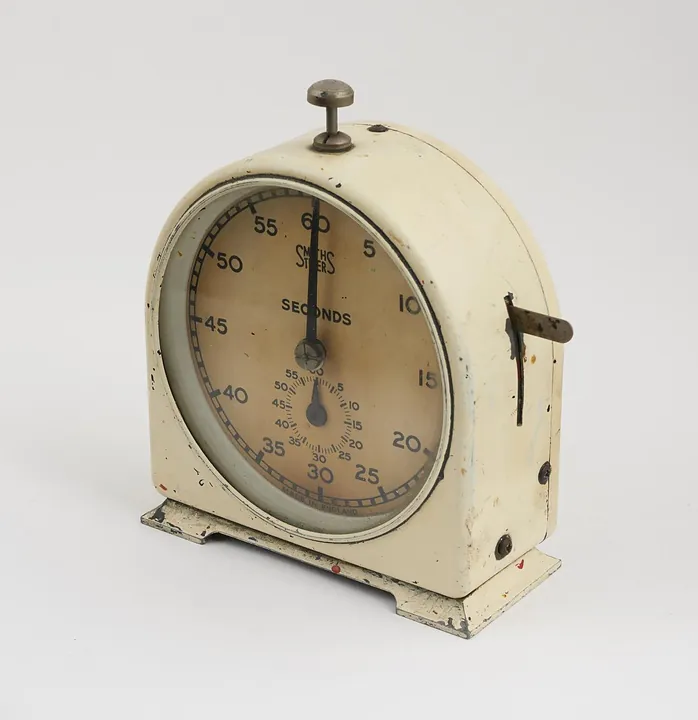
Clockwork timer used by renal dialysis patients to time blood clotting reaction when adding heparin to blood for dialysis
Science Museum Group, London
Instruments · 1940–1965
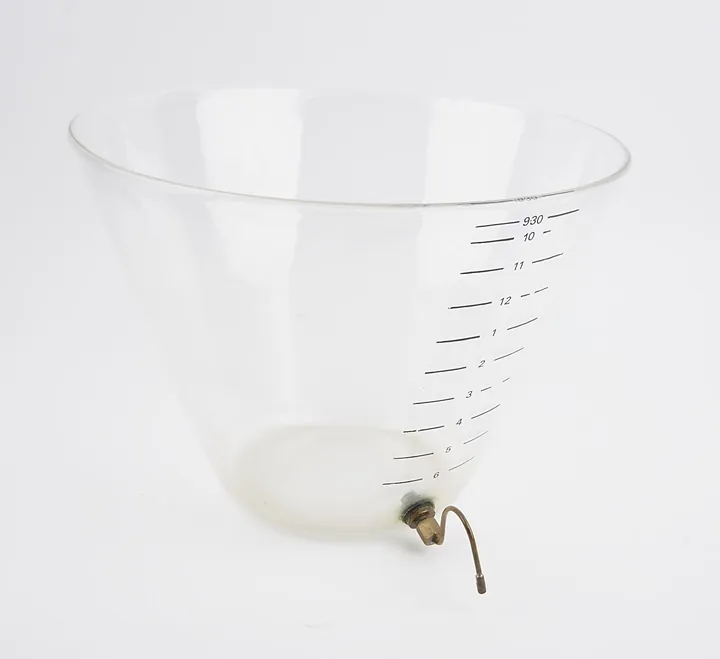
Glass bowl in the shape of an ancient Egyptian water-clock, 1940–1965
Science Museum Group, London
Instruments · 1940–1974
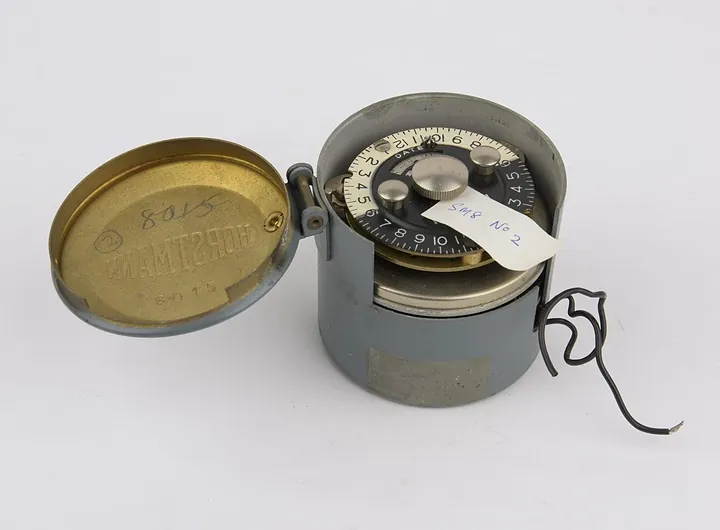
Stopwatch / timer by Horstmann Gear Co. Ltd., England, 1940–1974
Science Museum Group, London
Instruments · 1940–1974
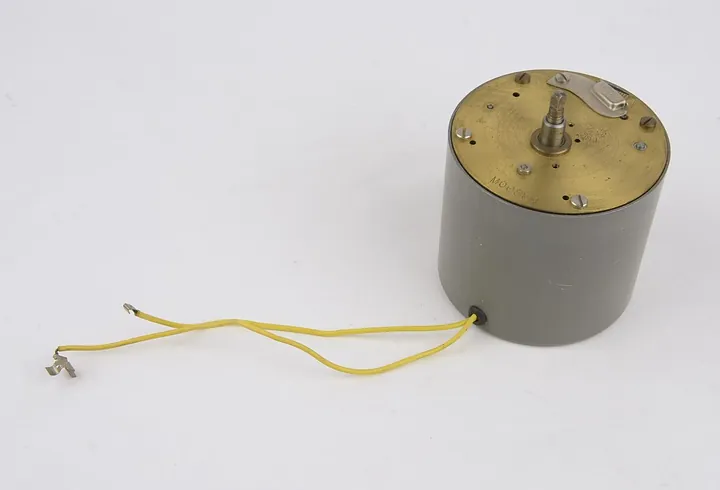
Stopwatch / timer by Horstmann Gear Co. Ltd., England, 1940–1974
Science Museum Group, London
Instruments · 1945–1955 (reproduction of an original of 350–250 BCE)
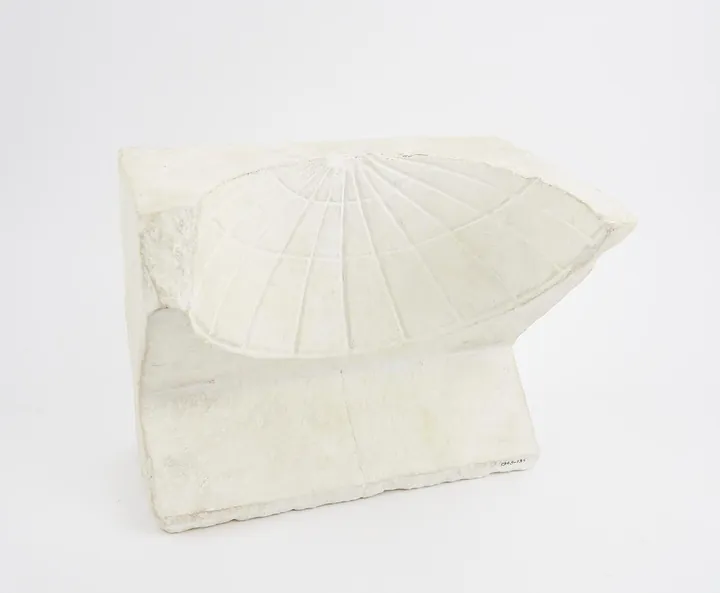
Reproduction sundial by the British Museum, England, 1945–1955, after an original of 350–250 BCE
Science Museum Group, London
Instruments · 1950–1959
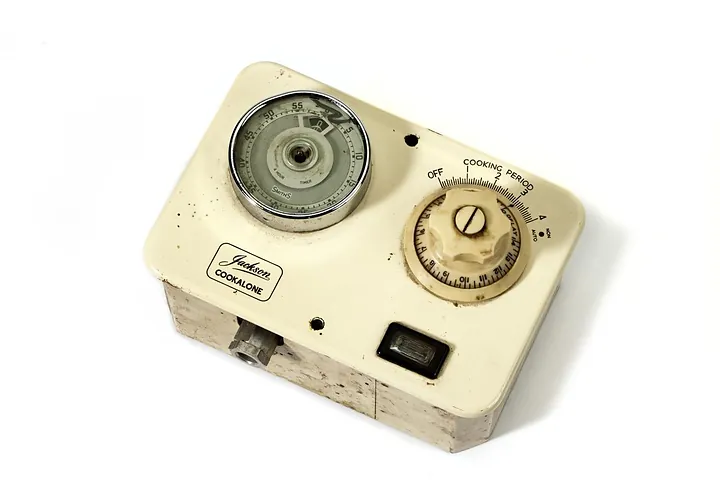
Stopwatch / timer by Jackson Electric Stove Co. Ltd, England, 1950–1959
Science Museum Group, London