
Wristwatches · Wristwatch
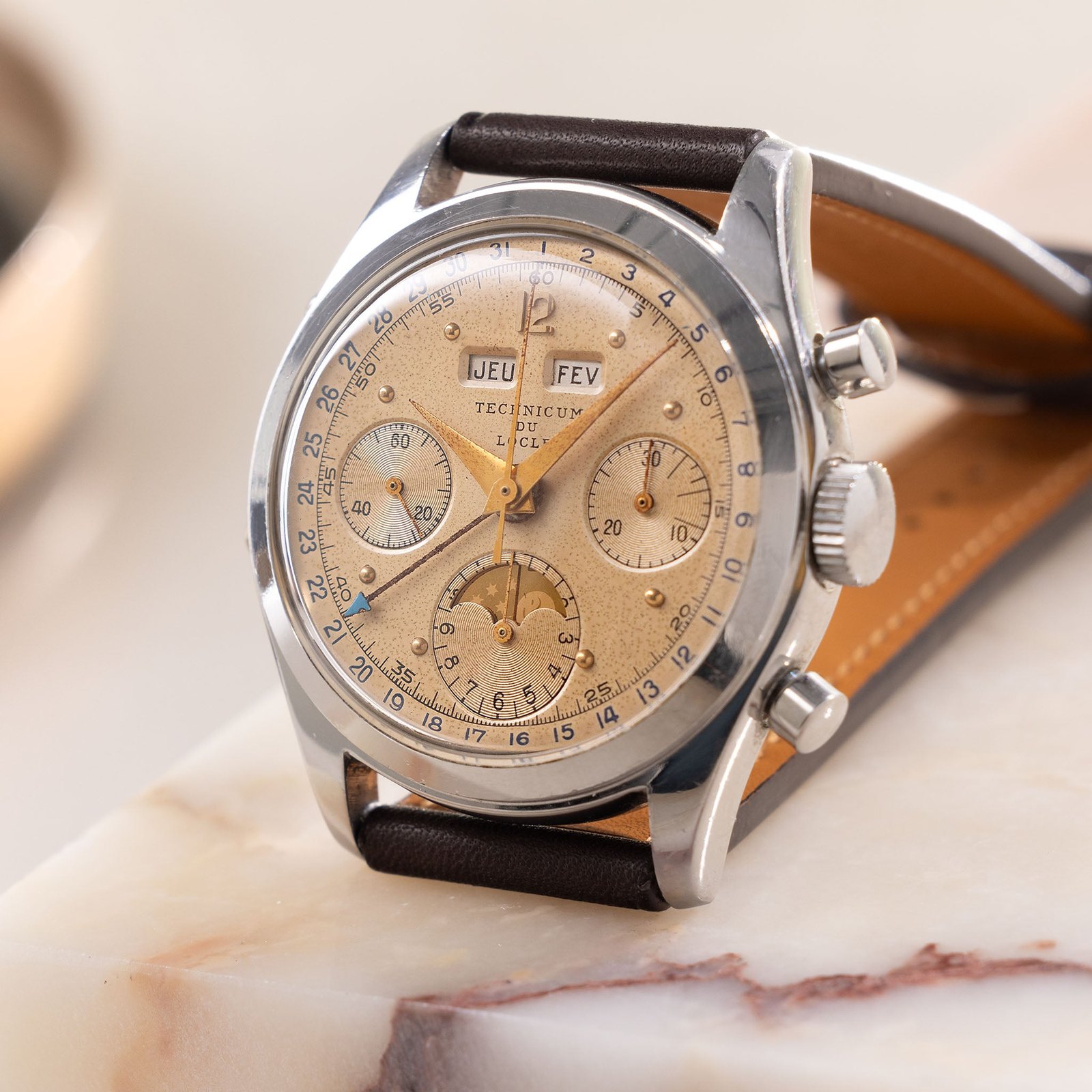
Technicum Le Locle Triple Date Moonphase Chronograph “Datocompax” School Watch, 1960s
- Maker / attribution
- Unrecorded in source
- Date
- 1960s
- Historical period
- Modern Mechanical Horology (1945 – 1969)
- Country of origin
- Switzerland
- Object type
- Wristwatch
- Dimensions
- Case 35 mm
- Stock no.
- w-2950
- Credit line
- Dealer listing, Bulang & Sons (w-2950)
- Catalogue title (original)
- Technicum Le Locle Triple Date Moonphase Chronograph “Datocompax” School Watch (English)
View the source record (dealer listing) ↗ (opens another website in a new tab)Suggest a correction
Record summary
Catalogued by Bulang & Sons (dealer), Copenhagen (stock number w-2950), this is a wristwatch, made in Switzerland, dated 1960s. The Atlas places it in the Modern Mechanical Horology period (1945 – 1969) of its Wristwatches collection. Recorded dimensions: Case 35 mm. The record is illustrated with 6 photographs.
Assembled from the source record's structured fields. Dates and attributions are given as the source states them; where a field is missing the Atlas leaves it blank rather than estimating.
Catalogue description
Dealer description — Bulang & Sons
This moonphase and annual calendar complication chronograph, known as a ‘Dato Compax,’ is a particularly special piece! Referred to as a ‘school watch’ or ‘montre école,’ this watch was created by a watchmaking student as part of their practical dissertation to graduate. Swiss technical colleges, like the Technicum in Le Locle, were established in the late 19th century to meet the demand for formally trained watchmakers, a crucial role in Switzerland’s renowned watchmaking industry. Located near La Chaux-de-Fonds—the birthplace of Swiss horology—Le Locle has a deep-rooted watchmaking tradition dating back to the 1600s. The Technicum D’Horlogerie is well-regarded for producing exceptional timepieces. For their school watches, students were given movements to modify and finish to reflect their skill. Initially, these ‘school movements’ were used for pocket watches, but with the rise of wristwatches, students transitioned to working with base calibers from different manufacturers. This particular example features a steel case with two pushers on the right side and two correctors on the left, a sleek design complemented by a hexagonal screw-down case back. The dial displays apertures for the day and month in the upper half, with three sub-dials for the moonphase and chronograph functions. It includes gold indexes, an applied “12,” a blue scale for the date, and elegant gold Dauphine hands. The student-made adjustments to the Valjoux caliber 88 showcase impressive aesthetic enhancements, including Côtes de Genève and chamfering, making this timepiece even more unique. Paired with a tasteful Bulang & Sons strap, this watch has been fully serviced by our watchmaker. A testament to the history and heritage of Swiss watchmaking, this timepiece is as beautiful as it is storied. Contact us today to make this rare watch yours! Specifications: - Technicum Le Locle “School Watch” - 35mm steel case with hexagonal screw-down case back - Chronograph - Triple Date - Moonphase - Dating to the 1960s - Silver dial with gold indexes and blue date scale; French language date display - Moonphase indicator with brown hue - Hand-finished Valjoux 88 movement - Fully serviced by our watchmaker
Historical context
Modern Mechanical Horology (1945 – 1969)
Tool watches for divers, pilots and astronauts; electric watches anticipate the electronic age.
The classic era of the mechanical wristwatch: dive watches, chronographs for motor racing and space flight, GMT watches for jet travel, slim dress watches, automatic calendars, and the rise of Japanese manufacturers alongside Swiss, American, German and Soviet industries.
Read the period in the timelineMore wristwatches from this periodEarlier: Golden Age of Mechanical Watchmaking
Atlas type guide
Chronographs and split-seconds watches
A chronograph is a watch with an additional seconds hand that can be started, stopped and returned to zero independently of the timekeeping. Louis Moinet built an early example in 1816 and Nicolas Rieussec a recording 'chronographe' in 1821; Adolphe Nicole's heart-shaped reset cam (patented 1862) made the modern return-to-zero possible. Split-seconds (rattrapante) chronographs add a second hand that can be stopped for intermediate times; flyback chronographs restart instantly.
Chronographs were essential tools for doctors (pulsometer scales), artillery (telemeter), engineers and sport. In wristwatches, Valjoux, Venus, Lemania and later the automatic chronographs of 1969 (Zenith El Primero, the Chronomatic Calibre 11 group and Seiko 6139) are milestones.
What to look for
- Push-pieces on the case band or a single button in the crown (monopusher).
- Subsidiary registers for minutes and hours; tachymeter, telemeter or pulsometer scales.
- Column wheel versus cam control visible in the movement.
- Calibre markings of specialist makers (Valjoux, Lemania, Venus, Landeron).
Dating clues
- Pocket chronographs with heart cam reset: after 1862.
- Wrist chronographs: from c. 1910; two-button designs from the 1930s.
- Automatic chronographs: from 1969.
General guidance written by the Atlas editors about this kind of object. It is not a statement about this particular piece; for that, rely on the source record above and on physical examination.
Read next:Flyback chronographChronograph
Related records

Wristwatches · 1945
Wristwatch by Eterna, 1945
Museum Rotterdam

Wristwatches · c. 1945
Breitling Premier, ref. 790, c. 1945
Antiquorum auction archive, Geneva

Wristwatches · c. 1945
Universal Genève Uni-Compax, ref. 22492, c. 1945
Antiquorum auction archive, Geneva

Wristwatches · c. 1950s
Baume & Mercier wristwatch, c. 1950s
Antiquorum auction archive, Geneva
Wristwatches · c. 1950
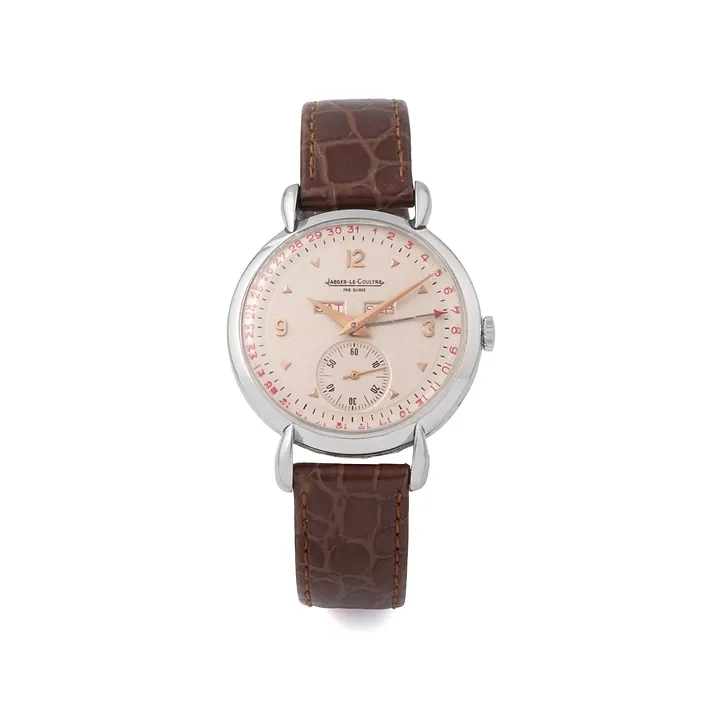
Jaeger Lecoultre Triple Calendar, c. 1950
Antiquorum auction archive, Geneva
Wristwatches · c. 1950
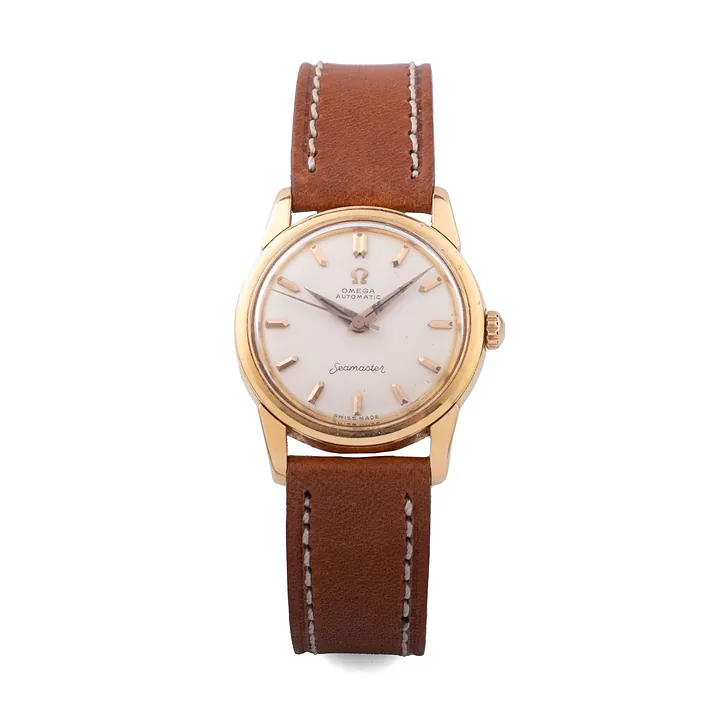
Omega Seamaster Automatic, ref. 2991-1, c. 1950
Antiquorum auction archive, Geneva
Wristwatches · c. 1950s
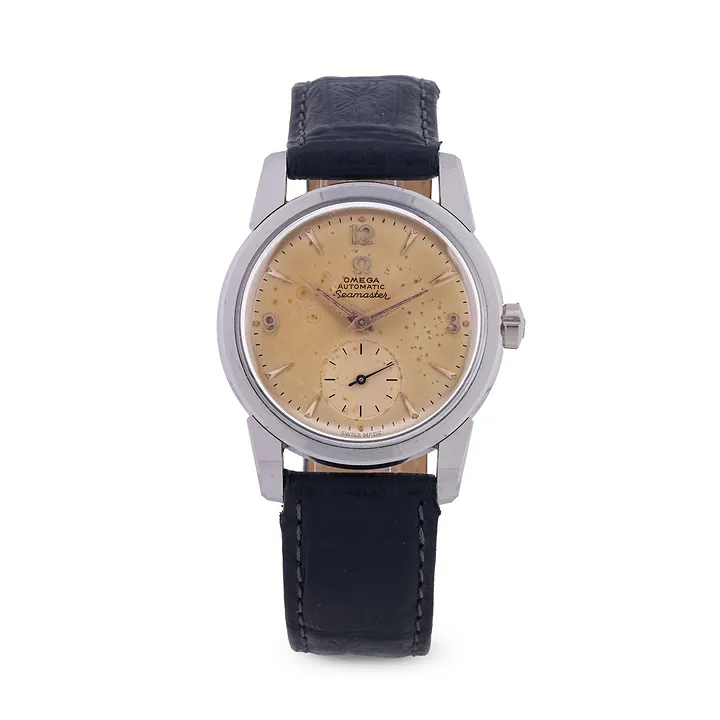
Omega Seamaster, ref. 2848, c. 1950s
Antiquorum auction archive, Geneva
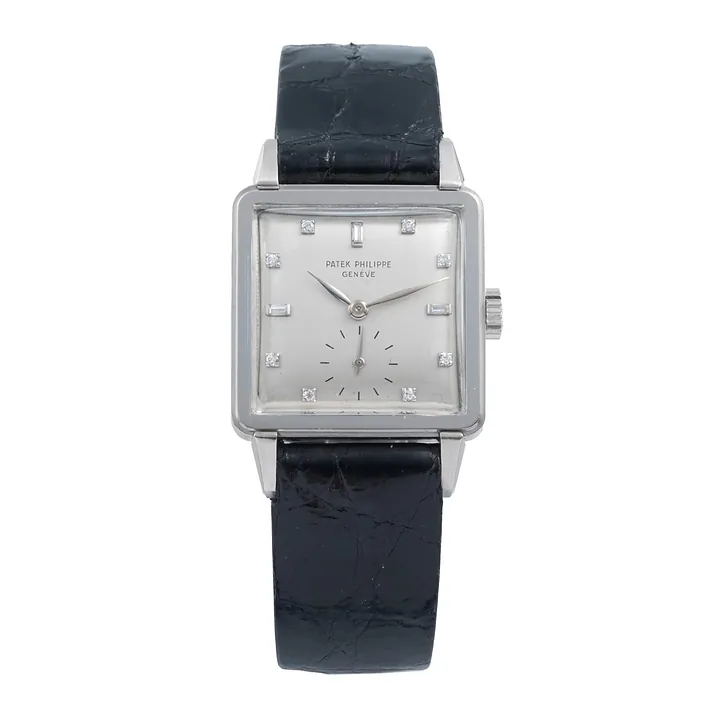
Wristwatches · 1950, sold in May 1951
Patek Philippe wristwatch, ref. 2422, 1950, sold in May 1951
Antiquorum auction archive, Geneva