Clocks · Table clock
Table clock by Paris) Gavelle (Uhrmacherfamilie, France, 1798–1833
- Maker / attribution
- Paris) Gavelle (Uhrmacherfamilie (creator)
- Date
- 1798–1833
- Historical period
- Precision & Scientific Horology (1750 – 1850)
- Country of origin
- France
- Place
- France
- Object type
- Table clock
- Holding institution
- Badisches Landesmuseum Karlsruhe
- Accession / object no.
- item_UUTJVHBA5BANAL7HVN4SKTT3BSOQOCDG
- Catalogue title (original)
- Tischuhr im ägyptisierenden Stil (German)
Record summary
Held and catalogued by Badisches Landesmuseum Karlsruhe (object number item_UUTJVHBA5BANAL7HVN4SKTT3BSOQOCDG), this is a table clock by Paris) Gavelle (Uhrmacherfamilie, made in France, dated 1798–1833. The Atlas places it in the Precision & Scientific Horology period (1750 – 1850) of its Clocks collection. The record is illustrated with 1 photograph.
Assembled from the source record's structured fields. Dates and attributions are given as the source states them; where a field is missing the Atlas leaves it blank rather than estimating.
Catalogue description
Catalogue description from Badisches Landesmuseum Karlsruhe (German)
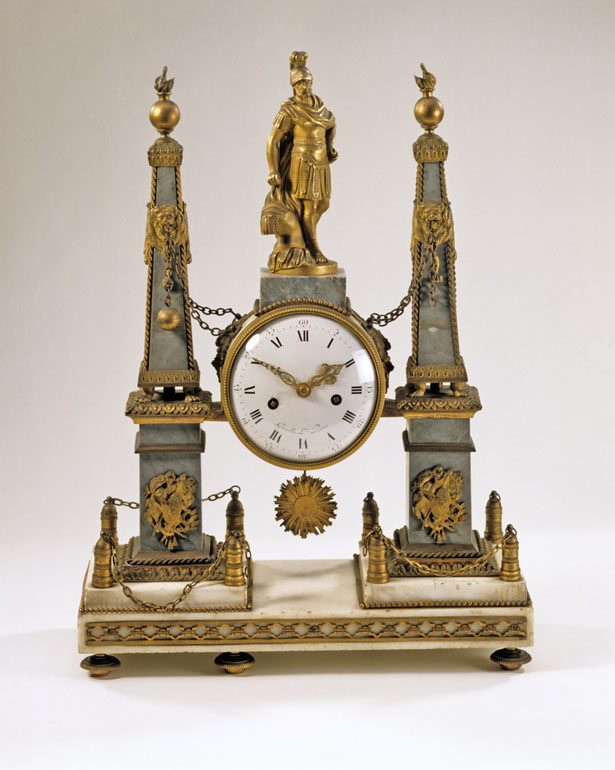
Bei den in Frankreich entwickelten Portaluhren, die ihre Blüte in der 1. Hälfte des 19. Jahrhunderts erlebten, ist typisch, dass das Werkgehäuse ohne Halt zwischen zwei Architekturteilen zu schweben scheint. Bei der vorliegenden Uhr sind dies zwei auf hohen Piedestalen stehende Obelisken aus grauem Marmor. Sie stehen auf einer großen Alabasterplatte und sind von Pfosten und Ketten eingefasst. Auf dem Uhrgehäuse steht eine Figur des römischen Kriegsgottes Mars. Nur sparsam aber sehr effektvoll sind die vergoldeten Bronzebeschläge wie die Randeinfassungen, Trophäen, Kugeln sowie die Uhr und Obelisken verbindende Kettchen. Die denkmalartige Gestaltung der Uhr ist bereits deutlich von der Ägyptenmode des ausgehenden 18. Jahrhunderts geprägt. Besonders nach dem Ägypten-Feldzug Napoleons 1798 rückte das Land und seine Kultur schlagartig in das europäische und vor allem französische Bewusstsein.Die Portaluhr war einst im so genannten Marmorsaal des Karlsruher Schlosse aufgestellt. In einem Inventar von 1833 wird sie wie folgt erwähnt: "1 Pendule mit Pyramiden von grauem Marmor auf beyden oben die Globen mit einer Figur von Bronze Mars vorstellend nebst schwarzem Sockel und Glasglocke". Der schwarze Holzsockel und die Glasglocke sind heute nicht mehr erhalten.
Shown in the original language of the source catalogue. An editor-reviewed English translation has not yet been published; we do not publish machine translations as authoritative text.
Historical context
Precision & Scientific Horology (1750 – 1850)
Harrison solves longitude; Mudge invents the lever; Breguet's Paris workshop defines the modern watch.
The age of the deadbeat escapement, compensated pendulums and observatory regulators. Domestic clocks spread through the middle classes: English longcase and bracket clocks, French gilt-bronze mantel clocks, Viennese Biedermeier wall clocks, Black Forest painted-shield clocks, and the first American shelf clocks.
Read the period in the timelineMore clocks from this periodEarlier: Early Modern Horology
Atlas type guide
Bracket, table and spring-driven clocks
Spring-driven clocks freed timekeeping from the hanging weight. The coiled mainspring, documented from the fifteenth century, made portable table clocks possible; to even out its declining force, makers used the fusee, a conical pulley connected to the barrel by a gut line or chain. Renaissance table clocks from Augsburg and Nuremberg — drum-shaped, square or tower-shaped in gilt brass — were luxury scientific objects, often with astronomical dials and alarms.
After the pendulum, English makers developed the bracket clock: a wooden case with a carrying handle, a short pendulum with a verge escapement, and often repeating work to sound the hours on demand at night. Later examples use the anchor escapement. In the nineteenth century, 'table clock' became a broad term for spring clocks of every nationality.
What to look for
- A fusee in the movement (cone-shaped pulley) and the type of line — gut or chain.
- Verge escapement with a short bob pendulum, often with a decoratively engraved backplate.
- Repeat cords or buttons that make the clock strike again on demand.
- Gilt-brass engraved cases and horizontal dials on Renaissance pieces.
- Case shapes: inverted bell, bell top, break-arch, lancet or balloon.
Dating clues
- Drum and tower table clocks: c. 1520–1650.
- Ebony veneered English bracket clocks with verge escapements: c. 1670–1800.
- Engraved backplates were usual on English clocks until c. 1800, then generally plain.
General guidance written by the Atlas editors about this kind of object. It is not a statement about this particular piece; for that, rely on the source record above and on physical examination.
Related records
Clocks · 1723–1811
Table clock by Louis Montjoye, France, 1723–1811
Badisches Landesmuseum Karlsruhe
Clocks · 1738–1814
Table clock by Jean Simon Bourdier, France, 1738–1814
Badisches Landesmuseum Karlsruhe
Clocks · 1750-1800
Bracket clock in metal case with scroll handles and flamed-shaped top signed by Pierre Seignoret, Clockmaket to the the Comte d'Artois
Victoria and Albert Museum, London
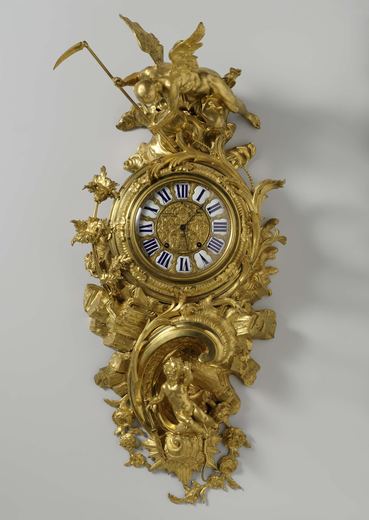
Clocks · 1756
Mantel clock, France, 1756
Rijksmuseum
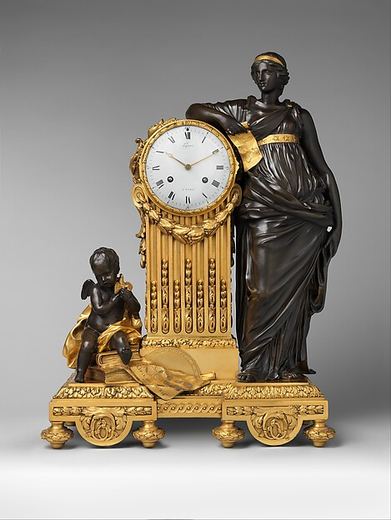
Clocks · ca. 1764–70
Mantel clock by Jean-André Lepaute, France, ca. 1764–70
The Metropolitan Museum of Art, New York
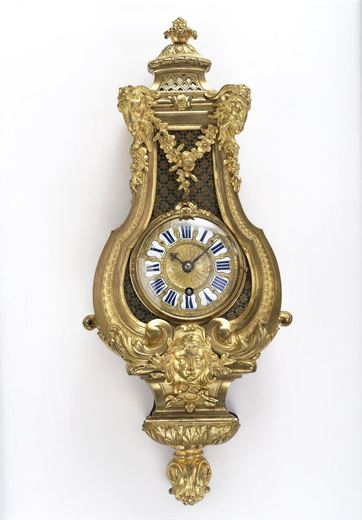
Clocks · 1760–1860
'Pendule d'alcove' wall clock, gilt-bronze and boulle marquetry, Paris, 1760-1860
Victoria and Albert Museum, London
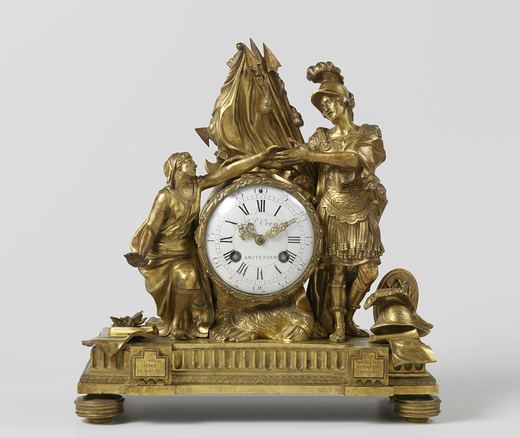
Clocks · 1760
Mantel clock, France, 1760
Rijksmuseum
Clocks · ca. 1768–70
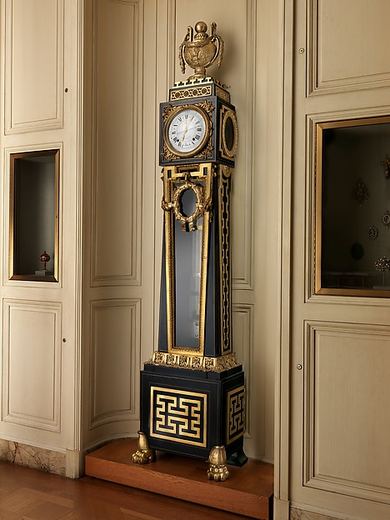
Longcase astronomical regulator by Ferdinand Berthoud, France, ca. 1768–70
The Metropolitan Museum of Art, New York