
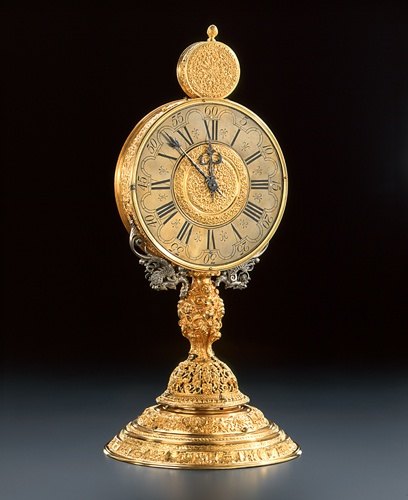
Instruments · Table clock
Table clock by Caspar Rauber (Schmied), Germany, 1572
- Maker / attribution
- Caspar Rauber (Schmied) (Created)
- Date
- 1572
- Historical period
- Renaissance Horology (1400 – 1600)
- Country of origin
- Germany
- Place
- Augsburg
- Object type
- Table clock
- Materials / technique
- Gehäuse: vergoldete Bronze mit silbernen Zierstücken; Werk: Eisen
- Dimensions
- H. 53 cm, D. der Scheibe 21 cm
- Holding institution
- Landesmuseum Württemberg
- Accession / object no.
- WLM 1968-425
- Credit line
- Landesmuseum Württemberg
- Catalogue title (original)
- Tischuhr, sog. Monstranzuhr (German)
View the source record ↗ (opens another website in a new tab)Suggest a correction
Record summary
Held and catalogued by Landesmuseum Württemberg (object number WLM 1968-425), this is a table clock by Caspar Rauber (Schmied), made in Augsburg, Germany, dated 1572. The Atlas places it in the Renaissance Horology period (1400 – 1600) of its Instruments collection. Materials and techniques recorded by the source: Gehäuse: vergoldete Bronze mit silbernen Zierstücken; Werk: Eisen. Recorded dimensions: H. 53 cm, D. der Scheibe 21 cm. The record is illustrated with 1 photograph.
Assembled from the source record's structured fields. Dates and attributions are given as the source states them; where a field is missing the Atlas leaves it blank rather than estimating.
Catalogue description
Catalogue description from Landesmuseum Württemberg (German)
Die Form dieser Tischuhr erinnert an eine Monstranz, also ein Schaubehältnis für das geweihte Brot, die Hostie. Für Renaissanceuhren waren originelle Gehäuse, wie Bücher, Gefäße, Statuen oder Dosen nicht unüblich. Das Gehäuse dieser Uhr besteht aus einem hohen Fuß, einem dosenförmigen Aufsatz, in dem die eigentliche Uhr sitzt, und einer weiteren runden Dose, die als Glockenhaus dient. An dem nicht mehr originalen Hauptzifferblatt der Vorderseite lassen sich innen die Stunden (I-XII) und außen die Minuten ablesen. Auf dem abnehmbaren Rückendeckel befinden sich zwei Sonnenuhren: außen eine besondere Form der Vertikalsonnenuhr, das sog. Organum Ptolemei, innen eine Horizontalsonnenuhr. Da die Ganggenauigkeit der Räderuhren noch zu wünschen ließen, waren Sonnenuhren ein wichtiges Hilfsmittel zur Korrektur der angezeigten Zeit. Da man für die meisten erhaltenen Monstranzuhren Augsburg als Herstellungsort annimmt, ist als Auflösung für die dreimal in das Werk eingebrachte Marke CR der Augsburger Meister Caspar Rauber wahrscheinlich.
Shown in the original language of the source catalogue. An editor-reviewed English translation has not yet been published; we do not publish machine translations as authoritative text.
Provenance
Literature: Württembergisches Landesmuseum, Schaller, Andrea: Prunkuhren der Renaissance (2001)
Historical context
Renaissance Horology (1400 – 1600)
Spring power makes clocks portable; Nuremberg and Augsburg produce the first watches; the Prague Orloj is built.
Instrument-making flourished in Nuremberg, Augsburg, Louvain and London: ivory diptych dials, astronomical compendia, astrolabes and nocturnals for wealthy patrons, navigators and scholars.
Read the period in the timelineMore instruments from this periodEarlier: Medieval Period
Atlas type guide
Scientific and navigational instruments
Timekeeping has always been tied to astronomy, navigation and measurement. Observatories used transit instruments to determine the exact moment a star crossed the meridian, and set their regulators by it; navigators combined sextant observations with chronometers to find longitude; surveyors, engineers and physicians used counters, pedometers and timers derived from watch and clock technology.
Instruments in this collection show how time measurement supported science and everyday technical life. Their makers were often the same workshops that produced clocks and watches, and their scales and dials document changing units and standards.
What to look for
- Engraved scales and verniers; the units used (degrees, hours, decimal divisions).
- Makers' signatures and town names, often on the main plate or limb.
- Accessories and fitted cases that indicate the intended use.
- Inventory or institutional marks from observatories, navies or schools.
Dating clues
- Vernier scales spread after the seventeenth century; dividing engines after Ramsden (1770s) made fine scales common.
- Mass-produced instruments with patent numbers belong mostly to the nineteenth and twentieth centuries.
General guidance written by the Atlas editors about this kind of object. It is not a statement about this particular piece; for that, rely on the source record above and on physical examination.
Related records
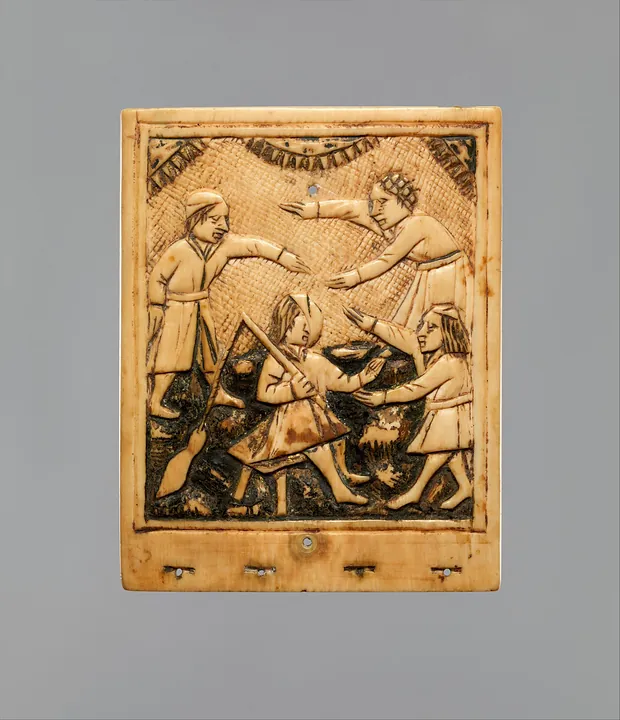
Instruments · c. 1500
Sundial, Germany, c. 1500
The Metropolitan Museum of Art, New York
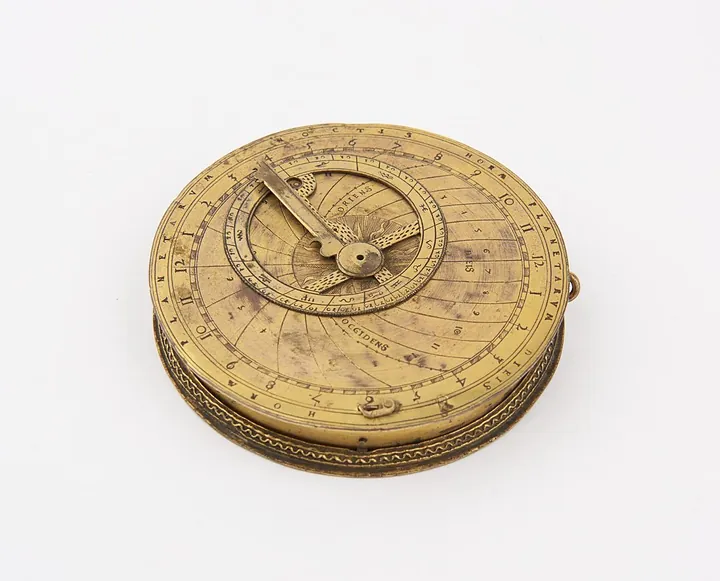
Instruments · 1501–1600
Circular sundial, copper gilt and engraved, German, 16th century (no compass needle on cover glass)
Science Museum Group, London
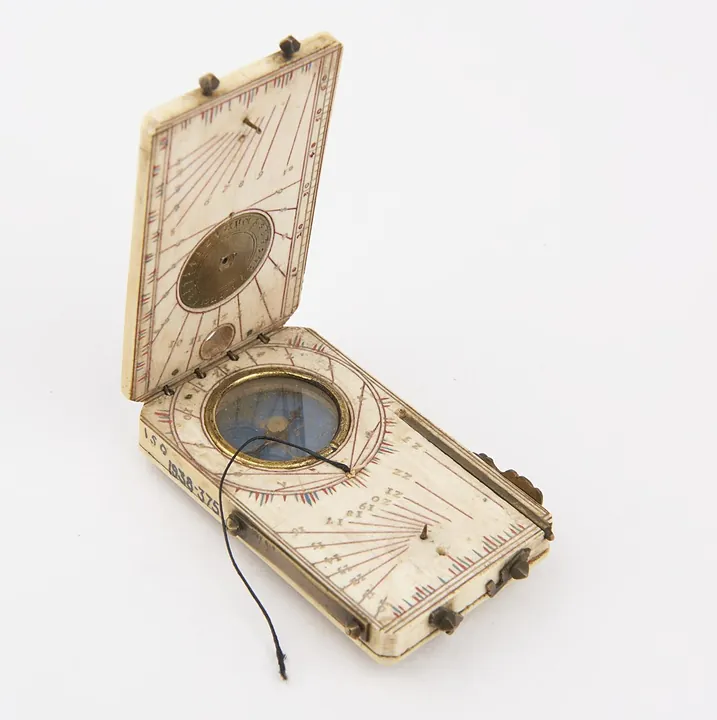
Instruments · 1501–1600
Tablet sundial, ivory, 3" x 1 3/4", German, 16th century
Science Museum Group, London
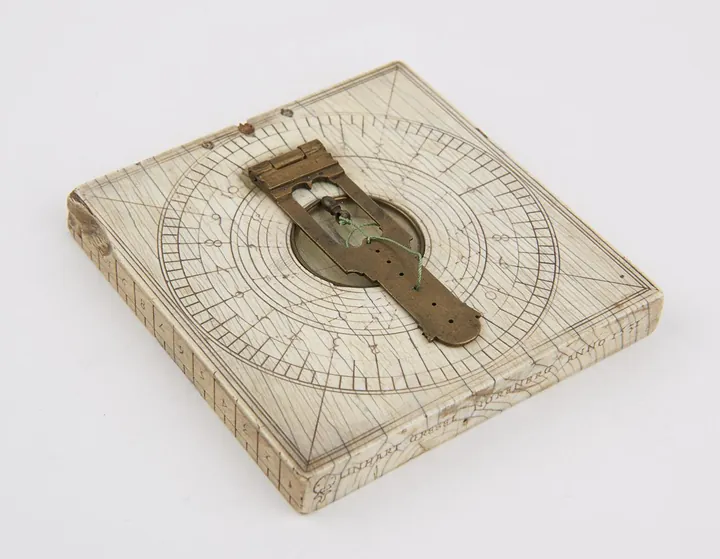
Instruments · 1531
Sundial with compass, in an engraved block of ivory by Gresel, German dated 1531
Science Museum Group, London
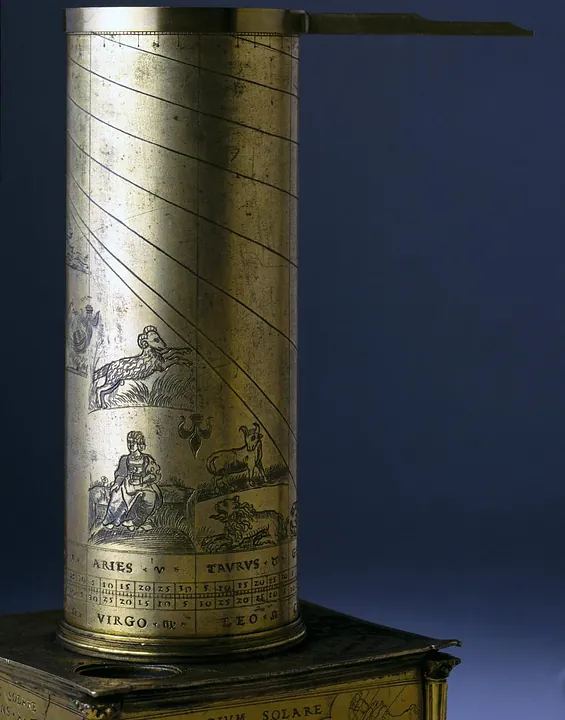
Instruments · 1531–1570
Sundial, Germany, 1531–1570
Science Museum Group, London
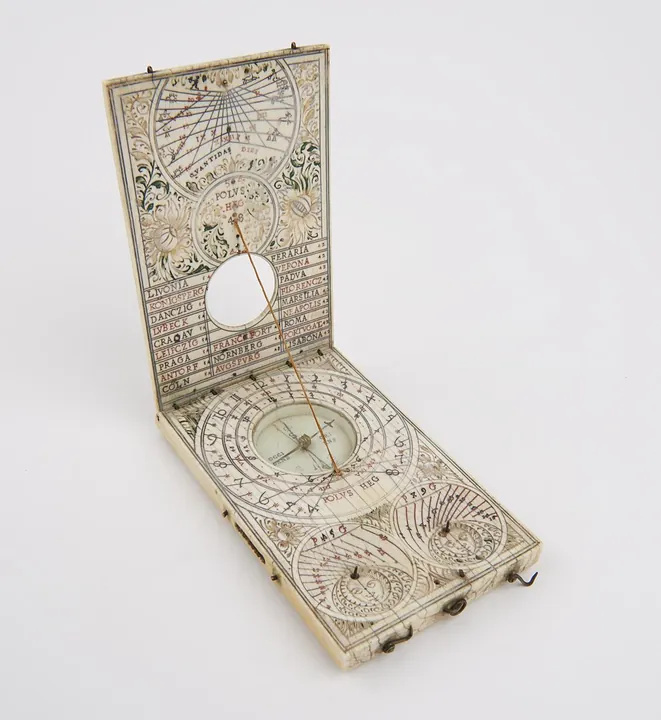
Instruments · 1537–1632
Tablet Sundial, ivory, engraved and coloured, 4 3/4"x3" (chipped)
Science Museum Group, London
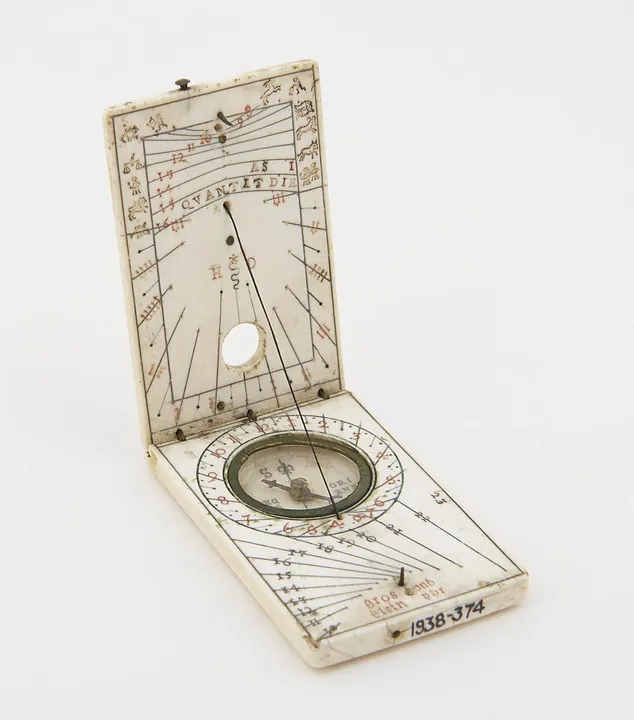
Instruments · 1537–1632
Tablet sundial of ivory, 3 x 1 7/8-inches, by Hans Ducher, Nuremberg, Germany, 1537–1632 (see note).
Science Museum Group, London
Instruments · 1543
Nocturnal with quadrant at back gilt metal diam 5 3/16in (11-1879 vram req) engraved " Caspar Vopel mathema faciebat coloniae 1543", Germany, 1543
Science Museum Group, London