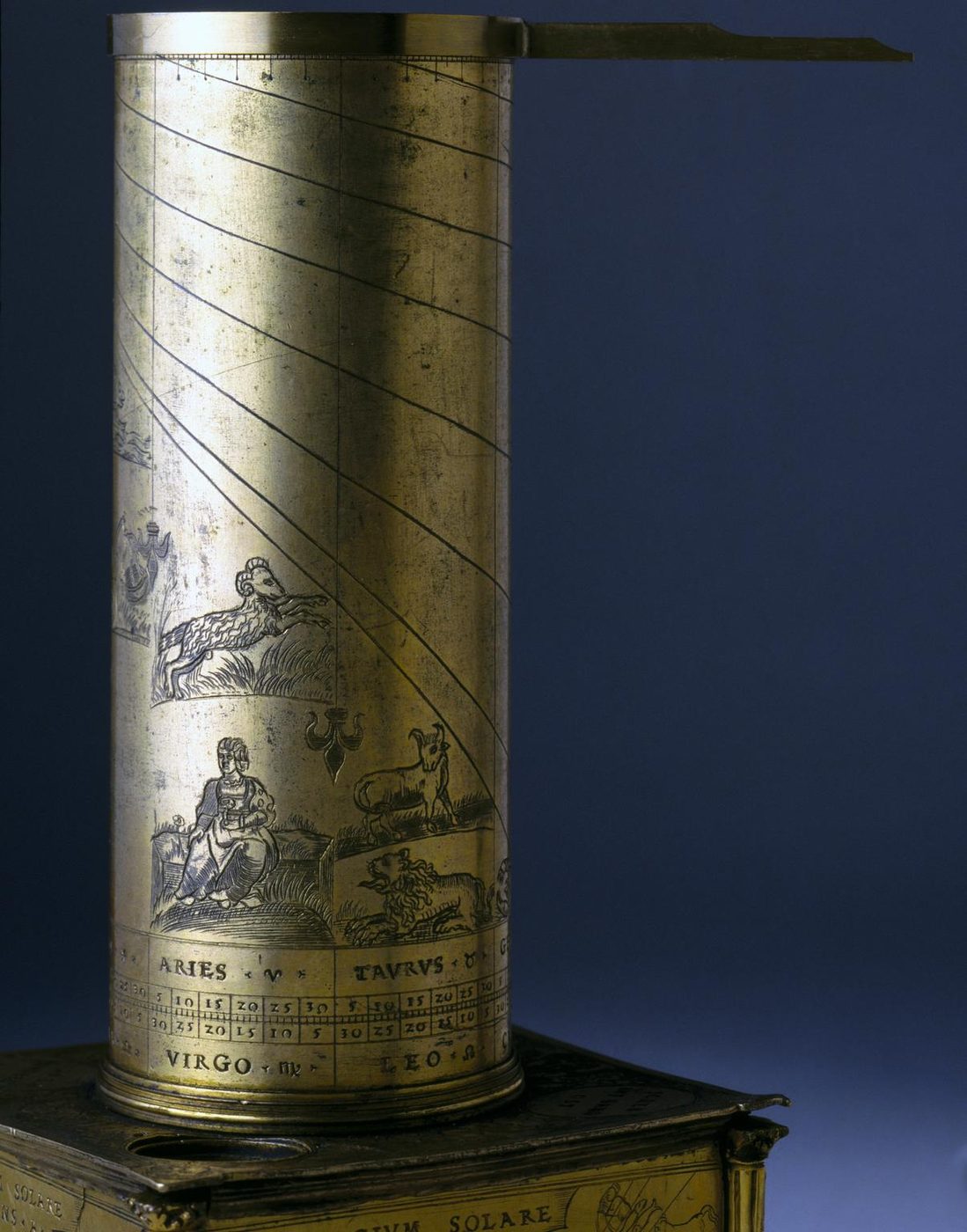
Instruments · Sundial
Sundial, Germany, 1531-1570
- Maker / attribution
- Unrecorded in source
- Date
- 1531-1570
- Historical period
- Renaissance Horology (1400 – 1600)
- Country of origin
- Germany
- Place
- Augsburg, Schwaben, Bavaria, Germany, Augsburg
- Object type
- Sundial
- Dimensions
- overall: 226 mm x 138 mm x 110 mm,
- Holding institution
- Science Museum Group, London
- Accession / object no.
- 1883-124
- Credit line
- Victoria and Albert Museum
- Catalogue title (original)
- Column Sundial in Gilt Bronze, 1531-1570
Record summary
Held and catalogued by Science Museum Group, London (object number 1883-124), this is a sundial, made in Augsburg, Schwaben, Bavaria, Germany, Augsburg, dated 1531-1570. The Atlas places it in the Renaissance Horology period (1400 – 1600) of its Instruments collection. Recorded dimensions: overall: 226 mm x 138 mm x 110 mm. The record is illustrated with 2 photographs.
Assembled from the source record's structured fields. Dates and attributions are given as the source states them; where a field is missing the Atlas leaves it blank rather than estimating.
Catalogue description
The source record does not include a narrative description. The structured fields above are reproduced from it.
Historical context
Renaissance Horology (1400 – 1600)
Spring power makes clocks portable; Nuremberg and Augsburg produce the first watches; the Prague Orloj is built.
Instrument-making flourished in Nuremberg, Augsburg, Louvain and London: ivory diptych dials, astronomical compendia, astrolabes and nocturnals for wealthy patrons, navigators and scholars.
Read the period in the timelineMore instruments from this periodEarlier: Medieval Period
Atlas type guide
Sundials and solar time-finders
A sundial tells time from the position of a shadow cast by a gnomon or style. Because the sun's apparent motion depends on latitude, every fixed dial is laid out for a particular latitude, and portable dials either carry a latitude scale or are made for one region. Sundials show local apparent solar time, which drifts against mean (clock) time by up to about sixteen minutes over the year — the equation of time.
Portable dials were the pocket instruments of the sixteenth to eighteenth centuries. Nuremberg and Augsburg workshops produced folding ivory diptych dials with inset compasses; English and French makers sold brass horizontal dials, ring dials and the Butterfield type; Japanese and Chinese makers had their own traditions of compass dials. After mechanical watches became reliable, dials remained in use for setting them, and nineteenth-century heliochronometers were built to correct directly for the equation of time.
What to look for
- The latitude engraved on the dial plate or a latitude arc on the gnomon — it shows where the dial was meant to be used.
- The type of hour lines: equal (equinoctial) hours, Italian or Babylonian hours counted from sunset or sunrise, or unequal temporal hours on early and Islamic instruments.
- An inset magnetic compass and whether a magnetic-declination mark is drawn on its card — a useful dating clue because declination changes over time.
- Maker's signatures and town marks: Nuremberg compass-makers (Kompassmacher) often struck a personal mark and the town's punch.
- Additional scales such as lunar volvelles, wind roses, perpetual calendars or lists of cities with their latitudes.
Dating clues
- Ivory diptych dials are characteristic of Nuremberg between about 1500 and 1700.
- Butterfield-type dials with a bird-shaped adjustable gnomon point to Paris workshops from the late seventeenth century onward.
- Equation-of-time tables engraved on the plate became common after the mid-seventeenth century, once pendulum clocks made the difference between solar and mean time obvious.
General guidance written by the Atlas editors about this kind of object. It is not a statement about this particular piece; for that, rely on the source record above and on physical examination.
Read next:The history timeline
Related records
Instruments · 1462
Astrolabe by Regiomontanus, Germany, 1462
The Metropolitan Museum of Art, New York
Instruments · ca. 1500
Sundial, Germany, ca. 1500
The Metropolitan Museum of Art, New York
Instruments · 1501-1600
Circular sundial, copper gilt and engraved, German, 16th century (no compass needle on cover glass)
Science Museum Group, London
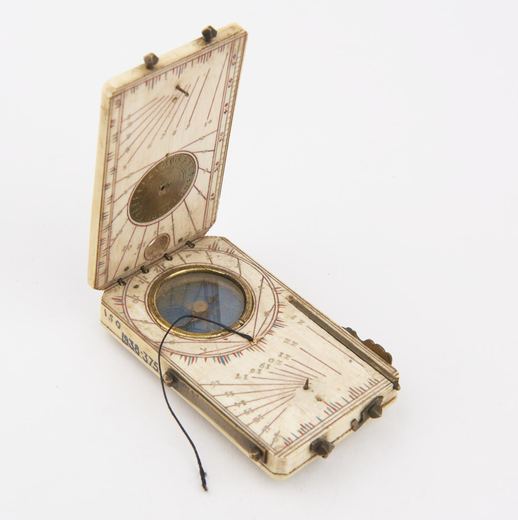
Instruments · 1501-1600
Tablet sundial, ivory, 3" x 1 3/4", German, 16th century
Science Museum Group, London
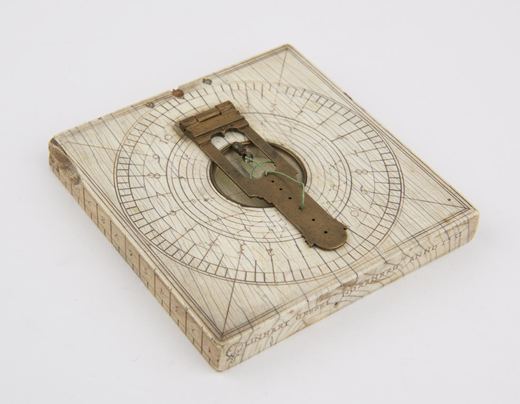
Instruments · 1531
Sundial with compass, in an engraved block of ivory by Gresel, German dated 1531
Science Museum Group, London
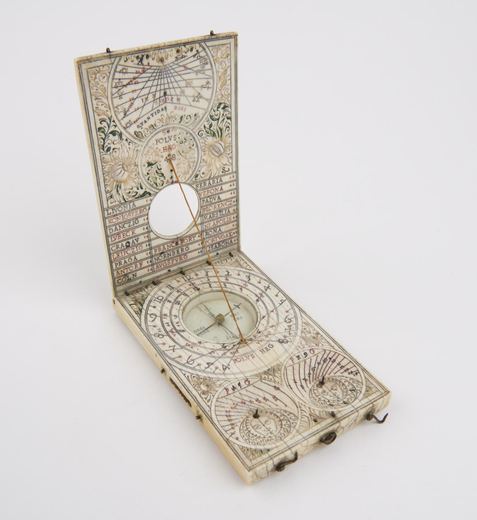
Instruments · 1537-1632
Tablet Sundial, ivory, engraved and coloured, 4 3/4"x3" (chipped)
Science Museum Group, London
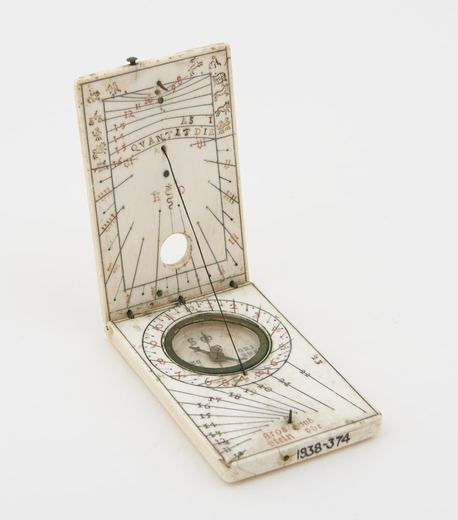
Instruments · 1537-1632
Tablet sundial of ivory, 3 x 1 7/8-inches, by Hans Ducher, Nuremberg, Germany, 1537-1632 (see note).
Science Museum Group, London
Instruments · 1543
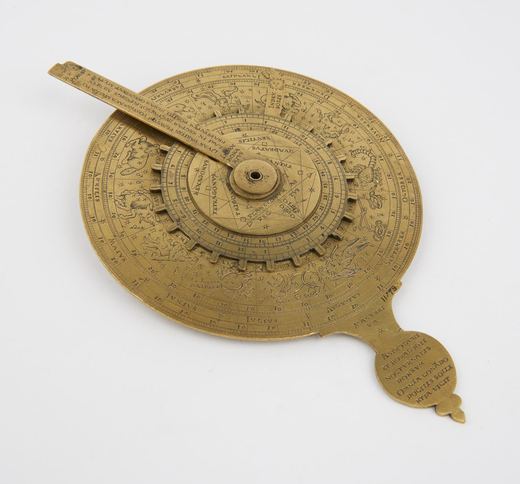
Nocturnal with quadrant at back gilt metal diam 5 3/16in (11-1879 vram req) engraved " Caspar Vopel mathema faciebat coloniae 1543", Germany, 1543
Science Museum Group, London