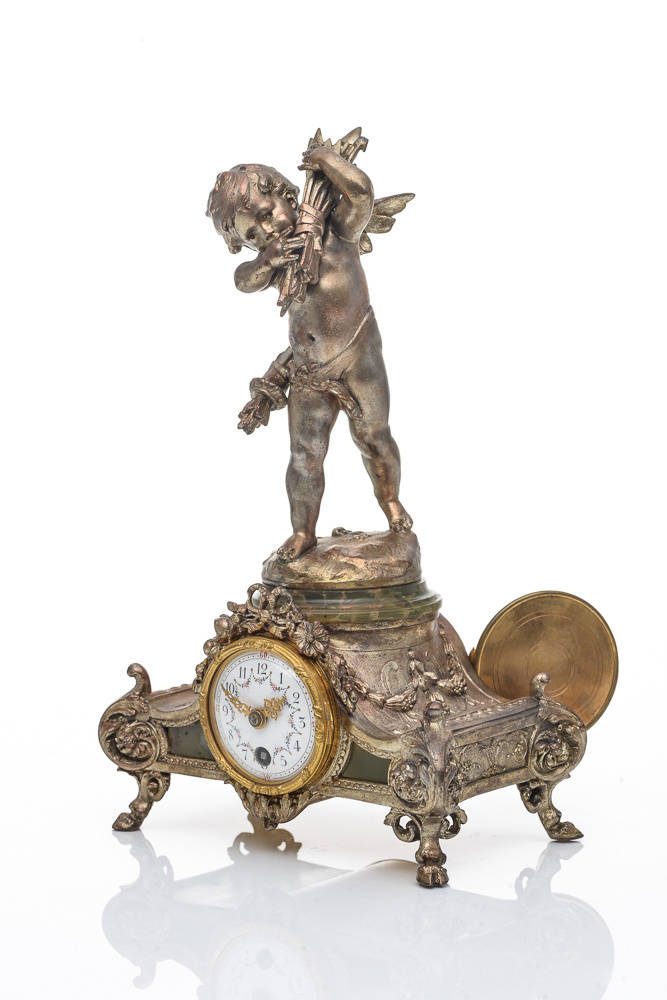
Clocks · Table clock
Table clock by Auguste (1826-1897) (Bildhauer) Moreau, Germany, 1800–1899
- Maker / attribution
- Auguste (1826-1897) (Bildhauer) Moreau (creator)
- Date
- 1800–1899
- Historical period
- Precision & Scientific Horology (1750 – 1850)
- Country of origin
- Germany
- Place
- Berlin
- Object type
- Table clock
- Holding institution
- City Museum Berlin
- Accession / object no.
- item_32SK4TG2XXHX3JBEWTC67HZTIDVFKCGZ
- Catalogue title (original)
- Kleine Tischuhr "Amor" signiert Aug. Moreau (German)
Record summary
Held and catalogued by City Museum Berlin (object number item_32SK4TG2XXHX3JBEWTC67HZTIDVFKCGZ), this is a table clock by Auguste (1826-1897) (Bildhauer) Moreau, made in Berlin, Germany, dated 1800–1899. The Atlas places it in the Precision & Scientific Horology period (1750 – 1850) of its Clocks collection. The record is illustrated with 1 photograph.
Assembled from the source record's structured fields. Dates and attributions are given as the source states them; where a field is missing the Atlas leaves it blank rather than estimating.
Catalogue description
The source record does not include a narrative description. The structured fields above are reproduced from it.
Historical context
Precision & Scientific Horology (1750 – 1850)
Harrison solves longitude; Mudge invents the lever; Breguet's Paris workshop defines the modern watch.
The age of the deadbeat escapement, compensated pendulums and observatory regulators. Domestic clocks spread through the middle classes: English longcase and bracket clocks, French gilt-bronze mantel clocks, Viennese Biedermeier wall clocks, Black Forest painted-shield clocks, and the first American shelf clocks.
Read the period in the timelineMore clocks from this periodEarlier: Early Modern Horology
Atlas type guide
Bracket, table and spring-driven clocks
Spring-driven clocks freed timekeeping from the hanging weight. The coiled mainspring, documented from the fifteenth century, made portable table clocks possible; to even out its declining force, makers used the fusee, a conical pulley connected to the barrel by a gut line or chain. Renaissance table clocks from Augsburg and Nuremberg — drum-shaped, square or tower-shaped in gilt brass — were luxury scientific objects, often with astronomical dials and alarms.
After the pendulum, English makers developed the bracket clock: a wooden case with a carrying handle, a short pendulum with a verge escapement, and often repeating work to sound the hours on demand at night. Later examples use the anchor escapement. In the nineteenth century, 'table clock' became a broad term for spring clocks of every nationality.
What to look for
- A fusee in the movement (cone-shaped pulley) and the type of line — gut or chain.
- Verge escapement with a short bob pendulum, often with a decoratively engraved backplate.
- Repeat cords or buttons that make the clock strike again on demand.
- Gilt-brass engraved cases and horizontal dials on Renaissance pieces.
- Case shapes: inverted bell, bell top, break-arch, lancet or balloon.
Dating clues
- Drum and tower table clocks: c. 1520–1650.
- Ebony veneered English bracket clocks with verge escapements: c. 1670–1800.
- Engraved backplates were usual on English clocks until c. 1800, then generally plain.
General guidance written by the Atlas editors about this kind of object. It is not a statement about this particular piece; for that, rely on the source record above and on physical examination.
Related records
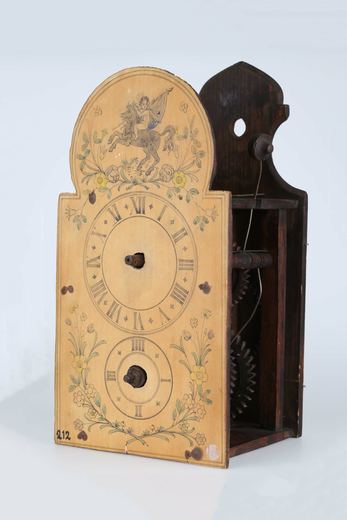
Clocks · 1750
Clock by Georg Gfell, Germany, 1750
German Clock Museum
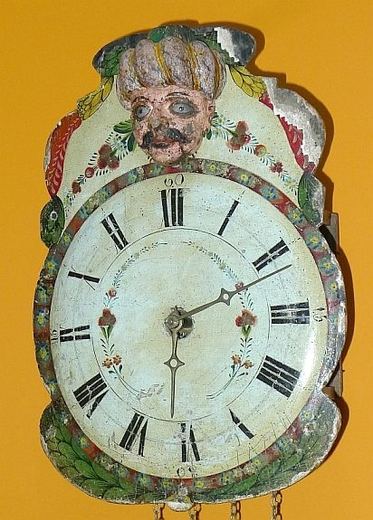
Clocks · 1750–1799
Cuckoo / black forest clock, Germany, 1750–1799
Badisches Landesmuseum Karlsruhe
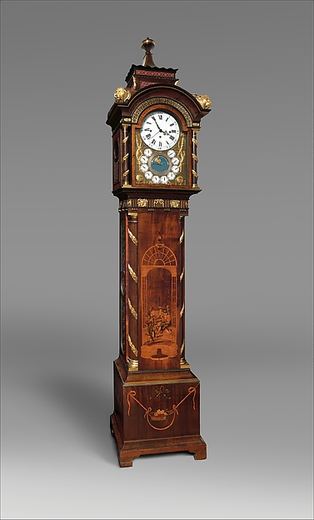
Clocks · ca. 1774–75
Longcase clock by Hermann Achenbach, Germany, ca. 1774–75
The Metropolitan Museum of Art, New York
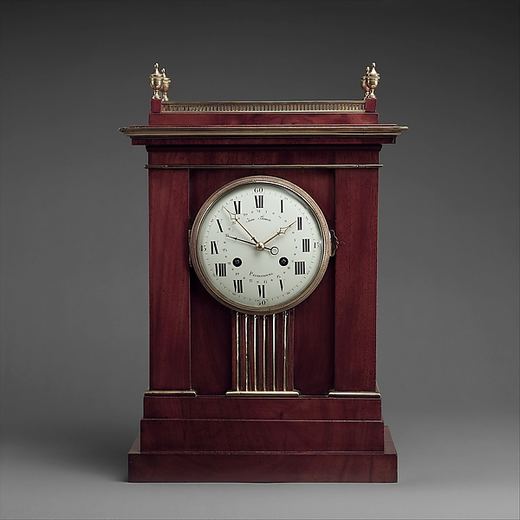
Clocks · ca. 1780–90
Clock by Workshop of David Roentgen, Germany, ca. 1780–90
The Metropolitan Museum of Art, New York
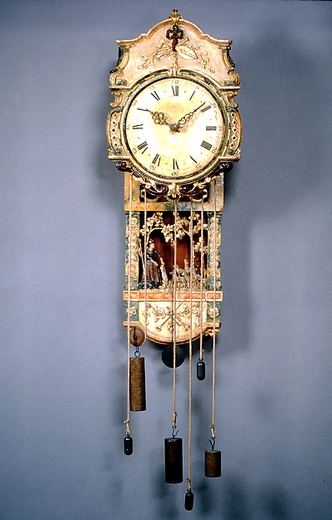
Clocks · ca. 1800
Musical clock by Martin Vanlo?, Germany, ca. 1800
The Metropolitan Museum of Art, New York
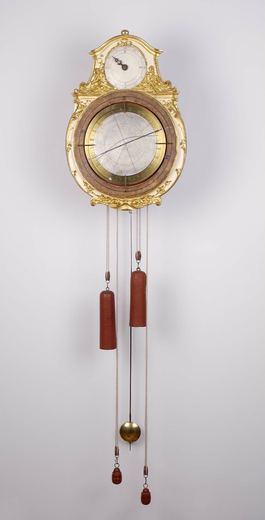
Clocks · 1787
Astronomical clock, Germany, 1787
German Clock Museum
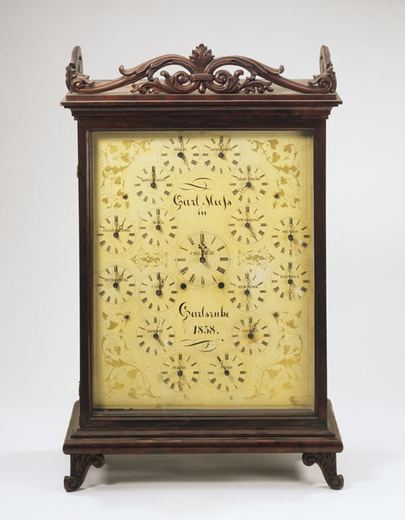
Clocks · 1800–1899
Clock by Carl Meeß, Germany, 1800–1899
Badisches Landesmuseum Karlsruhe
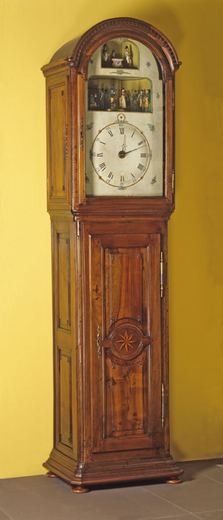
Clocks · 1800–1899
Clock by Ignaz Bruder, Germany, 1800–1899
Badisches Landesmuseum Karlsruhe