Clocks · German table clock
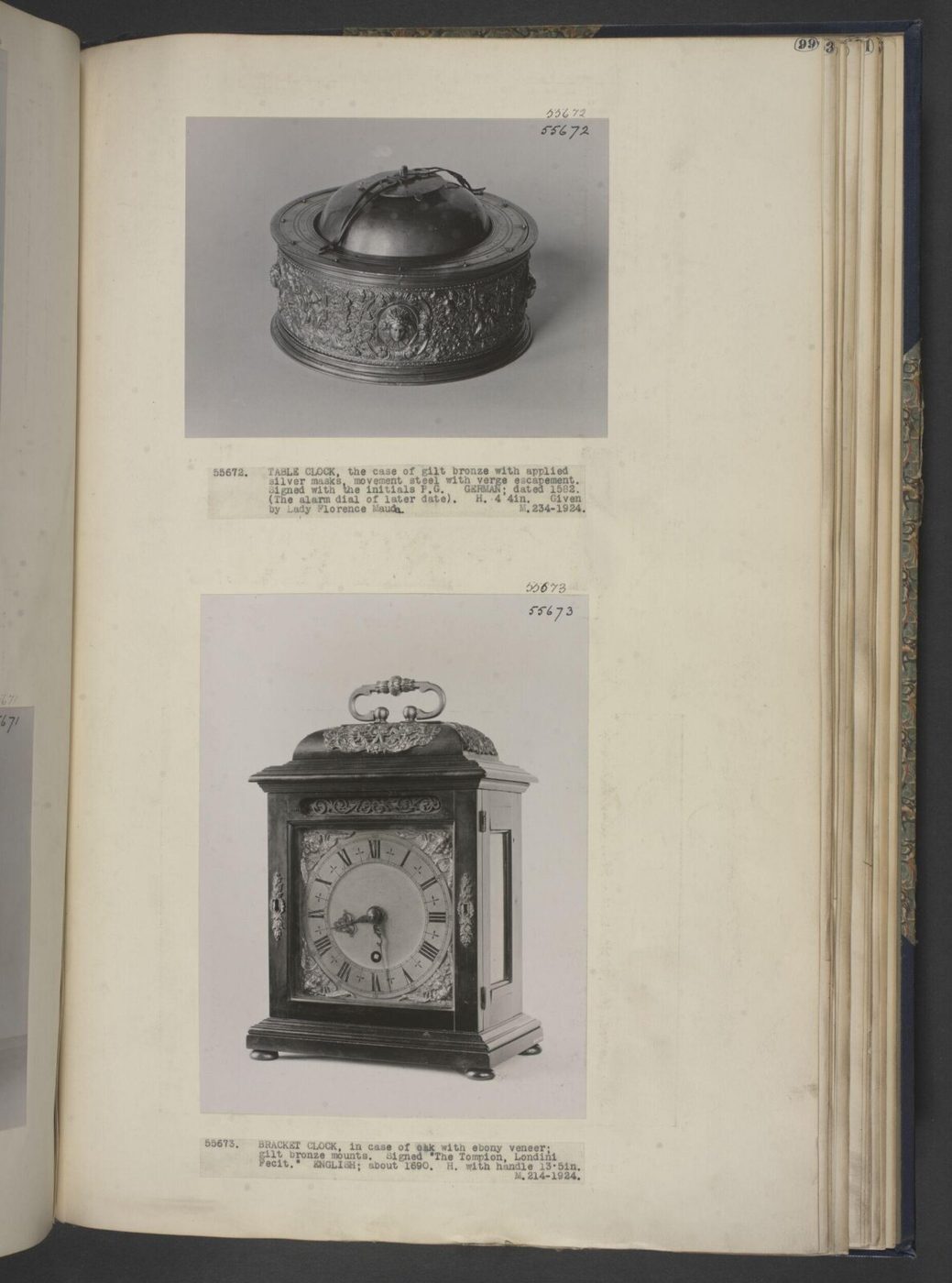
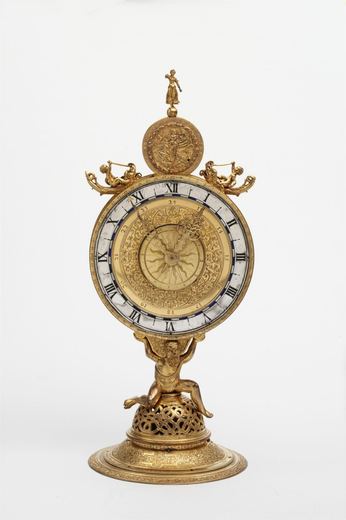
Table clock and dial. Germany, 1582.
- Maker / attribution
- P G (maker)
- Date
- 1582
- Historical period
- Renaissance Horology (1400 – 1600)
- Country of origin
- Germany
- Place
- Germany
- Object type
- German table clock
- Materials / technique
- Gilded brass and silver, the movement of iron, cast, chased and engraved
- Dimensions
- diameter: 15.6 cm; Diameter: 16.8 cm; Height: 7.3 cm
- Holding institution
- Victoria and Albert Museum, London
- Accession / object no.
- M.234:1, 2-1924
Record summary
Held and catalogued by Victoria and Albert Museum, London (object number M.234:1, 2-1924), this is a german table clock by P G, made in Germany, dated 1582. The Atlas places it in the Renaissance Horology period (1400 – 1600) of its Clocks collection. Materials and techniques recorded by the source: Gilded brass and silver, the movement of iron, cast, chased and engraved. Recorded dimensions: diameter: 15.6 cm; Diameter: 16.8 cm; Height: 7.3 cm. The record is illustrated with 4 photographs.
Assembled from the source record's structured fields. Dates and attributions are given as the source states them; where a field is missing the Atlas leaves it blank rather than estimating.
Catalogue description
V&A — Physical description
Case: Case of gilt bronze, with applied silver masks in strong relief. The side of the case is decorated with a repeating pattern of a seated figure and grotesques. Dial: Dial in the form of a brass ring 15.6 cm diameter 1.9 cm broad, the outer ring with touch pins hours I to XII in Roman; the inner ring 13 to 24 in arabic with Germanic Z’s. The half-hours marked by stars in each ring, and there is a narrow ring between the two hour rings lightly engraved with quarters. The bell protrudes 2.5 cm above the dial, and above it is a brass alarm disc 5.1 cm diameter engraved 1 to 12 in Arabic and with six lugs projecting outwards. The alarm disc is a renewal; it is of a slightly different colour, with arabic numerals of a more French type. Above this again is the curved, double-ended and pierced single hour-band. Movement: The iron movement plates are 15.2 cm diameter, separated by iron baluster pillars with bolts held by square nuts at each end. The movement between the plates is of iron throughout except for the crown escape wheel which is a brass disc with projecting brass teeth, almost certainly a late renewal. Going train with verge escapement. The balance is presumably a renewal and is now fitted with a balance-spring of 2 1/2 turns. The regulator arc is not geared and is adjustable over a range of about 115 degrees graduated 0 to 6, each unit subdivided into 6. The present balance cock is of brass 6.0 cm diameter and pierced and engraved. Both going and locking plate striking trains have fusees with chains and their spring barrel set-up ratchet wheels outside the top plate are of brass with steel detents. The count wheel outside the back plate 5.7 cms diameter is engraved and the notches are numbered, with figures similar to the arabic numerals on the dial. The count-wheel is driven by reduction gearing from the second wheel of the striking train.
V&A — Historical context
A letter bound into the Green Accession Registers for 1924 under M.234-1924 on headed paper from the Hans Crescent Hotel , London, SW1 reads 'June 4th 1924 Lady Colchester presents her compliments to Mr Mitchell and begs to say that the history of the clock given by her sister Lady F Maude (as told her by her father Lord de Montalt, formerly Lord Hawarden) that the clock was given to her ancestor Lord Fleming by the Queen Mary Stuart and that it had never been removed from the house in Scotland to which it was originally brought; until brought to London about 1861 when Lord de Montalt sent it to the Kensington Museum Loan Collection. The late Lord Balfour of Burleigh possessed the flagon which he said had the same pattern in the metal only as on the clock. They were some of the last gifts of the Queen to those who had been faithful to her to the last of whom Lord Fleming was one. Lady Colchester must beg that the facts mentioned may not be published without reference to Lady F Maude as the clock was her property and the facts were not mentioned by her.' (Wikipedia note Lord Balfour of Burleigh was a Conservative politician and sat in the House of Lords as a Scottish Representative Peer from 1876 to 1921 and served as Secretary of State for Scotland between 1895 and 1903. His second son, the seventh Lord, was a Scottish Representative Peer from 1922 to 1963.) On the Green Registered description is the following note 'I regret that I do not agree to an addition being made to the label exhibited with the clock. I should object very much to an addition being made.' Extract from a letter of Lady Florence Maude 11 June 1924 in reply to our request for permission to add to the label the history as given by Lady Colchester.
V&A — Object history
Said to have been presented by Mary Queen of Scots to Mary Fleming, one of her ladies in waiting and an ancestress of the donor Lady Florence Maude On loan to the South Kensington Museum from Earl de Montalt from 1863.
Historical context
Renaissance Horology (1400 – 1600)
Spring power makes clocks portable; Nuremberg and Augsburg produce the first watches; the Prague Orloj is built.
Spring power made the domestic clock portable. Augsburg and Nuremberg produced gilt-brass table clocks, often with astronomical dials and alarms; weight-driven Gothic wall clocks and English lantern clocks served households. Clocks of this period have foliot or balance-wheel control and usually only an hour hand.
Read the period in the timelineMore clocks from this periodEarlier: Medieval Period
Atlas type guide
Bracket, table and spring-driven clocks
Spring-driven clocks freed timekeeping from the hanging weight. The coiled mainspring, documented from the fifteenth century, made portable table clocks possible; to even out its declining force, makers used the fusee, a conical pulley connected to the barrel by a gut line or chain. Renaissance table clocks from Augsburg and Nuremberg — drum-shaped, square or tower-shaped in gilt brass — were luxury scientific objects, often with astronomical dials and alarms.
After the pendulum, English makers developed the bracket clock: a wooden case with a carrying handle, a short pendulum with a verge escapement, and often repeating work to sound the hours on demand at night. Later examples use the anchor escapement. In the nineteenth century, 'table clock' became a broad term for spring clocks of every nationality.
What to look for
- A fusee in the movement (cone-shaped pulley) and the type of line — gut or chain.
- Verge escapement with a short bob pendulum, often with a decoratively engraved backplate.
- Repeat cords or buttons that make the clock strike again on demand.
- Gilt-brass engraved cases and horizontal dials on Renaissance pieces.
- Case shapes: inverted bell, bell top, break-arch, lancet or balloon.
Dating clues
- Drum and tower table clocks: c. 1520–1650.
- Ebony veneered English bracket clocks with verge escapements: c. 1670–1800.
- Engraved backplates were usual on English clocks until c. 1800, then generally plain.
General guidance written by the Atlas editors about this kind of object. It is not a statement about this particular piece; for that, rely on the source record above and on physical examination.
Read next:Anchor (recoil) escapement
Related records
Clocks · 1400–1499
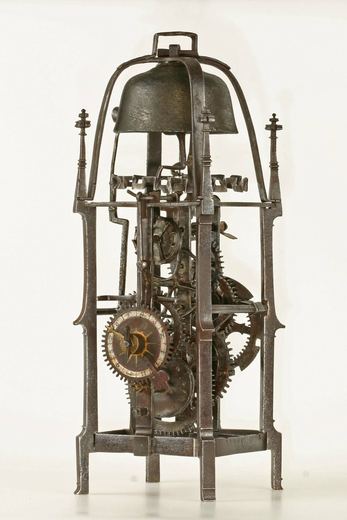
Alarm clock, Germany, 1400–1499
German Clock Museum
Clocks · 1400-1499
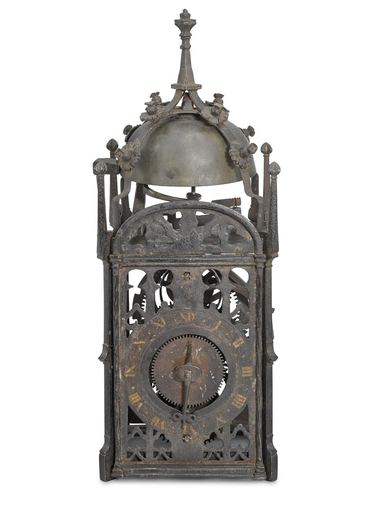
Lantern clock, Germany, 1400-1499
Science Museum Group, London
Clocks · 1500–1599
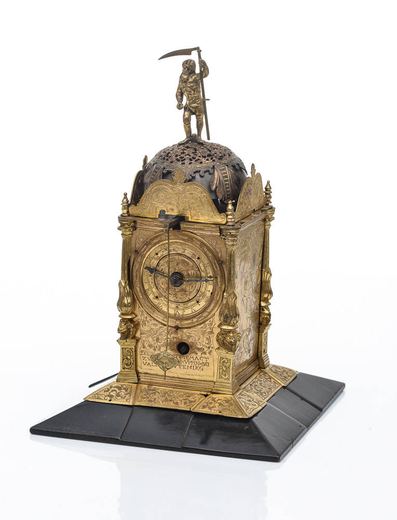
Table clock by Rutenieg, Valentin (um 1550) (Uhrmacher), Germany, 1500–1599
City Museum Berlin
Clocks · 1501-1600
German 16th century iron chamber clock
Science Museum Group, London
Clocks · ca.1550
Clock, a striking alarm clock in a gilt brass case, Germany, ca.1550.
Victoria and Albert Museum, London
Clocks · 1552
Carriage / travel clock, Germany, 1552
German Clock Museum
Clocks · 1560
Carriage / travel clock by HG, Germany, 1560
German Clock Museum
Clocks · 1564
Clock, gilt brass with enamelled silver dial ring, signed by Jeremias Metzger, Augsburg, southern Germany, dated 1564
Victoria and Albert Museum, London